February 15, 1975
Salvator Cicurel, a former Egyptian Olympic fencer and leader of the Cairo Jewish community, dies at 81 in Miami.
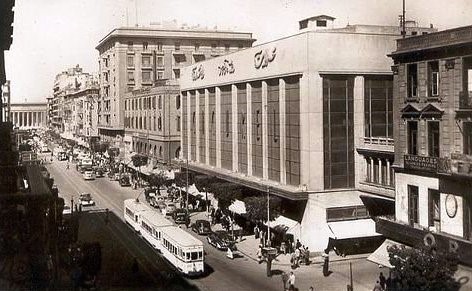
His father, Moreno, immigrated from Smyrna (Izmir) in Turkey to Cairo in 1870, when both were part of the Ottoman Empire, and worked in a Jewish-owned textile shop in the city’s main commercial district. In 1909, Moreno Cicurel opened Au Petit Bazar, a department store in the European district of Cairo. The store changed its name to Les Grands Magasins Cicurel et Oreco and grew into one of the largest department store chains in Egypt.
The flagship store “encompassed two buildings, each taking up a city block and looming four stories high. … Once inside, shoppers could view an array of goods in departments that supplied the king of Egypt as well as other elite and more middle class families.” (Nancy Reynolds, A City Consumed: Urban Commerce, the Cairo Fire and Politics of Decolonization in Egypt, Stanford, CA: Stanford University Press, 2012, p. 57)
Moreno Cicurel’s three sons, Solomon, Yusuf and Salvator, assumed control of the business in 1919 and expanded it into a retail empire, adding a series of discount thrift shops. Solomon was killed in a robbery in 1927, and Yusuf died in 1939, leaving Salvator in charge of the family business.
Salvator was educated in Switzerland and became Egypt’s national fencing champion and captain of the Egyptian Olympic fencing team in 1928. He also was an elite golfer. In addition to his affiliations in sports and Egyptian commerce, he was a leader of the Jewish community in Cairo, serving on the Cairo Sephardi Jewish Community Council and becoming its president in 1946.
Becayse the Cicurel store was a preferred shopping destination of the royal family, it was not placed under government administration during the 1948 Arab-Israeli war, as many other Jewish-owned businesses were. Even after a military coup ousted King Farouk in July 1952, the Cicurel store continued to enjoy protection because of Salvator’s connections with members of the Free Officers Movement. The Free Officers even helped Cicurel rebuild his main store after the Cairo fire of January 1952.
There is little to suggest that Cicurel was a political Zionist. Like many other well-off Egyptian Jews, he did little to bring about unnecessary political attention to himself or other members of the community and risk positions attained in Egyptian society.
The situation changed during the Suez crisis and war of 1956. The government seized control of all Jewish-owned businesses, including the Cicurel operation. After the war, Cicurel was forced to sell his interests to Egyptian Muslims, and the store was nationalized in 1961.
In a common story for Egyptian Jews who remained after 1948, especially the economic elite, Cicurel left Egypt for good in 1957 but immigrated to France. Most Jews who left Egypt after the 1956 war went to either America or to Europe and not to Israel.