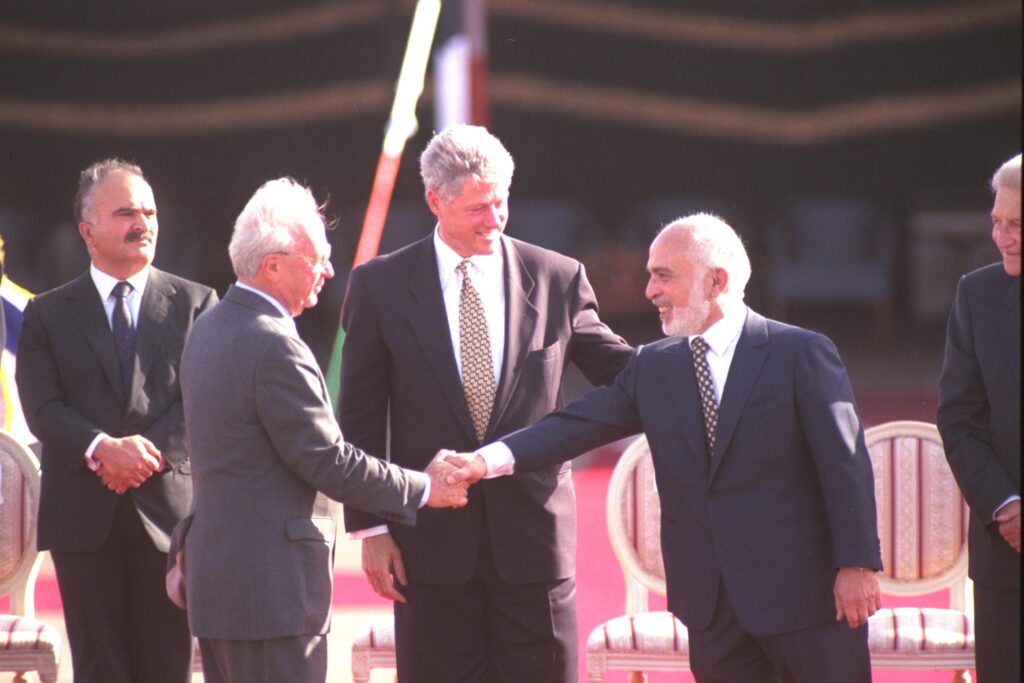
February 7, 1999
Jordan’s King Hussein, who in 1994 became the second leader of an Arab state to make peace with Israel, dies of complications from non-Hodgkin’s lymphoma.
Hussein ascended to Jordan’s throne in 1953 at age 18 after the assassination of his grandfather King Abdullah. His father was unable to become king because of mental illness. As king, Hussein had a mixed history with Israel. Secret talks between Israeli and Jordanian leaders took place from 1963 forward, reigniting diplomatic and political discussions that Abdullah I had with Golda Meir and other members of the Jewish Agency going back to the mid-1930s. Zionist leaders and Abdullah had a common foe in the radicalized nationalist views of the Palestinian mufti of Jerusalem, Hajj Amin al-Husseini. In the days leading up to the Six-Day War in 1967, Israel implored the king to keep Jordan out of the war, promising that Israel would not attack Jordan. The young king, however, fearing a backlash in the Arab world, gave control of his army to Egypt.
According to Michael Oren in Six Days of War, even after the fighting began, Israeli Prime Minister Levi Eshkol sent King Hussein a letter stating that Israel would take no actions against him if he ceased hostile activities. Jordan, however, received bad intelligence information about early Arab victories and sent troops into Jerusalem. Oren writes in the Middle East Forum: “The Jordanian forces might have fared better, if not for the Israeli discovery of a major Jordanian intelligence blunder. Indeed, Jordanian radio broadcast its military plans roughly an hour ahead of the actual deployment.” (Michael Oren, “Making Sense of the Six Day War,” Middle East Forum, May 6, 2002)
After Israel and the PLO agreed to the Oslo Accords in 1993, King Hussein understood that the PLO’s recognition of Israel would make it relatively easy for Jordan to follow suit. Fourteen months after the signing of the Oslo Accords, Israel and Jordan signed their peace treaty in October 1994.