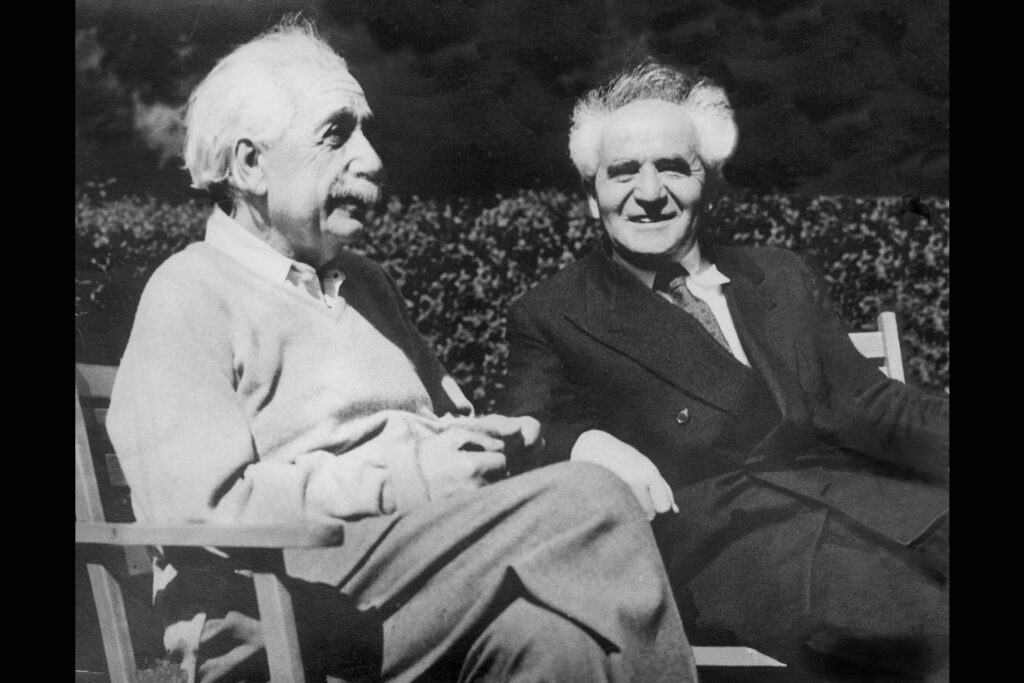
April 18, 1955
Nobel Prize-winning physicist Albert Einstein, an avowed Zionist and supporter of the State of Israel, dies three years after turning down an offer to serve as Israel’s president.
Though opposed to militant forms of nationalism, Einstein was drawn to Zionism after witnessing a series of attacks against Jews in Germany after World War I. Writing in 1921, Einstein articulated his view of Zionism: “I am a national Jew in the sense that I demand the preservation of the Jewish nationality as of every other. I look upon Jewish nationality as a fact, and I think that every Jew ought to come to definite conclusions on Jewish questions on the basis of this fact. I regard the growth of Jewish self-assertion as being in the interests of non-Jews as well as of Jews. That was the main motive of my joining the Zionist movement. For me, Zionism is not merely a question of colonization. The Jewish nation is a living thing, and the sentiment of Jewish nationalism must be developed both in Palestine and everywhere else.” (Albert Einstein, About Zionism: Speeches and Letters, translated and edited by Leon Simon, New York: Macmillan, 1931, p. 41.)
Einstein developed a friendship with Zionist leader Chaim Weizmann, who asked Einstein to accompany him and Zionist leader (and eventual Jewish National Fund head) Menachem Ussishkin on a fundraising tour of the United States in March 1921. Their goal was to raise money for the proposed Hebrew University of Jerusalem. It was Einstein’s first visit to the United States. In 1923 he visited Palestine, where he delivered the inaugural lecture at the yet-unbuilt Hebrew University.
In 1952, after Weizmann’s death, David Ben-Gurion offered Einstein the presidency of the State of Israel. The professor declined, citing his lack of aptitude and experience for the position.