May 17, 1983
Source: Israeli Ministry of Foreign Affairs. “Israel-Lebanon Agreement.” Israel’s Foreign Relations: Selected Documents, 1982-1984. Meron Medzini ed. Jerusalem: Ahva Press, 1990, pp. 401-414. https://www.gov.il/en/pages/114-agreement-between-israel-and-lebanon-17-may-1983
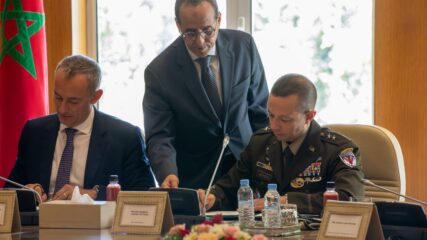
Secretary of State Marco Rubio’s initial April 2026 efforts to mediate talks between Israeli and Lebanese diplomats on an agreement to bring a measure of tranquility to the Lebanese south and Israeli north contained almost identical elements to the unratified Lebanese-Israeli treaty proposed by Secretary of State George Shultz in May 1983. But four decades later Israel had better control of its northern borders with Lebanon and Syria, and the Syrian government no longer was in a position to veto an agreement.
After Israel invaded Lebanon in June 1982 and rooted out the Palestine Liberation Organization, Israel occupied large portions of Lebanon for 18 years. Israel’s objective was to secure its northern border against attacks on civilians in the western Galilee. The United States sought to translate Israel’s military gains into a diplomatic settlement, culminating in a draft treaty May 17, 1983.
But Lebanon had a weak central government splintered by sectarianism, and Syria under President Hafez Assad saw Lebanon as an appendage (Assad also considered Jordan and Palestine to be part of greater Syria). Damascus would not tolerate another separate Israeli-Arab peace treaty after the 1979 Egyptian-Israeli treaty, about which Assad remained livid. Maintaining troops in eastern Lebanon and being deeply engaged in controlling Lebanese ports, Syria viewed the proposed accord as a threat to its regional dominance. It rejected any Lebanese diplomacy not controlled by Syria. Assad pressured Lebanese leaders to renounce the Israeli-endorsed agreement, blocking its ratification and nullifying U.S. mediation efforts. Assad’s regime kept Lebanese politics tied to his every whim.
When Bashar Assad replaced his father as Syrian president in the summer of 2000, he continued the policy of determining Lebanese politics in Damascus and kept supplying weapons and materials to Hezbollah. He grew more and more dependent on Iranian military support, particularly the Islamic Revolutionary Guard Corps. After Israel decapitated the Hezbollah leadership in Beirut in October 2024, a key pillar undergirding the Assad regime cracked, causing him to flee to Moscow in December 2024. With Syria under a new government and Hezbollah defanged by Israel, the Lebanese have shown an initial willingness to talk with Israel about making their border more tranquil.
The May 17, 1983, agreement formally sought to end the state of war between Israel and Lebanon and establish a framework for peaceful relations. It affirmed mutual recognition of sovereignty, territorial integrity and the inviolability of the international boundary. Israel committed to a phased withdrawal of its forces from Lebanon, contingent upon the creation of security arrangements to prevent attacks across the border. Central to the agreement was the requirement that each state prevent it territory from being used for hostile or terrorist activity against the other. All militias and other armed groups targeting the other side were to be dismantled, and prior arrangements enabling such forces were declared void.
The treaty established a Joint Liaison Committee, with U.S. participation, to oversee implementation, manage security coordination, and promote normalization in areas such as trade, communications and movement of people. The accord also envisioned negotiations to expand civilian and economic ties after Israel’s withdrawal.
In essence, the agreement sought normalization under security guarantees but lacked the political foundation within Lebanon to survive. And the U.N. forces placed in Lebanon already had proved unable to maintain order on the Lebanese-Israeli border.
By September 1982, some 14,000 PLO fighters had been escorted out of Lebanon by a multinational force of American, French, Italian and British troops. Israel had been largely successful in pushing out the PLO, which established headquarters in Tunis until the 1993 Oslo Accords allowed the leadership to enter Jericho and Gaza. But Lebanon had a weak national army, and the vacuum left by the PLO was slowly filled by Hezbollah, the Iranian sponsored militia.
With its large Shi’ite population, Lebanon was an ideal for target for Iran, which was interested in exporting the Islamic revolution to other parts of the Middle East. By March 1983, weapons and supplies were landing at the Damascus airport and being ferried into Lebanon for Hezbollah’s growth and use against Israel. Hezbollah became the strongest and most militant player in Lebanese politics.
In 2026, an Israeli-Lebanese agreement has a greater chance of success than at any time the previous four decades. Iran and Syria lack their longtime dominance over Lebanon. Israel has pushed its effective borders into Lebanon and Syria as a result of its wars with Hamas and Hezbollah. And Israel has a domestic imperative to bring stability and nonwar to its northern citizens. The Cold War that pulled Damascus toward Moscow is long over. And the U.S. during the second Trump administration has made it clear that it would like to erect a loose alliance after the Iran war of countries that seek nonbelligerency and prefer not to have their national interests threatened by Tehran-stimulated Islamic radicalism. Besides Israel and Lebanon, that alliance could include Egypt, Jordan, Saudi Arabia and other Gulf states.
— Ken Stein, April 15, 2026
Agreement between the Government of the State of Israel and the Government of the Republic of Lebanon
The Government of the State of Israel and the Government of the Republic of Lebanon:
Bearing in mind the importance of maintaining and strengthening international peace based on freedom, equality, justice, and respect for fundamental human rights;
Reaffirming their faith in the aims and principles of the Charter of the United Nations and recognizing their right and obligation to live in peace with each other as well as with all states, within secure and recognized boundaries;
Having agreed to declare the termination of the state of war between them;
Desiring to ensure lasting security for both their States and to avoid threats and the use of force between them;
Desiring to establish their mutual relations in the manner provided for in this Agreement;
Having delegated their undersigned representative plenipotentiaries, provided with full powers, in order to sign, in the presence of the representative of the United States of America, this Agreement;
Having agreed to the following provisions:
Article 1
1. The Parties agree and undertake to respect the sovereignty, political independence and territorial integrity of each other. They consider the existing international boundary between Israel and Lebanon inviolable.
2. The Parties confirm that the state of war between Israel and Lebanon has been terminated and no longer exists.
3. Taking into account the provisions of paragraphs 1 and 2, Israel undertakes to withdraw all its armed forces from Lebanon in accordance with the Annex of the present Agreement.
Article 2
The Parties, being guided by the principles of the Charter of the United Nations and of international law, undertake to settle their disputes by peaceful means in such a manner as to promote international peace and security and justice.
Article 3
In order to provide maximum security for Israel and Lebanon, the Parties agree to establish and implement security arrangements, including the creation of a Security Region, as provided for in the Annex of the present Agreement.
Article 4
1. The territory of each Party will not be used as a base for hostile or terrorist activity against the other Party, its territory, or its people.
2. Each Party will prevent the existence or organization of irregular forces, armed bands, organizations, bases, offices or infrastructure, the aims and purposes of which include incursions or any act of terrorism into the territory of the other Party, or any other activity aimed at threatening or endangering the security of the other Party and safety of its people. To this end all agreements and arrangements enabling the presence and functioning on the territory of either Party of elements hostile to the other Party are null and void.
3. Without prejudice to the inherent right of self-defense in accordance with international law, each Party will refrain:
a. From organizing, instigating, assisting, or participating in threats or acts of belligerency, subversion, or incitement or any aggression directed against the other Party, its population or property, both within its territory and originating therefrom, or in the territory of the other Party.
b. From using the territory of the other Party for conducting a military attack against the territory of a third state.
c. From intervening in the internal or external affairs of the other Party.
4. Each Party undertakes to ensure that preventive action and due proceedings will be taken against persons or organizations perpetrating acts in violation of this Article.
Article 5
Consistent with the termination of the state of war and within the framework of their constitutional provisions, the Parties will abstain from any form of hostile propaganda against each other.
Article 6
Each Party will prevent entry into, deployment in, or passage through its territory, its air space and, subject to the right of innocent passage in accordance with international law, its territorial sea, by military forces, armament, or military equipment of any state hostile to the other Party.
Article 7
Except as provided in the present Agreement, nothing will preclude the deployment on Lebanese territory of international forces requested and accepted by the Government of Lebanon to assist in maintaining its authority. New contributors to such forces shall be selected from among states having diplomatic relations with both Parties to the present Agreement.
Article 8
1. a. Upon entry into force of the present Agreement, a Joint Liaison Committee will be established by the parties, in which the USA will be a participant, and will commence its functions. This Committee will be entrusted with the supervision of the implementation of all areas covered by the present Agreement. In matters involving security arrangements, it will deal with unresolved problems referred to it by the Security Arrangements Committee established in subparagraph c below. Decisions of this Committee will be taken unanimously.
b. The Joint Liaison Committee will address itself on a continuing basis to the development of mutual relations between Israel and Lebanon, inter alia the regulation of the movement of goods, products and persons, communications, etc.
c. Within the framework of the Joint Liaison Committee, there will be a Security Arrangements Committee whose composition and functions are defined in the Annex of the present Agreement.
d. Subcommittees of the Joint Liaison Committee may be established as the need arises.
e. The Joint Liaison Committee will meet in Israel and Lebanon, alternately.
f. Each Party, if it so desires and unless there is an agreed change of status, may maintain a liaison office on the territory of the other Party in order to carry out the above-mentioned functions within the framework of the Joint Liaison Committee and to assist in the implementation of the present Agreement.
g. The members of the Joint Liaison Committee from each of the Parties will be headed by a senior government official.
h. All other matters relating to these liaison offices, their personnel and the personnel of each Party in connection with the implementation of the present Agreement will be the subject of a protocol to be concluded between the Parties in the Joint Liaison Committee. Pending the conclusion of this protocol, the liaison offices and the above-mentioned personnel will be treated in accordance with the pertinent provisions of the Convention on Special Missions of 8 December 1969, including those provisions concerning privileges and immunities. The foregoing is without prejudice to the positions of the Parties concerning that Convention.
2. During the six-month period after the withdrawal of all Israeli forces from Lebanon in accordance with Article I of the present Agreement and the simultaneous restoration of Lebanese governmental authority along the international boundary between Israel and Lebanon, and in light of the termination of the state of war, the Parties shall initiate, within the Joint Liaison Committee, bona fide negotiations in order to conclude agreements on the movement of goods, products and persons and their implementation on a non-discriminatory basis.
Article 9
1. Each of the two Parties will take, within a time limit of one year as of entry into force of the present Agreement, all measure necessary for the abrogation of treaties, laws and regulations deemed in conflict with the present Agreement, subject to and in conformity with its constitutional procedures.
2. The Parties undertake not to apply existing obligations, enter into any obligations, or adopt laws or regulations in conflict with the present Agreement.
Article 10
1. The present Agreement shall be ratified by both Parties in conformity with their respective constitutional procedures. It shall enter into force on the exchange of the instruments of ratification and shall supersede the previous agreements between Israel and Lebanon.
2. To Annex, the Appendix and the Map attached thereto, and the Agreed Minutes to the present Agreement shall be considered integral parts thereof.
3. The present Agreement may be modified, amended, or superseded by mutual agreement of the Parties.
Article 11
1. Disputes between the Parties arising out of the interpretation or application of the present Agreement will be settled by negotiation in the Joint Liaison Committee. Any dispute of this character not so resolved shall be submitted to conciliation and, if unresolved, thereafter to an agreed procedure for a definitive resolution.
2. Notwithstanding the provisions of paragraph 1, disputes arising out of the interpretation or application of the Annex shall be resolved in the framework of the Security Arrangements Committee and, if unresolved, shall thereafter, at the request of either Party, be referred to the Joint Liaison Committee for resolution through negotiation.
Article 12
The present Agreement shall be communicated to the Secretariat of the United Nations for registration in conformity with the provisions of Article 102 of the Charter of the United Nations.
Done at Kiryat Shmona and Khaldeh this seventeenth day of May 1983 in triplicate in four authentic texts in the Hebrew, Arabic, English, and French languages. In case of any divergence of interpretation, the English and French texts will be equally authoritative.