Updated with a new introduction May 20, 2026; originally posted in February 2017.
June 19, 1967
Johnson, Lyndon. “Five Principles of Peace.” National Foreign Policy Conference of Educators. Washington, DC. 19 June 1967. Speech.
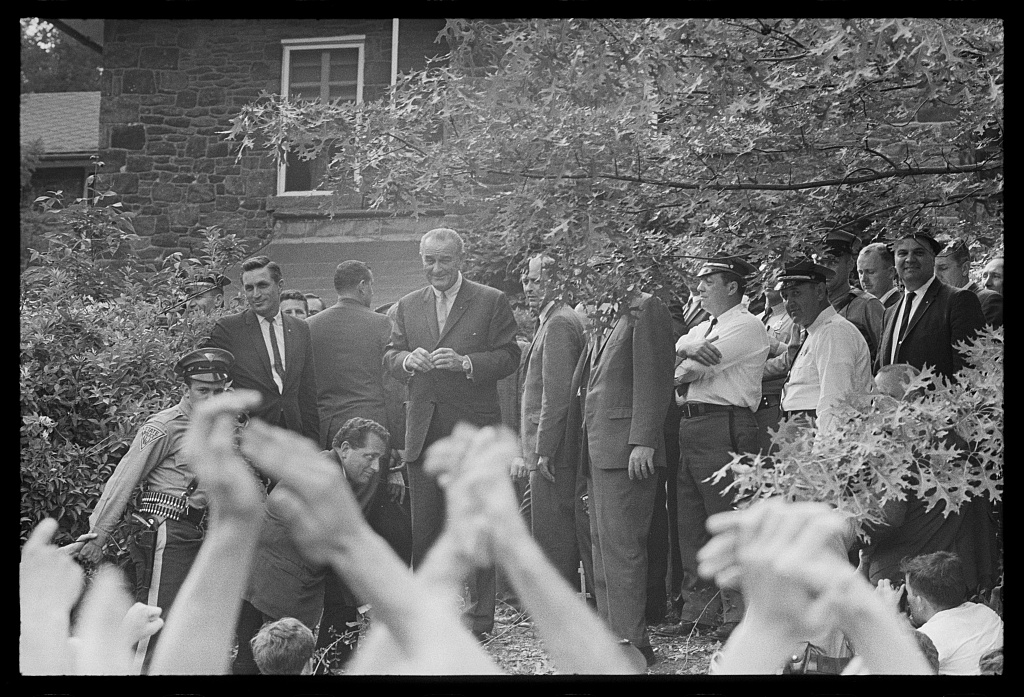
In the aftermath of the June 1967 war, President Lyndon B. Johnson attempted to move diplomacy away from triumphalism, revenge and temporary ceasefires toward something far more difficult: a durable political settlement. Speaking June 19, 1967, in Glassboro, New Jersey, only days after Israel’s stunning military victory, Johnson outlined what became known as the “Five Principles of Peace.” Coincidentally, the Israelis the same day passed a secret request to the Syrians and the Egyptians to begin talks, an overture that was not accepted.
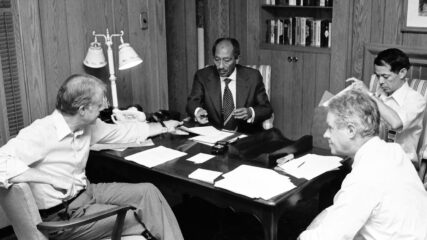
Johnson’s five core concepts became the five pillars upon which the Arab-Israeli negotiating process was based for more than a half-century. These principles were formulated into U.N. Security Council Resolution 242, passed unanimously November 22, 1967, and noted in the preamble of the 1978 Camp David Accords, the 1979 Egyptian-Israeli peace treaty, the 1993 Palestinian-Israeli Oslo Accords and the 1994 Jordanian-Israeli peace treaty.
What prompted Johnson to issue these principles?
In 1957, as a U.S. senator from Texas, he witnessed Israel’s withdrawal from the Sinai Peninsula after the 1956 war, and he was privy to a promise that the U.N. troops stationed in the Sinai between Israeli and Egyptian forces would not be removed unless the request was first referred to the U.N. Security Council. Then, as president, he saw the summary removal of these U.N. troops without Security Council approval at Egyptian request and the inevitable slide toward war.
According to Joseph Sisco, who was an undersecretary in the State Department in 1967 and was a key negotiator under Henry Kissinger in shuttle diplomacy between the Egyptians and Israelis and between the Israelis and the Syrians in 1974 and 1975, Johnson “saw the Eisenhower role, the very fact that we forced the Israeli withdrawal, and Johnson’s view was that the Israelis got very little in return and so that this time the approach was far less the notion that there should be total Israeli withdrawal, but rather, in the aftermath of the war, what we should try to do was to try to establish a structure, a framework for peace, if you will. UNSC 242 was the originator of the territory-for-peace” formula.
Johnson understood that military success had not resolved the Arab-Israeli conflict; it had merely transformed it. Israel now held Sinai, Gaza, the West Bank, East Jerusalem and the Golan Heights. Arab armies had suffered humiliation. Refugees, borders, waterways and recognition remained unresolved. Another war, he warned implicitly, would emerge unless the region addressed the underlying political realities that had fueled repeated conflict since 1948.
His principles were concise but strategically ambitious:
- First came the right of every state in the region to live in peace and security. This idea directly challenged the Arab refusal to recognize Israel’s legitimacy.
- Second, justice for refugees. Johnson avoided endorsing maximalist demands from either side, instead framing the refugee issue as a humanitarian and political problem requiring negotiated resolution.
- Third, freedom of maritime passage through international waterways, especially the Straits of Tiran, whose closure by Egypt had helped trigger the war.
- Fourth, limits on the regional arms race, which threatened to turn every crisis into catastrophe.
- Fifth, political independence and territorial integrity for all states in the area.
Most important, Johnson rejected both permanent conquest and forced withdrawal without peace. Territory and recognition, security and diplomacy, would have to move together. That balance became the intellectual foundation for Resolution 242: Israeli withdrawal from territories occupied in the conflict in exchange for Arab recognition, secure boundaries and the right of every state to live in peace.
The speech marked an important turning point in American Middle East diplomacy. Washington was no longer merely reacting to crises. The United States was beginning to define the political architecture through which Arab-Israeli negotiations would proceed for decades. Mediation started with a U.S. foundational formulation, shaped in the U.N. resolution, then mediated first briefly by the U.N. and then almost exclusively by the U.S. for more than half a century.
— Ken Stein, May 16, 2026
Now, finally, let me turn to the Middle East — and to the tumultuous events of the past months. Those events have proved the wisdom of five great principles of peace in the region.
The first and greatest principle is that every nation in the area has a fundamental right to live and to have this right respected by its neighbors.
For the people of the Middle East the path to hope does not lie in threats to end the life of any nation. Such threats have become a burden to the peace, not only of that region, but a burden to the peace of the entire world.
In the same way, no nation would be true to the United Nations Charter or to its own true interests, if it should permit military success to blind it to the fact that its neighbors have rights and its neighbors have interests of their own. Each nation, therefore, must accept the right of others to live.
This last month, I think, shows us another basic requirement for settlement. It is a human requirement: justice for the refugees.
A new conflict has brought new homelessness. The nations of the Middle East must at last address themselves to the plight of those who have been displaced by wars. In the past, both sides have resisted the best efforts of outside mediators to restore the victims of conflict to their homes or to find them other proper places to live and work. There will be no peace for any party in the Middle East unless this problem is attacked with new energy by all and, certainly, primarily by those who are immediately concerned.
A third lesson from this last month is that maritime rights must be respected. Our nation has long been committed to free maritime passage through international waterways; and we, along with other nations, were taking the necessary steps to implement this principle when hostilities exploded. If a single act of folly was more responsible for this explosion than any other, I think it was the arbitrary and dangerous announced decision that the Strait of Tiran would be closed. The right of innocent maritime passage must be preserved for all nations.
Fourth, this last conflict has demonstrated the danger of the Middle Eastern arms race of the last 12 years. Here the responsibility must rest not only on those in the area but upon the larger states outside the area. We believe that the scarce resources could be used much better for technical and economic development. We have always opposed this arms race, and our military shipments to the area have consequently been severely limited.
Now the waste and futility of the arms race must be apparent to all the peoples of the world. And now there is another moment of choice. The United States of America, for its part, will use every resource of diplomacy and every counsel of reason and prudence to try to find a better course.
As a beginning, I should like to propose that the United Nations immediately call upon all of its members to report all shipments of all military arms into this area and to keep those shipments on file for all the peoples of the world to observe.
Fifth, the crisis underlines the importance of respect for political independence and territorial integrity of all the states of the area. We reaffirmed that principle at the height of this crisis. We reaffirm it again today on behalf of all. This principle can be effective in the Middle East only on the basis of peace between the parties. The nations of the region have had only fragile and violated truce lines for 20 years. What they now need are recognized boundaries and other arrangements that will give them security against terror, destruction, and war. Further, there just must be adequate recognition of the special interest of three great religions in the holy places of Jerusalem.
These five principles are not new, but we do think they are fundamental. Taken together, they point the way from uncertain armistice to durable peace. We believe there must be progress toward all of them if there is to be progress toward any.
There are some who have urged, as a single, simple solution, an immediate return to the situation as it was on June 4. As our distinguished and able Ambassador, Mr. Arthur Goldberg, has already said, this is not a prescription for peace but for renewed hostilities.
Certainly, troops must be withdrawn; but there must also be recognized rights of national life, progress in solving the refugee problem, freedom of innocent maritime passage, limitation of the arms race, and respect for political independence and territorial integrity.
But who will make this peace where all others have failed for 20 years or more?
Clearly the parties to the conflict must be the parties to the peace. Sooner or later, it is they who must make a settlement in the area. It is hard to see how it is possible for nations to live together in peace if they cannot learn to reason together.
But we must still ask, who can help them? Some say it should be the United Nations; some call for the use of other parties. We have been first in our support of effective peacekeeping in the United Nations, and we also recognize the great values to come from mediation.
We are ready this morning to see any methods tried, and we believe that none should be excluded altogether. Perhaps all of them will be useful and all will be needed.
I issue an appeal to all to adopt no rigid view on these matters. I offer assurance to all that this Government of ours, the Government of the United States, will do its part for peace in every forum, at every level, at every hour.
Yet there is no escape from this fact: the main responsibility for the peace of the region depends upon its own peoples and its own leaders of that region. What will be truly decisive in the Middle East will be what is said and what is done by those who live in the Middle East.