Update June 9, 2026; originally posted June 2021.
Compiled by Dr. Ken Stein, CIE President, June 9, 2026
These sources and references unfold the history of the Jewish state through 1949, from state-seeking to state-making to state-keeping. Many items are found in Spanish, Hebrew, Polish and Italian.
Period Overviews
1. Jewish history up to the First Zionist Congress in 1897 — Era I. This analysis relates to the origins of Judaism and demonstrates the ancient and historic connection of the Jewish people to the Land of Israel.
2. Zionist history from 1898 until the founding of the modern State of Israel in 1948 — Era II and the 1950-51 Israel Year Book’s “History of the Zionist Movement.”
Specific Topics
1. Pre-state immigration and land purchase — Maps: Forming a Nucleus for the Jewish State, 1882-1947 provides prose and maps to show 65 years of intentional settlement until Israel’s establishment. For the idea of Zionism to become a territorial reality, a people needed to be connected to the land. Immigration, land acquisition and institution building were required. These 20 maps and accompanying text integrate the various aliyot (periods of immigration) and land purchases over seven decades. This resource can be used for a chronological unfolding of Jewish state-making. By 1945, when the world knew about the deaths of 6 million Jews in the Holocaust, the demographic, physical and institutional nucleus for a Jewish state existed in Palestine. The Arabs of Palestine were keenly aware that the Jews were on the brink of creating a state. The Arabic, English, German and Hebrew sources collected help explain how the Zionists evolved a state.
2. Origins of Zionism — Concepts on the origins and a sampling of Zionist ideas from important writers:
- 1880s, Ahad Ha’am, Cultural Zionism — Ahad Ha’am (the pen name for Asher Ginsberg) advocated for a spiritual Jewish renaissance but not necessarily the ingathering of Jews to Palestine. He argued that national survival would come through fulfillment of the Jewish character through the Jewish mind with poetry, ethics and folklore and that Palestine/Eretz Yisrael should be the center of that cultural awakening. He was one of the first Zionist advocates to point out that the Arab population in Palestine would in the future not view the Jewish presence positively. He opposed Theodor Herzl’s political or practical Zionism.
- 1896, Theodor Herzl, The Jewish State — Herzl argued that the Jewish people had to change the world around them. “No one can deny the gravity of the situation of the Jews. Wherever they live in perceptible numbers, they are more or less persecuted. Their equality before the law, granted by statute, has become practically a dead letter. They are debarred from filling even moderately high positions, either in the army, or in any public or private capacity. And attempts are made to thrust them out of business also, ‘Don’t buy from Jews!’ Is it not true that, in countries where we live in perceptible numbers, the position of Jewish lawyers, doctors, technicians, teachers, and employees of all descriptions becomes daily more intolerable? Is it not true that the Jewish middle classes are seriously threatened? Is it not true that the passions of the mob are incited against our wealthy people? Is it not true that our poor endure greater sufferings than any other proletariat? I think that this external pressure makes itself felt everywhere. In our economically upper classes it causes discomfort, in our middle classes continual and grave anxieties, in our lower classes absolute despair. … Plan for the Jews — Let the sovereignty be granted us over a portion of the globe large enough to satisfy the rightful requirements of a nation; the rest we shall manage for ourselves.”
- 1897, Max Nordau, address at the First Zionist Congress — “Everywhere the Jews have settled in large numbers, Jewish misery prevails; it is a peculiar misery which they do not suffer as human beings but as Jews. All kinds of vices are falsely attributed to the Jews. There is pre-existing sentiment for detestation of Jews. [Materially] the majority of Jews are a race of accursed beggars. Poverty grinds down his character. Fevered by the thirst for higher education, he sees himself repelled from the places where knowledge is attainable. The Jew is excluded from the society of his countrymen and is condemned to tragic isolation. Zionism has awakened Jewry to new life, morally through the national ideal, materially through physical rearing. The first time since Bar Kochba does there exist among the Jews an inclination to show themselves and to show to the world how much vitality they possess. Zionism is Judaism, and Judaism is Zionism.”
- 1906, history of Zionism through 1906, Jewish Encyclopedia — The 1906 edition of the Jewish Encyclopedia delivers 42 pages on the unfolding of Zionism from biblical times until its publication, including the death of Herzl in 1904.
3. Origins and impact of international recognition — The Balfour Declaration in 1917 and its incorporation into the League of Nations Mandate in 1922 provided international permission or sanction for the establishment of a Jewish national home in Palestine.
4. Arab impoverishment — Contributing significantly to the Zionist capacity to build a national home was the administrative turmoil created by World War I and the impoverishment of the majority-rural Arab population that began in the 19th century. The 1936-1939 Arab riots also severely damaged the Palestinian rural economy. Along with perennial peasant indebtedness and a dysfunctional Arab elite, the Arab community posed little threat to Jewish nation building:
- Economic condition of Palestinian Arab peasants (fellaheen) — “By the turn of the twentieth century usury capital had fractured the landscape of Palestine, alienating and dividing peasants from the aristocracy while providing merchants opportunities to accumulate great wealth and power; the peasants declared themselves ‘prisoners’ of the urban elites who exploited them and benefited from their toils.” (Charles Anderson, From Petition to Confrontation: The Palestinian National Movement and the Rise of Mass Politics, 1929-1939, doctoral thesis, New York University, 2013, p. 389)
- 1925-1939, Zionist and British observations — British High Commissioner Sir Herbert Samuelsaid in 1925 that “large numbers of the Arab peasantry are exceedingly poor.” The Jewish Agency’s Chaim Arlosoroff noted in 1931 that “the Bedouin of the south are on the threshold of starvation.” Moshe Smilansky, working for the Jewish Agency, remarked in 1932 that “in the Arab village nauseating poverty prevails.” Also in 1932, the director of the Palestine Department of Lands noted that “the fellah rarely had clear title [to the land] … and rarely ha[d] recourse to the formality of a regular mortgage, with perhaps not 5% of the fellah’s land mortgaged formally.” Sydney Moody of the British administration in Palestine reported to the League of Nations in 1935 that “the great majority of the farmers were in a depressed condition.” According to a government report on “Rural Indebtedness” in 1937, “the volume of the individual fellah’s indebtedness represented the full value of his annual income from crops and agricultural stock, or in other words his temporary wealth.” In December 1939, the managing director of the Jewish National Fund, Abraham Granovsky, noted “that the Arabs were in monetary distress due to indebtedness.”
- 1938, government report — The Palestine government’s “Report by the Registrar of Cooperative Societies on Developments During the Years 1921-1937,” published in Jerusalem in 1938, says on Pages 10 and 11: “An air of poverty and depression pervades most Arab villages. The fellah bears a heavy load of debts which robs him of most of his earnings and deprives him of the capital required for the amelioration of his land or the improvement of his crops. Any additional effort made merely increases the usurer’s share in the produce but does not benefit the cultivator himself to any great extent. The reasons for this state of chronic poverty and indebtedness are many: poor soil, lack of water, lack of knowledge of intensive methods of cultivation, bad means of communication with the towns, unsuitable marketing arrangements, frequent bad seasons and failures of crops, an antiquated land system, insecurity of tenure, unsuitable methods of taxation, and of the collection of taxes. … Extortion and maladministration extending over many generations have had their inevitable effect. The combination of these factors have reduced the fellaheen to a state of overwhelming poverty.”
- 1939, Gershon Agronsky, “Palestine Arab Economy Undermined by Disturbances” — “The almost uninterrupted disturbances which the Arabs have kept going since April 1936 have reduced their economy to a parlous state. Although one of the motives of the promoters of the ‘rebellion’ undoubtedly was to bring the Jewish community here to their knees by wrecking their economic life, it is doubtful if they thought far enough ahead to visualize the paralysis and decay which they were bound to inflict on their own people.”
5. Jewish state building and land purchases make the nucleus for a Jewish state by 1939:
- 1926, remarks by Yehoshua Hankin, real estate agent for Zionist buyers in Palestine — “I assume that you all know how much land we can purchase in Eretz Israel in the next 10 years. The areas are as follows: In the south, half a million dunams [a dunam equals a quarter-acre]; in Bet Shean Valley, despite the foreseeable difficulties, about 200,000 dunams; in the lowland and the Shomron, 150,000 dunams; in Yehuda, 50,000 dunams; in the area east of the Jordan River, 1,000,000 dunams; on west side of the Jordan River, in the Negev region, we have the possibility of purchasing 500,000 dunams and an additional 500,000 dunams in various other locations,” for a total of almost 3 million dunams or 75 million acres, as reported at a JNF meeting in Jerusalem on November 22, 1926.
- 1931-1949, Arab land sales to Jews as covered in Palestine Arab and British accounts — “Because the Jews are alert, and our leaders are asleep, the Jews are buying the lands,” al-Jami’ah al-Islamiyyah, August 21, 1932. “The situation is unbearable, and our lands are now falling on easy prey into the hands of the raiders. The brokers are increasing every day among various classes of rich and poor people who have been dazzled by the Zionist gold,” al-Jami’ah al-Arabiyyah, May 24, 1934. “Is it human that the covetous [Arab landowners] should store capital to evict the peasant from his land and make him homeless or even sometimes a criminal? The frightened Arab who fears for his future today melts from fear when he imagines his offspring as homeless and as criminals who cannot look at the lands of their fathers,” al-Difa’, November 5, 1934. “It is on our leaders’ shoulders that our calamity of land sales lies. They themselves as well as their relatives were guilty of selling lands to the Jews,” al-Jami’ah al-Islamiyyah, January 22, 1936. “The Arab landowner [needed] to be protected against himself, ” Sir John Shuckburgh, British Colonial Office, June 14, 1940, Record Group 733/425/75872, Part 2.
- 1937, “The Political Significance of Land Purchase” — “We have already acquainted you with the fact that, as foreseen by the JNF management, the disturbances in Palestine have brought about a considerable increase in the offers of land for sale. At a meeting of the Board of Directors held on 6 December a report was submitted showing that these offers were on a scale unprecedented since the World War. If means were available, contracts could be closed for 200,000 dunams in various parts of the country, including both areas in the projected Jewish and Arab State, and on their borders, with an undertaking on the part of the vendors to complete the transaction in a short time. Of these offers at least 150,000 dunams have been examined and found satisfactory in respect of lands in Upper Galilee, Districts of Beisan and Acre, Judean Hills (the British corridor) [Tel Aviv-Jerusalem Road] and in the south. The acquisition of this territory would require an LP1,100,000 additional, [above] of course to the regular budget of the JNF. Mr. Ben-Gurion referred to it as not less than the ‘rescue of the homeland,’” Eliyahu Epstein to JNF Directorate, December 31, 1937, Central Zionist Archives, S25/10250, Jerusalem.
- 1939, “The Land Frontier,” Jewish National Fund in Jerusalem, Avraham Granovsky — “The terror factor had diminished our [land purchasing] opportunities. On the other side, we witnessed the predicament of those Arabs who wanted to sell their lands. The economic situation in the Arab Sector had worsened throughout the years, and selling land became an economic lifesaver for them and for their families. However, despite their growing fear, we were able to act aggressively during those years, though it required an immense effort.” Central Zionist Archives, KKL Library, June 1939.
- 1946, purchasing lands for the Jewish National Fund,Yosef Weitz — “For several years now we have practiced the custom of projecting the possibilities of land purchases at the beginning of each year. From the totals of the past years, we can conclude that the potential for land purchases has not decreased. The potential remains each year at 200-250 thousands of dunams. It can clearly be determined that the source of land in the country has not dried out. Since we have purchased extensive tracts of land from the Arabs these past years and the possibility of more purchases still exists, it can be concluded that the will to sell in the Arab camp has not decreased. If there were no obstacles set up in our way, we could purchase land without restraint.” Minutes of JNF meeting, November 10, 1946, Central Zionist Archives, Jerusalem.
6. Jewish contributions to revenue in Mandatory Palestine — In 1928, while Jews were 17% of the population, Jewish revenue accounted for 44% of the British administration’s revenue in Palestine, according to remarks by David Lloyd George (House of Commons Debates, 5th Series, Vol. 245, November 17, 1930, and Manchester Guardian, April 3, 1930). The Jewish share of government revenue in 1944-45 was estimated at 65% while Jews constituted 32% of the population, meaning the per-capita Jewish contribution to government income was four times that of the rest of the population, according to the Zionist Organization and the Jewish Agency for Palestine in Reports of the Executives Submitted to the Twenty-Second Zionist Congress, Basel, Switzerland, December 1946.
7. Capital and finance — Jewish capital imports from 1932 to 1946 formed “at least 85 per cent of the influx of long-term capital to Mandatory Palestine from all sources combine. … For the entire Mandatory period Jewish capital investment accounted for 60 per cent of the addition to Palestine’s overall fixed capital formation. For the entire Mandate Jews invested 72,929,000 LP (60.2%), the Arabs, 34,811,000 LP (28.7%), the British Government, 13,449,000 LP (11.1%),” Jacob Metzer writes in The Divided Economy of Palestine, Cambridge, 1998. “The implications of this availability of capital allowed the Jewish sector to grow phenomenally, not from British taxpayer funds or subventions from the British government, or intrusion into the financial or monetary sector by Britain to protect the Jewish economy, but from capital imported by Jews for the Jewish economy. This allowed the Jewish economy before WWII to undertake massive investments without having to resort to borrowing or to domestic savings. The imported capital by Jews came from primarily (75%) private sources, consisting mostly of immigrant transfers. Capital was not sufficient to create jobs, increase demand, generate supply,” which “required banking, financial, and mortgage institutions, numbering more than half a dozen, which primarily serviced the Jewish economic sector.”
8. Political realities from 1938 to 1949, according to CIE’s conflict timeline — What did the Arabs know leading up to the U.N. Partition Resolution of 1947 and Israel’s Declaration of Independence in 1948? Why did they reject Zionism? Why did the Arab community in Palestine not succeed?
- 1930s to 1940s, Arabs collaborate in Zionist state building — Historian Hillel Cohen presents irrefutable evidence in Army of Shadows (University of California Press, 2009) of Arabs collaboration in the development of a Jewish national home Palestine.
- 1938, Arab leaders secretly meeting in Damascus discuss the likelihood of a Zionist state — “There is no boundary to the aspirations of the Zionists. If until September 1937 the Jews spoke about building a National Home in Palestine; today they are already talking about the establishment of a Jewish State in part of Palestine. The Jewish community in Palestine has proven in the last two years of the uprising that they could defend themselves. There is no denial that the Jews had held up quite well in their confrontations with the Arab gangs on the roads, in the orchards, and in the agricultural settlements,” Izzat Darwazzah, a Palestinian Arab political leader, September 30, 1938.
- 1944, partition, meaning two states for two peoples, is seen as the solution — “This brings me to my central point. … I see no alternative to partition; whereby Jewish immigration would lose most of its terror for the Arab — and much of its attraction for the Jew. Jewish immigration into a Jewish State would become a problem for the Jews themselves to deal with as they thought best. Jews and Arabs alike would enjoy the possession of their own respective territories, the former protected by international guarantees for their security and the latter relieved from the fear of further encroachments at the instance of a foreign mandatory. For neither would there be the same inducements as before to out-vie the other in a crescendo of demands for more. As things stand, with fanatical extremism growing daily, partition has come to provide the only road out of an impossible impasse. Maybe partition must be interpreted as the deferred penalty of vacillation, but if it is treated as an opportunity for well-planned reconstruction, it need not constitute a final confession of failure,” British High Commissioner Harold MacMichael to Colonial Secretary Oliver Stanley, July 17, 1944.
- 1945-1949, reasoned views for Palestinian Arabs’ dysfunctional condition.
- 1947, no Arab compromise with Zionism — During a meeting with three Zionist leaders September 17, 1947, Arab League Secretary-General Abdul Rahman ‘Azzam Pasha said that the Arabs would not accept a Jewish state, as recorded by one of the Jewish Agency officials at the meeting, David Horowitz, in his book State in the Making. “The Arab world regards you as invaders and is ready to fight you. The conflict of interests among nations is, for the most part, not amenable to any settlement except armed clash. The Arab world is not in a compromising mood,” ‘Azzam Pasha said. “It is likely, Mr. Horowitz, that your plan is rational and logical, but the fate of nations is not decided by rational logic. Nations never concede; they fight. You will not get anything by peaceful means or compromise. You can, perhaps, get something, but only by the force of arms. We shall try to defeat you. I am not sure we will succeed, but we will try. We were able to drive out the Crusaders, but on the other hand, we lost Spain and Persia. It may be that we shall lose Palestine. But it’s too late to talk of peaceful solutions.” “Then you believe in the force of arms alone? You don’t think there has been any progress whatsoever in the settlement of controversial issues among different peoples?” Horowitz said. ‘Azzam Pasha replied: “You speak of the Middle East. We don’t recognize that conception. We only think in terms of the Arab world. Nationalism, that’s a greater force than any that drives us. We don’t need economic development with your assistance. We have only one test, the test of strength.”
- 1947, State Department tries to prevent partition — “The UNSCOP Majority Plan is not only unworkable; if adopted, it would guarantee that the Palestine problem would be permanent and still more complicated in the future,” Director of Near Eastern and African Affairs Loy Henderson to Secretary of State George Marshall, September 22, 1947.
- 1947, Saudi King Abdul Ibn Saud rejects a Jewish state — “The decision of the Government of the United States to support the claims of the Zionists in Palestine is an unfriendly act directed against the Arabs and, at the same time, is inconsistent with the assurances given us by the late President Roosevelt. This decision is also inconsistent with the interests of the United States in these Arab countries. It is most difficult to believe that the Government of the United States can persist in its unfriendly decision,” Saudi King Abdul Ibn Saud to President Harry Truman, October 26, 1947.
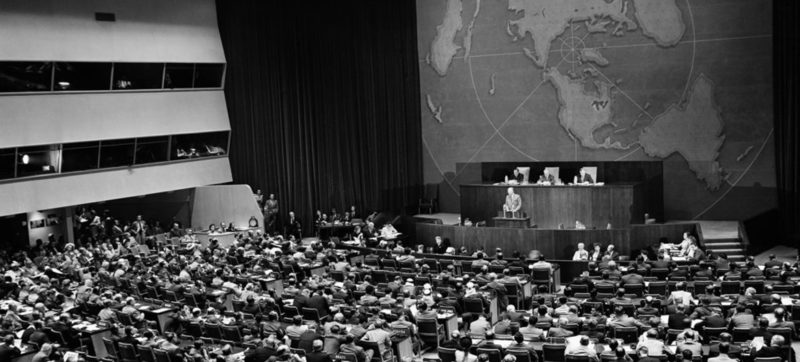
- 1948, Explainer: Israel’s Declaration of Independence — The struggle for international support and the warfare that began immediately after the United Nations approved partition delayed the work on a document inspired by the American example.
9. The Israeli War of Independence:
- Explainer: The Arab-Israel War of 1948 — A Short History.
- Yigal Allon, “Lessons From the War of Independence” — The Palmach commander emphasized Israel’s experience in pre-war operations, its centralized leadership, and its win-or-die circumstances for Israel’s victory and expansion of territory. “The enemy did not utilize the full potential of its manpower. In reality, the countries recruited small armies compared to their respective populations. Though superior in their numbers compared with ours, it did not assist them in achieving a decisive advantage over us.”
- Moshe Naor, “Israel’s 1948 War of Independence as a Total War,” 2008 — Through a lens of Jewish self-empowerment, Naor analyzed the two phases of the war, a civil war from the partition resolution until independence and an all-out multistate war beginning May 15, 1948.
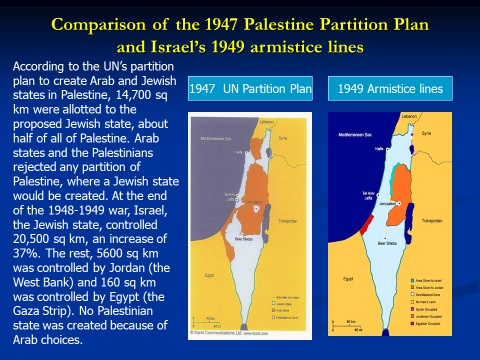
- 1948, U.N. General Assembly Resolution 194 — In a December 11, 1948, resolution that mentioned Palestine 11 times but never named Israel, the United Nations called for the return of Arab refugees to their homes if they are willing to live in peace.
- 1949, Israeli-Egyptian armistice — Signed February 24, 1949, the armistice agreement with Egypt was one of four Israel completed with Arab states in 1949 to end the War of Independence.
- 1949, Israel is keeping its expanded borders — In a Knesset address June 15, 1949, Foreign Minister Moshe Sharett provided an update on the status of the state with the war largely over (a formal Syrian armistice was still a month away) and emphasized that the territory Israel won during the war was now part of the state.