Originally posted July 25, 2026; introduction revised August 3, 2026.
July 8, 2026
Source: https://rahmemanuel.substack.com/p/the-us-israel-relationship-where
Introduction
At Tel Aviv University in early July, Rahm Emanuel, the former mayor of Chicago, Congressman, President Barack Obama’s chief of staff, one-time ambassador to Japan and a possible 2028 Democratic presidential candidate, delivered a frank public talk about his long-term personal relationship with Israel and the Jewish people and presented a candid assessment of what he saw as a faltering U.S.-Israel alliance.
He based his estimate on two reasons: the behavior of Israel’s politicians and its tensions with the Palestinians. Like others who have periodically chided Israel, he omitted the multiple reasons Israel will remain close to the United States for years to come, starting with the inevitable, overlapping strategic interests of Washington and Jerusalem in intelligence, anti-terrorism and sustained regional stability. Likewise, shared values and principles tie the countries together, regardless of who leads them. For seven decades, divergent positions on multiple issues have become ingrained in an otherwise deeply entwined relationship.
Emanuel assigned heavy responsibility to the Palestinians and Arab states for little negotiating progress in the Palestinian-Israeli theater. Like other politicians, pundits and essayists before him, he offered a prescription on how Israel and the Palestinians should unfold their future together. Like others before him, he is convinced that Palestinians and Israelis are eager to resolve their territorial, national and religious differences.
Here he is simply not correct. A huge chasm exists between what Palestinians and Israelis, respectfully, do not want and what mediators push to achieve. Mountains of distrust lie between Israelis and Palestinians; neither side has reached a consensus within its own broad tent of what territory it is willing to allow the other to control in the areas west of the Jordan River. Neither side is willing to recognize unconditionally the legitimacy or the sovereignty of the other. Nonetheless, outside parties like Emanuel feel that stepping up to a podium and articulating a unique magic formula could work, if only Israeli, Arab and Palestinian politicians and leaders would implement advice freely given.
The purpose of his talk was not to distance himself from Israel, but to warn it against what he sees as further alienation of America’s relationship. Emanuel presented the speech with emotional force as he identified with Israeli fears, disappointments and cynicism. Before criticizing Israel’s course, he established why he felt he had earned the right to judge Israeli politics. He and his family had embraced Israel throughout the country’s life.
Unlike many who offer Israel and Israelis advice, he showed that he had credibility before deriding its politics or actions. In a similar vein, others have claimed family history as an entry ticket to deliver criticism. How many others have cataloged time living in Israel or fighting in the Israeli army or mentioned relatives who perished in the Holocaust, then hectored Israelis for not pursuing a preferred political path?
Emanuel’s father was born in Jerusalem and fought in Israel’s War of Independence. An uncle died while serving in the Jewish underground. On trips to Israel, Emanuel visits that uncle’s grave on the Mount of Olives. Working for President Bill Clinton, he brought his father to the White House for the 1993 handshake between Yitzhak Rabin and Yasser Arafat. Later came the bombings, the failed negotiations and the Palestinian rejection of additional Israeli offers. Emanuel remembers all of it.
Emanuel’s major point was that Israel should end its military supply relationship with the United States. (Ending the supply relationship is not ending an alliance, but he erroneously equated the two?) For context, Prime Minister Benjamin Netanyahu had proposed the end of military aid from the United States during a lengthy interview on “60 Minutes” on May 10, 2026, and the idea was repeated in a Netanyahu-backed U.S. House resolution June 3, 2026. A week after Emanuel’s call to phase out military aid, 104 U.S. representatives voted to immediately stop the annual $3.3 billion appropriated for Israel under the terms of the 2016 Memorandum of Understanding. And in recent years, senators and representatives called for curbing arms sales to Israel to one degree other. Emanuel was not presenting new thoughts.
It is highly unlikely that, despite his longtime, fraught relationship with Netanyahu, Emanuel would have made such a pronounced and public declaration in Tel Aviv if others had not made the same suggestions. After the United States expended time and treasure on conflicts against Israel’s adversaries the past five years, the Israeli prime minister and others believe it is prudent to step away from direct military aid and instead see the U.S. alliance broaden through deeper cooperation in intelligence, cyber, technical innovation and other mutually beneficial fields.
Emanuel criticized Israeli policies only after reminding listeners of sincere but failed Israeli diplomatic efforts, of how Israeli leaders have sought to provide sovereignty for the Palestinians in exchange for security and received violence instead. Israelis, Emanuel argued, have legitimate reasons for distrusting diplomatic promises.
He noted that October 7 deepened wounds decades old. Friendship, he said, does not require silence. Quite the opposite. A friend who sees danger and says nothing becomes an accomplice. “The alliance is at a crossroads,” he declared, arguing that the traditional relationship between Washington and Jerusalem cannot continue unchanged.
But is it at a crossroads? For starters, strategic necessities require Israel military intelligence and the U.S. Central Command to continue their close-knit working relationships.
Emanuel’s reproach was directed at Netanyahu’s strategy and the behavior of his government ministers. He stressed that military power and force had become a substitute for political purpose, for dialogue. Emanuel was angry that Netanyahu had transformed Israel from the celebrated “Start-Up Nation” into a “modern-day Sparta” — a country feared for its weapons and military prowess, distrusted for its territorial ambitions, and increasingly excluded from international institutions. Emanuel concluded that “a state can dominate militarily and still lose political ground.”
Tactical victories were not being converted into strategic gains. Hamas leaders, Hezbollah commanders and Iranian figures could be eliminated, but Israel remained isolated without a credible postwar plan for Gaza, a durable arrangement in Lebanon or a diplomatic path capable of consolidating battlefield achievements. (Indeed, a durable arrangement with Lebanon is in process.) Emanuel occasionally forgot that the absence of trust between parties means they approach each other with caution.
Yitzhak Rabin said that about trust after the signing of the 1993 Oslo Accords; after a lifetime of fighting PLO Chairman Yasser Arafat, Rabin still didn’t trust him. Emanuel, like other genuine friends of Israel, does not seem to appreciate how hated Israel remains for many in the Middle East. This hatred is generational and cannot be switched off like a faucet turned hard in a different direction. Like many who offer Israel advice, I wonder if Emanuel knows that Israel is often referred to in the Arabic print media as the “occupying state,” where the occupation refers not to the West Bank or Gaza Strip or portions of Jerusalem, but to all the land from the Jordan River to the Mediterranean Sea.
Emanuel blamed Washington as well. Years of nearly unconditional American support, he said, encouraged Israeli leaders to believe that settlements, settler violence, civilian suffering and diplomatic defiance would carry no serious cost. Emanuel was Obama’s chief of staff but notably did not criticize his former boss for actions not taken. Here Emanuel overstated his case; Prime Ministers Rabin, Ehud Barak and Ehud Olmert did not condone settlements, settler violence or diplomatic defiance.
Emanuel proposed sweeping corrective actions. He said Israelis who attack Palestinian civilians or property should face American sanctions. Officials encouraging such violence should be penalized. Companies and banks supporting illegal settlement activity should also face sanctions. Annexation of the West Bank, Emanuel warned, would leave Israel alone.
His diplomatic alternative was the all-too-familiar two-state formula with a twist: It should become what he called a “23-state solution” — Israel, the Palestinians and the 21 existing Arab states constructing a regional framework. Arab governments would have to reform Palestinian governance, end financial rewards for terrorism, change education that promotes hatred and recognize the Jewish people’s historic connection to the land. Israel, in return, would halt territorial expansion and accept a genuine route to Palestinian sovereignty.
Does Emanuel truly feel that Arab leaders can transform Palestinian governance or push them to accept a Jewish state? Does he know that Arab leaders themselves have publicly chided Palestinian leaders for bad decisions? In a three-part series in al-Arabiya in 2020, Prince Bandar Bin Sultan, Saudi Arabia’s ambassador to the U.S. from 1983 to 2005, scathingly criticized Palestinian leaders from the 1930s to the 1990s for rejecting reasonable negotiating offers from Presidents Carter and Reagan.
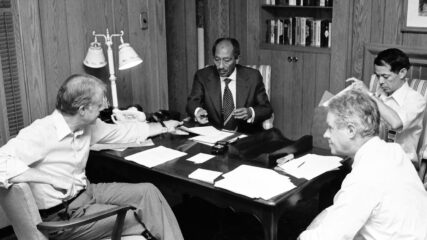
Fifty years ago, from 1977 to 1979, with anti-Israeli National Security Adviser Zbigniew Brzezinski championing tough love toward Israel, Jimmy Carter sought a comprehensive peace in which all Arab states accepted Israel. That effort produced only a bilateral Egyptian-Israeli treaty, not his Cecil B. DeMille grand conference. Does Emanuel believe Arab/Muslim states have one view about reaching an accommodation with Israel? American politicians do not seem to understand that Arab and non-Arab Muslim states, along with multiple foreign powers, have little interest in seeing the Palestinian-Israeli conflict go away. Does Emanuel realize that Iran, Turkey and Qatar are not likely to countenance a regional peace with Israel?
Emanuel, like many would-be American mediators and administrations before him, expects Israelis and Arabs to conform to a two-dimensional roadmap, ignoring the differences in geography and political will of heroic leaders that produced treaties between Egypt and Israel (1979) and between Jordan and Israel (1994). Those key realities are not present in the lands to be negotiated between Palestinians and Israelis. Jordan and Israel and Egypt and Israel never doubted the sovereign legitimacy of the other; the same cannot be said for Palestinians and Israelis.
It’s uncertain whether Emanuel’s remarks had any impact on Israeli listeners 111 days before the October 27 parliamentary election. Undoubtedly, keen supporters of his presidential candidacy embraced his remarks. Others interpreted his prescriptions as naïve. Regrettably, his political calculus did not seem to grasp sufficiently that Israel is not in northern Chicago with Wisconsin, Indiana, Michigan and Minnesota as neighbors.
— Ken Stein, July 28, 2026
The U.S.-Israel Relationship: Where It Stands Today and the Road Ahead
Prepared remarks delivered at Tel Aviv University by Rahm Emanuel.
I want to start by saying four words that Israelis don’t hear often anymore: I understand your cynicism.
I understand why, even if you oppose the Netanyahu government, you’re so prone to dismiss criticism from the outside world. I understand that the corrupt Palestinian leadership has never lived up to the Palestinian people’s legitimate aspirations for sovereignty and self-determination. I understand that, for all that everyone acknowledges that the world changed on October 7th, the dynamics that prevail today were born well before Hamas murdered 1,200 and kidnapped more than 250 innocents.
Before coming here, I visited my uncle’s gravesite on the Mount of Olives as I always do upon arriving in Israel — he died as a member of the underground. And as many of you know, my father, of blessed memory, was born in Jerusalem and fought in the war of independence. I had the honor, while working for President Clinton, of inviting him to witness the moment Prime Minister Rabin and Chairman Arafat shook hands and signed the declaration of principles on the south lawn of the White House. But not only did the peace not materialize, Israel’s reward for extending that olive branch was a wave of unrelenting violence: bombings at sites including Dizengoff Street, Ramat Gan, and the Mahane Yehuda market.
I was still advising President Clinton from Chicago when Prime Minister Barak offered Chairman Arafat 98% of what the Palestinians were seeking, but he refused to sign. And what did Israel earn for offering sovereignty in exchange for security that second time? The Intifada.
Prime Minister Olmert made a similar offer to the Palestinians in 2007. But President Abbas walked away yet again, sparking another wave of horrific violence. Three times since the early 1990s you have offered the Palestinians sovereignty in exchange for your security — and three times your offer was not only rejected, but you were attacked as a direct consequence. In the United States, we have a saying: “Fool me once, shame on you. Fool me twice, shame on me.”
I understand all of that. But even while acknowledging that history, the path forward cannot be shackled to a past defined exclusively by — and consumed by — recriminations. So I flew here from Chicago to tell you directly where things need to head if we are going to maintain the historic alliance that binds our two democracies.
Without question, the alliance is at a crossroads. It cannot stand or survive as it has been. To maintain the strength of our ties, we need significant changes and a new direction.
Let’s start by reviewing the recent history. Over the last five years, Israel has evolved from being lauded as the Start-Up nation to becoming, in Prime Minister Netanyahu’s words, a modern-day Sparta. You have turned from being known for your technological prowess to being considered primarily a territorial pariah. You need to think about what that means for your future.
The United States has been your foremost and steadfast ally since Israel’s founding. We are prepared to stand shoulder to shoulder with Israel on the long journey toward peace, should you choose that path. But the most important thing a true friend can do is to tell the truth even when it’s painful. And today is a day for truth.
The prime minister and his government have led Israel into a dead end. For too long, American policy toward Israel operated under the assumption that the best thing Washington could do for Jerusalem was to stand behind your government blindly and silently, without conditions, without demands and without consequences when we disagreed. That has been our mistake.
Unconditional support has produced a prime minister who has presumed that his strategic interests would incur no cost if he ignored America’s concerns about settlements and sparked a regional war.
Unconditional support has allowed you to deny food and medical relief to innocent Palestinians suffering in Gaza, leaving the world to conclude that Israelis not only want to kill the Palestinians, but that they are completely indifferent to their death, destruction and suffering.
Unconditional support has girded a political coalition in the Knesset that learned it can burn Palestinian farmland in the West Bank and terrorize Palestinian families without consequence.
Given all of this, we need a fundamentally new and different approach to the alliance. The new approach must stand on a new common understanding that the road to regional peace and stability depends on military and diplomatic efforts that, far from being at odds, complement one another. This was once Israel’s policy. Yitzhak Rabin admonished you to “fight terrorism as if there’s no peace process and work to achieve peace as if there’s no terror.”
But Prime Minister Netanyahu has done the former to the exclusion of the latter, and, as a direct result, support for Israel is plummeting around the world. You’ve lost Europe. Your scientists face exclusion from international research networks. Your artists and academics are shut out of exhibits and conferences. Fifty-five percent of Americans held a favorable view of Israel in 2022; today, it’s 37% and dropping. The only diplomatic gain you’ve made over the last three years is Somaliland.
For years, when I’ve met with Israeli officials, Iran has consistently been at the top of the agenda — and for good reason. Washington and Jerusalem share an interest in keeping the ayatollahs from possessing a nuclear weapon. But the history here is important. Whatever anyone might have liked or disliked about President Obama’s nuclear deal — recall that Prime Minister Netanyahu actively campaigned against it; many in your own security services saw merit in the deal — the JCPOA froze Iran’s nuclear program and placed international inspectors on the ground.
No longer. President Trump’s decision to shred that agreement licensed Prime Minister Netanyahu to do what he’s always desired: embrace a military-only approach. He encouraged President Trump to abandon the JCPOA in the first term and to scuttle all diplomatic opportunities prior to February 28th, when Iran was weakest at home and in the region.
And look what’s happened: You’ve lost ground. You’re less safe today, not more. And the problem isn’t a lack of military strength, but something more fundamental: Israel has failed to convert its military wins into strategic advantages.
The same dynamic extends beyond Iran. You had no day-after-Hamas plan for Gaza. You had no strategy to make a partner of the Lebanese government against Hezbollah. Sinwar, Nasrallah and Khamenei are all dead, just as many in Israel have long sought, and yet Israel has never been so isolated. It should be obvious that strategic isolation is not a foundation for security. It’s a countdown clock.
I haven’t been deaf to Prime Minister Netanyahu’s reasoning. Indeed, he was taken aback when I had the audacity as President Obama’s White House chief of staff to forcefully question in 2009 the wisdom of building new housing in the West Bank — a conversation that later spurred him to publicly label me a “self-loathing” Jew.
He believes that being Sparta is worthwhile even despite the reality that his own idol, Winston Churchill, once argued that weapons “are not sufficient by themselves. We must add to them the power of ideas.”
Here I want to be very clear: The United States cannot continue to finance and support that cynicism in silence. You cannot fight indefinitely against a world that has stopped believing you have the right to fight. You must instead find a new sustainable path to peace, security and prosperity. America stands ready.
The new path needs to be shaped by what has worked and what hasn’t in Israel’s efforts to become, in Ben-Gurion’s words, a nation among nations. Through the decades, Jerusalem has pursued three distinct strategies.
The first is unilateral action, which almost always creates instability. Think Lebanon or even Gaza after your withdrawal in 2005, which got you Hezbollah and Hamas, respectively. These are the places in which Iran, your most potent adversary, has most successfully inserted its talons, where it finds and nurtures its proxies. Israel thrives working with nation-states. Iran thrives working with failed states. We should not be adopting their strategy. With unilateral action, even when you win, you lose.
The second approach, which has also proven to be a surefire recipe for endless conflict, is “divorce and occupation.” I want to be very clear about this: The pursuit of a so-called greater Israel is as self-destructive and fanatical as the chant “From the river to the sea.”
Your government is complicit in the horrors now being inflicted on innocent families in the West Bank. That undermines your international legitimacy at a time when you can least afford it. The hard truth is that America’s silence through the years has engendered the worst of your domestic politics. We’ve done you no favors by averting our eyes from your misjudgments. To that end, if I have anything to say about it, every Israeli found attacking Palestinian civilians or their property in the future will be sanctioned. Every Israeli official who supports such violence will be sanctioned. Every construction company or bank building or financing illegal settlements will be sanctioned.
Prime Minister Netanyahu may take offense to these suggestions, but it would not be the first time. My commitments are neither radical nor new. They simply reflect how America applies its national security tools to achieve its goals.
To that end, Israel has at its disposal a third approach, one that has succeeded repeatedly in the past. And today I call on you to embrace it once again, for both our sakes and for the future of Israel.
I will never forget how, at the ceremony where Jordan and Israel made their peace in 1994, Israel’s military leadership stood at attention during the Jordanian anthem, and Jordan’s military leadership returned the honor during “Hatikvah.” Like your 1979 treaty with Egypt and the Abraham Accords negotiated decades later, your peace agreements with other nations have endured because Israelis found in their counterparts true partners.
The question today is how can the same wisdom apply again? And the answer comes down to a simple phrase: regional stability.
Even before October 7th, several of Israel’s Arab neighbors, most notably Saudi Arabia, had begun to see their own strategic interests in a new light, acknowledging more openly that the corruption of the Palestinian leadership was hindering the Arab world’s broad-based prosperity. And that highlights a linchpin that is too often overlooked: Regional stability in the Middle East is predicated fundamentally on the Arab world’s assuming its rightful place as the adult in the room with the Palestinian leadership.
Here’s why that’s so important: Unlike during the Oslo process, they appear now willing to step into that very role. In that spirit, I want to propose today a new three-part U.S. policy in the region which would advance our joint security interests by leveraging the Arab world’s desire for stability, Israel’s need for security and Palestinian demands for sovereignty. These three elements can be packaged as a singular strategic initiative that benefits everyone.
Let’s begin with a naked reality: Arab leaders, not Israel, must hold the Palestinians responsible and accountable for their actions and for being a true partner in peace. To that end, the now-discredited path to a two-state solution should be replaced by a 23-state solution: The 21 Arab nations that have exploited Palestinian rights as a slogan for decades now need to roll up their sleeves and stand up a governing authority capable of accepting the historic Jewish connection to this land. That new institution must put an end to the heinous practice of financially rewarding terrorists who kill Jews. And they must stop teaching young children to hate Israelis.
At the same time, Israel must cease and desist from its cynical game of nurturing destructive organizations like Hamas rather than real partners in pursuit of peace. Your government shouldn’t be permitted to take unilateral actions in the West Bank that undermine the possibility of a peace agreement.
With those preconditions met, we would open the door to a new reality: The Arab League would establish full diplomatic recognition of Israel, and Israel with the members of the Arab League. The political benefits for all parties would be far greater than a two-state solution could ever offer. But to get there, everyone would need to make good on their piece of the bargain.
I understand why Israelis will be reluctant to engage again. The terrible atrocities and unspeakable horrors of October 7th are seared in your collective consciousness, and they have convinced many Israelis that Palestinians want only to kill them. After the last three years of war, the Palestinians are convinced of the inverse. We now have two peoples suffering from deep trauma, incapable of seeing the other’s pain and anguish.
But hear me now: Israel will be alone if its leaders choose to attempt to annex the West Bank and pursue the fantasy of a greater Israel. America will not and cannot be complicit or complacent in that endeavor. That said, should you choose to pursue peace and security, we will be by your side. The end goal of our joint strategy should be a single, 23-state historic act of regional integration that establishes full diplomatic relations between Israel and its Arab neighbors. And, if you’re still not convinced, regional stability would be Israel’s best day and Iran’s nightmare.
Second, because the region’s prosperity depends on stability, we need to restore the economic promise of the Start-Up Nation that once seized the world’s imagination. The India-Middle East-Europe Economic Corridor — IMEC — was announced at the G20 three years ago to connect the rail lines, ports, highways, fiber-optic cables and energy networks running between India and Europe. By reducing logistical costs by 30% and bypassing the Strait of Hormuz, it would make Israel and several Gulf countries indispensable nodes along a new global supply chain and give each country along the corridor a direct financial stake in regional stability. With the 23-state solution, IMEC would, at long last, ensure that Israel is, politically and economically, a constituent part of the Middle East rather than an outlier.
Finally, much as America benefits from its alliance with the Middle East’s most dynamic democracy, we should end at long last the American taxpayer’s subsidy of Israel’s defense budget. Your economy is strong. Your defense budget exceeds $45 billion. We in America would continue to ensure that the IDF maintains its qualitative edge. But Israel should be able to buy American arms under the same financial terms, the same restrictions and the same requirements as every other trusted ally that abides by our laws.
This new direction is about reality. Those chanting “From the river to the sea” need to hear this loud and clear: They will never have their way. But those calling for a greater Israel must also hear this loud and clear: You’re never going to have your way either. Both are fantasies chanted by fanatics.
My three propositions are about Israel’s future, the alliance’s future, and a stable and peaceful Middle East. An Israel that buys its weapons like an ally and not a dependent. An Israel that has full diplomatic relations with all its Arab neighbors and is no longer the world’s pariah. An Israel that is the technological spine of the most important trade corridor on Earth.
I have spent 30 years standing up for Israel when it was politically costly and watching the window for peace narrow, not because peace was impossible, but because leaders on both sides found conflict more convenient than compromise. Hamas’ goal on October 7th was not just to kill as many Israelis as possible; it was to extinguish the idea that Israelis and Palestinians could ever find common ground and live side by side. The tragedy is that Netanyahu has helped Hamas achieve that objective. Not by being too soft, but by being too reckless and unwilling to plan for a day after in Gaza, which would have created and offered an alternative beyond occupation and isolation.
The Israel I grew up believing in was about making the impossible real, having both the imagination and tenacity to make the desert bloom. In the United States we have a saying: “If all you have is a hammer, everything looks like a nail.” Israel has become a prisoner of its own tools. Your military is a hammer such that, to Prime Minister Netanyahu, every security challenge is a nail. Today, you may be more strategically secure; however, you’re more diplomatically isolated than ever. That is a choice this government has made.
What we need now is an Israel that is not naïve but is also not blind to possibility, an Israel that will work with Arab and Palestinian partners alike. A 23-state solution, with Palestinian dignity and Israeli security, is the only way forward.
I hope to build with you a sustainable, peaceful Middle East in the years to come.