August 1, 2026

By Ken Stein, CIE President

Israel’s parliamentary election is scheduled for October 27, 2026. Polling the past month shows a clear but incomplete rejection of Benjamin Netanyahu’s governing bloc. The Zionist opposition consistently leads in projected seats, yet it does not always possess the 61-seat majority needed to govern without support or abstention from Arab parties.

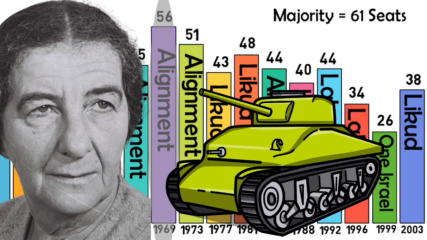
After every Israeli election, parties must assemble a coalition reaching at least 61 seats. No Israeli party has ever won an outright majority in the 120-member Knesset. Israelis do not elect representatives from individual geographic constituencies as Americans do. They vote for national party lists, and parliamentary seats are allocated roughly according to each party’s share of the valid vote.

A party winning 25% of the vote would receive approximately 30 seats. A party receiving less than 3.25% wins none. Before an election, therefore, politicians seek mergers that will carry their parties across the threshold. Votes cast for parties that fail to qualify are discarded when seats are distributed, sometimes changing the balance between competing blocs.

Each party determines the order of candidates on its list. Some use primaries; others allow party leaders or committees to select candidates. A candidate placed fourth has an excellent chance of entering the Knesset. A candidate ranked 45th almost certainly does not. Netanyahu has secured substantial power to place loyalists in prominent positions on Likud’s list, strengthening his control over the parliamentary faction.

Government formation frequently requires several weeks. After the election, Israel’s president consults the parties and assigns a member of the new Knesset the task of assembling a coalition. Negotiations can continue for 30 to 45 days or longer. The October 27 vote may therefore not produce a new government until December. The outgoing government remains in office until its successor is sworn in.

Parliamentary Polling

Poll date, sourceLargest parties or new formationNetanyahu blocZionist oppositionArab parties
June 29, Channel 12Likud 24; Yashar 22; Together 17525810
July 13, Channel 12Yashar 23; Likud 22; Together 16515910
July 15, Channel 13Likud 22; Yashar 21; Together 1550619
July 27, Channel 12Yashar 23; Likud 22; Together 14506010
July 30, Zman YisraelYashar 23; Likud 20; Together 14; “Likud B” 54955, or 60 with Likud B11
July 29-30, MaarivLikud 22; Zionist Home 4; proposed Edelstein-Gantz-Shaked-Simhi party 44957, plus Zionist Home’s 410

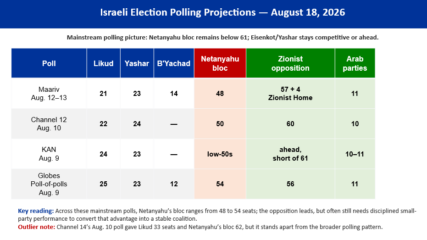
The first conclusion is unmistakable: Netanyahu’s traditional coalition is losing. Across the late-June and July surveys, the Likud/ultra-Orthodox/far-right bloc received only 49 to 52 seats, well below the 61 required. Netanyahu remains personally competitive, and Likud remains near the top, but his existing coalition formula no longer commands an electoral majority. Reuters summarized the accumulated polling July 29 as predicting a clear Netanyahu defeat while cautioning that the fragmented opposition still lacked an assured route to power.

The second major finding is Gadi Eisenkot’s rise. His Yashar party has generally polled between 21 and 25 seats, often narrowly overtaking Likud. Eisenkot increasingly appears to be Netanyahu’s principal personal challenger.

Preferred Prime Minister

Poll, dateNetanyahuEisenkotBennettPrincipal finding
Channel 12, July 1334%43%Eisenkot led Netanyahu by nine points
Channel 12, July 2738%38%Netanyahu and Eisenkot were tied
Maariv, July 29-3038%48%Eisenkot led Netanyahu by 10 points
Maariv, July 29-3039%44%Bennett led Netanyahu by five points

Among opposition voters in the July 29-30 Maariv poll, 45% wanted Eisenkot to lead the anti-Netanyahu camp, compared with 25% for Naftali Bennett. The poll included 501 respondents and had a maximum sampling error of 4.4 percentage points.

These movements should not be treated as irreversible. Netanyahu retains a substantial personal following that is stronger than his coalition’s seat total. Some Israelis oppose his present government but remain uncertain whether Eisenkot possesses the political organization and coalition-building ability necessary to replace him.

The third development is the weakening of the Together alliance of Bennett and Yair Lapid. It declined from 17 seats June 29 to 14 in the July 27 and July 30 surveys. Eisenkot appears to be consolidating the anti-Netanyahu vote by attracting centrists, former security officials and softer right-wing voters who want political change without moving ideologically left. Bennett remains relevant, but he is no longer the unquestioned leader of the opposition camp.

The decisive issue is not merely which party finishes first. It is whether the opposition can form a government. The July 15 Channel 13 poll gave the Zionist opposition exactly 61 seats, partly because the Chili Tropper-Yoaz Hendel alliance crossed the electoral threshold. The July 27 Channel 12 survey also gave the party four seats, bringing the non-Arab opposition to 60 — the first time that grouping reached that level in the Channel 12 series.

The Tropper-Hendel alliance, called Zionist Home-The Reservists, occupies the liberal-nationalist center-right. It is firmly Zionist and security-oriented but rejects the rigid division between automatically pro-Netanyahu and anti-Netanyahu camps. It favors universal military or national service, an official commission of inquiry into the failures surrounding October 7, governmental reform, and a constitutional framework. Its target voters are reservists, moderate former Likud supporters and centrists seeking a broad Zionist government that is not dependent on either the ultra-Orthodox or the Arab parties.

A second center-right formation may now transform the map. Informally called “Likud B,” it is gathering around former Likud ministers Yuli Edelstein and Gilad Erdan, with other possible participants including Benny Gantz, Ayelet Shaked and former Fire Service Commissioner Dedi Simhi. Edelstein left Likud after breaking with Netanyahu over legislation preserving broad exemptions from military service for Haredi men. He argues that hundreds of thousands of right-wing voters no longer have a political home.

Likud B would present itself not as a left-wing alternative, but as a statesmanlike, security-conscious and more institutionally responsible version of Likud. Its potential voters include traditional Likud supporters who lean right on security but oppose Netanyahu’s reliance on the ultra-Orthodox parties, his personal domination of Likud and the continuation of political paralysis.

Polling Effects of Likud B

Poll and proposed formationProjected seatsNetanyahu blocExisting Zionist oppositionOpposition including new partyEffect on smaller parties
Zman Yisrael, July 30: Edelstein-Erdan party5495560Tropper-Hendel and Gantz-Simhi fell below the threshold
Maariv, July 29-30: Gantz-Shaked-Edelstein-Simhi party4505660Tropper-Hendel fell to 2.4%, below the threshold
Channel 12, July 27: no separate Likud B506060Tropper-Hendel crossed the threshold with four seats
Channel 13, July 15: no separate Likud B506161Opposition reached a narrow majority

The July 30 Zman Yisrael poll projected five seats for an Edelstein-Erdan party. Yet its entrance did not produce a governing majority. Netanyahu’s bloc received 49 seats, the existing Zionist opposition 55 and the Arab lists 11. Adding Likud B to the opposition would yield only 60. More consequentially, its appearance drove both the Tropper-Hendel party and the Gantz-Simhi formation below the threshold. Without Likud B, each would have received four seats.

The July 29-30 Maariv poll found a similar result. A wider party containing Gantz, Shaked, Edelstein and Simhi received four seats. But its entry pushed Tropper and Hendel below the threshold at 2.4%. Netanyahu’s bloc rose slightly from 49 to 50, while the Zionist opposition fell from 57 to 56.

The implications are substantial. Likud B could draw votes away from Netanyahu without necessarily increasing the opposition’s total strength. By competing with Zionist Home and other small center-right parties, it could cause one or more lists to fall below 3.25%, wasting thousands of anti-Netanyahu votes. Its value may therefore lie less in running independently than in forcing a merger among Edelstein, Tropper, Hendel, Gantz, Shaked and other moderate right-wing figures.

Principal Electoral Variables

VariableCurrent positionElectoral implication
Netanyahu’s governing blocPolling at 49-52 seatsPresent coalition cannot reach 61
Yashar and EisenkotUsually polling at 21-25 seatsEisenkot is Netanyahu’s strongest challenger
Together allianceDeclined from 17 to about 14 seatsBennett and Lapid are losing ground to Eisenkot
Zionist Home-The ReservistsNear the four-seat thresholdCould provide the opposition’s decisive seats
Likud BFour or five seatsCould weaken Netanyahu but fragment the center-right
Arab parties10 or 11 seatsMay be needed for outside support or abstention
Electoral threshold3.25%Failure by one small party could shift several seats
Security and October 7Central voting considerationsCould restore Netanyahu or deepen demands for change

Arab turnout and party unity constitute another major uncertainty. Arab parties are polling to receive 10 or 11 seats. If the Zionist opposition finishes at 56 to 60, it might need the support, outside backing or abstention of the Arab parties. Yet several opposition leaders remain reluctant to form a government dependent on Arab parties. Fragmentation could also waste Arab votes if any lists fail to cross the threshold.

The issues driving voters favor the opposition but do not guarantee its victory. In the July 27 Channel 12 poll, 32% cited security and management of the multifront war as the most influential issue. Social division and political polarization followed, while personal security, crime and party leadership also mattered. Nearly 30% of respondents who changed parties said October 7 had influenced their decision.

The electoral picture is therefore clear but unsettled.

Netanyahu is behind but not defeated. Eisenkot has become the strongest challenger, yet he has not secured a governing coalition. The election may be decided by the survival, merger or disappearance of several small center-right parties. Arab turnout will matter. So will the threshold.

At the end of July, the opposition possesses the numerical advantage. But its crowded center-right flank creates danger. Likud B could become a bridge to a post-Netanyahu government — or another small party that divides the opposition and inadvertently helps Netanyahu survive.

Some Questions Driving Voter Preferences

Who is best able to protect Israeli security?

Should politicians be held responsible for the October 7, 2023, Hamas attack on Israel? How serious is the fact that a commission of inquiry was not appointed to look into the causes of October 7?

Should Haredim serve equally in the army as other Jewish Israelis? Which leader will push to have equity in society in terms of tax payments and service to the government?

How do I view the government’s effort to narrow the authority of the appointed judiciary and enhance the power of the elected government?

Was the hostage crisis managed appropriately?

Is my economic condition better today than it was when the current government took office at the end of December 2022?

How do I feel about the character virtues of a possible prime minister, though I cannot vote directly for that person, only for the party?

Which party and group of individuals are more likely to move away or toward identity politics?

Which party is best suited to manage the crucial U.S.-Israel relationship?

Does the Palestinian relationship matter to me?