August 18, 2026
As of August 18, we identified nine motivators that polling data indicated are influencing Israeli voters. The data came from reputable published Israeli media outlets and think tanks, then we extrapolated the numbers into voter preference priorities.

Different polls asked the questions differently, but our assessment indicated that three motivators ranked very high: national security; October 7 accountability; and cost of living.
The next tier of issues of ranked by importance to Israeli voters, stated to be high or high and rising were equality of service to the state, including Haredi military service; issues with Iran, including its nuclear program; and the bordering neighbors posing security worries — Gaza, Lebanon, the West Bank and Syria.
In the third tier of ranked importance for Israelis, rated as moderate or moderately high,were leadership, governance and institutional trust; management of the U.S alliance; and the kind of society Israelis want to have.
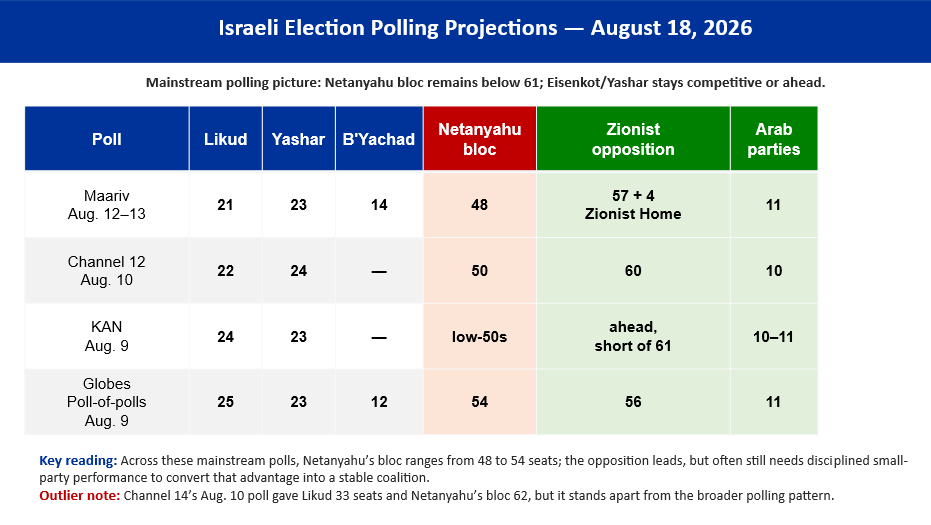
It is not clear which Israelis polled believed that a particular leader, party or coalition of parties would be best suited to manage the priority issues. Separately, in combing the polling data as of August 18, we found the following coalition estimates. Caution must be used in reading these findings because they are only a snapshot of a particular moment in a fluid Middle East and Israel, whose politics and politicians barely seem to rest.
| Rank | Motivator | Electoral Importance Now | Why It Matters |
| 1 | National security: Is Israel actually safer? | Very high | Still the umbrella issue. Iran, Gaza, Lebanon (No. 6) and October 7 (No. 2) feed into the fundamental judgment of competence. |
| 2 | October 7: responsibility and accountability | Very high | The election is the first national reckoning over who failed and who should continue governing. IDI found 61% saying Netanyahu should not run again vs. 35% saying he should. (Israel Democracy Institute) |
| 3 | Cost of living/economic burden of war | Very high | It is the strongest nonsecurity issue in direct vote-choice polling. 25% cited the economy and cost of living as affecting their choice. (The Times of Israel) |
| 4 | Haredi military service/equality of sacrifice | High and rising | This links security, religion-state and fairness. 68% of Israelis, including 60% of Likud voters, opposed an exemption law even if that meant new elections. (Israel Democracy Institute) |
| 5 | Iran: nuclear danger and whether the war ended too soon | High | Iran remains the principal strategic threat beyond Israel’s borders. 64% of Jewish Israelis said that ending the Iran war under current conditions was incompatible with Israel’s security interests. (Israel Democracy Institute) |
| 6 | Gaza, Hamas, Lebanon and security on Israel’s borders | High | These are concrete manifestations of No. 1. 72% favor a permanent security zone in southern Lebanon, even if that causes disagreement with Washington. (Israel Democracy Institute) |
| 7 | Leadership, governance and trust in institutions | Moderate-high | This has become larger than Netanyahu personally. 70% of Israelis say there is some danger to the integrity of the election, while only about 40% are optimistic about Israel’s democratic future. (The Times of Israel) |
| 8 | The United States: ally or constraint? | Moderate but potentially decisive for center-right voters | It usually operates through security rather than independently. Only 28% now say Israel’s security is central to Trump’s thinking, down from 44% a month earlier; 51% said Washington has greater influence over Israeli defense decisions than Israel’s own government. (Israel Democracy Institute) |
| 9 | What kind of Israel? Identity, demography, cohesion, emigration | Moderate now; structurally very important | It is less likely to determine a ballot directly than war or prices, but it shapes the campaign’s deeper anxiety. “Societal divisions” already register at 15% as a direct voting concern. (The Times of Israel) |
Tier 1 — issues that can directly decide the election: national security, October 7 accountability, the economy and Haredi conscription. Together, these issues address competence, responsibility, household pressure and equality of sacrifice. These are also the issues most capable of moving voters between Likud and the center-right opposition rather than merely mobilizing voters already committed to a bloc. (The Times of Israel)
Tier 2 — security questions that reinforce the first tier: Iran and Israel’s immediate borders. They matter enormously, but most voters process them through the broader question of whether Benjamin Netanyahu, Gadi Eisenkot or another leader has the judgment to keep Israel safe. The Lebanon number is especially revealing: 72% support maintaining a security zone even at the cost of friction with the United States. (Israeli Democracy Institute)
Tier 3 — systemic questions: governance, relations with Washington and Israel’s social identity. These questions might not top a voter’s list when asked for one issue, but they shape the choice between leaders. Concern over election integrity is now unusually broad — 90% on the Jewish left, 76% in the center and 66% on the right — showing that distrust of institutions is no longer confined to one camp. (The Times of Israel)
So, as of August 18, the election is still fundamentally about security and competence, but the issues most likely to determine movement among undecided voters are narrower: October 7 accountability, Haredi burden-sharing, the cost of prolonged war, and whether the current prime minister has sufficient ability to manage the Washington portfolio.
From now through October 23, the Friday before the election, polling of Israeli voters and issues will be continuous. In the weeks and months before previous parliamentary elections, events in and around Israel, such as terrorist attacks, have influenced the voting preferences of those who remain uncertain about party preferences until the last minute.
From that Friday until voting ends at 10 p.m. October 27, no polls may be published. Multiple exit surveys and other polls will take place in the week before October 27 with Israelis and the rest of the world eager to hear what the Election Day exit polls reveal. It is likely that only in the subsequent three to six weeks will Israelis know who their next prime minister will be. Until the next government is sworn into office, which could be in December, the current Israeli government and parliament legally remain in office.
See my previous Election Watch assessment from July 31.
— Ken Stein, August 18, 2026