May 14, 1948
As the British Mandate neared its end in Palestine in 1948, a lengthy Zionist to-do list stood before the builders of the Jewish state: the location of the capital, the state’s name, Jewish military unification, a formal, written request for U.S. recognition, and the wording of the Declaration of Independence. Writing the Declaration of Independence had to wait until the month before the state was declared May 14, 1948, amid pressing political and strategic matters.
In September 1947, two months before the U.N. General Assembly endorsed the partition of Mandate Palestine into Arab and Jewish states, Arab League leader Azzam Pasha said no to members of the Jewish Agency who were seeking a two-state compromise. He emphatically said, “Nations never concede; they fight. You won’t get anything by peaceful means or compromise. You can perhaps get something, but only by the force of arms. We shall try to defeat you. I’m not sure we’ll succeed, but we’ll try. We were able to drive out the Crusaders, but, on the other hand, we lost Spain and Persia. It may be that we shall lose Palestine. But it’s too late to talk of peaceful solutions.”
Golda Myerson (Meir) unsuccessfully tried until the eve of independence to persuade Jordan’s King Abdullah not to join the fight against Israel. At the United Nations, Jewish Agency diplomats first lobbied feverishly for a proposal for a two-state solution, then for the necessary two-thirds majority in favor of U.N. General Assembly Resolution 181.
British and American diplomats almost immediately colluded to try to reverse the vote and maintain control of Palestine through a trusteeship. Britain took the view in spring 1948 that its troops could not enforce partition against the Arab will and decided to hand over military bases, equipment and road crossings to Arab irregulars. Those areas saw some of the fiercest fighting during the Israeli War of Independence because they all were of high strategic value.
The U.S. State Department argued for delaying a Jewish state in part because of the military imbalance between the Jewish militias and Arab forces. The U.S. military projected a need to send in as many as 50,000 American troops to rescue the Jewish population that they were convinced could not hold back the projected Arab onslaught. The State Department feared a Soviet intrusion into the Middle East in response. Washington and Moscow would then be on an inevitable collision course. Often forgotten about America’s views toward a budding Jewish state, State Department personnel, particularly Secretary of State George Marshall, vigorously argued against a Jewish state that would forever alienate Arab states and jeopardize access to Arab oil.
Evidence for the great-power pessimism included a surge in intercommunal fighting within Palestine and anti-Jewish violence in Arab countries before and after the partition vote in November 1947. In January 1948, the new Arab Liberation Army attacked Jewish settlements at Dan and Kfar Szold.
On April 12, however, the Zionist Executive Council decided to declare independence upon the end of the British Mandate, scheduled for May 15. A small group of lawyers and politicians then pieced together the Declaration of Independence, using the U.S. Declaration and Constitution as philosophical frameworks.
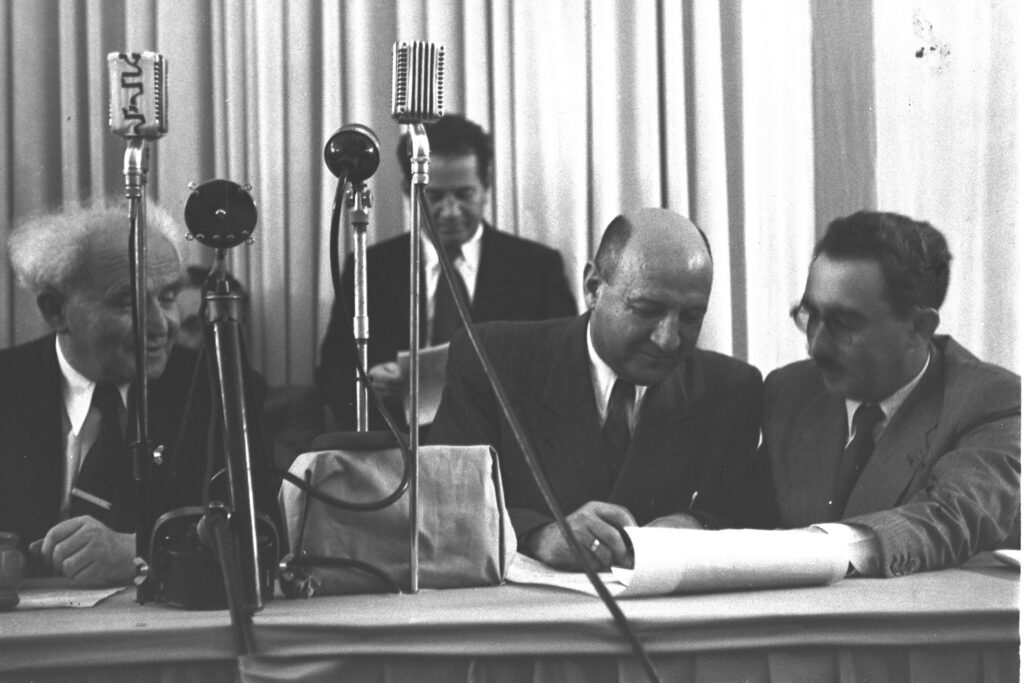
Moshe Shertok (Sharett), who led the political section of the Jewish Agency, was the primary author of the first draft, with David Ben-Gurion becoming the final wordsmith.
On Friday, May 14, after some debate, the Jewish community’s National Council voted to accept the final text. Ben-Gurion had his secretary secure a bank safe-deposit box that morning to keep the Declaration safe during the War of Independence, knowing that the Egyptians would be bombing Tel Aviv. At 4 p.m., he read the Declaration at the Tel Aviv Museum.
The lack of electricity meant that few in besieged Jerusalem heard Ben-Gurion’s radio broadcast of the Declaration and the singing of “Hatikvah,” the Zionist song destined to become the national anthem. What they missed was a synopsis of Jewish history and a statement of Israel’s intent toward its inhabitants, its neighbors and the international community.
The Declaration is divided into four parts:
• A biblical, historical and international legal case for the existence of a Jewish state in the Land of Israel.
• The self-evident right of the Jewish people to claim statehood.
• The actual declaration of statehood.
• Statements about the state’s operations, including an enumeration of citizen rights.
Comparisons between the American and Israeli Declarations are instructive.
Both assert the right to control their destinies and be free of despotic abuses, although Israel’s version includes thousands of years of Jewish sovereignties, connections and catastrophes.
Both proclaim the importance of liberty and freedom as basic human and natural rights.
Both promise safeguards for the individual and aspire to foster economic well-being.
Neither says anything about national borders.
Unlike the U.S. document, the Israeli Declaration proclaims legitimacy from the actions of international organizations, especially the United Nations. No such organization existed at America’s founding.
Both documents were issued amid war. But although the Americans and British had been fighting for more than a year when the U.S. Declaration was signed, many on both sides still hoped for reconciliation. Israel, by contrast, declared independence during a full-fledged war for survival, with the knowledge that failure meant obliteration. Nonetheless, Israel’s Declaration offers “peace and amity” to its neighbors and requests “to return to the ways of peace.”
Both Declarations reference a higher authority. The Israeli version closes with the phrase “with trust in the Rock of Israel” (Tzur Yisrael), a reference to God from II Samuel 23:3. It was Ben-Gurion’s compromise between secular and religious pressures. Any more direct mention of God might have required addressing religious practice and risked fragmenting society in the fragile early years of the state. The American document, approved by a more religiously unified group, cites “Nature’s God,” appeals to “the Supreme Judge” and seeks “the protection of divine Providence.”
One of the most important distinctions is what came after the Declarations.
The U.S. Constitution in 1787 provided the legal foundation for the new nation, leaving the Declaration of Independence as an aspirational, symbolic document.
In Israel’s case, the 1947 partition resolution called for the proposed Arab and Jewish states to write and ratify constitutions. But when Israel failed to ratify a constitution by 1950, the Declaration’s guarantee of “full freedom of conscience, worship, education and culture” became the foundation for protecting civil liberties. Israel’s Basic Laws later stipulated civil rights.
The Israeli Declaration served as a rallying point for Jews fighting for survival in 1948 and for its Diaspora supporters through the decades. Israelis demonstrating for a just democratic society have continued to point to its guiding principles, as during the protests from 2023 to 2026 of the Netanyahu government’s effort to diminish severely the power of the judiciary to benefit of the prime minister.
Over the years, no amendments were written for the Declaration of Independence. Israel’s guiding constitutional principles were formulated in 14 Basic Laws that define and regulate the roles, functions and prerogatives of government institutions, declare Jerusalem the capital, protect the rights of citizens, explain how treaties are ratified, and define Israel as the nation-state of the Jewish people.
— Ken Stein, June 4, 2026