Updated July 21, 2026, with a new introduction; originally posted in September 2023.

September 13, 1993

Source: National Archives and Records Administration

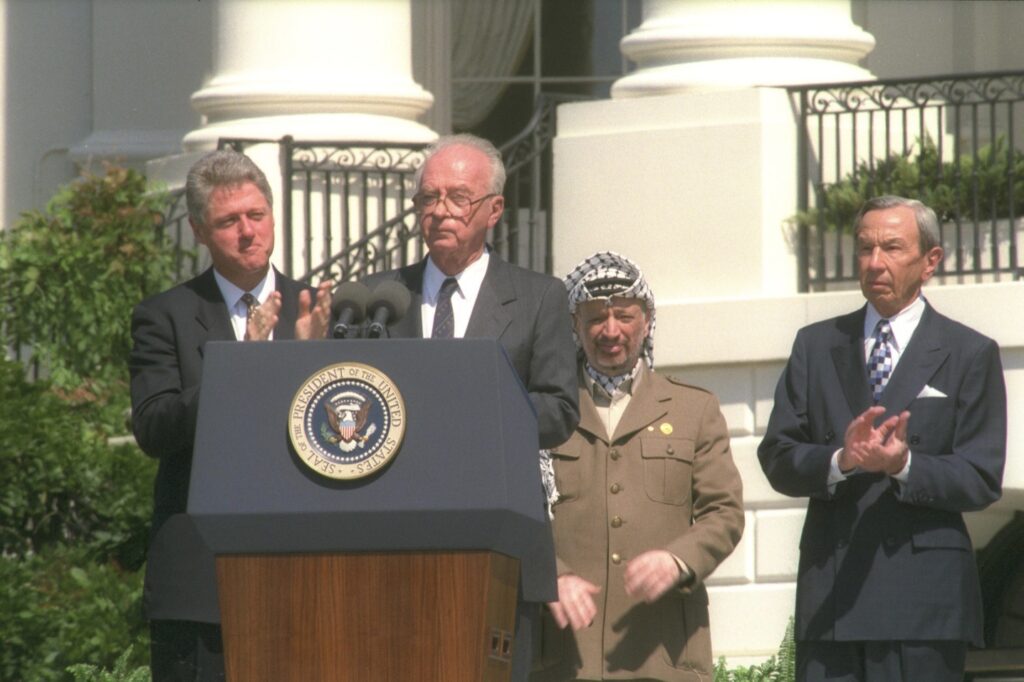
Israeli Prime Minister Yitzhak Rabin spoke as both a lifelong soldier and a national leader confronting a painful historical turning point. Standing in the audience, I could see that Rabin had difficulty being at a signing ceremony with Yasser Arafat. Rabin acknowledged that the Oslo agreement was difficult for Israelis, Jews abroad, bereaved families, and veterans whose lives had been shaped by war, terrorism and loss. For many victims, he said, peace had come too late.

Nonetheless, Rabin insisted that Israelis and Palestinians were destined to live together on the same land. Speaking directly to the Palestinians, he declared, “Enough of blood and tears,” rejecting revenge and hatred in favor of dignity, empathy, mutual recognition and coexistence. Both peoples, he stressed, wanted ordinary human lives: homes, families, trees, security and freedom.

Rabin understood that the past could not be erased, but the accords offered a chance to open a new chapter based on neighborliness, respect and understanding. Rabin knew that Israel was facing a potentially existential threat from the radical Islamic wing of the Palestinian national movement, driven by Iran. Rabin would say in November 1995, just before his assassination, that he signed the Oslo Accords to bolster the secular wing of Palestinian Arab identity. Rabin was all too prescient as Hamas, the Islamic wing, would brutally attack Israel in October 2023.

Rabin did not expect his Palestinian co-signer on the White House lawn that day to dramatically drop his inclination to destroy Israel or disavow the use of terrorism to do so. But in signing with Arafat and the PLO, Rabin delayed by 15 years the rise of Hamas to a share of Palestinian political leadership.

Drawing upon Ecclesiastes, Rabin argued that history had reached “a time for peace.” On the eve of the Jewish new year, he prayed that the agreement would bring hope and renewal to Israelis, Palestinians, the Middle East and the wider world. He concluded with the traditional Jewish prayer asking God to grant peace to Israel and humanity.

— Ken Stein, July 20, 2026


President Clinton, the president of the United States, your excellencies, ladies and gentlemen: This signing of the Israeli-Palestinian Declaration of Principles here today, it’s not so easy — neither for myself as a soldier in Israel’s war, nor for the people of Israel, nor to the Jewish people in the Diaspora, who are watching us now with great hope mixed with apprehension.

It is certainly not easy for the families of the victims of the wars, violence, terror, whose pain will never heal, for the many thousands who defended our lives in their own and have even sacrificed their lives for our own. For them, this ceremony has come too late.

Today, on the eve of an opportunity for peace and perhaps end of violence and wars, we remember each and every one of them with everlasting love.

We have come from Jerusalem, the ancient and eternal capital of the Jewish people. We have come from an anguished and grieving land. We have come from a people, a home, a family that does not know a single year, not a single month, in which mothers have not wept for their sons. We have come to try and put an end to the hostilities so that our children, our children’s children, will no longer experience the painful cost of war, violence and terror. (Applause.) We have come to secure their lives and to ease the soul and the painful memories of the past, to hope and pray for peace.

Let me say to you, the Palestinians, we are destined to live together on the same soil, in the same land. We, the soldiers who have returned from battles stained with blood, we who have seen our relatives and friends killed before our eyes, we who have attended their funerals and cannot look into the eyes of their parents, we who have come from a land where parents bury their children, we who have fought against you, the Palestinians, we say to you today in a loud and a clear voice: Enough of blood and tears. Enough. (Applause.)

We have no desire for revenge. We harbor no hatred towards you. We, like you, are people. People who want to build a home, to plant a tree, to love, live side by side with you in dignity, in empathy, as human beings, as free men. We are today giving peace a chance and saying to you (applause) and saying again to you: Enough.

Let us pray that a day will come when we all will say farewell to the arms. We wish to open a new chapter in the sad book of our lives together, a chapter of mutual recognition, of good neighborliness, of mutual respect, of understanding. We hope to embark on a new era in the history of the Middle East.

Today, here in Washington at the White House, we will begin a new reckoning in the relations between peoples, between parents tired of war, between children who will not know war. President of the United States, ladies and gentlemen, our inner strength, our higher moral values, have been derived for thousands of years from the Book of the Books, in one of which, Kohelet [Ecclesiastes], we read: “To everything there is a season, and a time to every purpose under Heaven; a time to be born and a time to die; a time to kill and a time to heal; a time to weep and a time to laugh; a time to love and a time to hate; a time for war and a time of peace. Ladies and gentlemen, the time for peace has come. (Applause.)

In two days, the Jewish people will celebrate the beginning of a new year. I believe, I hope, I pray that the new year will bring a message of redemption for all peoples; a good year for you, for all of you; a good year for Israelis and Palestinians; a good year for all the peoples of the Middle East; a good year for our American friends who so want peace and are helping to achieve it. For presidents and members of previous administrations, especially for you, President Clinton, and your staff, for all citizens of the world, may peace come to all your homes.

In the Jewish tradition it is customary to conclude our prayers with the word amen — as you said, amen. With your permission, men of peace, I shall conclude with words taken from the prayer recited by Jews daily, and whoever of you volunteer, I would ask the entire audience to join me in saying amen. 

Oseh shalom bimromav, Hu yaseh shalom aleinu, v’al kol Yisrael. V’imru, amen. [May the One who makes peace on high bring peace to us and to all Israel. And let us say, amen.] (Applause.)