Source: Sefer Hapalmach, Vol. 1, pp. 39-49, United Kibbutz, Israel, 1952-3
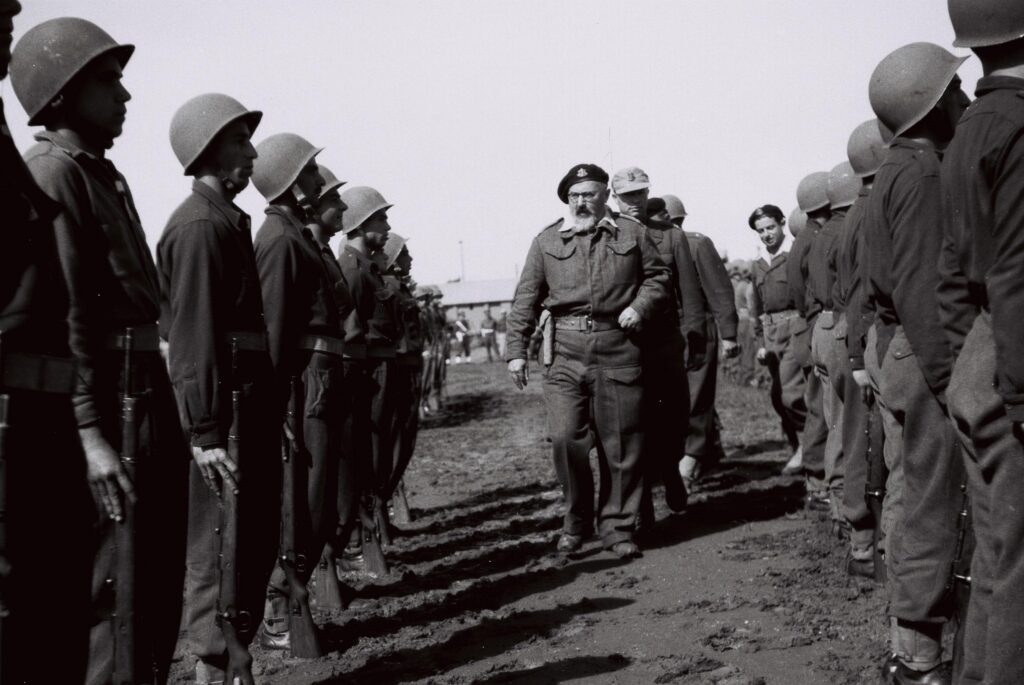
Yitzhak Sadeh (1890-1952)
Sadeh was born in Russia and immigrated to Eretz Israel in 1920. Soon after his arrival, he became an activist in the defense of the Yishuv and the commander of Haganah forces in Jerusalem. After the Arab attack on the Jewish settlement of Tel Hai in 1920, the Haganah evolved into the core of what became the Israel Defense Forces.
One of the architects of the Jewish community’s defense forces, he helped engineer the transition from passive defense to active engagement against foes, structuring forces that launched pre-emptive strikes. He set in motion the tactics of counterattacks and commando operations and engaging a threat before an anticipated attack.
He participated in the founding of the Palmach in 1941 and served as its first commander until 1945, when he became chief of the General Staff of the Haganah. He led multiple Haganah operations during the 1948 War of Independence. Known as “The Elder,” he was admired for his charismatic leadership and mentored some of Israel’s top early military personnel, including generals Moshe Dayan, Yigal Allon and Yitzhak Rabin.
During the 1948 war he commanded the Israel’s new armored brigade. It was instrumental in winning critical battles in the center of the country and in the south at Mishmar HaEmek and in capturing Lod (now Ben-Gurion) airport. Thousands of mourners attended his funeral in 1952. Israel remembered his contribution to the security of the country by naming many locations in his honor.
Sadeh explains how Jewish defense forces in pre-state Israel (1920-1948) had to evolve and invent their own military tactics in response to changing realities on the ground. Jews had no recent independent military tradition to draw upon for either organization or philosophy. Early Jewish self-defense efforts like Hashomer (Watchmen), established in 1909, focused on simple self-defense — protecting lives and property with pistols and limited resources, focusing geographically first on the Galilee. Over time, the Haganah, established in 1920, absorbed the Hashomer groups and expanded the idea of turning defense into a broad, organized movement that by the 1940s trained thousands and built discipline and a commitment to the Zionist cause as well as perseverance and resilience to protect life and property in Palestine.
The Arab riots of 1929 exposed several vulnerabilities in the security of Jewish settlements in Palestine. Zionists were too reliant upon British protection. The young Haganah was underdeveloped. Isolated communities — those not contiguous to one another were — were indefensible islands. British police left unarmed Jewish communities defenseless in Hebron and Safed. And there was in places a false sense of security that continued Jewish growth would go unchallenged by those in the Arab population who feared being supplanted. Local, isolated Jewish defense could not prevent physical losses; rising Jewish immigration numbers did not ensure safety and security.
By 1936, it became clear that passive defense was not enough. The Haganahshifted its thinking, developing tactics that included counterattacking and engaging adversaries outside Jewish settlements. Still, its major combatant focus was on havlagah (avoiding retaliatory violence against civilians), though that mindset and strategy shifted, particularly with the outbreak of the persistent Arab attacks on Jewish settlements and enterprises from April 1936 to 1939. Embraced by the left-wing Zionist leaders, havlagah was not accepted by the more militant, right-of-center outlooks personified by the Irgun Zvai Leumi.
The Haganah slowly moved from a loose collection of local guards to a civilian national command, initiated training programs and established clandestine arms factories. The Haganah by the end of the 1930s cooperated closely with willing British officers like Orde Wingate, who taught Haganah recruits commando tactics and preparations for night warfare. He encouraged independent thinking among field commanders, who learned to take the initiative in encounters without waiting for central orders.
New units like the Nodedet (mobile patrols) and later the Fosh (field companies) introduced flexible, aggressive tactics. Small groups used surprise, ambushes and coordinated movements — often described as “hammer and anvil” attacks — to outmaneuver larger forces. Training improved, emphasizing navigation, use of terrain and independent decision-making by junior commanders. These methods boosted confidence and effectiveness while keeping casualties relatively low.
During World War II, cooperation with British and Allied forces further strengthened these capabilities. Some 30,000 Jews served in the British army. They gained experience in sabotage, commando raids and joint operations and adapted what they learned to their own needs. Despite setbacks and political challenges, these evolving tactics laid the foundation for a more advanced military force. In 1941 the Haganah established the Palmach strike forces and the Palyam, an elite naval unit that escorted five dozen ships carrying European Jews to Palestine from 1945 forward.
Sadeh’s article repeatedly bookmarks the local security conditions that stimulated the young Jewish community to evolve heightened and diverse security responses with altered tactics, structure, training and preparedness. Innovation and adaptation turned geographically scattered defense groups in the World War I period into increasingly skilled and adaptable fighting units and welded a mosaic of diverse immigrants into a common commitment to defense of a state in the making.
— Ken Stein, May 1, 2026
Yitzhak Sadeh, “Haganah — Jewish Self Defense — Tactical Development,” 1952
Every nation has unique war tactics that are set according to its needs, the fighting circumstances, the given possibilities and the measure of its military tradition. Tradition in itself is conditional — revolutionary transformations of circumstances and socially productive relations can influence tradition and even change it. It might even lead to the emergence of radical innovations in the methods of war.
For the Jews, who had never conducted wars independently in recent generations (though they participated as soldiers in the armies of the countries of their residence), there were no “traditional war tactics.” If destiny forces us to fight our enemies, then a specific Jewish tactic may be developed based on life’s necessities, the character of the warrior and the conditions of our war. As of today, we can discern only the first signs of the formation of such tactics.
Since Jews served as soldiers in various armies in the world, their training was based on different military traditions. In our current activities, we can see the influences of the various training methods. Specifically, as Jews we can trace our fighting tactics to a relatively recent period — that of the days of self-defense in Russia [during the Kishinev pogroms that began in 1903] and the activities of Hashomer in Eretz Israel, the self-defense organization that, in my personal opinion, was a continuation of the self-defense measures in Russia.
In these two instances, the aims of defense were not political or military. They were, first and foremost, defense mechanisms created to defend lives and property and were modeled after the fashion of police actions. The weapons used in those days were the pistol and improvised bombs. Rifles later appeared in the hands of Hashomer members when their activities expanded to include the protection of vast agricultural areas, which required a means to deal with continuing incidents, as they were increasingly confronted by an enemy who had used rifles. But Hashomer fighters still kept their affinity for the use of pistols.
Though it was established in Eretz Israel, the founders of Hashomer copied its structure from revolutionary circles that viewed defense as a task to be conducted by a carefully selected caste of individuals. It became essential as a first step to widen the concept of defense and turn it from that narrow framework into a popular movement — every Jew in the country should know how to protect his life, his property and his enterprise.
Reaching Out
The transition from Hashomer to a wide and popular defense strategy was initially devoid of tactical and military concerns. Due to the lack of battlefield experience, the emphasis was put on a thin layer of “strict military discipline.” The marching exercises, the “attention at ease” drills and other minor military manners were imported by those who had served in the Jewish Brigades alongside the British army. The military training centered on pitiful practices of speedy weapon assembly and disassembly with one’s eyes closed.
During that period, the Haganah accomplished something exceptional: It established a movement of thousands and organized them in clandestine formations. With an almost total lack of any public awareness, the Haganah became one of the most influential movements of the pre-state Israeli youth. It taught the Israeli youth the virtues of bravery, devotion and acceptance of the authority of the national institutions. It also created a tradition of loyalty and commitment that attracted newcomers for one sole purpose: the defense of the Zionist enterprise.
The Impact of the Riots
The tactics of the Haganah were effective in warding off Arab attacks until 1936, but we already had ample reasons to be cautious during the riots of 1929. Although the Arab attackers were defeated wherever they encountered our resistance [the Arabs won in Hebron and Safed because these places had no defense], at the end of those riots the Arabs had obtained a political success: the cessation of the aliyah! Unfortunately, that red light was not sufficient to awaken us and propel us to create active defenses and develop a system of counterattacks. Our weapons, our training methods and our defenses were not ready for such transformation.
At that time, the Haganah was cautious and apprehensive because of the political ramifications of its actions. Following the increased dangers, though, the Haganah leaders chose to dismiss those apprehensions and started to become more daring in confronting those dangers rather than merely acting in a defensive manner.
From the riots of 1929 to those in 1936, we increased the quantity of our military equipment and improved our training, but the conscious recognition of the need for “military thinking” at the Haganah was not ripe yet.
The scope of the events in 1936 drove us to make some changes to our tactics, namely the establishment of small units assigned to act outside the boundaries of the Jewish settlements and face the enemy outside, in the battlefield. This new approach signified the emergence of new tactics and the initiation of counterattacks.
These new types of operations were conceived in the mountains around Jerusalem and, in sporadic instances, in other parts of the country and were subsequently deployed against the Arab gangs in those areas. At the end of 1936, the leaders of the Haganah had attempted to summarize that year’s activities by stating, “No more police, but army for the Haganah,” which meant not only defending lives and property inside the fences, but meeting the enemy outside, in the field. It resulted in the establishment of Fosh [Hebrew acronym for field companies, Plugot Sadeh].
In the middle of 1937, this new attitude resulted in the establishment of the field companies, which marked the change in our military tactics. From that point on, we operated in accordance with our specific needs and utilized the special qualities of our fighters.
The “Nodedet” — The Mobile Unit
By this point, events were developing very rapidly and provided us with no time for well-organized training procedures. The first operations of the Nodedet, our small forces that acted as mobile patrol units, were in various locations where the new tactics were to be executed. The following are instances of the application of our new strategies.
Hartuv, a secluded moshava [communal farm; located near the railroad to Jerusalem in the foothills], was surrounded by neighboring Arab towns and villages. Their defense plan in times of emergency involved gathering all the inhabitants into a two-story building and waiting for the enemy to attack. Hartuv had a very small population and did not have sufficient manpower for self-defense.
Here, for the first time, seven fighters were sent to assist them. The commander of that force gathered the people as before in the big building but then went outside the building with two of his men in order to ward off the enemy by launching an unexpected counterattack.
In the Bayit Vegan neighborhood in Jerusalem, the defense plan consisted of placing the defending force inside the neighborhood and in various observation posts at its borders. The Arabs launched their attacks from a hill that was less than 100 yards away. But here, again, the new method was applied. A small unit took over the hill before the arrival of the attackers, and when the Arab gang attempted to reach that point, as they had done previously, they were chased away by our unit. Our defending forces then pursued the retreating Arabs to their base and continued their assault there as well.
This new method of defense drew the attention of young commanders in Jerusalem who had not received training for this approach in the past. Many of them volunteered to participate in such actions as privates, and this became the method of rapid acquisition of the skills for counterattacks and night operations.
A unit of the Nodedet was sent to deal with a situation in one of the settlements near Jerusalem that was constantly attacked by Arab gangs. During an actual attack, the unit boarded a pickup truck, leaving the impression that the Israeli fighters were retreating. Shortly after leaving the settlement, the truck slowed down, and the fighters jumped off, with the pickup truck continuing on without them. The unit then advanced under the cover of the terrain toward the point from which the Arabs launched their attack, surprised them from behind, and subjected them to crossfire from the settlement’s defenders and the Nodedet unit. In that instance, the static defense of the settlement acted as an anvil, and the Nodedet force became the hammer. It was in that vicinity that we deployed our first ambushes.
We applied an even more advanced tactic in another settlement in that area. We placed an ambush next to a nearby village that we assumed served as a base for launching attacks against that settlement. In addition, we deployed a patrol unit in the area. The duty of the patrol was to push the assailers back to the village. In this instance, we used the ambush near the village as the anvil and the wandering patrol as the hammer. This advanced strategy allowed us for the first time to have the anvil and the hammer units as parts of the same force.
The new methods that were applied to both commanders and privates made their characters as strong as steel. Most of them were tested in real actions, and, to this day, we exploit these “real-time practices” in all of our military operations.
In the middle of 1937, out of sheer necessity, we established the Fosh, which became our force for implementing our tactic of “dynamic defense.” From the early days of this new force, we were aware of the need to provide special training to all its commanders and their units, but we did not have a team of experts who could train them. So, in a concerted effort, we established the first training courses for company leaders [up to 12 warriors], and, over time, we improved our training methods until we were able to prepare cadres of low-ranking commanders who could lead their units independently or as part of a larger unit into daring and successful operations.
All over the country and especially in strategically located settlements, we founded field companies and began the process of training them in maneuvers, using proper cover under fire and becoming part of the landscape and the terrain.
This type of training provided us with a system that allowed us to reach great numbers of fighters and expand our operations. Also, these basic training methods transformed the meaning of defense and have led to great feelings of enthusiasm among the defenders.
One example stands out. One settlement, Sheik Abrek, was attacked in broad daylight, and all the vehicles that went up the roads leading to the valleys [Zebulon and Jezreel] were ambushed simultaneously by Arab terrorists. In the midst of the attack, one of our companies training nearby rushed to counterattack, fought the enemy and continued to pursue him while he was retreating.
This case demonstrated that our policy of increasing the number of our warriors and improving the methods of their training proved to be adequate. Needless to say, this small event contributed to the morale of the Fosh fighters and increased their self-confidence.
Early in 1938, pioneers entered the newly inaugurated Kibbutz Hanita in the Upper Galilee and set up their defenses according to conventional methods through static positions in trenches. The Fosh fighters who were sent there to strengthen Hanita’s defense had an opportunity to prove their effectiveness in just five days. When Israeli laborers were attacked in a nearby location, the Fosh force responded promptly with a counterattack. One unit fired directly at the attackers, and the other performed an outflanking maneuver and attacked the enemy from the side. Nothing could emphasize the effectiveness of our tactics more than the following: While we attacked the enemy, a British armored vehicle was driving along the major road, and the soldiers inside the vehicle fired randomly and ineffectively in the direction of the Arab attackers, who were well-hidden in the hilly terrain and ignored the futile British attempt to stop their attack.
On another occasion, a force that consisted of only eight fighters launched an attack against an Arab gang that had murdered three Israelis. One of the Israeli fighters was wounded, and two of his comrades evacuated him from the raging battle. The remaining five calmly continued their assault and inflicted many casualties on the gang members. Distinctly effective was the commander of the force, who was an outstanding marksman.
In the middle of 1938, when the situation in the country worsened and the British could not exert their control over the Arabs, the Fosh took the initiative. It organized the front lines and expanded the deployment of its units. The Fosh defense system now encompassed the whole country. It recruited three more platoons and deployed them at strategic locations. Thus, wherever Fosh was in control, the disturbances subsided significantly, and the number of civilian casualties and damage to property decreased. Whoever wishes to review the newspapers of those days will realize how the security situation in various places in the country improved from the month of July onward.
Method of Operation
How did these units operate? The recruits were originally enlisted for a one-month period. When it became clear that this period was not sufficient, it was expanded to three to four months. These recruits were organized in up to four companies, which made up a platoon. Each company consisted of ten recruits. The forces were deployed on patrol assignments in a schematic manner — one patrol in the morning, one at night and one in training.
All the small units were deployed together twice a day: when Jewish laborers went to work in the morning and in the evening when they returned to their homes.
The platoon headquarters coordinated the routes of the patrols so that they would cover as much area as possible. During night reconnaissance activities, the companies were divided into smaller units that were deployed at the exits of the homes of suspect Arab villagers. Whoever ventured out of the village at nighttime was confronted by an armed Israeli soldier. The villagers usually thought that these few Israeli soldiers were backed up by larger contingency forces. Consequently, these patrols, even without engaging in armed confrontation, prevented the activities of Arab gangs, notably in the Sharon Region.
There were instances where real confrontations occurred and the gang members needed to be taught real lessons. In every such confrontation, we had the upper hand. Such were the cases in Samaria and Givat Ada, where we inflicted heavy casualties on the Arab gangs. In another instance, our patrols were sent to punish gang members for murdering innocent civilians.
In short order, the ambush methods improved significantly. Most ambushes were deployed at the exit points of the Arab gangs. The following example illustrates our methods. A Fosh unit and its commander established an ambush in the southern part of the country. The ambush waited patiently and silently near an Arab village and could hear the rifle shots that were aimed at a Jewish settlement. The unit waited for its turn. Finally it arrived. The gang returned to the village and began feasting and celebrating in the village’s guesthouse. While the Arabs were having coffee, the ambush commander ordered its members to stay put and crossed the village fences alone, approached the guesthouse and left the people inside with a “present” of his own: two explosives that he threw in through the guesthouse’s window.
In time, the ambushes became more systematic, and the training practices improved. Navigation and map studies became much more precise, in opposition to the Arabs’ basic and instinctive navigation. Even the commanders of the basic units that consisted of ten soldiers were required to submit a weekly reconnaissance plan. No patrol was allowed to leave before it had been replaced by another one. By becoming increasingly aware of how well the Arab predators executed their attacks, we increased the responsibility for planning down to the basic commanders, expecting them to be creative and follow the principle of “surprise so that you will not be surprised.”
Wingate Squads
In a later period, Captain [Charles Orde] Wingate began his operations in the northern part of the country. He provided us with the same tactical training that we had already begun to practice, but on a larger scale and with the benefit of his great talent.
His plans were bigger and more daring. At times he deployed two or more platoons with efficient coordination. We learned from Wingate how to mobilize our forces. He would regularly assigned his units to walk more than 40 kilometers, mostly at nighttime. He would switch the locations of his forces from one place to another, and he always had the element of surprise on his side.
When the Arab gangs became proficient in placing land mines, the Fosh units assumed the task of punishing the villages that served as safe haven for the gangs. In those villages, we blew up the home of the village leader as a caution, not to harm innocent villagers. We would warn the inhabitants of those villages prior to the explosion, requesting that they stay away at the time of the incident.
Shortly before the cessation of the Arab riots, we had to expand our activities in the southern regions of the country. We deployed many ambushes between Na’an and the Negev in response to the placement of mines by the Arabs. Since we had to place many ambushes, we divided our forces into small units. Each unit had one automatic weapon, and that additional firepower enabled us to increase the number of our ambushes from eight to sixteen. On some occasions, the ambushes inflicted heavy casualties on the enemy.
The training of fighters cannot be sketchy, unfocused, accidental or unsystematic. The Fosh, in addition to its value as a defense mechanism for the protection and the safety of our national enterprise, was also an enormous experiment that hastened the development of military principles for the defense of our country.
After the dismantling of Fosh, we lacked a unit that could concentrate on military studies. We continued our efforts to establish a centralized force that would propel the Haganah to dynamic and advanced military power, as was demonstrated in the Palmach.
The Pum (Special Operations)
The riots were over by this time [1939]. The Fosh completed its tasks with great tactical achievements and had significant successes with a low number of casualties. However, the main purpose of its establishment had not been fulfilled. The Fosh failed to make the rest of the Haganah organization follow its example. The Fosh was not able to attract large numbers of youths. And, of no less importance, the Arabs won the political battle with the publication of the British Inquiry Commission recommendations of 1939.
The edicts of the commission led to the establishment of a special unit by the Haganah. Its purpose was to fight those edicts by a variety of means but to act outside the organizational framework of the Haganah.
The most important task at that time was to prepare our people for action with regard to the “illegal” aliyah. Accordingly, special marine training courses were established. At the time when the Patria ship disaster occurred, the “Pum” people sank a British police boat, and some of our people were punished because of their cooperation with the British in halting the immigration of “illegal” newcomers. [Haganah members unintentionally sank the Patria in the port of Haifa in November 1940 in their attempt to prevent the expulsion of illegal Jewish immigrants back to Europe. Of the nearly 1,800 Jewish immigrants and British crew on board, 267 died, and 172 were wounded.]
After the dismantling of the Fosh, many of its commanders were too young to hold commanding positions in other organizations. Fatigue after the riots in conjunction with the discontinuation of the Fosh affected the morale of its people. The not-yet-complete tactical doctrines came to a stop. Indeed, in the time of a ceasefire it would have been proper to amend mistakes of the past and restart anew, and, in this instance, we could have turned the Fosh into regular military units.
The Outbreak of WWII
The first thunders of the war reached us from afar. It seemed as if our activities here had no direct connection to that war. There is fighting going on in Europe … but how could we relate all of that to our own reality?
There is one thing that we could learn from the developing war, and that is the focus and the emphasis on the value of the individual. When the echoes of the infiltration of the Allied patrols into the Maginot and the Siegfried lines came to our attention, they appeared familiar and similar to our own operations during the riots. Though we were curious about the details of the operations of those patrols, it was only a distant interest.
But the time the first blows hit France, Belgium and Holland and the situation in the Middle East worsened drastically, it became clear to us that the perils of destruction might threaten our people in the Diaspora and in Eretz Israel. It became obvious that we would have to be prepared to fight Hitler indirectly and defend our country from the invasion of a ruthless enemy.
All the while, there were known changes that took place in the war tactics of the Allies. They were not only interested in tank warfare or in confronting armored divisions, but also in commando operations and the use of paratroopers.
As for us who have not yet faced an open war with regular armies, we were interested in learning more of the tactics and the training of those who “fall from the skies” into the midst of their enemy’s military bases or the invading marines onto the shores of a surprised enemy or the fighting of an army that is only slightly equipped against a heavily armed opponent.
As the war got closer to our country, we had to evaluate ourselves and assess our capabilities. We knew that we could not determine the outcome of a battle by sheer numbers. But we also knew that we could weigh our side significantly by assisting the Allies with our knowledge of the country, our readiness to face danger and the lessons we had learned from our previous fighting experiences. When we were asked to help, we readily responded.
The Boat
The first task that was presented to us in 1941 was similar to the commando operations with which we were familiar. It required a force of 22 fighters. The assignment included a sabotage action based on surprise and quick execution. We were supposed to be integrated with other forces, and the objects were the oil refineries in Tripoli, Lebanon. The first reconnaissance mission that our team carried out produced insufficient general intelligence, such as knowledge that there were tight defenses and a high fence, but the second mission was far more specific. We found out that along the beach was a string of fortresses, five kilometers apart from one another, that were manned by Senegalese soldiers equipped with automatic weapons. The refineries were located one and a half kilometers inland. On top of the surrounding hills, there were cannon posts defended by two platoons.
Our motorboat was supposed to come as close as possible to the shores of Tripoli. Two men were to stay on board, the boat commander and the driver. Those who were assigned to embark into smaller invading boats were divided into three groups: One was to guard the boats, the second was to be stationed along the railroad that reached the refineries, and the third was to infiltrate the refinery compound and place explosives with delayed activation next to them so that all of our forces would have ample time to return to their boats. The fighters were ordered to execute the operation under any circumstance.
Our fighters were well prepared. There were discussions and arguments among them for the right to participate in that mission. For example, the person who trained our fighters in judo did not belong to our unit and was not originally assigned to that mission but was able to “prove” his right by claiming that he wished to join the fighters whom he was responsible for training.
The commander that was chosen to lead the mission, Zvi Spector, joined the 22 fighters only a couple of days before the designated departure time. He was an outstanding warrior who excelled in the Pum’s operations and had exceptional tactical skills.
The early maneuvers and training of the 23 warriors were conducted in stormy weather and rough seas, which proved the capability of our sailors, who met in the dark of night in the middle of the sea at the exact spot and at the exact time as planned.
What is known to us today is that the 23 warriors never reached their destination, and the operation was not executed. We still do not know the cause of their disappearance. We lost 23 of our most daring and courageous people. It is hard to imagine a unit better than this one. If the operation had been successful, it would have meant a hard blow to the Germans, who had begun to gather fighter planes to launch an attack against the Allies in the Middle East. Damaging the refineries would have cut short their oil supply for military purposes. In addition, we wished to demonstrate our capabilities to the Allies so that they would ask for our participation in joint military operations in the future.
A new opportunity presented itself in June 1941 [a month after the disappearance of the boat] when we were asked to participate in the British invasion of Syria.
The Operation in Syria
Much has already been said about the operation in Syria, and we do not intend to recount the facts that are already known. As far as we were concerned, the operation served as an impetus for the reorganization of our brigade.
The people who participated in that operation were among the new recruits of our newly founded unit. Their training, especially that of the commanders, was based on the methods that we developed in the Fosh. Our headquarters were certain that the mission would be properly executed. We based our assessment on the experience of the assigned fighters who had gained their previous experience during the Arab riots.
Thus, based on our practices and knowledge of the capabilities of these fighters, we dared to offer the Allies far-reaching plans. The idea of cooperation with the Allied forces came along with the proposals to take over the Litani River bridges by two of our units. One unit was designated to conquer the enemy’s positions on the rocky area on the west bank of the river, and the other was to take control of the bridges. We estimated that we could carry out this operation successfully, but for reasons that cannot be enumerated here, the scope of our participation was minimized. As a result, we were assigned to find ways of connecting the country’s main northern road with the southern roads of Syria.
At the time of the operation, we were instructed to cut all radio and telephone communications along the front line, from Benot Ya’akov Bridge to the sea [the Mediterranean]. We were also assigned to lead an Australian unit to a designated location in order to prevent the French army [acting on the orders of the Vichy government, which had succumbed to the Nazis] from blowing up the main road there. It should be noted here that the Jewish inhabitants along the Eretz Israel border with Syria were not familiar with the area, so we were compelled to receive assistance from local Arab inhabitants.
Our forces were divided into small units consisting of two to three fighters each. They all demonstrated perseverance in covering long distances by foot, bravery and navigation skills from the moment they launched their reconnaissance missions. When the battles broke out, our fighters demonstrated that the intense training they received proved effective in face-to-face confrontations with the enemy using hand grenades and cold weapons [bayonets]. They also cooperated effectively with the Australian units. Once they had defeated the enemy, our fighters quickly became proficient at operating the captured French weapons.
Because of their courage and fighting skills, our commanders assumed leadership positions and even led the Australians into battles. One of our units took over an enemy headquarters, inflicted upon them heavy casualties and captured a whole platoon as prisoners of war. Thus, our small company was able to prevent a much larger unit from invading our territory.
Since all telephone lines were disrupted along the front lines, this action had dire consequences for the French, whom we surprised during the initial stages of the Allied invasion.
Our proposal to blow up the Litani bridge reached the Allied headquarters a few hours before the operation started. The Australian brigadier in the field was supportive of our plan, but when time came to execute it, the Allies did not have sufficient manpower to carry it out.
We were highly encouraged by the consequences of our first cooperation with the Allied forces. We were now convinced that our military plans were adequate, that our skills at operating in small units were recognized, and that our fighters performed very well. The Australians, who expressed their wish that we continue to cooperate with them, were too naïve. They did not understand the reasons behind the refusal of the British high command to further use our skills, which was guided by the fear that we might use these battle experiences against the mandatory rule.
Joint Action
Soon after our participation in the battles against the French, we were given an opportunity to apply our marine training. We were asked by the navy commanders of the Allies to participate in the planning of operations, though the majority of these never materialized. The navy commanders appreciated our contribution and even demanded that we cooperate with them. Later on, they even borrowed our methods in marine training to instruct their own commando units.
From our cooperation with the Allies, we acquired advanced techniques of sabotage; we were privy to military plans and were able to contribute our own input. We’ve learned a lot from the Allies, but we also realized from the onset that every plan and every action had to be modified in order to meet our own objectives, especially when they were applicable to our country.
We have always aspired to improve and advance our commando modes of operations, but the Allies were more interested in sabotage operations. On that ground, we had differences of opinion: We demanded that our fighters receive comprehensive training and that sabotage training only be a part of it, but the Allies refused to comply with our demands.
Once the threat of the German invasion of Eretz Israel became imminent, our approach won. All the plans of sabotage actions that we devised were duly approved. It started with the methods of training and the extensive use of commando operations characterized by agility, light weaponry, acting inside enemy territory and the use of explosives for sabotage purposes. We established and trained special units in our brigade in order to deploy them simultaneously against the Germans and the Arabs. We even had contingency plans to infiltrate our neighboring Arab countries in the event of a German invasion of their boundaries.
More than once, we have heard of critics who raised doubts about our skills at executing independent actions. Time and again, we even heard from our people that their training was not sufficient. But when we deployed our “German unit” against the Germans themselves, their complete success silenced all criticism. At that time, we learned about the death of two Jewish soldiers. We sent our German unit dressed in German uniforms to carry out a sabotage action against a German headquarters.
Our unit was accompanied by a German officer who initially collaborated with us and then betrayed us. We were supposed to act in cooperation with the “free Frenchmen” [who opposed the Vichy government’s cooperation with the Nazis], but, midway through our action, the German officer’s treason became obvious, as we and the French fighters were surrounded by German soldiers. One of our fighters began to fire at the German soldiers, causing numerous casualties, before he was shot to death. Our second soldier threw his hand grenades into a German explosive cache and died from this explosion along with many German soldiers. Miraculously, a French officer who was present when the action took place told us the details of the event. His account was verified by Germans who were in that military camp at the time before they were captured by the Allies and became prisoners of war.
Needless to say, this action of supreme bravery served as a guiding beacon for our German unit in its future military undertakings.
The Days of El Alamein (July 1942 and October-November 1942)
During those critical days, our brigade was called upon to be deployed at the front line in the southern region of Eretz Israel. We knew that we were very few in number, and we would remain small, even if the rest of the Haganah brigade had joined forces with us. We were in a great dilemma: How could we confront a much larger enemy? We only knew one thing for certain: We will not surrender; we will fight to the bitter end. We will inflict many casualties on the enemy by sabotage, by our weapons, by explosives, by ambushes, but we shall not surrender.
The tactical planning of the Haganah included a defense plan in the event that a much larger army attempt to conquer our country, such as the German army. This mode of thinking took place even before the massive slaughter carried out by the Nazis in Europe.
Our tactical plan in the face of a possible German invasion was far-reaching. It identified the port city of Haifa as our last bastion, where every Jew in the country who knew how to operate a weapon would join us. We also assumed that the Allies would support our last stand by artillery, by air and by sea. This plan preceded the defense of Stalingrad, but it was quite similar in its nature and determination. It was to be our Stalingrad. In that possible confrontation, we wished to gain time until the balance of power would change on all fronts in favor of the Allies.
To our great relief, this was exactly what happened not near Haifa, but rather in El Alamein [where the Nazis’ Afrika Korps was defeated by the Allies in its campaign to conquer North Africa and take control of the Suez Canal]. Thus, they remained only contingency plans for us. These plans were not just tactical or theoretical exercises; they served as an educational tool, a guide for future operations. In every future battle in which we are called upon to defend our Zionist enterprise, we shall be able to implement such plans successfully.