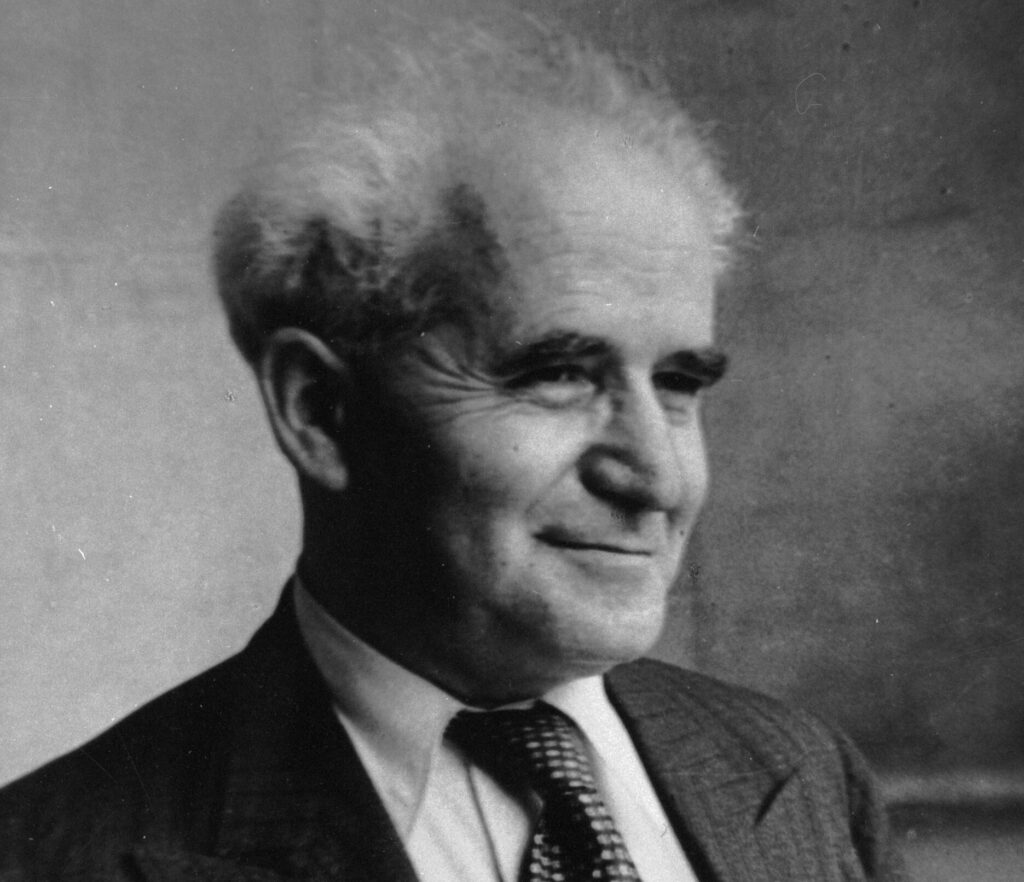
In New York, urging American (Jewish) support, Ben-Gurion proclaims the eventual establishment of a Jewish state.
[1] Brown, Michael The Israeli-American Connection: Its roots in the Yishuv, 1914-1945, Wayne State University Press, Detroit (1996), p.223.
[2] Ibid., p.225.
[3] Gal, Allon. David Ben-Gurion and the American Alignment for a Jewish State, Indiana University Press, Bloomington (1985), p.74.
[4] Ibid., p.94.
[5] Ibid., p. 171.
[6] Ibid., p. 82.
[7] Goldmann, Nahum. The Autobiography of Nahum Goldmann, Tranlated by Helen Sebba, Holt, Reinhart, and Winston, Chicago (1969), p.291.
[8] Ibid., p. 221.
[9] Ben-Gurion believed that ultimately, negotiations with the Arabs would prove fruitless. Ben-Gurion’s view was coldly practical; there was little hope for understanding between the Arab and Jewish communities of Palestine because Arabs had rational, existential reasons for opposing the core goals of Zionism. He did not believe that enlightenment or the understanding of practical benefits for the Arabs in Palestine would soften Arab resistance to Zionism; he did not believe that bi-nationalism or parity with the Arabs offered a solution; he did not believe that transfer of the Arab population outside of Palestine was a prerequisite for large Jewish immigration to Palestine; and he believed that Jewish development could provide for the present and future population (Gal).
[10] Gal, Allon. David Ben-Gurion and the American Alignment for a Jewish State, Indiana University Press, Bloomington (1985), p.169.
[11] Brown, Michael. The Israeli-American Connection: Its roots in the Yishuv, 1914-1945, Wayne State University Press, Detroit (1996), p.237.
* Syria is here meant to include Palestine.
* By the end of the war, the number had reached 33,000.