December 7, 1988
Arafat, Yasser, et al. “Joint Statement by Yasser Arafat and a Group of Five American Jews, Stockholm.” The Washington Post, Washington, D.C., published December 8, 1988.
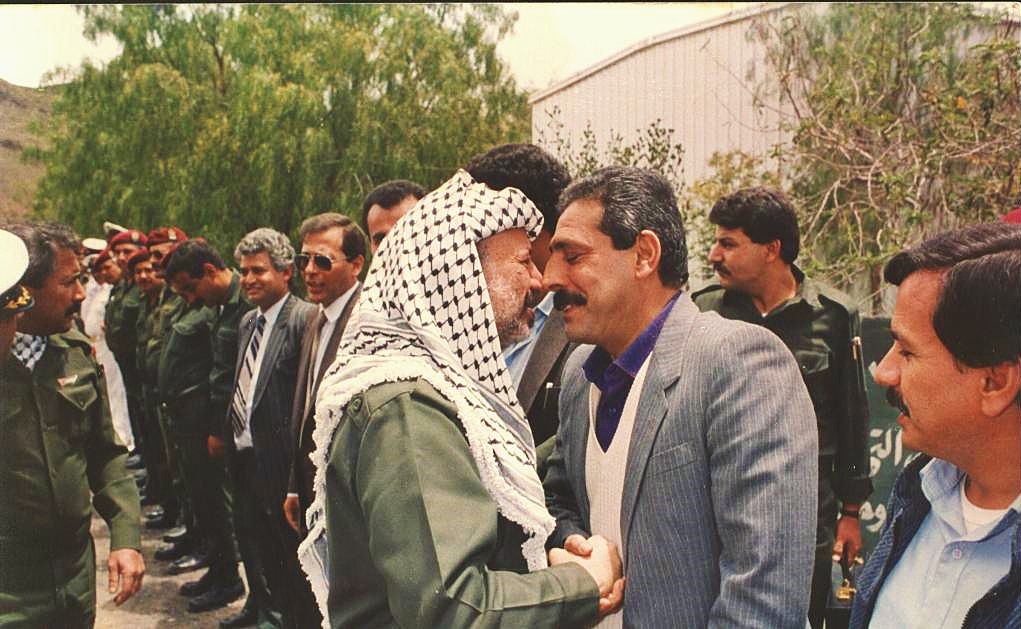
The Stockholm Declaration emerged as a phase in an evolving Palestine Liberation Organization diplomacy. PLO Chairman Yasser Arafat sought dialogue with the United States with the objective of using Washington’s acceptance to solidify his legitimacy as the leader in Palestinian Arab national identity.
The declaration was issued during the U.S. transition from President Ronald Reagan to President George H.W. Bush between November 1988 and January 1989. Arafat and the PLO had rejected numerous secret overtures from the Carter administration a decade earlier to renounce terrorism and engage in a vague negotiating process with Israel through the United States to avoid direct talks. Arafat at the time was fending off leadership challenges from Palestinians living in the West Bank and Gaza Strip. Since the Egyptian-Israeli treaty signing in March 1979, Palestinians from those areas and Jerusalem wanted to test the political waters to gain self-government or self-rule as outlined by Egyptian President Anwar Sadat and Israeli Prime Minister Menachem Begin in the Camp David Accords.
Arafat did not want any alternative voices speaking on behalf of Palestinian political hopes. Palestinians in the West Bank who asserted semi-independence from him were intimidated and threatened. In December 1987, Palestinians in the West Bank rebelled against Israeli administration in what became known as the First Intifada, seeking to throw off Israeli control of their daily lives.
In early March 1983, standing in the large meeting room of the U.S. consul general’s home in Jerusalem (according to my notes of that meeting), some five dozen Palestinian leaders from the West Bank and Gaza Strip were requested by former President Carter “to come forward and speak openly on their own behalf.” One replied, “We would like to do so, but we must clear our political actions through Arafat.”
By 1988, Arafat was being openly challenged by Hamas, the Palestinian Islamic resistance movement, which found him an obstacle to its objective to shape and direct the Palestinian future. In August 1988, Hamas issued its charter, a statement of principles that focused explicitly on destroying Israel.
Arafat always wanted and needed the PLO to be the “sole legitimate representative of the Palestinian people.” Anis Mansour, a prominent Egyptian journalist, noted in October 1988, “Arafat considers himself the self-appointed head of state; he wants a red carpet. Arafat does not want others to make decisions for him.”
When I asked Arafat in a meeting in Tunis in early October 1993 how he defined Palestinian self-determination, he semi-joked, “I determine that by myself.”
Many American diplomats I interviewed over the years — Ed Abbington, Samuel Lewis, Mike Newlan, Phil Wilcox — agreed that Arafat would do just about anything to deny Palestinians in the West Bank independent agency or a voice of their own separate from his leadership.
As Arafat would do again in September 1993 just before signing the Oslo Accords, he ingratiated himself with an American administration by accepting a spoken and written embrace of Israel. On both occasions, his view was that a dialogue with the United States would enhance if not solidify the legitimacy of his leadership. Arafat realized what Sadat had concluded in the 1970s: Working with and through Washington was necessary to advance an Arab national interest even if not totally compatible with the long-term ideological preference for Israel’s disappearance.
One month before the Stockholm gathering with Americans, the Palestine National Council met in Algiers and issued two landmark documents: the Palestinian Declaration of Independence and a political statement implicitly accepting a two-state solution grounded in U.N. Security Council Resolution 242 (1967) and Resolution 338 (1973). Since the 1970s, the United States had conditioned dialogue with the PLO on its recognition of Israel, acceptance of Resolution 242 (an evolving concept of trading land for peace or land for security and engaging in direct negotiations) and renunciation of terrorism. The Algiers decisions came while the PLO operated out of Tunis after losing its base in Lebanon in 1982 and sought to assert its primacy. Location mattered: While Hamas was in Gaza and Palestinians in the West Bank were adjacent to Israel, Arafat’s PLO was 1,300 miles away.
The Stockholm meeting brought Arafat together with five prominent American Jewish leaders to clarify the Algiers resolutions. The resulting joint statement was crafted to remove U.S. objections to opening dialogue by explicitly acknowledging Israel, accepting a negotiated two-state framework and condemning terrorism. It marked the clearest PLO move toward political recognition of Israel to date, but recognition was not acceptance of Israel as a Jewish state.
On December 16, 1988, a week after the Stockholm meeting, U.S. Ambassador Robert Pelletreau initiated the first official face-to-face meeting with the PLO, led by Yasser Abed Rabbo, a member of the PLO Executive Committee. Frank Carlucci, who was the U.S. defense secretary from 1987 to 1989, noted that the U.S.-PLO dialogue was about Arafat insisting on a Palestinian state with no interest in negotiating seriously with Israel.
The Stockholm Declaration reaffirmed that the Palestinian National Council had endorsed a political program rooted in U.N. resolutions. It stated that the PLO, as the sole legitimate representative of the Palestinian people, agreed to enter negotiations at an international conference with the United States, the Soviet Union, other U.N. Security Council members and Israel. According to PLO hopes that weren’t rooted in the text of Resolutions 242 and 338, the principle of Palestinian self-determination in those negotiations would lead to an Arafat-led Palestinian state.
The declaration explicitly accepted Israel’s existence, proclaimed the establishment of the State of Palestine, and rejected terrorism “in all its forms, including state terrorism.” It also called for resolving the refugee issue through return or compensation under international law. Israel rejected any Palestinian claims to return to any lands under Israeli control.
On May 20, 1990, the Bush administration ended the U.S.-PLO dialogue when Palestinians under the PLO umbrella attempted a raid on beaches near Tel Aviv to kill Israeli civilians. U.S. Secretary of State James Baker concluded that Arafat had breached the pledge to renounce terrorism. Arafat’s actions shaped multiple American perceptions of him as unreliable, and yet, in September 1993, Arafat was on the White House lawn signing the Oslo Accords with U.S. President Bill Clinton and Israeli Prime Minister Yitzhak Rabin.
— Ken Stein, December 6, 2025
The Palestinian National Council met in Algiers from November 12 to 15, 1988, and announced the Declaration of Independence, which proclaimed the state of Palestine, and issued a political statement.
The following explanation was given by the representatives of the PLO of certain important points in the Palestinian Declaration of Independence and the political statement adopted by the PNC in Algiers.
Affirming the principle incorporated in those UN resolutions which call for a two-state solution of Israel and Palestine, the PNC:
- Agreed to enter into peace negotiations at an international conference under the auspices of the UN with the participation of the permanent members of the Security Council and the PLO as the sole legitimate representative of the Palestinian people, on equal footing with the other parties to the conflict; such an international conference is to be held on the basis of UN resolutions 242 and 338 and the right of the Palestinian people of self-determination, without the external interference, as provided in the UN Charter, including the right to an independent state, which conference should resolve the Palestinian problem in all its aspects;
- Established the independent state of Palestine and accepted the existence of Israel as a state in the region;
- Declared its rejection and condemnation of terrorism in all its forms, including state terrorism;
- Called for a solution to the Palestinian refugee problem in accordance with international law and practices and relevant UN resolutions (including right of return or compensation).
The American personalities strongly supported and applauded the Palestinian Declaration of Independence and the Political Statement adopted in Algiers and felt there was no further impediment to a direct dialogue between the United States Government and the PLO.