Israel@75 WebinarsCIE+
Live and recorded online discussions lasting less than an hour go in depth into specific aspects of the State of Israel, from its international relations to its domestic culture.

Live and recorded online discussions lasting less than an hour go in depth into specific aspects of the State of Israel, from its international relations to its domestic culture.
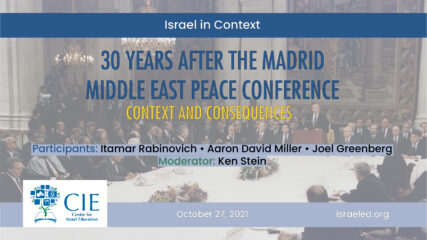
This 54-minute webinar, recorded Oct. 27, 2021, is part of the Center for Israel Education’s “Israel in Context” series and is incorporated into an extensive set of documents, study guides, videos and other resources CIE has compiled at https://israeled.org/madrid-conference/ to mark the 30th anniversary of the Madrid Middle East Peace Conference, when Israel first sat at the same table with all of its immediate Arab neighbors to talk peace.

President Biden comes to the presidency with more Washington experience than any other former president. While he has designated a foreign policy team with significant experience, his immediate priorities will be domestic. With a razor thin senate majority why would he expend political capital in trying to find solutions to Middle Eastern issues that are highly complex, seemingly intractable, and culturally embedded? The exception might be seeking to curtail Iran’s nuclear and regional aggressiveness.

CIE Founding President, Professor Ken Stein and Visiting Israeli Scholar, Dr. Nachman Shai, who served in the Israeli Parliament for 10 years, explain the context and implications of the Abraham Accords for Israel and the Middle East.

A four-person panel of journalists and scholars focuses on multiple aspects of the 2020 U.S. presidential and congressional elections in this 75-minute video recorded Sept. 3, 2020.
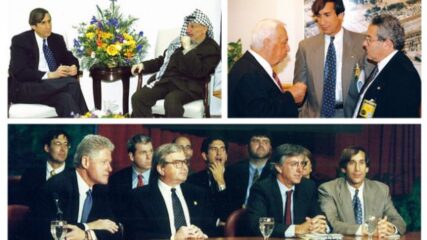
March 3, 2020 Aaron David Miller analyzes the evolving role of the United States in Middle Eastern and Israeli politics and diplomatic processes. Miller currently serves as vice president for new initiatives and a distinguished research…
The analysis summarizes the declaratory or aspirational Trump Plan for a Palestinian-Israeli settlement, outlining proposals on final status issues, and the proposed economic development package, with a hope for a two state-solution. Maps are used to show how Palestine’s and Israel’s borders have changed over the last 150 years. (Video or audio)
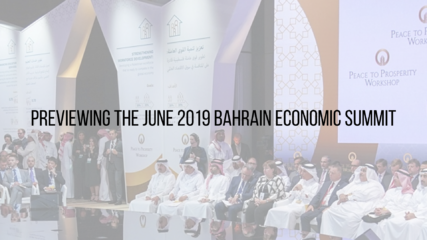
CIE President Ken Stein speaks with David Makovsky, the Ziegler distinguished fellow at the Washington Institute for Near East Policy on June 19, 2019. The major focus of the discussion was on the upcoming US led Peace to Prosperity workshop which was held in Bahrain June 25 and 26, 2019 at which Makovsky was an observer. Stein and Makovsky discuss, in-depth, the economic summit, the Trump administration’s Middle East Peace Plan, and the prospects for success.
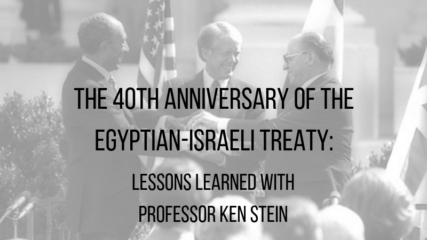
March 26, 2019 From 1967 forward, Arab-Israeli negotiations began in earnest. First under the Nixon and Ford administrations, then under the Carter administration, Egyptian President Anwar Sadat and Israeli prime ministers implemented the political trade-offs…

Professor Asher Susser describes the neighborhood of the Middle East, Arab nationalism, and the changing relationships of the region’s states with Israel.
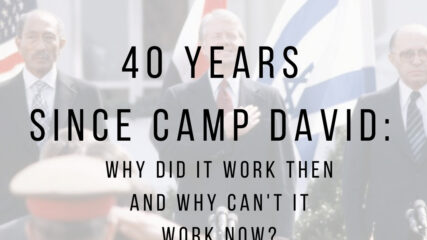
Emory Professor of Contemporary and Middle Eastern History, Political Science, and Israeli Studies and Center for Israel Education President Kenneth W. Stein applies decades of document-based research, interviews and scholarship, including new insights gleaned from the study of detailed minutes in the Israel State Archives, to examine the Camp David Accords 40 years after Egypt’s Anwar Sadat and Israel’s Menachem Begin signed the agreement Sept. 17, 1978, that concluded 13 days of negotiations led by President Jimmy Carter.
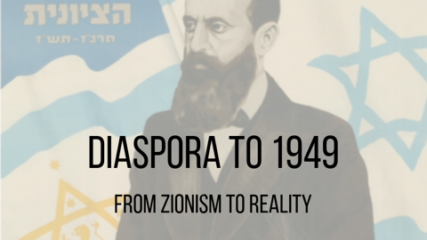
Emory Professor of Contemporary and Middle Eastern History, Political Science, and Israeli Studies and Center for Israel Education President Ken Stein outlines the history of Zionism and the British Mandate at the CIE 2018 Educator Enrichment Workshop.
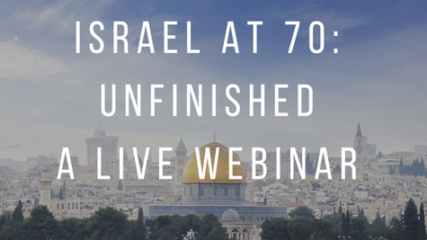
Israel is only 70 years old. It is certainly more developed and different than the US was in 1846. What are the domestic and foreign policy issues that remain open-ended? Which issues have settled into consensus acceptance? CIE President and Founder Professor Ken Stein explores these questions and more in this webinar from May 2018.
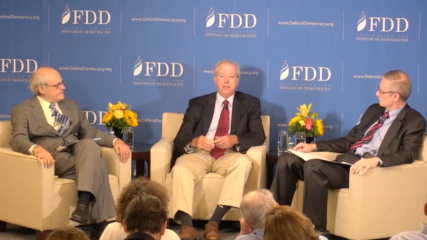
On August 15, 2016, I had the pleasure of participating in a panel discussion with former Ambassador Dennis Ross for the Foundation of Defense of Democracies (FDD) in Washington, DC.
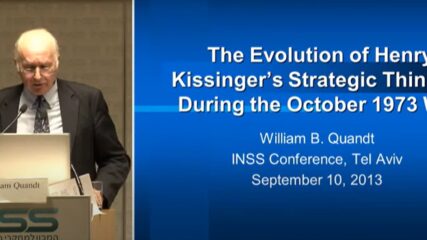
September 10, 2013 Speaker: Professor William Quandt, Professor Emeritus, University of Virginia, speaks at the “Yom Kippur War — A Launching Pad for U.S. Middle East Policy” conference, held in Tel Aviv by the Institute…
