View this article in: Spanish

February 8, 2026

By Ken Stein, Center for Israel Education

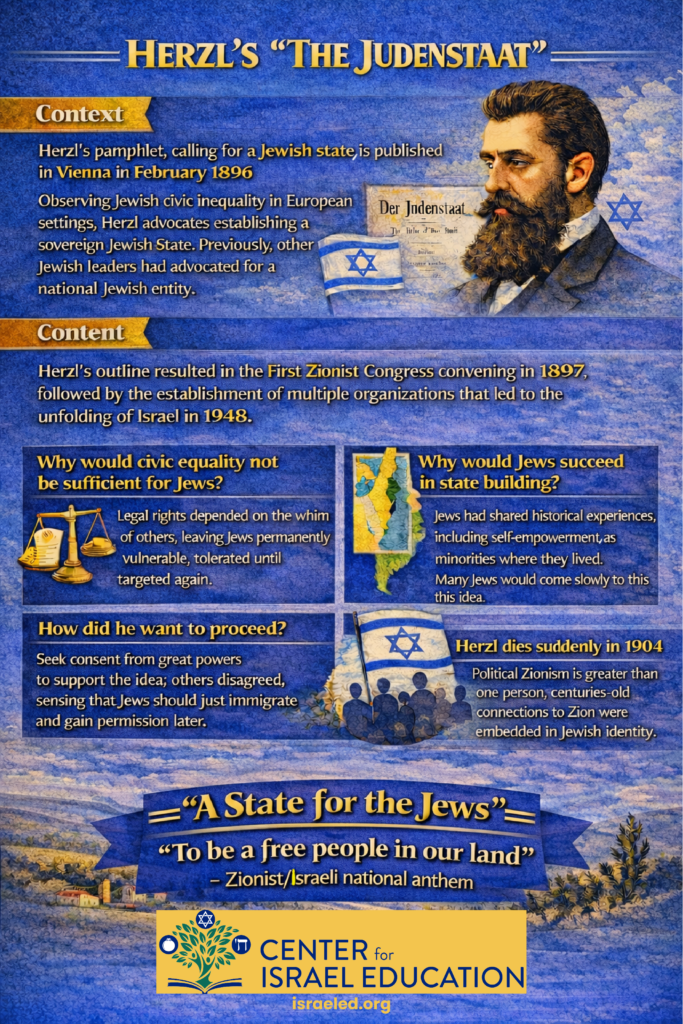
Theodor Herzl was not the first Jew to imagine a return to Jewish sovereignty, but he transformed the eternal hope of Jewish physical return to the Land of Israel and provided reason and a road map for the re-establishment of a sovereign Jewish state.

Living in late-19th-century Europe, Herzl witnessed a paradox that deeply troubled him. Some Jews were gaining legal equality, entering universities, professions and public life while sometimes limited to living in certain localities and regions. But antisemitism was not disappearing, and true Jewish entry into broader societies was delayed or denied. The antisemitism Herzl referenced was not focused on religious persecution, such as pogroms and other sporadic violence against Jews; he was vexed by the majority non-Jewish populations and their leaders sustaining the very disabilities that many said were disappearing. He was convinced that the antisemitism of unequal status necessitated the solution of Jews having their own sovereign state. Relying on the tolerance and good will of others would, he believed, forever keep Jews in an inferior status.

On February 14, 1896, he published The Jewish State, arguing that the Jews were a nation and that only a sovereign Jewish state could normalize Jewish life. He was optimistic that Jews could make that state because they shared a history and values and had exercised mutual responsibility for one another over centuries of Diaspora existence. He sensed that Jews were well prepared for collective action in forging a state, in taking this idea and turning it into reality.

Herzl in his outlook, writings and actions combined a clear-eyed assessment of Jewish vulnerability with a practical plan for launching diplomacy, organizing settlement and achieving international legitimacy. Jews, he thought, should gain permission from great powers to initiate Jewish sovereignty. Others believed it was better to start the modern Zionist political movement by just beginning immigration and creating organizations without seeking permission or sanction. Then a third group of Zionists thought it best to do both: start the state-making process while seeking sanction.

Multiple Jewish thought leaders preceded Herzl in proposing the Jewish people’s physical return to the Land of Israel. In the mid-1800s, Orthodox rabbis such as Judah Alkali and Zvi Kalischer and secular socialists such as Moses Hess crisply argued that the time had come to constitute a Jewish territory. Leon Pinsker in 1882 published Auto-Emancipation, which called for the creation of a Jewish national home. In the 1880s scattered Jews across Eastern Europe formed groups known as Hovevei Zion (“Lovers of Zion”). They promoted Jewish settlement in Eretz Yisrael and established agricultural settlements, including Rishon LeZion. Some early immigrants were supported by philanthropists, including Baron Edmond James de Rothschild and Sir Moses Montefiore.

When these ideas were offered, they were unknown to some people because of lack of proximity, and the number of Jews supporting them was small. But the dynamic of Jews moving to Eretz Yisrael was being crystallized. Herzl’s singularly precedent-setting contribution was channeling and choreographing multiple views of what modern political Zionism could be into an international political movement. He convened a series of Zionist Congresses. The first in Basel, Switzerland, in 1897 founded the Zionist Organization; subsequent congresses added the means to support re-establishing a Jewish presence in Eretz Yisrael. These new institutions included the Anglo-Palestine Bank and the Jewish National Fund. Initially, linking Jews to Eretz Yisrael was slow and often difficult, but persistence sustained a few.

Tragically, Herzl died in 1904 at the age of 44, but his ideas endured. Herzl both articulated long-suppressed aspirations by Jews and possessed the leadership and organizational ability to mobilize diverse communities and shape a dynamic, purposeful movement.


1. Why did Herzl write The Jewish State?
Herzl wrote the pamphlet to argue that antisemitism was not a temporary social problem but a permanent political condition for Jews living as a minority. He sought to convince Jews and non-Jews alike that the Jewish problem required a political solution, not just social reform or goodwill. Non-Jews, he said, would not stop disliking Jews and curbing their rights. He wrote: “Can we hope for better days, can we possess our souls in patience, can we wait in pious resignation till the princes and peoples of this earth are more mercifully disposed towards us? I say that we cannot hope for a change in our current feeling. And why not? Even if we were as near to the hearts of princes as are their other subjects, they could not protect us. They would only feel popular hatred by showing us too much favor. By ‘too much,’ I really mean less than is claimed as a right by every ordinary citizen, or by every race. The nations in whose midst Jews live are all either covertly or openly Anti-Semitic.”

2. Why did Herzl write the pamphlet in the 1890s?
The 1890s marked a moment when Jewish emancipation seemed complete in law but hollow in reality. Mass politics, nationalism and racial antisemitism were intensifying, convincing Herzl that delay would only worsen Jewish insecurity. Herzl had neither a remarkably profound nor distant relationship to Judaism. For him, the moment crystallized a whole series of disabilities experienced by Jews. He wrote: “No one can deny the gravity of the situation of the Jews. Wherever they live in perceptible numbers, they are more or less persecuted. Their equality before the law, granted by statute, has become practically a dead letter. They are debarred from filling even moderately high positions, either in the army, or in any public or private capacity.

“Attacks in Parliaments, in assemblies, in the press, in the pulpit, in the street, on journey — for example, their exclusion from certain hotels, even in places of recreation — become daily more numerous. The forms of persecution vary according to the countries and social circles in which they occur. In Russia, imposts are levied on Jewish villages; in Romania, a few persons are put to death; in Germany, they get a good beating occasionally; in Austria, Anti-Semites exercise terrorism over all public life; in Algeria, there are traveling agitators; in Paris, the Jews are shut out of the so-called best social circles and excluded from clubs. Shades of anti-Jewish feeling are innumerable.”

3. Why did Herzl, an assimilated and nonobservant Jew, believe antisemitism had reached new heights?
Herzl saw antisemitism as not solely of religious origin. He viewed it as the denial to Jews of rights and privileges and noted that antisemitism happened even when Jews were patriotic, educated and assimilated. He became convinced that prejudice was rooted not in Jewish behavior, but in Jewish statelessness. He wrote: “When civilized nations awoke to the inhumanity of discriminatory legislation and enfranchised us, our enfranchisement came too late. It was no longer possible to remove our disabilities in our old homes.”

4. Why did Herzl think civic equality in Europe and the Mediterranean world was insufficient?
Legal rights depended on the goodwill of governments and majorities that could revoke them. Herzl believed that equality without sovereignty left Jews permanently vulnerable. He wrote: “We might perhaps be able to merge ourselves entirely into surrounding races if these were to leave us in peace for a period of two generations. But they will not leave us in peace. For a little period they manage to tolerate us, and then their hostility breaks out again and again.”

5. What benefits did Herzl believe a sovereign Jewish state could provide to others?
Herzl argued that only a state could provide Jews with security, dignity and normal political existence, enabling them to shape their own future. He wrote: “If given a chance, Jews could offer enormous advantages, assume part of the public debt, build new roads for traffic, which our presence in the country would render necessary, and do many other things. The creation of our State would be beneficial to adjacent countries, because the cultivation of a strip of land increases the value of its surrounding districts in innumerable ways.”

6. Why did Herzl believe that Jews could build a state together?
Centuries of shared history, ethical traditions, communal institutions and mutual aid had trained Jews in collective responsibility and organization. He also believed that countries that found a domestic Jewish presence intolerable would not stand in the way of Jews slowly attaining a state. He wrote, “The Governments of all countries scourged by Anti-Semitism will be keenly interested in assisting us to obtain the sovereignty we want.”

7. What concrete plan did Herzl propose beyond diagnosing Jewish insecurity?
Herzl outlined diplomatic engagement with great powers and organized Jewish migration, land purchase and economic planning to ensure legitimacy and sustainability. He wrote: “The plan, simple in design, but complicated in execution, will be carried out by two agencies: The Society of Jews and the Jewish Company. The Society of Jews will do the preparatory work in the domains of science and politics, which the Jewish Company will afterwards apply practically. The Jewish Company will be the liquidating agent of the business interests of departing Jews, and will organize commerce and trade in the new country.”

8. How did Herzl view the role of great powers in assisting the building of a Jewish sovereign state?
Herzl believed that Jews should gain sanction to build their state. He sought a charter to do so from the Ottoman sultan but failed. The charter Herzl sought came in the 1917 Balfour Declaration, which was added word for word in the League of Nations document setting up British governance in Palestine in 1922. He wrote: “Should the Powers declare themselves willing to admit our sovereignty over a neutral piece of land, then the Society will enter into negotiations for the possession of this land. Here two territories come under consideration, Palestine and Argentina. In both countries important experiments in colonization have been made, though on the mistaken principle of a gradual infiltration of Jews. The infiltration is bound to end badly. It continues till the inevitable moment when the native population feels itself threatened, and forces the Government to stop a further influx of Jews. Immigration is consequently futile unless we have the sovereign right to continue such immigration.”

As noted above, well before Herzl published The Jewish State in 1896 and convened the First Zionist Congress in 1897, Jews immigrated to Palestine without the permission of the Ottoman sultan and against the will of his government. From 1882 to 1917, the Jewish population in Palestine increased from 24,000 to some 60,000. It expanded to 400,000 before the outbreak of World War II and to 650,000 when Israel declared independence in 1948. Notably, Jews by 1917 had purchased from Arabs one-quarter of all the land they would acquire by 1948.

9. Why did Herzl’s ideas survive and grow after his early death?
His vision gave political form to long-standing Jewish hopes. Moreover, hundreds of Jewish leaders picked up the idea torch that he lighted. Those ideas had smoldered for generations before Herzl. Jewish identity from its ancient, biblical origins had revolved about a body of laws, ethics, values, lifecycle events, communal caring and a calendar of religious observances focused on Jerusalem. Herzl was a disciplined organizer, a fine choreographer and a charismatic orator. Most of his contemporary Jews did not choose his socio-political movement; most who left the zones of anti-Jewish hostilities found refuge where liberty and freedom were already practiced, such as the Americas. The few Jews who ignited political Zionism did it steadily but not in great numbers. Eventually, Jews who chose Cape Town, Buenos Aires, Boston, Philadelphia and other places across the globe embraced the notion that Jews should have a sovereign state of their own.

Suggested Readings