December 4, 2025

Source (Hebrew): Conference of the Association for Public Law, https://www.maariv.co.il/news/law/article-1259010

Introduction

Aharon Barak argues in a speech to the Israeli Association for Public Law’s conference in Haifa that Israeli democracy is being hollowed out by a dangerous redefinition of democracy as mere majority rule. True democracy, he insists, rests on two equal pillars: free elections and the rule of liberal values, including human rights, separation of powers, judicial independence and the rule of law. He warns that safeguards are collapsing as the prime minister increasingly controls the Cabinet, the government dominates the Knesset, and both seek to subordinate the courts by politicizing judicial appointments and delegitimizing judges.

Administrative law, once a barrier to arbitrary power, is being stripped away in favor of unchecked ministerial authority. Gatekeepers such as the attorney general are under attack, while polarization, discrimination and erosion of shared civic norms weaken the social contract. The result is a drift toward authoritarianism masked by elections. Barak warns that only an engaged public, through free media, civil society, protest and elections, can halt this democratic decay and restore Israel’s constitutional foundations.

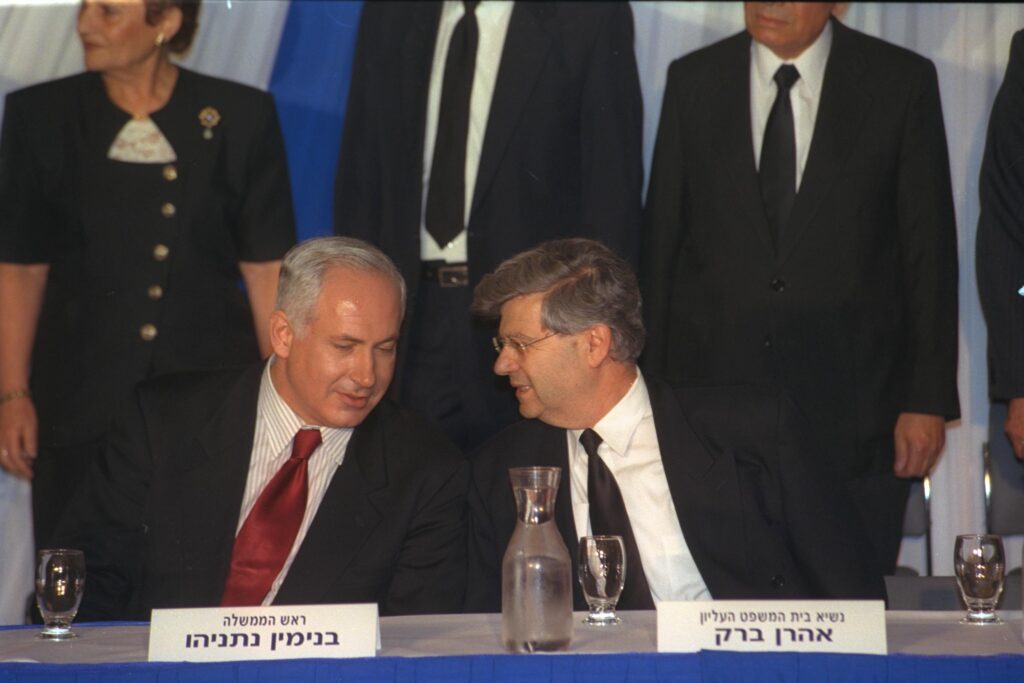
Barak earned an extraordinary career in law and public service. He was Israel’s attorney general in the 1970s and the president of the Supreme Court from 1995 to 2006, when he engineered the furthest-reaching judicial transformation in Israel’s history. At the Egyptian-Israeli negotiations at Camp David, Barak was a key adviser to Prime Minister Menachem Begin. Barak’s notes from the last night of those meetings in September 1978 showed that Begin did not promise to halt all settlements for the duration of Palestinian autonomy negotiations, as Jimmy Carter and Zbigniew Brzezinski claimed. Barak reaffirmed the absolute accuracy of those notes with Carter present at a 2003 conference.

During the rancorous debate about judicial overhaul in early 2023, an effort to place judicial decisions under the purview of the sitting government and thereby reduce its institutional independence from the influence of the sitting prime minister, Barak was a vocal critic of the government. His central belief is that democracy is not simply majority rule, but a system of protected values enforced by the courts. In his formulation, “the world is filled with law,” meaning that every government action is subject to judicial review.

The fierce Israeli judicial overhaul battles since early 2023 were a political reckoning of sorts for Barak’s legal revolution. Israeli politicians weighed in on the pace and content of the proposed judicial overhaul, including Prime Minister Benjamin Netanyahu, Defense Minister Yoav Gallant, President Isaac Herzog and 18 retired Israelis Supreme Court judges.

Barak relied on two 1992 Basic Laws — Human Dignity and Liberty and Freedom of Occupation — to declare that Israel had effectively adopted a constitutional bill of rights, even without a formal constitution or public referendum. He asserted that the Supreme Court could invalidate Knesset legislation that violated these Basic Laws. This move became known as Israel’s “constitutional revolution.”

Barak also dramatically expanded the doctrine of “reasonableness,” allowing judges to strike down ministerial and military decisions not because they were illegal, but because judges found them substantively unreasonable. This doctrine empowered courts to override Cabinet appointments, security judgments and public policy choices.

Because Israel lacks a written constitution, federalism, an independently elected executive or a second legislative chamber, Barak’s doctrine gave extraordinary power to a small group of unelected judges over the elected Knesset. Supporters viewed this judicial review as essential to protect civil liberties. Critics saw it as a shift from popular sovereignty to judicial supremacy. The Netanyahu government challenged if not attacked that perceived power when it came to office at the end of 2022. Some saw Netanyahu’s effort to undermine the independence of the judiciary as an attempt to neuter the judicial system amid his personal legal battles against corruption charges. (See “Context and Consequences of Israel’s Proposed Judicial Overhaul,” March 2023.)

— Ken Stein, January 7, 2026

Ask a person on the street, “What is democracy?” In most cases, the answer you will get is “Democracy is elections” or “Democracy is the rule of the majority.” This is certainly what the coalition thinks, and this is certainly how the government and its head think.

But no. Democracy is not just elections, and it is not just the rule of the majority. Democracy, as we understand today, has two pillars. The first pillar is the rule of the people. It is realized by electing representatives in a decent, egalitarian and secret way. Some call this the formal aspect of democracy. The second pillar is the rule of values, including human rights, the separation of powers, the rule of law and the independence of the judiciary. Some call this the substantive aspect of democracy.

Both aspects, formal and substantive, are essential for democracy. Without them, democracy will cease to be a true democracy. Indeed, there is a close connection between the formal aspect and the substantive aspect of democracy. There are no elections without equality. The elections should be held against the backdrop of information from members of society about the problems that characterize it and against the background of public debate before elections.

I repeat to you what is understood and known to each of you. I do this in order to point out that essential aspects of Israeli democracy are under severe attack. For this must be remembered: Democracy does not become a dictatorship overnight. Democracy is weakening, and significant aspects of it are disappearing. What are these characteristics, why are they under attack, and what can be done to stop the deterioration of our democracy?

The separation of powers is essential for democracy. Without a separation of powers, one branch — first and foremost the executive branch — may take over and take all the power into its own hands. There is a tapestry of mechanisms designed to prevent abuse of power by one of the authorities. The modern understanding of the separation of powers, in contrast to its historical understanding since the days of Montesquieu, sees the separation of powers as a requirement of checks and balances.

According to this approach, there are three governmental branches: the legislature, the executive branch and the judiciary. There must be checks between these authorities and especially subordination to the law so that no authority can do whatever it wants. The government is not omnipotent. It must act in accordance with the Basic Laws, the Knesset laws and the rulings of the courts. The Knesset is also incapacitated, and it must act in accordance with the Basic Laws and the rulings of the courts. And, of course, the court is also not omnipotent since it is limited in its powers by laws and Basic Laws.

There has to be a balance among the three branches. The government falls when it does not have the confidence of the Knesset and when the opposition can present a government that enjoys the confidence of the Knesset. The Knesset dissolves when the prime minister resigns. The judges are selected by an appointments committee in which the other two governmental authorities are also represented. The principle of separation of powers, which expresses checks and balances, has suffered in Israel since the establishment of the state. This principle has completely collapsed these days.

This is expressed by a number of phenomena:

  1. The Knesset has stopped criticizing the government. The government controls the Knesset. Our relative electoral system, coalition discipline and the coalition regime that grants relatively large power to minority groups — all of these have led to the government’s takeover of the Knesset and the Knesset’s legislation. Thus, for example, the government determines, in practice, the composition of the Knesset committees. If the chairman of the committee or a member of Knesset acts independently in the Knesset, the government can replace him with another or arrange for the establishment of a new committee headed by a Knesset member acting in accordance with its instructions. The people elected the Knesset, but the government controls the Knesset. One can count on the fingers of one hand the cases in which a Knesset member from the coalition recently expressed a political position contrary to the government’s position or voted together with the opposition.
  2. The prime minister controls the members of the government. Menachem Begin would say that as prime minister he is first among equals. He explained: “They see me as the first, and I see them as equal to me.” Those days have passed. Today’s prime minister sees himself first, and he doesn’t see the ministers as his equals. In his view, he is the one who appoints them, and he has the ability to fire them. In practice, government decisions are usually the prime minister’s decisions, to which the government’s consent is routinely given. For example, although a number of ministers expressed a position in support of the establishment of a state commission of inquiry under the existing law, the prime minister decided otherwise, and all the ministers aligned themselves with this decision.
  3. When we combine the two phenomena that I discussed — the government’s takeover of the Knesset and the prime minister’s takeover of the government — we reach the bottom of our deterioration, that is, to an authoritarian regime of a single government. The prime minister, who controls the government, which controls the Knesset, actually rules the country alone.
  4. The party that can ostensibly prevent this phenomenon is the judiciary. This is its role. It must ensure that the executive and legislative branches act within the framework of their authority and do not deviate from them. The role of the judges is, among other things, to protect democracy. The Knesset, the government and the prime minister know this. What do they do in this state of things? They are looking for ways to take over the judges and appoint “our own” judges. In this way, the personal and institutional independence of the judges is severely impaired.

The government does this in different ways. For example, they are changing the method of appointing judges, mainly to the Supreme Court. In the new system, the politicians appointed the judges. And according to the Israeli reality that I have discussed, at the end of the day, the person who can appoint the judges as he wishes is the prime minister, and the judges who will be appointed will be as expected — the judges who will implement the interests of the government.

Government ministers are showing contempt for the judiciary. There are calls not to uphold court rulings, attacks on judges and consistent delegitimization of the judiciary. By virtue of the court’s very nature as a body that protects human rights, the individual and the minority from the decisions of the majority, it is in constant tension with the other authorities. This is a healthy and desirable tension on which democracy is based. All authorities are responsible for ensuring that tension continues to be healthy and that there is dialogue between the authorities. Today there is no dialogue. There is a monologue, and there is a breaking of tools.

The judiciary has a president. He was elected according to the law. Harming him is an injury to the entire judiciary. If so, let us hurt him. We will not call him “The President” Amit, but “The Judge” Amit. As far as the government is concerned, the court has no president, and the judiciary has no head. And whoever calls himself president is, according to her, a leftist whose objectivity is not to be believed. In any case, he should not be relied upon in his activities as president. Therefore, his authority to appoint members of the state Commission of Inquiry should not be recognized.

To Yitzhak Amit, I say: Be strong and courageous. Don’t give up. You are the president of the Supreme Court, and we have full confidence in you as a judge and as president.

The destruction of the principle of separation of powers, and the violation of the independence of the judiciary, has negative effects on the other components of democracy. Thus, for example, in a democracy, the executive branch, the government, is the trustee of the public. The government must act for the benefit of the public. The man in power must act — and this is what I wrote in one of the rulings — “fairly, honestly, out of only relevant considerations and reasonableness.” On this basis, we will build our entire administrative law, which determines the way administrative power is exercised.

All of these have disappeared and are no longer. The only question of interest to the ministers is the formal question of whether the law granted them authority. Once the authority has been given, they can exercise it as they wish. They claim that they have absolute discretion, a claim that was rejected by the Supreme Court 60 years ago.

In a democratic state, no authority has absolute discretion. Administrative law, one of the masterpieces of Israeli public law, no longer exists, and all that remains is the question of formal authority. For example, the justice minister does not convene the committee for the appointment of judges to the Supreme Court as long as he is not convinced that it will appoint the appointments he wants. As far as the current government is concerned, administrative law is part of the “deep state” that must be fought.

At the base of democracy is the individual, the person. His rights are protected by the independent court. It is the fortress of the individual. When the court is “our own,” there will be no protection of the individual’s rights. The rule of the majority may become the tyranny of the majority.

The gatekeepers: The attorney general and the system of legal advisers in government ministries are another critical pillar in democracy. They are the defenders of public interest. They are the gatekeepers, and they must ensure that the rules of administrative and constitutional law are upheld and that the law is not trampled upon. The current government is working to enact laws that will dismantle the role of the attorney general and the independence of the legal advisers in government ministries, and the government is undermining the role of the attorney general.

The government tried to fire the attorney general in an illegal proceeding and elect an attorney general who is “one of them.” To this end, not only the Supreme Court but also the legal adviser to the government, which is also one of the most prestigious institutions of the Israeli legal system, was destroyed.

As long as this process of destruction is not over, they will make life miserable for the attorney general, Gali Baharav-Miara, who stands at the guard of our democracy. Stand firm on the guard of our democratic life, continue as you are doing today. Where would we be without you?

Polarization: In a general view of Israeli society today, in my opinion, it is characterized by a deep rift. We no longer listen to the position of others. The identity of the claimant is sufficient to reject his arguments. The public debate is no longer relevant. Polarization is dangerous for democracy. It increases the tension between the authorities and intensifies the feeling of a zero-sum game, where one wins, the other loses. There is a strong belief that the success of one depends on the loss of the other. Polarization disrupts the possibility of reaching consensus decisions. A polarized society is a society that loses its resilience to deal with threats.

Violation of the social contract: The social contract that has been the foundation of the state since its establishment has been violated. At the foundation of the social contract is the concept that citizens give the power to the ruler to protect them and act for the common good. In our reality, there is a clear statement that the rulers are acting in favor of sectoral interests. The social contract is also a series of agreements, norms, ways of conduct and legal customs that allow us to live together. It is the understanding that living in society is always a concession and negotiation, all of which are trampled violently.

The Declaration of Independence no longer expresses our shared values. Our Arab citizens, who according to the Declaration of Independence are entitled to full and equal citizenship, are discriminated against and exposed to bullying that the police for some reason are unable to eradicate. Israeli statehood is perceived by the prime minister as a “deep state” that must be fought.

Statehood and unity were replaced by partisanship and separatism. The equality of the burden of war has been replaced by the political deal that perpetuates the distinction between blood and blood and frees an entire population of ultra-Orthodox, even if their Torah is not their art, from the obligation to bear the burden. We are no longer a state whose values are Jewish and democratic values.

The relationship between the political echelon and the army, the police and the Shin Bet has completely gone wrong. The prime minister considers himself authorized to instruct the executive echelon on how he should act in each of the arenas. The demonstrators are treated as criminals. I think that we are no longer citizens, but subjects. The courtroom became a square for a demonstration. The distance between a demonstration in the courtroom and an outburst in the courthouse and the judges’ chambers is not great.

In a democratic country, free media of various shades are an extremely important role. I see great danger in the various proposals to shut down the media or take over them. We are on a slope, and we are no longer the same democracy we were in the past.

I noted a long list of actions that deteriorate our society and undermine our democracy. I think there’s a strategy here, a flood strategy. The defenders of democracy build a dam in one place, plug a hole — in the High Court, in the revocation of an appointment, in an investigation of the police investigations department — but there are endless holes. This is a policy that ultimately exhausts the public and the gatekeepers and undermines their ability to defend democracy.

Can this deterioration be stopped? Can we defend our fragile democracy? I know that this question bothers us all.

In my opinion, it is possible to stop our deterioration from substantive democracy to formal democracy, from liberal democracy to a different kind of regime. The ones who can do this are the people. The court, with its own powers, will not be able to prevent our deterioration over time. The court will not be able to defend the Declaration of Independence and our social contract if the people do not want them.

But the people can stop the deterioration. The people can do so through lively public discourse, in civil organizations, in demonstrations. It is important that the people protect the court and the gatekeepers. It is important that the media discuss substantive issues from a broad perspective. It is important that the parties running in the elections pledge to stop the regime’s coup and act to repeal laws and arrangements that harm democracy.

They must commit to protecting the court, the judicial system and the gatekeepers. They must commit to acting in accordance with the rules of administrative law and to ensure a proper balance of the basic principles of the state as Jewish and democratic and to complete the constitutional project to fortify our constitutional structure. This will fulfill the promise made in the Declaration of Independence to establish a constitution.

And, of course, the people will be able to do so in general, egalitarian and secret elections. And we — each of us — will work in his own field to re-establish our social contract, which is based on the Declaration of Independence and the values of a Jewish and democratic state, and the statehood that characterized us.