March 12, 1979

Source: https://www.presidency.ucsb.edu/documents/jerusalem-israel-address-before-the-knesset

Against the advice of close political confidants, President Jimmy Carter remained determined not to let the chance of an Egyptian-Israeli peace treaty slip away, and he traveled to Egypt and Israel in early March 1979. Carter had invested enormous time since mid-1977 in trying to ignite general Arab-Israeli negotiations; when that failed, he focused on securing an Egyptian-Israeli treaty rather than the comprehensive peace that had desperately sought.

In the memoir Keeping Faith, Carter acknowledged that this visit was “an act of desperation.” Numerous outstanding issues separated Egypt and Israel. Israel insisted that a treaty would supersede all commitments Egypt had with other Arab states, including the 1950 collective Arab defense agreement that said that one Arab country would come to the aid of another if attacked. Carter remembered that Israeli Prime Minister Menachem Begin was under enormous domestic pressure from his own political allies (Arik Sharon and Yitzhak Shamir) not to sign a treaty with Egypt under which Israel would return the Sinai Peninsula, that large buffer between Israel and the Suez Canal to Egypt.

Counterbalancing Sharon, Shamir and others in opposing a treaty, Foreign Minister Moshe Dayan was instrumental in persuading Begin to sign the treaty. Dayan argued that if Israel blocked a treaty, the United States would reinterpret Israel — not Egypt — as the obstacle to peace. Moreover, Dayan said, Israel could lose important diplomatic cover across the globe and at the United Nations, and U.S. strategic support for Israel would deteriorate while the Cold War continued in the Middle East and elsewhere. Dayan was keenly aware that two months earlier the Shah of Iran had fallen from power, likely replaced by a cleric, Ayatollah Khomeini, whom Israeli intelligence sources identified as a rising enemy of Israel and the Jewish people. And Dayan told Begin that any move toward greater regional peace between Israel and Arab states would have to rest on an Israeli treaty with Egypt, even if it that relationship turned out to be a cold peace, as it did.

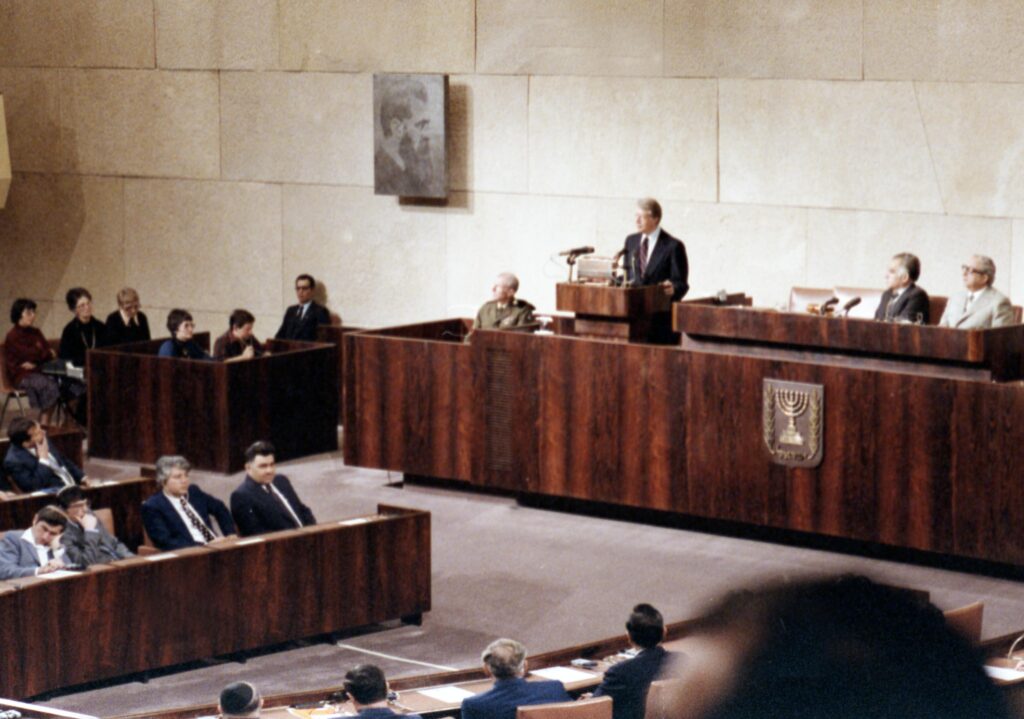
Carter’s speech to the Knesset, the first address by a U.S. president to the Israeli parliament, framed the moment as one of “concern and caution and hope.” He praised Israel’s democratic character, the shared values binding Israel and the United States, and the enormous risks Israelis and Egyptians had taken since Egyptian President Anwar Sadat’s 1977 Jerusalem visit and the 1978 Camp David Accords.

Carter emphasized that both countries yearned for a peace that was real rather than symbolic. He urged Israelis to seize this unique opportunity and acknowledged that no treaty could satisfy every national aim but could protect the vital interests of both sides far better than continued conflict. He reassured Israel of America’s “indestructible” partnership, pledging economic, military and political support, including guarantees for oil supplies and assistance with security burdens arising from territorial withdrawal.

Carter stressed that peace with Egypt could open doors to broader regional reconciliation, including with Palestinians, and insisted the United States would never back any arrangement jeopardizing Israel’s security. He concluded by quoting biblical passages and calling on Israelis to act with courage and realism to transform the dream of peace into lasting reality.

Sadat, Begin and Carter signed the Egyptian-Israel peace treaty March 26, 1979. As Dayan predicted, it became the cornerstone for other Arab states to recognize Israel, including the 1994 Jordanian-Israeli treaty and the 2020 Abraham Accords between Israel and four Arab states.

— Ken Stein, December 7, 2025


The president spoke at 12:16 p.m. in the Knesset chamber. In his opening remarks, he referred to Yitzhak Shamir, the speaker of the Knesset.

Before his address, the president placed a wreath at the Knesset Memorial, a sculpture with an eternal flame dedicated to soldiers and civilians who gave their lives for Israel.

After his address, the president attended a luncheon with members of the Foreign Affairs Committee of the Knesset, then returned to the King David Hotel.

In the evening, the president and Rosalynn Carter, accompanied by Deputy Prime Minister Yigael Yidin, went to the Shrine of the Book, a part of the Israel Museum, to view the Dead Sea Scrolls.

Earlier in the day, the president attended a breakfast meeting with Prime Minister Menachem Begin and members of the Israeli Cabinet at the prime minister’s residence.

Mr. President, Mr. Prime Minister, Mr. Speaker, distinguished members of the Knesset, and friends:

For the last 24 hours, I have been writing different versions of this speech. I have discarded the speech of despair; I have discarded the speech of glad tidings and celebration. I have decided to deliver the speech of concern and caution and hope.

I’m honored to stand in this assembly of free men and women, which represents a great and an ancient people, a young and a courageous nation.

I bring with me the best wishes and the greetings of the people of the United States of America, who share with the people of Israel the love of liberty, of justice and of peace. And I’m honored to be in Jerusalem, this holy city, described by Isaiah as a quiet habitation in which for so many of the human race the cause of brotherhood and peace are enshrined.

I am here in a cause of brotherhood and of peace. I’ve come to Cairo and also here to Jerusalem to try to enhance the bold, brave and historic efforts of President Sadat and Prime Minister Begin and to demonstrate that the United States of America is as determined as these two leaders are to create lasting peace and friendship between Egypt and Israel and to put an end to war and the threat of war throughout the Middle East.

No people desire or deserve peace more than the Jewish people. None have wanted it so long. None have spoken of it more eloquently. None have suffered so much from the absence of peace. Pogrom after pogrom, war after war, Israel has buried its sons and its daughters.

Yesterday morning at Yad Vashem, I grieved in the presence of terrible reminders of the agony and the horror of the Holocaust.

Modern Israel came into being in the wake of that historic crime, the enormity of which is almost beyond human comprehension. I know that Israel is committed and determined, above all, that nothing like it must ever, ever be permitted to happen again on Earth.

Americans respect that determination, and we fully share that determination with you. And Americans recognize that for Jews over the centuries, as for Israel since its independence, caution and wariness have been a practical and a moral necessity for survival. And yet, in these past months, you’ve made enormous sacrifices, and you’ve taken great risks for peace.

This sacred dedication to peace, born and fostered in Jerusalem and in Cairo, has given to men and women everywhere renewed sense of hope that human reason, good will and faith can succeed, can break down barriers between peoples who in our lifetimes have only known war.

As Prime Minister Begin said after the Camp David summit, the agreements reached there proved that any problem can be solved if there is some — and he repeated, just some — wisdom. Those are truthful and also reassuring words. I know from my intense, personal involvement in these negotiations that President Sadat and Prime Minister Begin have not wavered from their often-expressed commitment to peace.

President Sadat told me in Cairo that he will let nothing stand in the way of our shared goal of finishing the treaty of peace between Israel and Egypt and of making it a living testament of friendship between the two neighboring peoples. I believe him, and I know in my heart that Prime Minister Begin and the government of Israel are no less fervently committed to the same noble objective.

But we’ve not yet fully met our challenge. Despite our unflagging determination, despite the extraordinary progress of the past six months, we still fall short. It’s now the somber responsibility of us all to exert our energies and our imaginations once again to contemplate the tragedy of failure and the legitimate exultation if we bring peace.

In this effort, the support of the members of the Knesset will obviously be crucial. Our vision must be as great as our goal. Wisdom and courage are required of us all, and so, too, are practicality and realism. We must not lose this moment. We must pray as if everything depended on God, and we must act as if everything depends on ourselves.

What kind of peace do we seek? Spinoza said that peace is not an absence of war; it is a virtue, a state of mind, a disposition for benevolence, for confidence, for justice. Americans share that vision and will stand beside Israel to be sure that that vision is fulfilled.

In Egypt, I saw vivid evidence of this deep longing for peace among the Egyptian people, millions of them. But, like you, they worry about the uncertainties of that first crucial stage in the broad task of pounding Middle East swords into plowshares. Like you, they hope to banish forever the enmity that has existed between the neighbors, the permanent neighbors of Egypt and of Israel. Like you, they want this peace, and, like you, they want it to be real and not just a sham peace.

My friends, from my own experience as president of the United States, I understand all too well that historic decisions are seldom easy, seldom without pain. Benjamin Franklin, who negotiated the treaty of peace between England and America after our own War of Independence, once said that he had never seen a peace made, even the most advantageous, that was not censured as inadequate.

Throughout the peace process, both Israel and Egypt have understood that no treaty can embody every aim of both nations. What a treaty can do, what it can do far better than the fragile status quo and infinitely better than the insidious tensions that will build if our efforts are further stalled or fail, is to protect the vital interests of both Israel and Egypt and open up the possibility of peace for all the states and all the peoples of this troubled region.

Doubts are the stuff of great decisions, but so are dreams. We are now at the very edge of turning Israel’s eternal dream of peace into reality. I will not pretend that this reality will be free from further challenges. It will not. And better than most, the Jewish people know that life is seldom easy. But we must make this beginning. We must seize this precious opportunity.

Fifty-seven years ago, the Congress of the United States of America committed itself to a Jewish homeland. Twenty-six years later, President Harry Truman recognized the new State of Israel 11 minutes after your nation was born. Seven presidents have believed and demonstrated that America’s relationship with Israel is more than just a special relationship. It has been and it is a unique relationship. And it’s a relationship which is indestructible because it is rooted in the consciousness and the morals and the religion and the beliefs of the American people themselves.

Let me repeat what I said to Prime Minister Begin last year on the lawn of the White House on the anniversary of the founding of the modern State of Israel, and I quote: “For 30 years we have stood at the side of the proud and independent nation of Israel. I can say without reservation, as president of the United States, that we will continue to do so, not just for another 30 years, but forever.”

We recognize the advantages to the United States of this partnership. You know that America deeply desires peace between Israel and Egypt and that we will do everything we can to make peace possible.

The people of the two nations are ready now for peace. The people of the two nations are ready now for peace. The leaders have not yet proven that we are also ready for peace, enough to take a chance. We must persevere. But with or without a peace treaty, the United States will always be at Israel’s side.

Meeting in this hall of liberty reminds us that we are bound more than in any other way by instinctive, common ideals and common commitments and beliefs. This Knesset itself is a temple to the principle and the practice of open debate. Democracy is an essential element to the very nationhood of Israel, as it is to the United States.

You’ve proven that democracy can be a stable form of government in a nation of great diversity and in a time and a place of danger and instability. But Israel and the United States were shaped by pioneers — my nation is also a nation of immigrants and refugees — by peoples gathered in both nations from many lands, by dreamers who, and I quote, “by the work of their hands and the sweat of their brows” transformed their dreams into the reality of nationhood.

We share the heritage of the Bible, the worship of God, of individual freedom, and we share a belief in cooperative endeavor, even in the face of apparently insurmountable obstacles.

In nations around the world where governments deny these values, millions look to us to uphold the right to freedom of speech, freedom of the press, the right to emigrate, the right to express one’s political views, the right to move from one place to another, the right for families to be reunited, the right to a decent standard of material life.

These are the kinds of unbreakable ties that bind Israel and the United States together. These are the values that we offer to the whole world. Our mutual dedication to these ideals is an indispensable resource in our search for peace.

The treaty between Egypt and Israel that we hope may be placed before you for approval promises to be the cornerstone of a comprehensive structure of peace for this entire region.

We all recognize that this structure will be incomplete until the peace can be extended to include all the people who have been involved in the conflict. I know and I understand the concerns you feel as you consider the magnitude of the choices that will remain to be faced even after a peace treaty is concluded between Israel and Egypt. And as the time for these choices approaches, remember this pledge that I make to you again today: The United States will never support any agreement or any action that places Israel’s security in jeopardy.

We must proceed with due caution. I understand that. But we must proceed.

As recently as two years ago, after all, these present steps that have already been taken seemed absolutely unthinkable. We know that confrontation magnifies differences. But the process of negotiation circumscribes differences, defines the differences, isolates them from the larger regions of common interests and so makes the gaps which do exist more bridgeable. We’ve seen the proof of that in the last 16 months.

At Camp David, Prime Minister Begin and President Sadat forged two frameworks for the building of that comprehensive peace. The genius of that accomplishment is that negotiations under these frameworks can go forward independently of each other without destroying the obvious relationship between them.

They are designed to be mutually reinforcing, with the intrinsic flexibility necessary to promote the comprehensive peace that we all desire. Both will be fulfilled only when others of your Arab neighbors follow the visionary example of President Sadat, when they put ancient animosities behind them and agree to negotiate as you desire, as you’ve already done with President Sadat, an honorable solution to the differences between you.

It’s important that the door be kept open to all the parties to the conflict, including the Palestinians, with whom, above all, Israel shares a common interest in living in peace and living with mutual respect.

Peace in the Middle East, always important to the security of the entire region, in recent weeks has become an even more urgent concern.

Israel’s security will rest not only on how the negotiations affect the situation on your own borders, but also on how it affects the forces of stability and moderation beyond your borders.

I’m convinced that nothing can do more to create a hospitable atmosphere for those more distant forces in the long run than an equitable peace treaty between Israel and Egypt.

The risks of peace between you and your Egyptian neighbors are real. But America is ready to reduce any risks and to balance them within the bounds of our strength and our influence.

I came to Israel representing the most powerful country on Earth. And I can assure you that the United States intends to use that power in the pursuit of a stable and a peaceful Middle East.

We’ve been centrally involved in this region, and we will stay involved politically, economically and militarily. We will stand by our friends. We are ready to place our strength at Israel’s side when you want it to ensure Israel’s security and well-being.

We know Israel’s concern about many issues. We know your concern for an adequate oil supply. In the context of peace, we are ready to guarantee that supply. I’ve recommitted our nation publicly to this commitment, as you know, only in recent days in my own country.

We know Israel’s concern that the price of peace with Egypt will exacerbate an already difficult economic situation and make it more difficult to meet your country’s essential security requirements. In the context of peace, we are prepared to see Israel’s economic and military relationship with the United States take on new and strong and more meaningful dimensions even than already exist.

We will work not only to attain peace, but to maintain peace, recognizing that it’s a permanent challenge of our time.

We will rededicate ourselves to the ideals that our peoples share. These ideals are of course not only of our strength, but of our self-respect as nations, as leaders and as individuals.

I’m here today to reaffirm that the United States will always recognize, appreciate and honor the mutual advantages of the strength and security of Israel. And I’m here to express my most heartfelt and passionate hope that we may work together successfully to make this peace.

The Midrash tells us that, and I quote, “Peace is the wisp of straw that binds together the sheaf of blessings.” But the wisp of straw, we know, is fragile and easily broken.

Let us pray God to guide our hand. Millions of men, women and children, in Israel and Egypt and beyond, in this generation and in generations to come, are relying on our skill and relying on our faith.

In the words of a Sabbath prayer, “May He who causes peace to reign in the high heavens let peace descend on us, on all Israel, and on all the world.”