December 18, 2025
Source: https://www.congress.gov/bill/119th-congress/senate-bill/1071
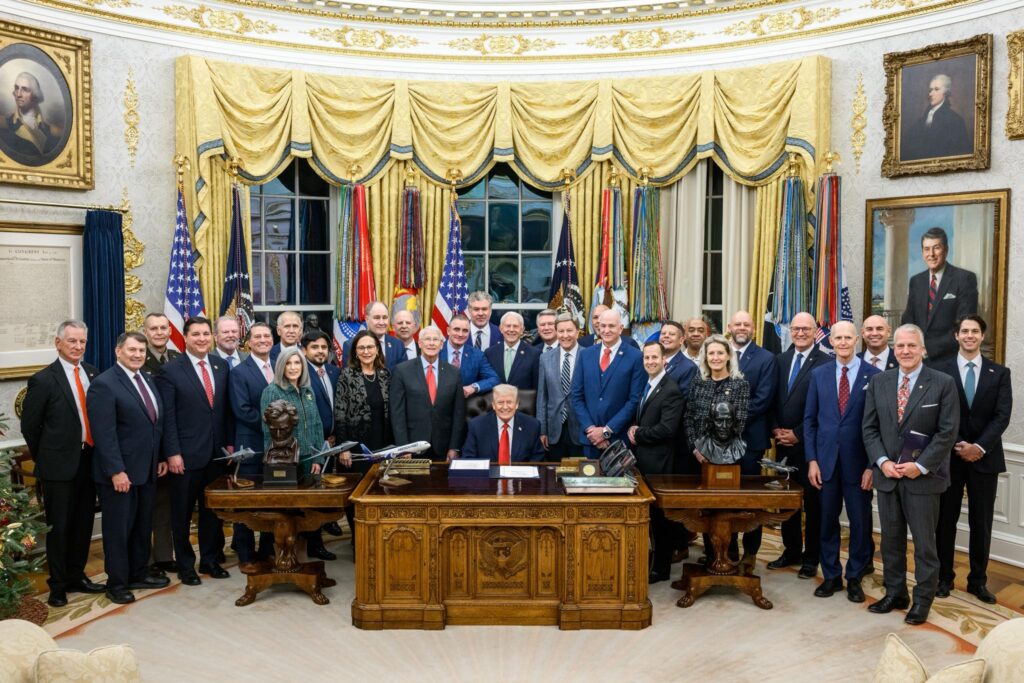
The National Defense Authorization Act for fiscal year 2026 reflects the American government’s preferences for what should occur in the Middle East after the two-year Hamas-Israel war. Passed by the House on December 10, 2025, and the Senate on December 17 and signed by President Donald Trump on December 18, the overview of U.S. defense policy lays out plans for continued U.S. engagement in the region while recognizing the end of Israel’s need for war-level military supply and support.
For example, the fiscal 2025 NDAA called for military and intelligence support to help Israel defeat Hamas and for an assessment of intelligence lessons learned from the war, including failures before Hamas’ October 7, 2023, assault on southern Israel and insights into fighting against tunnels and rockets. With the war ended by the 20-point Trump ceasefire plan and the assessment completed, Congress left those items out of the fiscal 2026 legislation.
The 65th annual NDAA does not approve actual U.S. spending. Instead, it provides an overview of congressional military thinking and foreign policies in consultation with the administration and establishes broad targets for appropriators to use.
A rough way to judge the importance of something in U.S. military policy-making is to count NDAA references. After being mentioned 40 times in the fiscal 2022 NDAA and 38 times in the fiscal 2023 legislation, Israel appeared 120 times in the fiscal 2024 law, enacted 2½ months after Hamas’ October 7 attack, although the increase in part reflected a one-year focus on expanding the Abraham Accords. The fiscal 2025 law mentioned Israel 74 times, and the fiscal 2026 law has 69 references to Israel.
By comparison, Egypt is mentioned once for 2026, in reference to anti-terrorist efforts along its border with Sudan, after being left out in 2025 and mentioned in 2024 only in the Abraham Accords section.
Jordan, also referenced for 2024 only in relation to Abraham Accords expansion, had an entire section in the fiscal 2025 law about enhancing its air and missile defenses after the Hashemite kingdom helped Israel fend off Iranian missile and drone attacks in April and October 2024. An enhanced U.S. security partnership with Jordan and Lebanon gained its own section for fiscal 2026. From these comparisons, regardless of the number of times Israel is referenced, the Trump administration’s NDAA centers its foreign and defense policies on Israel as a hub for stability in the region, rewarding countries that are part of a reliable core, including those that were signatories to the 2020 Abraham Accords.
As a key adversary, Iran was mentioned more than 125 times in fiscal 2023 and has been cited more than 50 times annually since the breakout of the Hamas-Israel war.
The start of that war in October 2023 led to the fiscal 2024 NDAA innovation of grouping multiple sections under the title “Matters Relating to Israel,” which remains for fiscal 2026. Bilateral efforts against tunnels and drones are constants in that portion of the legislation, as is authorization for military exercises.
But after emphasizing joint pilot training with NATO and aerial refueling assistance for fiscal 2024 and military trauma education and training for fiscal 2025, the 2026 law emphasizes research on emerging technologies.
Outside “Matters Relating to Israel,” U.S. support for Israeli anti-missile systems is a perennial element of the NDAA. The fiscal 2026 legislation follows the example of laws before and during the Hamas war in addressing the Iron Dome, David’s Sling and Arrow 3 interceptors and authorizing up to $200 million for Israel for those systems. Some of that money has shifted from Iron Dome to Arrow 3, whose development could help Trump’s proposed Golden Dome anti-ballistic-missile shield over North America.
The new legislation also allows up to $300 million to be appropriated for U.S.-Israel cooperative programs, an amount that hasn’t changed for years.
The fiscal 2026 law also provides support for Trump’s vision of broad Middle East peace.
While the legislation does not mention Gaza or the Palestinians overall, it does promote assistance for Lebanon alone and in cooperation with Jordan to disarm Hezbollah. The law repeals sanctions against Syria, contingent on not threatening Israel, among other conditions.
The law maintains vigilance against Iran and includes it with Russia, China and North Korea as adversaries to be monitored, assessed and reported on. Among other factors are how they are cooperating and how they threaten such allies as Israel, Ukraine and Taiwan. One possible response is to increase U.S. military stockpiles held in Israel in case of conflict.
The NDAA reflects changing public views about Israel after two years of negative social and broadcast media on Gaza.
The acts for fiscal 2022 and 2023 made no mention of boycotts against Israel. But the fiscal 2024 legislation raised Congress’ concerns “about the antisemitic efforts of the Boycott, Divestment, and Sanctions (BDS) movement against the State of Israel, including its efforts to delegitimize, isolate, and ultimately destroy the Jewish state” and directed the defense secretary to report on whether any contractors selling at least $10 million worth of goods at military exchanges or commissaries were boycotting Israel.
The next year, still directed by the Biden administration, Congress ordered the Defense Commissary Agency not to contract with any company boycotting Israel or boycotting companies or people doing business in Israel. The contractor had to sell at least $10 million worth of goods to the U.S. military over two years to be subject to the ban.
For fiscal 2026, Congress moved beyond business boycotts, broadening its focus to arms embargoes and other sanctions imposed by countries or international organizations. Some countries, such as Spain, Slovenia, Canada and Italy, have halted all arms sales to Israel, while others have cut off specific weapons systems, such as the Netherlands with F-35 components.
The new NDAA directs the defense secretary, in consultation with the secretary of state and the director of national intelligence, to assess every 180 days and report to Congress annually for five years how such embargoes are affecting Israel’s U.S.-guaranteed qualitative military edge, which U.S. law guarantees. Of particular concern are any security vulnerabilities against regional foes shared by Israel and the United States, including Iran and such proxies as Hamas, Palestinian Islamic Jihad and Hezbollah.
The legislation does not call for U.S. action against those embargoing Israel but requests possible U.S. actions to fill any Israeli military gaps, from equipment sales to joint programs to develop replacements. By implication, U.S. allies are informed that actions taken against Israel’s military advantage may be interpreted as contrary to U.S. military and foreign policy interests. With its pro-Israel views revealed in the NDAA for 2026, the Trump administration apparently sees no inconsistency with the pro-Saudi view enshrined in the November 2025 U.S.-Saudi Strategic Defense Agreement, which designates Saudi Arabia as a “major non-NATO ally of the U.S.” and allows the Saudis to join Israel as the two Middle Eastern countries with the cutting-edge F-35 fighter in their arsenals. Evenhandedness for Trump toward Israel and Saudi Arabia could be a foundation for a more formal Saudi-Israeli relationship that would stop just short of formal diplomatic relations.
— Michael Jacobs and Ken Stein, December 24, 2025
Read the Full 2026 NDAA in a Printable PDF