March 1, 1957
Source: U.S. Department of State, U.N. provisional document A/PV.666, March 1, 1957, United States Policy in the Middle East, September 1956-June 1957
The context for Israeli Foreign Minister Golda Meir’s statement at the United Nations lies in the chain of events leading to the Suez war of 1956, Israel’s success in the war and Israel’s withdrawal from the Sinai Peninsula under great-power pressure.
In July 1956, Egyptian President Gamal Abdel Nasser nationalized the Suez Canal, provoking Britain and France, which had long controlled the waterway and depended on it for economic interests, to agree to retake the canal and topple Nasser if possible. The British were vexed at his deeply felt hostility toward them. The French disliked Nasser because of his support for the Algerian rebels fighting to end France’s long-term presence.
Israel had faced mounting security pressures from Egypt, including the closure of the Straits of Tiran, which shut down Israel’s southern port of Eilat. Additionally, Nasser had encouraged Palestinian terrorists to use the Gaza Strip to attack civilians in adjacent Israeli settlements and villages.
Prime Minister David Ben-Gurion sought to stem the cross-border terrorist attacks from Gaza by undermining Nasser. In late October 1956, Israel launched a military campaign into the Sinai Peninsula, coordinated secretly with Britain and France. Britain and France then intervened under the pretext of separating the combatants to resecure control of the canal. The military operation was swift and effective, with Israeli forces reaching Sharm el-Sheikh and reopening the Straits of Tiran.
Despite Israel’s battlefield success, the political outcome was determined by superpower pressure. The United States and the Soviet Union opposed the Anglo-French intervention and forced Britain, France and Israel to withdraw. The compromise that emerged required Israel to evacuate Sinai and Gaza in exchange for the deployment of a U.N. peacekeeping force and informal assurances regarding freedom of navigation.
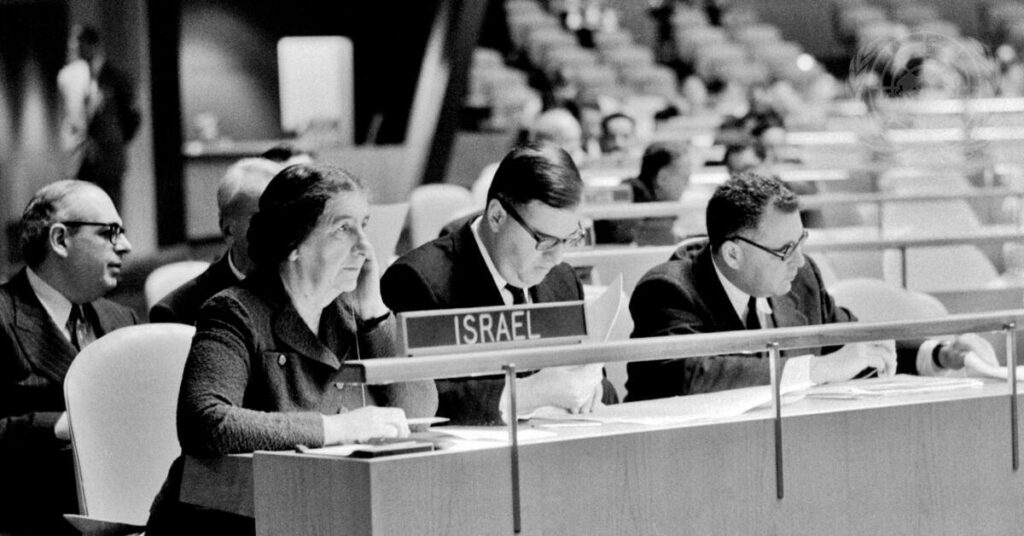
In her March 1, 1957, address to the United Nations, Meir outlined the conditions under which Israel agreed to withdraw from the Gaza Strip and Sharm el-Sheikh. She said that Israel had no territorial ambitions in those areas and that its primary objective had been to secure freedom of navigation through the Gulf of Aqaba and the Straits of Tiran, waterways Israel regarded as international and essential to its survival.
Meir emphasized that Israel’s withdrawal was contingent upon assurances that these waterways would remain open to Israeli and international shipping and that the United Nations Emergency Force would be deployed to prevent renewed hostilities. She underscored that interference with Israeli shipping would be considered an act of aggression justifying self-defense under international law. She framed Israel as committed to regional peace, economic development and cooperation, while making clear that Israel reserved the right to act if conditions of insecurity returned.
Meir’s statement reflected an uneasy balance: Israel complied with international demands but sought to preserve the strategic gains of the campaign, particularly access to vital maritime routes. Her remarks revealed the fragility of the arrangement because the guarantees relied on an international presence and political will rather than binding enforcement mechanisms.
As a result of the war, Israel was not given the right to move Israeli-flagged ships through the Suez Canal. The port of Eilat reopened, but Nasser again blockaded access to the port in May 1967, one of several reasons Israel felt it had to go to war against Egypt in June 1967. After the Six-Day War, Israel remained in control of Sinai and at the banks of the Suez Canal until it signed a treaty with Egypt in March 1979. The Ashdod became the first Israeli ship to steam through the Suez Canal in April 1979.
— Ken Stein, March 27, 2026
Statement in the U.N. General Assembly by Israeli Foreign Minister Golda Meir
March 1, 1957
The government of Israel is now in a position to announce its plans for full and prompt withdrawal from the Sharm el-Sheikh area and the Gaza Strip, in compliance with Resolution I of 2 February 1957.
We have repeatedly stated that Israel has no interest in the strip of land overlooking the western coast of the Gulf of Aqaba. Our sole purpose has been to ensure that, on the withdrawal of Israeli forces, continued freedom of navigation will exist for Israel and international shipping in the Gulf of Aqaba and the Straits of Tiran. Such freedom of navigation is a vital national interest for Israel, but it is also of importance and legitimate concern to the maritime powers and to many states whose economies depend upon trade and navigation between the Red Sea and the Mediterranean Sea.
There has recently been an increasingly wide recognition that the Gulf of Aqaba comprehends international waters in which the right of free and innocent passage exists.
On 11 February 1957, the secretary of state of the United States of America handed to the ambassador of Israel in Washington a memorandum dealing, among other things, with the subject of the Gulf of Aqaba and the Straits of Tiran.
This statement discussed the rights of nations in the Gulf of Aqaba and declares the readiness of the United States to exercise those rights on its own behalf and to join with others in securing general recognition of those rights.
My government has subsequently learned with gratification that other leading maritime powers are prepared to subscribe to the doctrine set out in the United States memorandum of 11 February and have a similar intention to exercise their rights of free and innocent passage in the gulf and the straits.
The General Assembly’s Resolution II of 2 February 1957 contemplates that units of the United Nations Emergency Force will move into the Straits of Tiran area on Israel’s withdrawal. It is generally recognized that the function of the United Nations Emergency Force in the Straits of Tiran area includes the prevention of belligerent acts.
In this connection, my government recalls the statements by the representative of the United States in the General Assembly on 28 January and 2 February 1957, with reference to the function of the United Nations Emergency Force units which are to move into the Straits of Tiran area on Israel’s withdrawal. The statement of 28 January, repeated on 2 February, said: “It is essential that units of the United Nations Emergency Force be stationed at the Straits of Tiran in order to achieve there the separation of Egyptian and Israeli land and sea forces. This separation is essential until it is clear that the nonexistence of any claimed belligerent rights has established in practice the peaceful conditions which must govern navigation in waters having such an international interest.”
My government has been concerned with the situation which would arise if the United Nations Emergency Force, having taken up its position in the Straits of Tiran area for the purpose of assuring nonbelligerency, were to be withdrawn, in conditions which might give rise to interference with free and innocent navigation and, therefore, to the renewal of hostilities. Such a premature cessation of the precautionary measures taken by the United Nations for the prevention of belligerent acts would prejudice important international interests and threaten peace and security.
My government has noted the assurance embodied in the secretary-general’s report of 26 February 1957, that any proposal for the withdrawal of the United Nations Emergency Force from the Gulf of Aqaba area would first come to the Advisory Committee, which represents the General Assembly in the implementation of its resolution of 2 November 1956. This procedure will give the General Assembly an opportunity to ensure that no precipitate changes are made which would have the effect of increasing the possibility of belligerent acts. We have reason to believe that in such a discussion many members of the United Nations would be guided by the view expressed by Ambassador Lodge on 2 February in favor of maintaining the United Nations Emergency Force in the Straits of Tiran until peaceful condition were in practice assured.
In the light of these doctrines, policies and arrangements by the United Nations and the maritime powers, my government is confident that free and innocent passage for international and Israel shipping will continue to be fully maintained after Israel’s withdrawal.
It remains for me now to formulate the policy of Israel both as a littoral state and as a country which intends to exercise its full rights of free passage in the Gulf of Aqaba and through the Straits of Tiran.
The government of Israel believes that the Gulf of Aqaba comprehends international waters and that no nation has the right to prevent free and innocent passage in the gulf and through the straits giving access thereto, in accordance with the generally accepted definition of those terms in the law of the sea.
In its capacity as a littoral state, Israel will gladly offer port facilities to the ships of all nations and all flags exercising free passage in the Gulf of Aqaba. We have received with gratification the assurances of leading maritime powers that they foresee a normal and regular flow of traffic of all cargoes in the Gulf of Aqaba.
Israel will do nothing to impede free and innocent passage by ships of Arab countries bound to Arab ports or to any other destination.
Israel is resolved on behalf of vessels of Israel registry to exercise the right of free and innocent passage and is prepared to join with others to secure universal respect of this right.
Israel will protect ships of its own flag exercising the right of free and innocent passage on the high seas and in international waters.
Interference, by armed force, with ships of Israel flag exercising free and innocent passage in the Gulf of Aqaba and through the Straits of Tiran will be regarded by Israel as an attack entitling it to exercise its inherent right of self-defense under Article 51 of the [U.N.] Charter and to take all such measures as are necessary to ensure the free and innocent passage of its ships in the gulf and in the straits.
We make this announcement in accordance with the accepted principles of international law under which all states have an inherent right to use their forces to protect their ships and their rights against interference by armed forces. My government naturally hopes that this contingency will not occur.
In a public address on 20 February, President Eisenhower stated: “We should not assume that if Israel withdraws, Egypt will prevent Israeli shipping from using the Suez Canal or the Gulf of Aqaba.”
This declaration has weighed heavily with my government in determining its action today.
Israel is now prepared to withdraw its forces from the Gulf of Aqaba and the Straits of Tiran in the confidence that there will be continued freedom of navigation for international and Israeli shipping in the Gulf of Aqaba and through the Straits of Tiran.
We propose that a meeting be held immediately between the chief of staff of the Israel Defense Forces and the commander of the United Nations Emergency Force in order to arrange for the United Nations to take over its responsibilities in the Sharm el-Sheikh area.
The government of Israel announces that it is making a complete withdrawal from the Gaza Strip in accordance with General Assembly Resolution I of 2 February 1957 (A/RES/460). It makes this announcement on the following assumptions:
(a) That on its withdrawal the United Nations forces will be deployed in Gaza and that the takeover of Gaza from the military and civilian control of Israel will be exclusively by the United Nations Emergency Force.
(b) It is further Israel’s expectation that the United Nations will be the agency to be utilized for carrying out the functions enumerated by the secretary-general, namely: “Safeguarding life and property in the area by providing efficient and effective police protection, as will guarantee good civilian administration, as will assure maximum assistance to the United Nations refugee program, and as will protect and foster the economic development of the territory and its people.” (A/PV.659, p. 17)
(c) It is further Israel’s expectation that the aforementioned responsibility of the United Nations in the administration of Gaza will be maintained for a transitory period from the takeover until there is a peace settlement, to be sought as rapidly as possible, or a definitive agreement on the future of the Gaza Strip.
It is the position of Israel that if conditions are created in the Gaza Strip which indicate a return to the conditions of deterioration which existed previously, Israel would reserve its freedom to act to defend its rights.
Accordingly, we propose that a meeting be held immediately between the chief of staff of the Israel Defense Forces and the commander of the United Nations Emergency Force in order to arrange for the United Nations to take over its responsibilities in the Gaza area.
For many weeks, amidst great difficulty, my government has sought to ensure that on the withdrawal from the Sharm el-Sheikh and the Gaza areas, circumstances would prevail which would prevent the likelihood of belligerent acts.
We record with gratitude the sympathetic efforts of many governments and delegations to help bring about a situation which would end the insecurity prevailing for Israel and her neighbors these many years. In addition to the considerations to which I have referred, we place our trust in the vigilant resolve of the international community that Israel, equally with all member states, enjoy its basic rights of freedom from fear of attack, freedom to sail the high seas and international waterways in peace, freedom to pursue its national destiny in tranquility without the constant peril which has surrounded it in recent years.
In this reliance we are embarking upon the course which I have announced today.
May I now add these few words to the states in the Middle East areas and, more specifically, to the neighbors of Israel:
We all come from an area which is a very ancient one. The hills and the valleys of the region have been witnesses to many wars and many conflicts. But that is not the only thing which characterizes that part of the world from which we come. It is also a part of the world which is of an ancient culture. It is that part of the world which has given to humanity three great religions. It is also that part of the world which has given a code of ethics to all humanity. In our countries, in the entire region, all our peoples are anxious for and in need of a higher standard of living, of great programs of development and progress.
Can we, from now on, all of us, turn a new leaf and, instead of fighting with each other, can we all, united, fight poverty and disease and illiteracy? Is it possible for us to put all our efforts and all our energy into one single purpose, the betterment and progress and development of all our lands and all our peoples? I can here pledge the government and the people of Israel to do their part in this united effort. There is no limit to what we are prepared to contribute so that all of us, together, can live to see a day of happiness for our peoples and see again from that region a great contribution to peace and happiness for all humanity.