November 20, 1942
Source: Halperin, Samuel. The Political World of American Zionism. Detroit: Wayne State University Press, 1961, pp. 333-334.
A Reply by 818 Rabbis of America to a Statement Issued by 90 Members of the Reform Rabbinate Charging That Zionism Is Incompatible With the Teachings of Judaism
Introduction
Two decades before this statement, American Jewish attitudes toward Zionism were far more divided. In the 1920s, major segments of Reform Judaism, shaped by the Pittsburgh Platform, rejected Jewish nationalism, defining Judaism strictly as a religion rather than a peoplehood tied to land. Organizations such as the American Council for Judaism later crystallized this opposition, warning that Zionism threatened Jewish integration and loyalty in the United States.
By the 1940s, however, this outlook had shifted dramatically. This document is a rebuttal by a broad group of American rabbis defending Zionism against criticism from a minority of colleagues who claimed it conflicted with Jewish religious and moral teachings. The authors argue that anti-Zionist rabbis misrepresent both Zionism and Judaism, emphasizing that most American rabbis see Zionism as fully consistent with Jewish faith and tradition. They reject claims that Zionism is overly secular or nationalistic, asserting instead that Jewish religious texts and prophetic teachings support national restoration in the ancestral homeland. The statement also maintains that Zionism does not undermine Jewish loyalty to the United States and notes Zionism’s endorsement by American political leaders. Finally, the rabbis stress the urgency of addressing Jewish homelessness after World War II, arguing that immigration to Palestine and the re-establishment of a Jewish homeland are essential for the political, economic and spiritual rehabilitation of European Jewry.
The transformation in rabbinic views reflected the profound impact of Adolf Hitler, the Holocaust and the persistence of Jewish displacement, all of which reshaped American Jewish opinion. By May 1948, with the establishment of Israel, support for a Jewish state had become the overwhelming consensus across American Jewry. While anti-Zionism did persist into the early 1950s, it remained marginal, confined largely to small ideological circles rather than the American Jewish mainstream.
American Jewish attitudes toward Israel in the 1950s and early 1960s were not hostile, but they were often cautious, selective and in many cases emotionally restrained — what might reasonably be described as lukewarm compared with later decades. After Israel’s establishment in 1948, most American Jews expressed pride in the new state and contributed financially through campaigns like the United Jewish Appeal. Yet identification was largely philanthropic rather than personal. Many still viewed Israel as a refuge for displaced Jews rather than a pillar of their own identity. Concerns about “dual loyalty” charges lingered, especially among middle-class, upwardly mobile Jews seeking full integration into American society. Institutions emphasized that American Jews’ political allegiance was solely to the United States, even as they supported Israel’s survival. Residual anti-Zionism, though diminished, persisted in small circles such as the American Council for Judaism.
During the early 1960s, attachment to Israel remained relatively limited in daily American Jewish life. Israel was respected but somewhat distant — geographically, culturally and psychologically. Religious denominations had not yet fully integrated Israel into liturgy, education or identity formation, and travel to Israel was still uncommon.
The Six-Day War in June 1967 marked a decisive turning point in American Jewish affinity for Israel, transforming concern into enduring identification and mobilization. In the weeks before the war, many American Jews feared Israel’s destruction as Arab states massed forces and issued existential threats. That anxiety generated unprecedented communal unity: Emergency fundraising surged, synagogues filled, and a sense of shared fate intensified across denominational lines.
Israel’s swift and unexpected victory produced a powerful emotional and psychological shift. Relief gave way to pride, and distance gave way to identification. For many American Jews, especially younger generations, the war created a lasting bond with Israel as both a symbol of Jewish survival and a focal point of Jewish identity. It also normalized public expressions of attachment to Israel in American Jewish life.
Institutionally, the post-1967 period saw expanded philanthropy, political advocacy and travel to Israel. Doubts that had lingered — about dual loyalty or the viability of a Jewish state — receded sharply. In their place emerged a broad consensus: Israel was central, not peripheral, to American Jewish identity, as it became for many Jewish diasporas worldwide.
— Ken Stein April 7, 2026
A Reply by 818 Rabbis of America to a Statement Issued by 90 Members of the Reform Rabbinate Charging That Zionism Is Incompatible With the Teachings of Judaism
Released to the press November 20, 1942
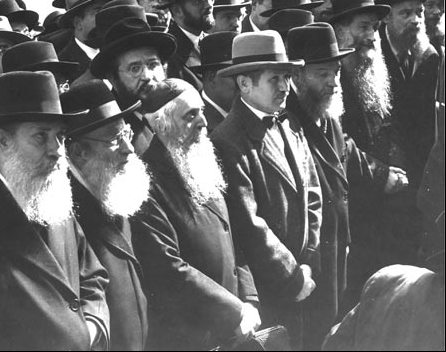
We, the undersigned Rabbis of all elements in American Jewish religious life, have noted with concern a statement by ninety of our colleagues in which they repudiate Zionism on the ground that it is inconsistent with Jewish religious and moral doctrine. This statement misrepresents Zionism and misinterprets historic Jewish religious teaching. …
We call attention in the first place to the fact that the signatories to this statement … represent no more than a very small fraction of the American rabbinate. They constitute a minority even of the rabbinate of Reform Judaism with which they are associated. The overwhelming majority of American Rabbis regard Zionism not only as fully consistent with Judaism, but as a logical expression and implementation of it.
Our colleagues concede the need for Jewish immigration into Palestine as contributing towards a solution of the vast tragedy of Jewish homelessness. They profess themselves ready to encourage such settlement. They are aware of the important achievements, social and spiritual, of the Palestinian Jewish community, and they pledge to it their unstinted support. And yet, subscribing to every practical accomplishment of Zionism, they have embarked upon a public criticism of it. In explanation of their opposition, they advance the consideration that Zionism is nationalistic and secularistic. On both scores they maintain it is incompatible with the Jewish religion and its universalistic outlook. They protest against the political emphasis which, they say, is now paramount in the Zionist program and which, according to them, tends to confuse both Jews and Christians as to the place and function of the Jewish group in American society. They appeal to the prophets of ancient Israel for substantiation of their views.
Treasuring the doctrines and moral principles of our faith no less than they, devoted equally to America and its democratic processes and spirit, we nonetheless find every one of their contentions totally without foundation.
Zionism is not a secularist movement. It has its origins and roots in the authoritative religious texts of Judaism. Scripture and rabbinical literature alike are replete with the promise of the restoration of Israel to its ancestral home. Anti-Zionism, not Zionism, is a departure from the Jewish religion. Nothing in the entire pronouncement of our colleagues is more painful than their appeal to the prophets of Israel — to those very prophets whose inspired and recorded words of national rebirth and restoration nurtured and sustained the hope of Israel throughout the ages.
Nor is Zionism a denial of the universalistic teachings of Judaism. Universalism is not a contradiction of nationalism. Nationalism as such, whether it be English, French, American or Jewish, is not in itself evil. … The prophets of Israel looked forward to the time not when all national entities would be obliterated, but when all nations would walk in the light of the Lord, live by His law and learn war no more.
Our colleagues find themselves unable to subscribe to the political emphasis “now paramount in the Zionist program.” We fail to perceive what it is to which they object. … There can be little hope of opening the doors of Palestine for mass Jewish immigration after the war without effective political action. …
We have not the least fear that our fellow Americans will be led to misconstrue the attitudes of American Jews to America because of their interest in Zionism. Every fair-minded American knows that American Jews have only one political allegiance — and that is to America. There is nothing in Zionism to impair this loyalty. Zionism has been endorsed in our generation by every President from Woodrow Wilson to Franklin Delano Roosevelt and has been approved by the Congress of the United States. The noblest spirits of American life … have lent their sympathy and encouragement to the movement.
Jews, and all non-Jews who are sympathetically interested in the plight of Jewry, should bear in mind that the defeat of Hitler will not of itself normalize Jewish life in Europe. An Allied peace which will not frankly face the problem of the national homelessness of the Jewish people will leave the age-old tragic status of European Jewry unchanged. … Following an Allied victory, the Jews of Europe, we are confident, will be restored to their political rights and to equality of citizenship. But they possessed these rights after the last war, and yet the past twenty-five years have witnessed a rapid and appalling deterioration in their position. In any case, even after peace is restored, Europe will be so ravaged and war-torn that large masses of Jews will elect migration to Palestine as a solution of their personal problems. Indeed, for most of these there may be no other substantial hope of economic, social and spiritual rehabilitation.
The freedom which, we have faith, will come to all men and nations after this war must come not only to Jews as individuals wherever they live, permitting them to share freedom on a plane of equality with all other men, but also to the Jewish people, as such, restored in its homeland, where at long last it will be a free people within a world federation of free peoples.