June 3, 1948
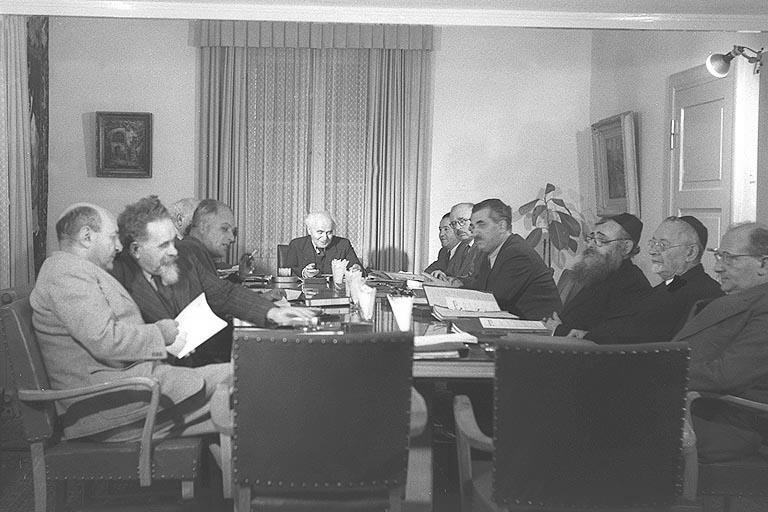
David Ben-Gurion delivers a report to the provisional government on the status of the War of Independence against neighboring Arab states, discussions with the United Nations and the domestic needs of a new country at war. The report comes as Israel and the Arab League announce their intentions to accept a truce appeal from the United Nations.
After the U.N. General Assembly passed Resolution 181 in November 1947 and as the British administration of Palestine approached its conclusion, the Va’ad Leumi (National Council) prepared for a provisional government to lead the soon-to-be established Jewish state. First established was Minhelet HaAm (People’s Administration), which lasted from May 4 through May 14, 1948.
On the 14th, with the delivery of the Declaration of Independence, HaMemshela HaZmanit (literally: Independent Government) was established with 15 ministerial positions, many of which are still in place. The new Cabinet represented a consolidation from the Jewish Agency, which had 40 departments during the British Mandate.
Ben-Gurion, serving as both prime minister and defense minister for the provisional government, focuses on three areas in his June 3 report: military, political and domestic. In addressing the status of the war, he accuses the British of directly assisting the Arab war effort, reports on the situation in Jerusalem, highlights the heroic resistance of the city’s residents, and praises the army for its success not only in repelling Arab forces, but also in taking the offensive.
“The entire expanse of the State of Israel allocated to us under the terms of the U.N. resolution is in our hands,” Ben-Gurion says, “and we have conquered several important districts outside those boundaries. … We will remain constantly on the offensive, which will not be confined to the borders of the Jewish state.”
Domestically, the prime minister highlights the early success in establishing public services and the large number of immigrants who have arrived despite the war. He concludes by informing the council that the dissident military groups Irgun (Etzel) and Lehi (Stern Gang) have agreed to disband and join the unified Israel Defense Forces. But Ben-Gurion expresses doubt that those groups will keep their promise. Just a few weeks later, the Altalena incident threatens to divide the young state when Irgun commander Menachem Begin tries to bring weapons to Irgun forces active in the defense of Jerusalem.
The U.N.-brokered ceasefire goes into effect June 11 and lasts nearly a month before it is broken by an Egyptian attack in the Negev on July 8.