March 1, 1906
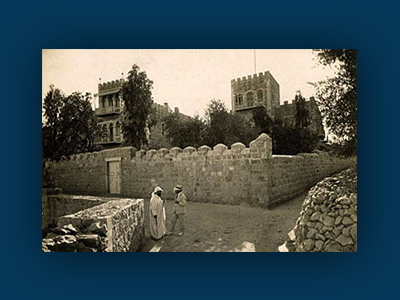
The first 40 students enrolled in the new Bezalel School of Arts and Crafts in Jerusalem. Those students, all women, are chosen from a pool of 400 applicants and focus more on developing handicrafts than on fine arts. According to the 1907 American Jewish Year Book, the first students receive instruction in painting, drawing and tapestry.
The school’s goals in 1906, according to Bezalel’s website, are “to train the people of Jerusalem in crafts, develop original Jewish art and support Jewish artists, and to find visual expression for the much yearned-for national and spiritual independence that seeks to create a synthesis between European artistic traditions and the Jewish design traditions of the East and West, and to integrate it with the local culture of the Land of Israel.”
The idea for Bezalel originated with Boris Schatz, a Latvian-born sculptor. Schatz lived in Eastern Europe before being trained in sculpture in Paris and moving to Sofia, Bulgaria, where he established an art academy. Attracted by the Zionist movement, Schatz began meeting with leaders of the movement, including Theodor Herzl, to develop support for an arts and crafts school in Jerusalem.
Schatz described the meeting with Herzl: “After I had finished speaking and wondered with beating heart: What answer will he give me? ‘Good, we shall do that,’ he said quietly and resolutely. And after a brief pause he asked: ‘What name will you give to your school?’ ‘Bezalel,’ I answered, ‘after the name of the first Jewish artist, who once built us a temple in the wilderness.’” (Boris Schatz, “The Bezalel Institute,” in Israel Cohen (ed.), Zionist Work in Palestine: London and Leipzig, 1911, p. 64.)
Schatz’s ideas were introduced in summer 1905 at the Seventh Zionist Congress in Basel, where they were approved.
The school focuses on two ideologies in its early years, to develop a national art for the future Jewish state and to provide work for settlers in the Yishuv through the creation of handicrafts that could be sold in the marketplace. In support of the latter goal, the Berlin-based founding board of the school proclaims, “No charity but work!” (Dalia Manor, Art in Zion: The Genesis of Modern National Art in Jewish Palestine: London and New York, 2005, p. 11.)
The original Bezalel closes in 1929 because of financial difficulties, but it is re-established in 1935 as the New Bezalel School of Arts and Crafts.
Correction: CIE previously listed the Bezalel opening in January 1906, but the academy has confirmed that March 1, 1906, is the correct date.