July 4, 2026
By Ken Stein, President, Center for Israel Education
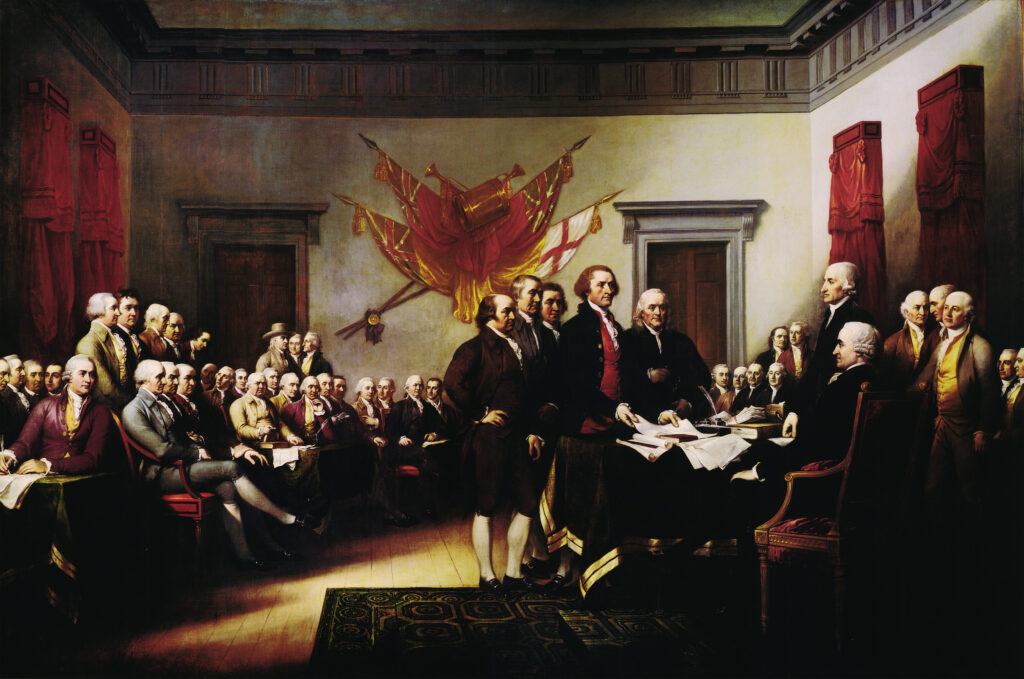
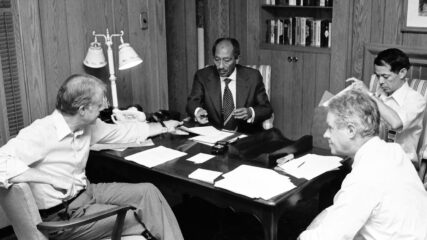
A short comparison of key concepts found in the American Declaration of Independence, July 4, 1776, and the Israeli Declaration of Independence, May 14, 1948.
| Category | U.S. | Israel |
| Purpose | List abusive particulars that cannot be tolerated and justify dissolving political bonds to the British king; express the natural right to do so | List historical contributions to humanity; make the case for international legitimacy and the Jewish connection to the land; establish the state |
| Military situation when written | More than a year into war but still with hopes for reconciliation | Major confrontations with local Arabs, impending invasion by neighbors, little action by British forces |
| Claim of historical connection to the land? | No | Yes, an ancestral return to an ancient homeland |
| History as a people stated? | No | Yes |
| Request for Diaspora support? | None, but appeal for foreign governments’ backing | Direct appeal for support and immigrants |
| Philosophical source of rights | Inalienable rights from political philosophers | Bible; established right to believe in one God |
| Basis of legitimacy | No earlier rights or claims from documents stating right for independent state | Balfour Declaration, League of Nations Mandate, U.N. General Assembly Resolution 181 |
| Revolting against what? | Long list of man-made legal impositions and some physical attacks | Abused as minority over centuries; insecure existence at hands of others |
| Ending what? | Despotic abuses | Precarious life and statelessness |
| Prerogatives sought | Self-determination, liberty, freedom, equality | Self-determination, liberty, freedom, equality |
| Reconciliation previously offered? | Yes, sought peaceful redress of abuses | Yes, accepted partition and reached out to Arab neighbors before and after independence |
| Mention of higher authority | Yes, “Supreme Judge,” “Nature’s God,” “Creator,” “divine Providence” | No appeal to God; one reference, “Rock of Israel” |
| Concern for democratic principles | Deriving just powers from the consent of the governed | Liberty, justice, peace, full social and political equality for all, and freedom of conscience, worship, education and culture |
| Who governs after independence? | “Free and Independent States” | National Council transformed into Provisional State Council |
| Government prerogatives | “Levy War, conclude Peace, contract Alliances, establish Commerce, and to do all other Acts and Things which Independent States may of right do” | “Safeguard Holy Places, take steps to establish economic union, protect all Jewish and non-Jewish citizens” |
The American Declaration of Independence of July 4, 1776, and the Israeli Declaration of Independence of May 14, 1948, emerged from different historical circumstances, yet they share a striking moral foundation. Both proclaim the right of a people to political independence, national self-determination, liberty and government based on justice rather than foreign control.
The documents’ similarities are remarkable. Both documents transform historical suffering into political hope. Each joins national self-determination with universal ideals. Each affirms that a people may reclaim control over its destiny. Most important, both envision independence not as power for its own sake, but as a means of protecting liberty, human dignity, equality, religious freedom, and the right of individuals and communities to live according to their conscience.
As both countries progressed, they made changes to their founding documents. America added its Constitution and Bill of Rights; Israel, without a constitution, instead added a series of constitutional Basic Laws to guide government behavior. Both societies recognized and embraced the view that the rule of law required explanation in changing times while staying true to foundational concepts of liberty, freedom and protection of individual rights.
The American Declaration argues that all people possess inherent rights, including “Life, Liberty and the pursuit of Happiness,” and that governments derive their authority from the consent of the governed. When government destroys those rights, the people may establish a new political order. Israel’s Declaration similarly presents Jewish statehood as the fulfillment of a people’s natural and historical right to govern itself in its ancestral homeland. After centuries of persecution, exile and statelessness, the Jewish people sought the same essential objective claimed by the American colonists: freedom to determine their own political future.
Both declarations also connect independence with universal principles. The American document appeals to natural law and equality. Israel’s Declaration promises that the new state will be based on “freedom, justice and peace,” while ensuring complete equality of social and political rights for all inhabitants, regardless of religion, race or sex. It explicitly guarantees freedom of religion, conscience, language, education and culture. Although the American Declaration does not set out such protections in comparable detail, its defense of liberty helped establish the philosophical foundation upon which American religious freedom and constitutional rights developed.
Each document also places national independence within a larger moral and international setting. The American Declaration appeals to the “opinions of mankind,” explaining why the colonies believed separation was justified. Israel’s Declaration similarly addresses the international community, citing the Jewish people’s historical connection to the land, the League of Nations Mandate, and the United Nations partition resolution. Neither declaration presents independence as an entirely private national matter. Both seek recognition from other nations and attempt to demonstrate that their claims are lawful, reasonable and morally defensible.
Both texts were written during moments of danger. The American colonies were already engaged in war with Britain. Israel declared independence knowing that neighboring Arab armies were preparing to invade. In each case, political leaders announced sovereignty before military victory was assured. Independence was therefore not merely celebrated; it had to be defended. Both peoples accepted the risks of war to secure national freedom.
The declarations also express confidence that liberty requires political institutions. The American document established the philosophical case for representative government. Israel’s version called for elected and regular institutions and promised the drafting of a constitution. Both understood that independence alone was insufficient. Freedom had to be sustained by law, civic responsibility, equality and accountable government.
The differences are largely matters of emphasis. The American Declaration concentrates on grievances against British rule and justifies revolution. Israel’s Declaration provides a broader historical account of Jewish attachment to the land, persecution, immigration, international recognition and national restoration. The American text is more accusatory, listing the actions of King George III. The Israeli text is more constructive, describing the principles and obligations of the new state.
Israeli Declaration of Independence
May 14, 1948
Source: https://israeled.org/israel-declaration-independence/

The Land of Israel was the birthplace of the Jewish people. Here, their spiritual, religious, and national identity was formed. Here, they achieved independence and created a culture of national and universal significance. Here, they wrote and gave the Bible to the world.
Exiled from Palestine, the Jewish people remained faithful to it in all the countries of their dispersion, never ceasing to pray and hope for their return and the restoration of their national freedom.
Impelled by this historic association, Jews strove throughout the centuries to go back to the land of their fathers and regain their Statehood. In recent decades, they returned in their masses. They reclaimed the wilderness, revived their language, built cities and villages, and established a vigorous and ever-growing community, with its own economic and cultural life. They sought peace yet were prepared to defend themselves. They brought the blessings of progress to all inhabitants of the country.
In the year 1897, the First Zionist Congress, inspired by Theodor Herzl’s vision of the Jewish State, proclaimed the right of the Jewish people to national revival in their own country.
This right was acknowledged by the Balfour Declaration of November 2, 1917, and reaffirmed by the Mandate of the League of Nations, which gave explicit international recognition to the historic connection of the Jewish people with Palestine and their right to reconstitute their national home.
The Nazi Holocaust, which engulfed millions of Jews in Europe, proved anew the urgency of the reestablishment of the Jewish state, which would solve the problem of Jewish homelessness by opening the gate to all Jews and lifting the Jewish people to equality in the family of nations.
The survivors of the European catastrophe, as well as Jews from other lands, proclaiming their right to a life of dignity, freedom and labor, and undeterred by hazards, hardships, and obstacles, have tried unceasingly to enter Palestine.
In the Second World War, the Jewish people in Palestine made a full contribution in the struggle of the freedom-loving nations against the Nazi evil. The sacrifices of their soldiers and the efforts of their workers gained them title to rank with the peoples who founded the United Nations.
On November 29, 1947, the General Assembly of the United Nations adopted a Resolution for the establishment of an independent Jewish State in Palestine, and called upon inhabitants of the country to take such steps as may be necessary on their part to put the plan into effect.
This recognition by the United Nations of the right of the Jewish people to establish their independent state may not be revoked. It is, moreover, the self-evident right of the Jewish people to be a nation, like all other nations, in its own sovereign state.
Accordingly, we, the members of the National Council, representing the Jewish people in Palestine and the Zionist movement of the world, met together in solemn assembly today, the day of the termination of the British Mandate for Palestine, and by virtue of the natural and historic right of the Jewish people and of the resolution of the General Assembly of the United Nations, hereby proclaim the establishment of the Jewish State in Palestine, to be called Israel.
We hereby declare that as from the termination of the Mandate at midnight, this night of the fourteenth to the fifteenth of May 1948, and until the setting up of the duly elected bodies of the State in accordance with a Constitution, to be drawn up by a Constituent Assembly not later than the first day of October 1948, the present National Council shall act as the Provisional State Council, and its executive organ, the National Administration, shall constitute the Provisional Government of the State of Israel.
The State of Israel will be open to the immigration of Jews from all countries of their dispersion; will promote the development of the country for the benefit of all its inhabitants; will be based on the precepts of liberty, justice, and peace taught by the Hebrew Prophets; will uphold the full social and political equality of all its citizens, without distinction of race, creed, or sex; will guarantee full freedom of conscience, worship, education, and culture; will safeguard the sanctity and inviolability of the shrines and Holy Places of all religions; and will dedicate itself to the principles of the Charter of the United Nations.
The State of Israel will be ready to cooperate with the organs and representatives of the United Nations in the implementation of the resolution of the assembly of November 29, 1947, and will take steps to bring about the Economic Union over the whole of Palestine.
We appeal to the United Nations to assist the Jewish people in the building of its State and to admit Israel into the family of nations.
In the midst of wanton aggression, we yet call upon the Arab inhabitants of the State of Israel to return to the ways of peace and play their part in the development of the State, with full and equal citizenship and the representation in all its bodies and institutions, provisional or permanent.
We offer peace and amity to all the neighboring states and their peoples, and invite them to cooperate with the independent Jewish nation for the common good of all. The State of Israel is ready to contribute its full share to the peaceful progress and development of the Middle East.
Our call goes out to the Jewish people all over the world to rally to our side in the task of immigration and development and to stand by us in the great struggle for the fulfillment of the dream of generations — the redemption of Israel.
With trust in the Rock of Israel, we set our hand to this Declaration, at this Session of the Provisional State Council, in the city of Tel Aviv, on this Sabbath eve, the fifth of Iyar 5708, the fourteenth day of May 1948.
Signers: Meir Argov; Daniel Auster; David Ben-Gurion; Yitzhak Ben-Zvi; Mordechai Bentov; Eliyahu Berligne; Peretz Bernstein; Rachel Cohen-Kagan; Eliyahu Dobkin; Wolf Gold; Avraham Granot; Yitzhak Gruenbaum; Kalman Kahana; Eliezer Kaplan; Avraham Katznelson; Saadia Kobashi; Moshe Kol; Yitzhak-Meir Levin; Meir David Loewenstein; Zvi Lure; Yehuda Leib Maimon; Golda Meir; Nahum Nir; David-Zvi Pinkas; David Remez; Berl Repetur; Pinchas Rosen; Herzl Rosenblum; Zvi Segal; Haim-Moshe Shapira; Moshe Sharett; Mordechai Shatner; Bechor-Shalom Sheetrit; Ben-Zion Sternberg; Meir Vilner; Zorach Warhaftig; and Aharon Zisling.
American Declaration of Independence, July 4, 1776
Source: https://www.archives.gov/founding-docs/declaration-transcript

In Congress, July 4, 1776
The unanimous Declaration of the thirteen united States of America,
When in the Course of human events, it becomes necessary for one people to dissolve the political bands which have connected them with another, and to assume among the powers of the earth, the separate and equal station to which the Laws of Nature and of Nature’s God entitle them, a decent respect to the opinions of mankind requires that they should declare the causes which impel them to the separation.
We hold these truths to be self-evident, that all men are created equal, that they are endowed by their Creator with certain unalienable Rights, that among these are Life, Liberty and the pursuit of Happiness. — That to secure these Rights, Governments are instituted among Men, deriving their just Powers from the Consent of the Governed, that whenever any Form of Government becomes destructive of these Ends, it is the Right of the People to alter or to abolish it, and to institute new Government, laying its Foundation on such Principles and organizing its Powers in such Form, as to them shall seem most likely to effect their Safety and Happiness. Prudence, indeed, will dictate that Governments long established should not be changed for light and transient Causes; and accordingly all Experience hath shewn, that Mankind are more disposed to suffer, while Evils are sufferable, than to right themselves by abolishing the Forms to which they are accustomed. But when a long Train of Abuses and Usurpations, pursuing invariably the same Object, evinces a Design to reduce them under absolute Despotism, it is their Right, it is their Duty, to throw off such Government, and to provide new Guards for their future Security. Such has been the patient Sufferance of these Colonies; and such is now the Necessity which constrains them to alter their former Systems of Government. The History of the present King of Great Britain is a History of repeated Injuries and Usurpations, all having in direct Object the Establishment of an absolute Tyranny over these States. To prove this, let Facts be submitted to a candid World.
He has refused his Assent to Laws, the most wholesome and necessary for the public Good.
He has forbidden his Governors to pass Laws of immediate and pressing Importance, unless suspended in their Operation till his Assent should be obtained; and when so suspended, he has utterly neglected to attend to them.
He has refused to pass other Laws for the Accommodation of large Districts of People, unless those People would relinquish the Right of Representation in the Legislature, a Right inestimable to them and formidable to Tyrants only.
He has called together Legislative Bodies at Places unusual, uncomfortable, and distant from the Depository of their public Records, for the sole Purpose of fatiguing them into Compliance with his Measures.
He has dissolved Representative Houses repeatedly, for opposing with manly Firmness his Invasions on the Rights of the People.
He has refused for a long Time, after such Dissolutions, to cause others to be elected; whereby the Legislative Powers, incapable of Annihilation, have returned to the People at large for their exercise; the State remaining in the mean time exposed to all the Dangers of Invasion from without, and Convulsions within.
He has endeavoured to prevent the Population of these States; for that Purpose obstructing the Laws for Naturalization of Foreigners; refusing to pass others to encourage their Migrations hither, and raising the Conditions of new Appropriations of Lands.
He has obstructed the Administration of Justice, by refusing his Assent to Laws for establishing Judiciary Powers.
He has made Judges dependent on his Will alone, for the Tenure of their Offices, and the Amount and Payment of their Salaries.
He has erected a Multitude of new Offices, and sent hither Swarms of Officers to harrass our People, and eat out their Substance.
He has kept among us, in Times of Peace, Standing Armies without the consent of our Legislatures.
He has affected to render the Military independent of and superior to the Civil Power.
He has combined with others to subject us to a Jurisdiction foreign to our Constitution, and unacknowledged by our Laws; giving his Assent to their Acts of pretended Legislation:
For quartering large Bodies of Armed Troops among us:
For protecting them, by a mock Trial, from Punishment for any Murders which they should commit on the Inhabitants of these States:
For cutting off our Trade with all Parts of the World:
For imposing Taxes on us without our Consent:
For depriving us, in many Cases, of the Benefits of Trial by Jury:
For transporting us beyond Seas to be tried for pretended Offences:
For abolishing the free System of English Laws in a neighbouring Province, establishing therein an arbitrary Government, and enlarging its Boundaries, so as to render it at once an Example and fit Instrument for introducing the same absolute Rule into these Colonies:
For taking away our Charters, abolishing our most valuable Laws, and altering fundamentally the Forms of our Governments:
For suspending our own Legislatures, and declaring themselves invested with Power to legislate for us in all Cases whatsoever.
He has abdicated Government here, by declaring us out of his Protection and waging War against us.
He has plundered our Seas, ravaged our Coasts, burnt our Towns, and destroyed the Lives of our People.
He is, at this Time, transporting large Armies of foreign Mercenaries to compleat the Works of Death, Desolation, and Tyranny, already begun with circumstances of Cruelty and Perfidy, scarcely paralleled in the most barbarous Ages, and totally unworthy the Head of a civilized Nation.
He has constrained our fellow Citizens taken Captive on the high Seas to bear Arms against their Country, to become the Executioners of their Friends and Brethren, or to fall themselves by their Hands.
He has excited domestic Insurrections amongst us, and has endeavoured to bring on the Inhabitants of our Frontiers, the merciless Indian Savages, whose known Rule of Warfare, is an undistinguished Destruction, of all Ages, Sexes and Conditions.
In every stage of these Oppressions we have Petitioned for Redress in the most humble Terms: Our repeated Petitions have been answered only by repeated Injury. A Prince, whose Character is thus marked by every act which may define a Tyrant, is unfit to be the Ruler of a free People.
Nor have we been wanting in Attentions to our British Brethren. We have warned them from Time to Time of Attempts by their Legislature to extend an unwarrantable Jurisdiction over us. We have reminded them of the Circumstances of our Emigration and Settlement here. We have appealed to their native Justice and Magnanimity, and we have conjured them by the Ties of our common Kindred to disavow these Usurpations, which, would inevitably interrupt our Connections and Correspondence. They too have been deaf to the Voice of Justice and of Consanguinity. We must, therefore, acquiesce in the Necessity, which denounces our Separation, and hold them, as we hold the rest of Mankind, Enemies in War, in Peace, Friends.
We, therefore, the Representatives of the United States of America, in General Congress, Assembled, appealing to the Supreme Judge of the World for the Rectitude of our Intentions, do, in the Name, and by Authority of the good People of these Colonies, solemnly Publish and Declare, That these United Colonies are, and of Right ought to be, Free and Independent States; that they are Absolved from all Allegiance to the British Crown, and that all political Connection between them and the State of Great Britain, is and ought to be totally dissolved; and that as Free and Independent States, they have full Power to levy War, conclude Peace, contract Alliances, establish Commerce, and to do all other Acts and Things which Independent States may of right do. And for the support of this Declaration, with a firm Reliance on the Protection of divine Providence, we mutually pledge to each other our Lives, our Fortunes, and our sacred Honor.
Signers: Button Gwinnett, Lyman Hall and George Walton of Georgia; Roger Sherman, Samuel Huntington, William Williams and Oliver Wolcott of Connecticut; Caesar Rodney, George Read and Thomas McKean of Delaware; Samuel Chase, William Paca, Thomas Stone and Charles Carroll of Maryland; John Hancock, Samuel Adams, John Adams, Robert Treat Paine and Elbridge Gerry of Massachusetts; Josiah Bartlett, William Whipple and Matthew Thornton of New Hampshire; Richard Stockton, John Witherspoon, Francis Hopkinson, John Hart and Abraham Clark of New Jersey; William Floyd, Philip Livingston, Francis Lewis and Lewis Morris of New York; William Hooper, Joseph Hewes and John Penn of North Carolina; Robert Morris, Benjamin Rush, Benjamin Franklin, John Morton, George Clymer, James Smith, George Taylor, James Wilson and George Ross of Pennsylvania; Stephen Hopkins and William Ellery of Rhode Island; Edward Rutledge, Thomas Heyward Jr., Thomas Lynch Jr. and Arthur Middleton of South Carolina; and George Wythe, Richard Henry Lee, Thomas Jefferson, Benjamin Harrison, Thomas Nelson Jr., Francis Lightfoot Lee and Carter Braxton of Virginia.