June 1, 1941
After World War I, Iraq was under a British mandate, in accordance with the plan put forth by the League of Nations. In April 1941, a pro-Nazi government seized power, and it took the British three months to regain control of the government. During the period of pro-Nazi rule, radio stations routinely broadcast antisemitic propaganda, anti-Jewish slogans were written in the streets, and Muslim-owned shops were visibly identified to protect them from anti‐Jewish violence.
Approximately 130,000 Jews lived in Iraq. Ten years later, 90% of them had left, and most had immigrated to Israel through Operation Ezra and Nehemiah.
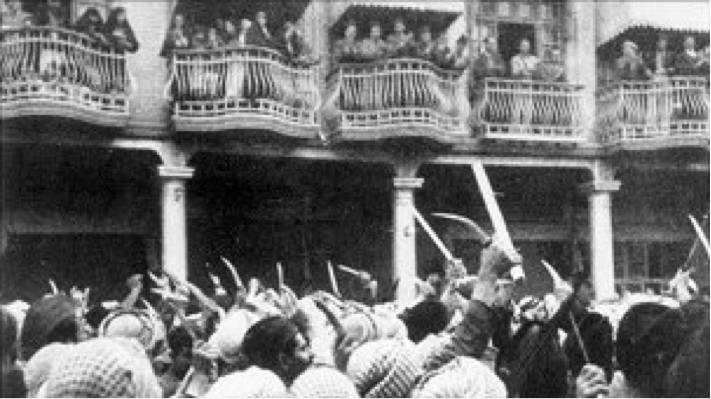
In the power vacuum between the fall of the pro-Nazi government and the re-establishment of British rule, a pogrom known as the Farhud breaks out against the Jews of Baghdad. The Farhud takes place on the Jewish holiday of Shavuot, which falls on June 1 and 2. The anti-Jewish violence kills 180 people and wounds more than 240. Some 100 Jewish houses are destroyed, and more than 500 Jewish businesses are looted.
Few of the rioters are arrested, and the British take no responsibility for their failure to intervene and protect Jewish life and property. The Farhud is a painful indicator that times have changed and that Jewish life in Iraq is not secure. Many Iraqi Jews therefore turn to Israel and Zionism.
As one Zionist pamphlet from 1944 states: “Every child remembers these two frightful days which turned out to be days of weeping and appeals for help. … We should hear the appeal for help of those girls and women who were touched by the dirty hands. We should share with those children their feelings of terror when they saw with their own eyes their fathers and mothers being killed and dishonored. We should look upon the memory of those days as a guiding light that will show us our way in the dark of the future.” (Andrew G. Bostom, The Legacy of Islamic Anti-Semitism: From Sacred Texts to Solemn History, Amherst, NY: Prometheus Books, 2008, p. 663)