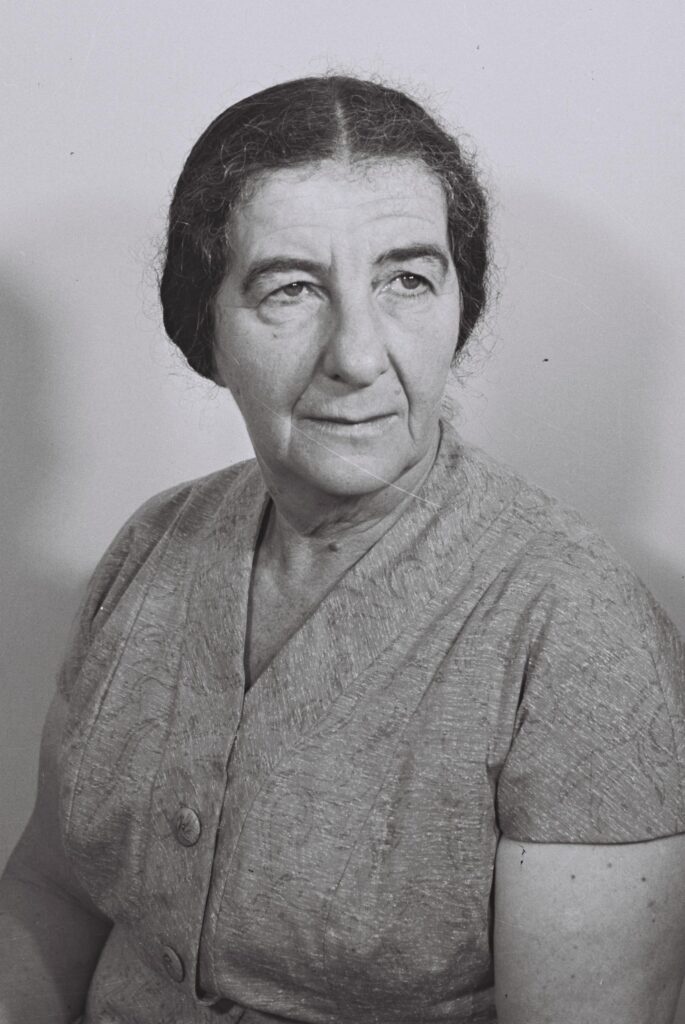
May 3, 1898
Golda Meir, Israel’s first female prime minister, is born Golda Mabovitch in Kyiv, Ukraine, then part of czarist Russia. She and her family immigrate to the United States in 1906 and settle in Milwaukee, where she trains to become a teacher. She marries Morris Myerson, and they immigrate to Palestine in 1921, eventually settling on Kibbutz Merḥavyah.
In 1928, Meir moves to Tel Aviv and becomes the executive secretary of the Women Workers Council of the Histadrut, the General Federation of Jewish Labor. She rises through the ranks of the Histadrut and joins its executive committee in 1934. After the British arrest Moshe Sharett in 1946, Meir becomes the acting head of the political department of the Jewish Agency, the de facto government of the Yishuv (Jewish community) during the British Mandate. In January 1948 she travels to the United States to raise money for arms for the anticipated war with the Arabs. She returns with $50 million.
After the creation of the state in 1948, Meir is appointed Israel’s first ambassador to the Soviet Union, and in 1949 she is named labor minister. She serves as foreign minister from 1956 until she retires from politics in 1965. David Ben-Gurion persuades her to change her last name from Myerson to Meir.
When Prime Minister Levi Eshkol dies of a heart attack February 26, 1969, Meir comes out of retirement to become Israel’s fourth prime minister and the first woman to hold the position. She is only the third female prime minister in the world. Her most criticized act as prime minister is the decision not to launch a pre-emptive strike at the start of the 1973 Yom Kippur War. She instead waits for Syrian aggression, knowing that a first strike could cost American military support.
She retains her office in the delayed 1973 election, but after the Agranat Commission reports on the failures of the October 1973 war, she resigns in spring 1974. She dies four years later.