January 22, 2026

Source: https://www.youtube.com/watch?v=ZlkzyuEEZR8

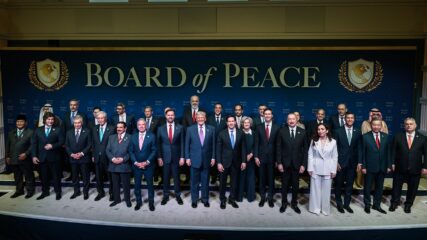
The official launch of the Trump-led Board of Peace in Davos, Switzerland, provided an opportunity for updates on Gaza as the ceasefire enters Phase 2.

Ali Sha’ath, the chief commissioner of the new technocratic Palestinian government, the National Committee for the Administration of Gaza, announced that the Rafah Crossing between Gaza and Egypt would open the next week, despite Israeli objections and Hamas’ failure to return the body of Master Sgt. Ran Gvili.

Israeli government representatives continued to insist that Gvili’s return must precede the Rafah opening, and Hamas must fully disarm. Special U.S. envoys Steve Witkoff and Jared Kushner traveled to Israel from Switzerland to try to persuade Prime Minister Benjamin Netanyahu to accept the crossing’s opening, but their visit produced no immediate announcement.

Sha’ath’s recorded statement in Davos made no mention of Israel or Hamas but urged the people of Gaza to support his committee’s efforts to achieve a future of peace, economic opportunity and freedom.

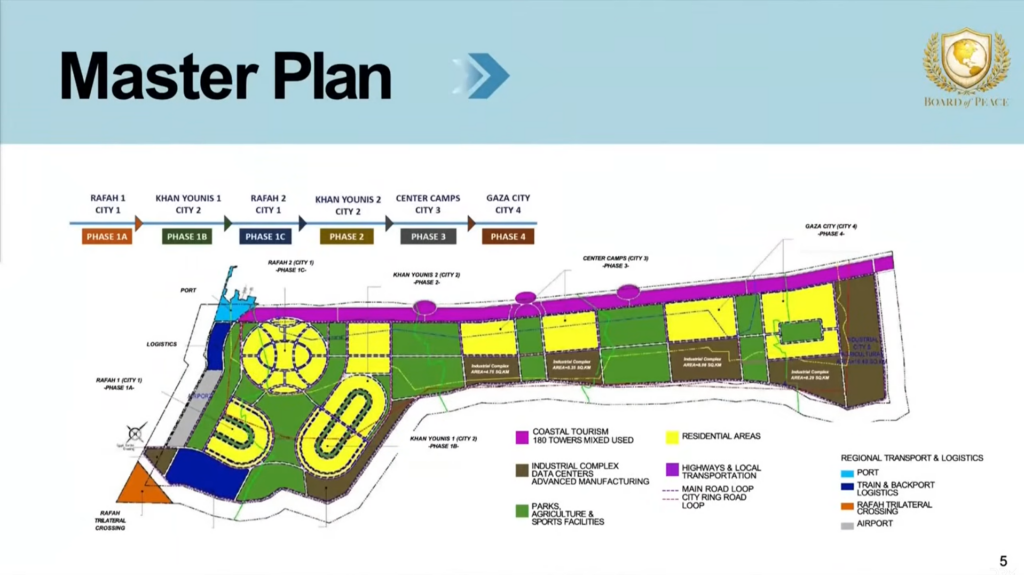
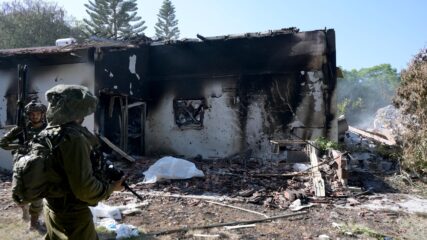
Kushner filled out the details of the plan for Gaza’s reconstruction as a phased real estate development, starting in Rafah and moving northward. Even without the Rafah Crossing, he said humanitarian aid is flowing in record amounts, and 100% of nutritional needs are being met. Despite 60 million tons of rubble in Gaza, Kushner said new cities to accommodate the population can rise in two to three years with sufficient international investment.

Such investment depends on security, which means Hamas’ disarmament. Kushner said Hamas agreed to disarm and must do so, and any delay will only extend the 20 years of misery Gaza residents have experienced under Hamas’ dominance in the Strip. But once Hamas is demilitarized, Gaza can become a tourist destination and center of industry with full employment.

“People ask us what our Plan B is. We do not have a Plan B. We have a plan,” Kushner said. “We signed an agreement. We are all committed to making that agreement work. … Stuff like this is very doable if we make it happen.”

With that grand vision in play, the high commissioner for Gaza, Bulgarian politician and former U.N. envoy Nickolay Mladenov, urged understanding as well as support from the world. “Please stop listening to the rumors and to the gossip. Focus on what we have to do today because the future of 2 million Palestinians is at stake. And if we give them a chance, we will do more than that. We will create opportunities for 1 billion people who live in the Middle East and beyond.”

— Michael Jacobs, January 25, 2026


Ali Sha’ath, chief commissioner of the National Committee for the Administration of Gaza: Distinguished leaders, colleagues and friends, it is an honor to be here today. I want to start by thanking President Donald J. Trump and his administration for their intensive efforts to advance peace in the whole region. I also thank Egyptian President Abdel Fattah el-Sisi, Qatar and Turkey as mediators, the Palestinian Authority, and members of the United Nations Security Council for welcoming the comprehensive peace plan. These efforts created the opportunity for a new future in Gaza Strip.

But what will really matter is what comes next. This transition will succeed only if it delivers real, tangible improvements in daily life for Gazans. As chief commissioner of the National Committee for the Administration of Gaza, it’s my responsibility to turn this moment into action, to restore order, to rebuild institutions and to create a future for the people of Gaza defined by opportunity and dignity under the principle of one authority, one law and one weapon.

As a first step, I am pleased to announce the Rafah Crossing will open next week in both directions. For Palestinians in Gaza, Rafah is more than a gate. It is a lifeline and symbol of opportunity. Opening Rafah signals that Gaza is no longer closed to the future and to the world.

I want to be clear: There is much more work ahead, and none of it is easy. The road forward will involve difficult decisions and setbacks. But this is a real step, and it marks a new direction.

Now I would like to address the people of Gaza.

[Translated from Arabic] From Egypt, I address my words now to the sons of our steadfast and patient people in the Gaza Strip. You have remained steadfast and preserved your families and your land during difficult, lean years that tested your depths and every limit. Your legendary steadfastness is the greatest offering Gaza has given, and it is the foundation upon which we will build our future together.   

This moment is not for looking back, but for moving forward toward a prosperous and bright future, a future where our children grow up without fear or anxiety, where work is rewarded, schools are opened, and daily life regains its stability and security.

The coming stage requires the concerted efforts of everyone, but you will not face it alone. Your voices have weight. Your actions have impact. And your commitment to peace and the rebuilding of your communities will define the features of the new Gaza Strip. Step by step, with discipline and determination, we will build a capable Gaza, capable of self-reliance, and we will build it into a center for freedom, opportunity and peace.

[Resuming English] Today I ask the international community not only to support this effort, but to work with us. Judge us by our actions, hold us to clear standards and stand with the people of Gaza as we take this responsibility for our future. Thank you, ladies and gentlemen. …

Special envoy Steve Witkoff: This is really my honor to be up here speaking. I remember when the president asked Jared, I and of course our great secretary of state to work on something that the world thought was impossible and unattainable.

But the president, on this peace deal for Gaza as on all other deals we work on on his behalf, said we had to try. And, of course, we were inspired by that.

We have achieved a peace deal in Gaza. We have brought the hostages home, all of the bodies except for one [Master Sgt. Ran Gvili], and we will bring that body home, too. And maybe most importantly, we have created a sense of hope for what the future can bring to Gaza and all other places where the Board of Peace will operate.

And I am so honored, Mr. President, to have worked on this on your behalf. I’d like to thank some people here who are here with us tonight who have done so much, done indispensable work to bring this deal together. Sheikh Mohammed, my good friend from Qatar, and Ali Al-Thawadi, Hakan Fidan and Ibraham, General Hassan [Rashad] and Foreign Minister Badr Abdelatty and of course President Sisi, and Prime Minister Netanyahu, former special envoy Ron Dermer and Michael Eisenberg for all that they did.

I would also like to thank our core working group and members of the Board of Peace who have been working nonstop on behalf of this incredible, noble effort around the clock for months on end, sacrificing time with their families and their own personal lives because they believe in the mission and the vision that the president has set out for us. I’d also like to thank — those people include Tony Blair, Yakir Gabay, Josh Gruenbaum, Aryeh Lightstone, Laron Tonkman, Admiral Cooper, General Frank, and I probably have forgotten some along the way.

And then perhaps most importantly I want to thank our administration. We have an incredible team. It’s amazing to work for this administration. I think you see the results that we get on behalf of the president because he inspires us so much. So I’d like to thank the vice president of the United States, JD Vance, for all of his help and guidance; our Treasury secretary; of course the secretary of state, who we work hand in glove with; and a special thanks to our chief of staff, Susie Wiles, who is always available to us for consultation, for steering and for all else that she does. Thank you.

Special envoy Jared Kushner: Thank you, Steve. And I have to say, one of the great honors for me of being able to work on this has been working with Steve, who really is as brilliant as his heart is tremendous. He’s a lot of fun to be with, and even in some of these, you know, very difficult moments where we didn’t think things were happening, working together really was an amazing treat.

I’m going to go now today just through a couple quick slides just to show you the progress that’s been made in the last couple months.

It was just over 100 days ago that we got the final deal done, and everyone was celebrating and joyous about the hostages coming home and the end to this long war that nobody thought was possible. And Steve and I were panicking, saying, “What do we do next?” You know, how do you implement peace?

And as you guys know, peace is a different deal than a business deal because you’re changing a mindset. And in Israel there was two years of very intense war. For the people in Gaza, there was more than just two years of war. They had 20 years of hopelessness being ruled by a terrorist organization. For the people in the Middle East, their hearts were pulled by this and throughout the entire world. It really was weighing on us.

And so we needed to think about what do we do next. How do we change the habits? How do we change the behaviors? And we really got to work right away. And the team that Steve thanked, including the White House team and the team, the volunteers, it’s really been an incredible effort, very entrepreneurial.

And we really did it in the way I’ve been working now with President Trump for 10 years on politics. And what continues to amaze me is that he always takes a first-principles approach and says, “What’s the most optimal outcome? Aim for that.” Whereas politicians are always focused on the downside or what could go wrong or how to make it a little bit better, he always says, “Aim for the best possible and, you know, do your best to get there. And if everyone thinks it’s impossible, that’s even more reason why you should aim for it.”

And so, really, thank you for the leadership and the inspiration for doing this. And I think you’ll see today we’ve achieved more than we thought was possible. And our ambition is still to go for something, I think, better than most people think is possible as well.

So let’s see if these things work. They never usually work. Good.

So, quickly, I’ll go through this. Two-year war, 90,000 tons of munitions. There’s over 60 million tons of rubble there and tens of thousands of fatalities. Through the ceasefire we were able to get to, through the 20-point plan, ceasefire, release of hostages. Getting the U.N. resolution passed was a huge, huge effort, really thanks to Mike Waltz and the whole team there. They did an incredible job. And we then, with the help of the U.N., we’ve worked very, very well with them. This is why you need a new organization like the Board of Peace to work with the U.N.

I want to thank Tom Fletcher, who did an incredible job of really getting it going. We’ve done historic humanitarian aid.

Going forward, the No. 1 thing is going to be security. Obviously, we’ve been working very closely with the Israelis to figure out a way through de-escalation, and the next phase is working with Hamas on demilitarization, which I’ll talk about in a second. But without security, nobody’s going to make investments. Nobody’s going to come, you know, build there. We need investments in order to start giving jobs. We want to take these people — 85% of the aid of Gaza, 85% of the GDP of Gaza has been aid for a long time. That’s not sustainable. It doesn’t give these people dignity. It doesn’t give them hope. And so we want to use free-market-economy principles. A lot of what President Trump spoke about that he’s doing in America, we want to bring the same mindset, the same approach to a place like Gaza to give these people the ability to thrive and have a good life.

Let’s see. So, on the aid, I mentioned the U.N. So now people aren’t talking about famine; 100% of the food needs are met. And that’s been overabundance. The cost of goods have gone down tremendously. Over 55,000 trucks have gone in and over 1.4 million pallets, and it’s been the largest humanitarian effort done into a war zone that anyone’s been able to tell us about. This really has been a great joint effort that everyone’s been able to do, and so it’s a great thing.

We all just heard from Ali. We have been so impressed, Steve and I. We’re speaking to him and the entire committee. Such bravery of these people to step up, and we’ve worked with the Palestinian Authority, who’s been helping us as well. But this committee is the first time a technocratic, apolitical committee. I really want to thank the Arab partners for helping us select the right people to do this, and we just need to believe in them and support them.

I put this up here. It’s probably a little too small for me to read, but this is really important if you saw the mission statement. So Hamas’ mission statement was “We need to destroy the State of Israel.” That has not worked well for the people, as we’ve seen. Their mission statement is “We are committed to establishing security, restoring the essential services that form the bedrock of human dignity, such as electricity, water, health care and education, as well as cultivating a society rooted in peace, democracy and justice, operating with the highest standards of integrity, transparency.” So these are the basic things. Their goal is to have peace and to help their people, which is an obvious mission statement for a government but actually fairly novel for Gaza.

So we did a master plan. We brought in — I thank you, Yakir Gabay, who’s one of the most successful real estate developers and brilliant people I know. He’s volunteered to do this not for profit, really because of his heart. He wants to do this, and we’ve developed ways to redevelop Gaza.

Gaza, as President Trump’s been saying, has amazing potential, and this is for the people of Gaza. We’ve developed it into zones. In the beginning we were toying with the idea of saying, “Let’s build a free zone, and then we have a Hamas zone,” and then we said, “You know what? Let’s just plan for catastrophic success.” Hamas signed a deal to demilitarize; that is what we are going to enforce.

People ask us what our Plan B is. We do not have a Plan B. We have a plan. We signed an agreement. We are all committed to making that agreement work. There’s a master plan. We’ll be doing it in phasing. In the Middle East, they build cities like this in — you know, 2, 3 million people — they build this in three years. And so stuff like this is very doable if we make it happen.

Rafah we’ll start with. This will show a lot of workforce housing. We think this could be done in two, three years. We’ve already started removing the rubble and doing some of the demolition. And then New Gaza. It could be a hope. It could be a destination, have a lot of industry, and really be a place that the people there can thrive, have great employment. Once this starts going, we think there should be 100% full employment and opportunity for everybody there.

And we have a lot of data on what can be, but we think that this really gives the Gazan people an opportunity to live their aspirations. But it all starts with security, and it all starts with governance.

Final note I’ll just say on the Board of Peace, which is that all the lessons we’re doing is we’re basically studying the best practices from all over the world, and we’re watching who does education the best, who does health care delivery the best. All these things are — it’s not secret IP. All this is IP that the Board of Peace is going to make public, and we want to encourage all the countries to be able to follow these best practices.

A lot of the things that President Trump is doing in America, if they’re working, we should all be copying them. If we find what’s working in other countries, we should be copying them too. And so what the Board of Peace will have the ability to do if we’re successful with Gaza is really show how do you do peace implementation, which is something that when we got this deal done, we didn’t really find too much expertise or know-how on how to do it.

So as we’re creating this system, hopefully it’s something that we can just document these learnings and make them available to all else who want to use them in the future.

So demilitarization, this is something we’re starting now that we have a new government in Gaza. This government will be working with Hamas on the demilitarization to really take the principles that were agreed to in the document to the next phase, and hopefully that will be successful. Without that, we can’t rebuild. So if Hamas does not demilitarize, that will be what holds back Gaza and the people of Gaza from achieving their aspiration. And that’s very important.

So the next 100 days we’re going to continue to just be heads down and focused on making sure this is implemented. We continue to be focused on humanitarian aid, humanitarian shelter, but then creating the conditions to move forward. So thank you.

Final point I’ll just make is this is really only possible because of the work of so many people and President Trump’s great leadership. But a lot of you have been asking, how can we help? So the countries have all been incredibly generous. We’ll be doing the first conference where we’ll announce a lot of the contributions that’ll be made in a couple weeks in Washington.

From the private sector, there’ll be amazing investment opportunities. I know it’s a little risky to be investing in a place like this, but we need you to come, take faith, invest in the people, try to be a part of it.

And then, finally, I’ll just talk to people on the media and on the social media, which is this deal only happened because we worked with Israel, we worked with Turkey, we worked with Qatar, we worked with Saudi, we worked with Egypt. I mean, everyone worked together. We worked with UAE. We all worked together to make this happen.

I see a lot of people trying to escalate, you know, criticizing Israel or Israelis criticizing Turkey or Qatar. Just calm down for 30 days. I think that the war is over. Let’s do our best to try working together. Our goal here is peace between Israel and the Palestinian people. Everyone wants to live peacefully. Everyone wants to live with dignity.

Let’s put our efforts towards promoting those who are doing the work to build this up, like Ali and his committee. Let’s focus on the positive stories, and let’s just calm down, turn a new chapter, and if we believe that peace is possible, then peace really can be possible.

So we’re going to continue to work every day. We need all of your help to do it. And, again, I just really want to thank President Trump for his leadership in doing this. This would not have been possible without your commitment to this. Everyone thought it was impossible to end this war. You never gave up. You never stopped. Every time there was a setback, you told us to try harder. You gave us different ideas.

And we’ve made several impossible things happen just in Gaza to date. And there’s no reason why we shouldn’t be able to make even more impossible things happen. So, really, thank you for your amazing leadership. …

High Representative for Gaza Nickolay Mladenov: Mr. President, it’s a great honor and a massive responsibility for me, for my team, for all of us to be here with you to begin this journey. Who would have thought two years ago that we will be sitting here with this group of countries, with this leadership, giving the people of Gaza a new chance? Who would have thought that last Friday I would be sitting, Mr. President, in Cairo with an amazing group of Palestinian technocrats. People who you don’t see on the news, people who are not media personalities but who are experts who are committed to giving their people a chance in life. And this is what this is all about.

For too long, Gazans, Palestinians and Israelis have lived with conflict, with death, with destruction. Now the page turns, and whether the page turns successfully really depends on all of us. We have the ingredients for it. We have the leadership of the United States and President Trump. We have a great group of countries joining the Board of Peace and more to come. We have a fantastic Palestinian team on the ground, and we must make it work. Our partnerships are there. Our plans are in place, and we need your support.

And, finally, I look to all of you who are in this room and who are watching this meeting from their screens at home or in their offices. Please put away your talking points for a minute. Please put away your fears. Please put away your concerns. Please stop listening to the rumors and to the gossip. Focus on what we have to do today because the future of 2 million Palestinians is at stake. And if we give them a chance, we will do more than that. We will create opportunities for 1 billion people who live in the Middle East and beyond and who are responsible, also who want to see transformation and a chance in life for the future.

So please join us on this journey. Join the Board of Peace, and join us in supporting this excellent initiative. And thank you again, President Trump and the United States, for taking this decisive leadership forward. …

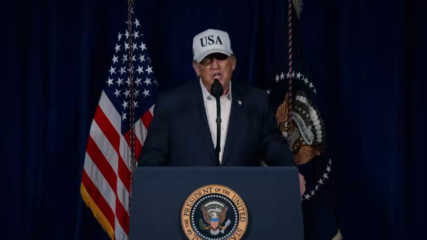
President Donald Trump: I’m a real estate person at heart, and it’s all about location. And I said, “Look at this location on the sea. Look at this beautiful piece of property. What it could be for so many people. It’ll be so, so great. People that are living so poorly are going to be living so well.”

But it all began with the location. That’s the vision. They look out on the waters, and very few people are, very few places are like it. So we put together a team that’s outstanding, a team that’s done it before, a team that I think has done tougher jobs if you want to know the truth. We’ve done some tough jobs, and we continue to. As far as the United States is concerned, we’re behind it.