March 22, 2026
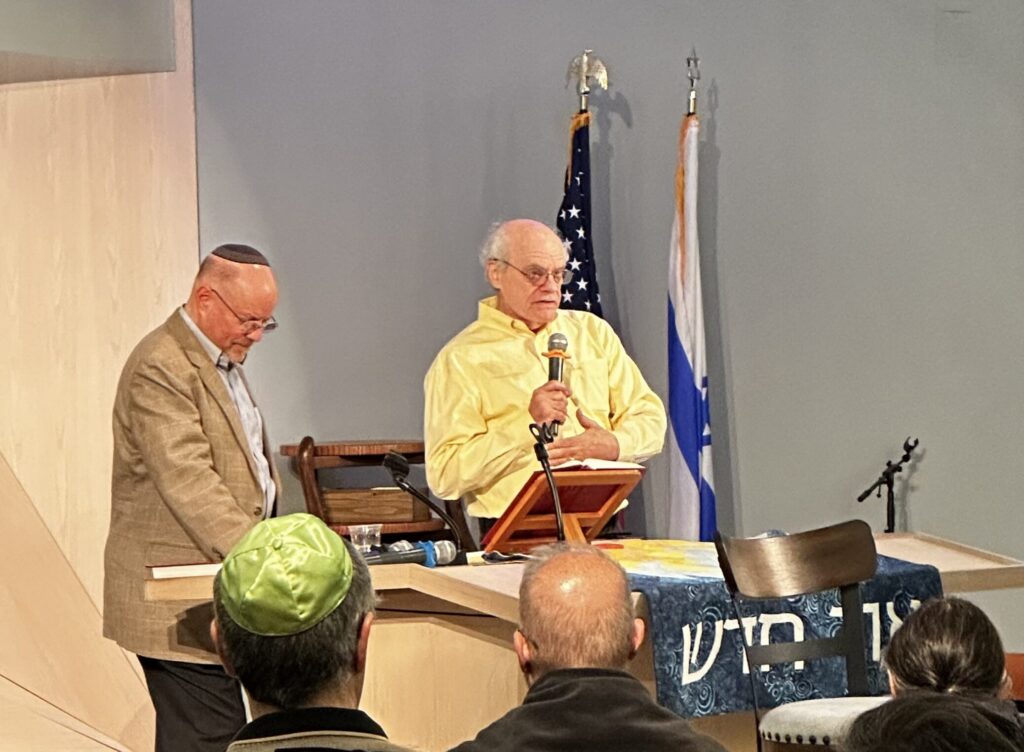
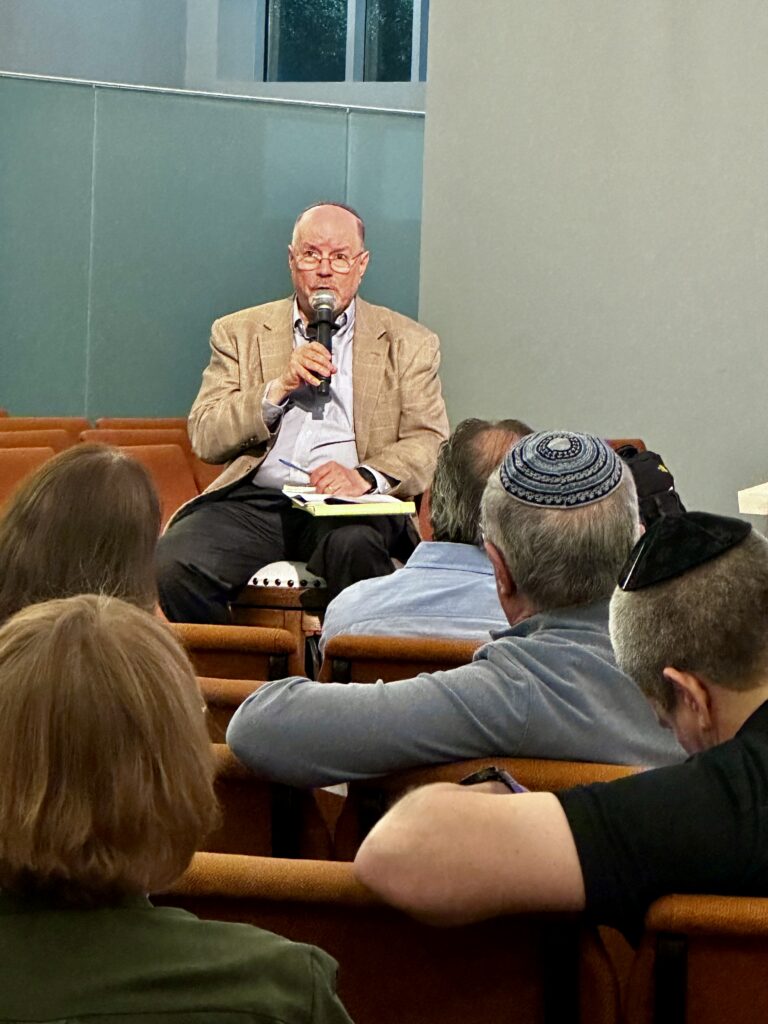
At the Washington Institute for Near East Policy, Michael Eisenstadt is Senior Fellow in Middle Eastern military and political matters. He addressed an audience for 75 minutes, including a conversation with CIE President and Emory Emeritus Professor Ken Stein, at Congregation Or Hadash in Sandy Springs, Georgia. (Note that the audio does not include the Q&A period.)
Introduction
Michael Eisenstadt framed the wars since October 7, 2023, as both the culmination and rapid unraveling of Iranian regional strategy. The two-year Hamas-Israel war stopped with a ceasefire in October 2025, and the combined U.S.-Israel attack on Iran was in its third week when he made this presentation.
Over two decades Iran evolved from a strategically isolated state into the architect of a powerful “Axis of Resistance,” surrounding Israel and Gulf Arab states with proxy forces in Lebanon, Gaza, Iraq and Yemen while advancing toward nuclear status. Iran’s strategy rested on four pillars: fighting far from Iran’s borders, relying on proxies to absorb costs, avoiding simultaneous conflict with the United States and Israel, and pursuing a long war of attrition. Since 2023, however, Israel and the United States have systematically reversed these advantages. Proxy networks have been degraded, Hezbollah’s capabilities sharply reduced, and Iran itself increasingly exposed to direct attack.
The war in Gaza revealed both Israeli vulnerabilities and Hamas miscalculations. Hamas expected a unified regional escalation that never materialized, exposing the limits of Iran’s alliance system. Subsequent campaigns, particularly against Hezbollah and through direct strikes on Iranian assets, shifted the conflict onto Iranian territory, effectively flipping the script on Tehran’s doctrine. Eisenstadt highlighted the paradox that these strategic gains emerged from the trauma of October 7, much as earlier regional transformations followed wars.
In part because the war was ongoing, his assessment of the U.S.–Israel–Iran war was restrained. While Iran’s air defenses, its missile infrastructure and elements of its nuclear program had been significantly damaged, the outcome remained far from decisive. Iran retained residual capabilities, especially missiles protected in hardened underground facilities, and the regime could endure and maintain control of the Strait of Hormuz. As a result, Eisenstadt suggested that the outcome, instead of a clean end, could be a transition to a prolonged, lower-intensity conflict characterized by intermittent strikes, proxy remnants and persistent instability in the Persian Gulf. Even weakened, Iran could disrupt maritime traffic and impose global economic costs with geographic oversight of the Strait of Hormuz.
In sum, Eisenstadt argued that Iran’s grand strategy has been fundamentally undermined but not eliminated. The war has shifted the regional balance, yet its ultimate outcome will depend less on battlefield destruction than on whether Iran’s regime adapts, survives and continues to promote is pre-war objectives across the region over time.
— Ken Stein, April 7, 2026
Ken Stein: I want to welcome you all here to the Max and Tillie Stein Israel Lecture here at Or Hadash. Thank you all for joining us tonight.
Iran is located about 1,200 to 1,400 miles away from Israel. It has a population of about 93 million. Some 1 million of the folks in Iran are part of the government — that is, part of the bureaucracy, police, Islamic Guards, who protect the regime. Iran historically has been a autocracy. And more recently it’s been a kleptocracy. By that I mean since the oil price increased after the 1973 war, Iran’s income exploded, and the Shah helped himself to the public trough and probably accumulated some 15 to 18 to 20 percent of all the revenue that Iran was earning.

And when the Shah fell in 1979, that process of helping yourself to the trough did not stop simply because there was a clerical regime now in power. So one of the reasons that it becomes extraordinarily difficult to remove a group of people who are defending the regime is because their salaries are predicated on them.
Now the salaries have to do with contracts. They have to do with just regular monthly payments. But suffice it to say that part of the current Iranian regime’s existence is trying to survive so that you can have access to the billions of dollars that might be available to you the day after tomorrow, No. 1.
No. 2, as part of the very, very brief introduction, is that Iran merges two major intellectual or philosophical concepts, Zoroastrianism and Islam. And their leading poet, in the middle of the eighth or ninth century, put together a whole series of notions and ideas that became an epic for Iran’s identity. Then it was Persia.
And the particular Shah that we’re talking about came to power in the ’40s. He was almost overthrown in 1953. And America was involved in his restoration to power, so that there’s an animosity there in Iran for America because of its intrusion into Iranian affairs.
Not to say that this is what causes Iran today to label the United States the Big Satan. It is an underlying feature of the hostility that exists between the clerical regime and the United States. The United States is labeled the Big Satan. Israel is labeled the Little Satan.
Israel is hated, vilified by the Iranian regime. It was from 1979 forward, and it’s not a transitory idea. It’s in deep in the Iranian policy and polity. I’m sure there’s a lot more that I could probably say and I didn’t, but my apologies.
In Middle Eastern history and political science field, one quickly identifies peers and friends who undertake quality research and can also explain the nuances of the region to others. Mike Eisenstadt is one of those dozens of thinkers and researchers across the world with whom I have this great faith.
Steve Wertheim: My name is Steve Wertheim, and I’m honored to serve as the president of Congregation Or Hadash. Michael Eisenstadt is the Kahn Senior Fellow and director of the Military and Security Studies Program at the Washington Institute. He’s a specialist in Arab, Israeli and Persian Gulf security affairs and has published extensively on irregular and conventional warfare, as well as nuclear weapons proliferation in the Middle East. He’s a scholar-soldier offering a unique, blended professional experience, scholarly insight and a deep understanding of America’s national security infrastructure. He’s an expert in the Persian Gulf and Arab-Israeli security affairs, having published hundreds of articles.
Before joining the institute in ’89, he worked as a military analyst for the U.S. government and served for 26 years as an officer of the U.S. Army Reserve with deployments to Iraq, Turkey and Israel before retiring from the Reserve in 2010.
His publications are numerous. Ladies and gentlemen, please welcome Michael Eisenstadt.
Michael Eisenstadt: Ken asked me to talk about the wars of the last few years since October 7th. And what I thought I would do in order to provide kind of an overarching framework and kind of a coherent narrative is to kind of frame this discussion in terms of the rise of Iranian regional power over the last 2½ decades and a sudden fall.
And I think as somebody who’s followed Iran for about 35 years now, it’s pretty remarkable to me how Iran went from a country that was previously, say just 2½ decades ago, surrounded by its enemies — you had U.S. troops in Iraq and Afghanistan, U.S. Navy in the Persian Gulf — to a country that then in turn surrounded its enemies with proxies, with rockets and missiles, in Gaza and Lebanon and in Iraq and in Yemen, which threatened Israel but then also threatened the Saudis and the Emiratis.
It also came from a country that was strategically lonely. Iran has never had a great power patron, nor do they want one really ideologically. It’s not consistent with their desires or worldview. And they only had one regional ally, Syria, and then a really important proxy, which is Lebanese Hezbollah. So they went from a strategically lonely country, which only had kind of one regional ally, to the leader of the region’s most cohesive bloc, what they call the Axis of Resistance, which included proxy armies in Iraq, as I mentioned before, and Lebanon and in Gaza and the Houthis, to now many of these proxy armies have been destroyed. And they went from a nuclear rogue state to a nuclear threshold state whose status, as such, was legitimized by the Joint Comprehensive Plan of Action, the nuclear deal that was struck in 2015, to know where many of their nuclear capabilities have been destroyed.
I would not use the term obliterated, and to be honest with you, we don’t really know exactly the status of those capabilities. But what’s remarkable is that Iran created — they were bereft of allies, bereft of a regional network. And they made it through patience, through perseverance, through tremendous resources invested. And just since October 7th, within just a couple of years, much of it has been destroyed.
Moreover, the war since October 7th marked the undoing of Iran’s national security concept, which was predicated on the following principles.
First of all, fight your enemies as far as from your own borders as possible on their own territory. So we saw, as I mentioned before, they helped build up Hamas’ capabilities so they could enmesh Israel in a series of wars as we saw between 2008, which was the first Israel-Hamas war — actually, there were conflicts before that that were not quite wars — until just now, until October 7th, and built up Hezbollah’s capabilities so that Hezbollah could serve as Iran’s strategic deterrent to defend Iran and deter an Israeli attack on Iran’s nuclear program.
The second principle of their national security concept was to fight via proxies; in other words, to offload risks and burdens on others so Iranians didn’t have to get killed.
So it was Arabs, or, in the case of the fighting in Iraq, it was Afghanis and also Pakistanis fighting in Iran’s Shiite foreign legion that were often killed — or the Syrian civil war, excuse me, that these proxies were often killed.
And then avoid, if at all possible, taking on both Israel and the United States at the same time. And we see now they find themselves, second time within a year, fighting wars against the United States and Israel together.
And then play the long game. Wear down your enemies, make attrition and exhaustion and win by outlasting them. And we see that the U.S. and Israel have attacked and are trying to defeat Iran by flipping the script on it and by defeating it in a short war.
The only way you can defeat a long war strategy is by either exhausting your enemy in the long war, which we did kind of during the Cold War with the Soviet Union, or you short-circuit or derail the long war strategy with a short war which results in a decisive outcome, which kind of short-circuits Iran’s plan.
So that’s what I think. That’s how I would characterize what Israel and the United States are doing now. And I mentioned before that their goal was to fight the war on the enemy’s territory, bring the war to Israel, but we saw last summer that actually Iran was attacked on Iranian territory, from Iranian territory on a number of occasions using Mossad assets and the like. There might be some of that going on in this war as well.
So really the United States and Israel have flipped the script on Iran and enabled this reversal of fortunes.
Let me make just a couple of comments about first the Gaza war, then the Lebanon war between Israel and Hezbollah. And actually it’s a two-part war because we’re seeing a second part right now. And then the various conflicts between Israel and Iran and then Israel and the United States and Iran since October 7th.
So the Gaza war, first let me talk about that. Oh, and let me just say this is one of the paradoxes of strategy and warfare. These achievements would not have been possible without the disaster of October 7th. Just like in many ways the Egypt-Israel peace treaty would not have been possible without the disaster of the October ’73 war, so there are sometimes things that are, I won’t say good, but that are necessary, that come out of things that are sometimes tragic.
So with regard to the Gaza war, the background to that were two things. First, there was a two-week conflict in the middle of 2021, May or June or so. There was tensions on the Temple Mount, the Haram Sharif, which led Hamas to try to take advantage of this, shot rockets at Israel. Israel shot back. And as a result there was communal conflict in Israel, if you remember, in a number of mixed towns where there were Arabs and Jewish residents. There were conflicts between Israeli Jews and Israeli Arab citizens.
And we know from some of the documents that have been captured since October 7th that this was a seen as a major opportunity by Yahya Sinwar and others, that there’s a weakness here that can be exploited. And then you had the Israeli judicial reform and the protests, which led to tensions in Israel among the Jews.
So in the eyes of Yahya Sinwar, Mohammed Deif. Sinwar was the head of Hamas in Gaza. Deif was the head of their military force in Gaza. They see Israel, from their point of view, there’s tensions between Jews and Arabs and among Jews. The country’s coming unraveled from their point of view, which fits with their ideological worldview that Jewish nationalism is not an authentic expression, that Israel’s a fake entity, does not represent an authentic expression of Jewish nationalism. And here’s an opportunity to be exploited.
And what’s tragic is Yoav Gallant, the defense minister, in March of 2023 gave a speech that he was initially fired for and reinstated, saying, “We need to stop the judicial reform now. It’s tearing the country apart. It’s causing problems with reservists. The IDF’s fighting power will be questioned by our enemies.” And there were also intelligence assessments that were coming up — this has been reported in the Israeli press — warning of the fact that the judicial reform and the tensions in the general society would be exploited by Israel’s enemies.
And that’s really what happened on October 7th. Those of you who know the story of Kamtza and Bar Kamtza from the Talmud, about groundless hatred among Jews being the cause of the fall of the Second Temple, it kind of resonates, what happened there.
So it was a deterrence failure. Israel failed to deter Hamas. They thought that Hamas was focused on internal development, on stabilizing the economic situation, building up the Gaza Strip. It was also an intelligence failure in terms of understanding their adversaries and the intentions of their adversaries. But Yahya Sinwar also, as head of Hamas, had illusions that there was this concept that the Iranians had been pushing since about 2017, what they call the unity of the fronts among their Axis of Resistance, that any member of the Axis who was attacked will be kind of saved by the other members. The other members of the Axis will come to their assistance.
So Sinwar thought, if we attack Israel, Hezbollah’s going to come in. The Houthis are going to come in. Yemen, the Iraqis are going to come in — Iraqi resistance forces that are armed by Iran would come in. And Iran would come in.
It turned out to be a major flaw in his reasoning. Hezbollah did join a day later after the October 7th attack, but in a very limited basis. And I’ll get into that a little bit more in a minute. We see this in the Middle East among Arab leaders time and again. Gamal Abdel Nasser in 1967, thinking that he could perhaps impose a blockade on Israel and then maybe launch a war that will lead to Israel’s destruction. Saddam Hussein twice invading neighbors, once Iran in 1980 and then Kuwait a decade later, thinking that if he takes the oil of those countries, he’ll emerge as regional power. And then bin Laden with his 9/11 attack, believing that this would kind of foment a war between Islam and the West and lead to the rise of Islam once again.
So it was kind of this romantic reasoning that they had this hope that this would be this cataclysmic event that would unify Arabs and Muslims and enable them to defeat Israel.
Long story short, it led to a long war, which ended only late last year with the imposition of a ceasefire. Although one of the goals of the war was to destroy Hamas, Hamas effectively still controls about a little less than half of Gaza. And Israel has found itself in a position where, because of a lack of a well-defined strategy, the United States eventually intervened to impose a ceasefire and to internationalize the conflict.
Now, Israel has always resisted the internationalization of its conflict with the Palestinians whenever possible. And yet we find ourselves in a situation where Israel, through kind of a lack of a clear set of goals, ended up in that situation.
And there’s a lot of kind of unfinished business in Gaza. We know Israel continues to carry out strikes against Hamas as they try to reconsolidate in the parts of Gaza that they control. So that part of the campaign was not very successful in many ways, even though, from a military point of view, it effectively ended the threat from Gaza. But there’s a lot of unfinished business there.
Now with regard to Lebanon and Hezbollah, I mentioned that Hezbollah joined the war on the second day. Yoav Gallant, who I mentioned before, who was the defense minister, went to the Cabinet on October 11th, three days after Hezbollah opened up what they called a support front for Gaza. They were going to tie down Israeli forces in the north in order to enable Hamas to have a kind of more even playing field in Gaza. And he went to the Cabinet and said, “We have a plan for dealing with Hezbollah. This should be our primary effort. They are the main enemy. We’ll put Hamas on the back burner for now, and we’ll focus on Hezbollah.”
It was rejected by the government. And I think, just as an outsider and independent observer, I think it was the right decision simply because, first of all, as defense minister who presided over Gaza and was defense minister at the time of the surprise attack from Gaza, he had no standing and credibility to make the case to the government that we will succeed in Lebanon after what happened just three days before in Gaza. But also I think from the point of view of maintaining American support, which was critical throughout this war, it was important to focus on one thing at a time. And I think the eventual decision of the government to focus on Gaza first and then Lebanon second later on was the right decision in the end.
About a year later, September of 2024, Israel implemented the plan that Gallant wanted to implement the previous October. And it started with the beeper and walkie-talkie attack September 17th and 18th, which actually was not as effective as it had been hoped. It only killed a few dozen people. But I think, if I remember correctly, it was I think 4,000, three or 4,000, I don’t remember the exact number, were wounded of Hezbollah fighters. If it had worked as planned, it would’ve been much higher, about 15,000 people that would’ve been wounded. Still a major psychological shock to Hezbollah.
Then there was a meeting of senior Hezbollah military officials in Beirut just a few days after that to figure out the response. And it was a meeting of what they called the Radwan Forces, which are kind of Hezbollah’s elite force that would’ve carried out the kind of October 7th attack that we saw in Gaza on the Lebanese border at a future date.
And Israel was able to kill them all. They were all meeting in a single room, and Israel killed them all.
And then Israel went forth just three days later with Operation Northern Arrows, which was their attack on Hezbollah’s missile force. Remember I said before that Hezbollah’s missile and rocket force was Iran’s strategic deterrent in many ways to deter an Israeli attack on Iran’s nuclear program.
And Israel, in the span of about six to eight hours, was able to destroy 70 to 80 percent of Hezbollah’s rocket and missile force. And then a couple of days later they killed Hassan Nasrallah, the longtime commander and head of Hezbollah.
And then October 1st they went in on the ground and in the next seven weeks or so uprooted all the infrastructure that Hezbollah had built in southern Lebanon to support an October 7 type attack into Israel. And then by November 27th, the Lebanese government in coordination with Hezbollah agreed to a ceasefire.
But, in fact, Hezbollah never really observed the ceasefire. According to the ceasefire, they were supposed to vacate from the south and give up their arms. And they never did that. And Israel has continued striking at them.
And then, as a result of the more recent war involving the United States, Israel and Iran, Hezbollah was pressed by Iran to attack. They did so with a very small force. Israel used the opportunity then to dramatically ramp up operations against Hezbollah. So we’re seeing actually the second phase of this war going on now.
Let me just make my final comments here about the United States and Israel and Iran and this road to war.
The first phase of the conflict that we’re involved in now occurred in April of 2024 when the Israelis launched a strike in Damascus against an annex of the Iranian Embassy where there was a meeting of senior Quds Force officials.
Now, Quds Force is part of the Revolutionary Guard Corps, which is Iran’s kind of elite military force, which is a main regime support force. But also the Quds Force is involved in kind of efforts to carry out operations overseas on behalf of Iran and the regime there. And they’re responsible for liaison with Hezbollah and Hamas and building up Hezbollah and Hamas and the Houthis and other proxies.
So the command group of the Quds Force that is responsible for operations in Syria, Lebanon and Gaza was meeting, and the Israelis killed them. There were three generals at the meeting and their staff, and the Israelis killed them. And, by the way, the senior general there was also in his eulogy, after he was killed by the Israelis, he was named as one of the planners of October 7th.
I don’t think that the Iranians knew about the timing of the attack. But I think they gave kind of advice to Hamas previously about when you do this, here’s how we recommend, and they helped them with the training. But I don’t think there’s any indication right now that they knew about the timing exactly.
But anyhow when he was killed, the Iranians responded with over 300 missiles, drones against Israel. And as a result of Israel’s robust missile defenses, as well as efforts by the United States to organize with the Brits, the French, also the Jordanians and the Saudis, although the Saudis I don’t think actually were actively involved in shooting, but their territory was overflown by American and other aircraft. They created a defense in depth.
Countries next to Israel intercepted drones that were coming over so that by the time the drones reached Israel, about half the drone force had been shot down already by American, British, French and Jordanian forces. And the rest were dealt with by the Israeli Air Force.
And the Israelis shot down about 110 missiles that were shot at Israel. So Iran launched 300 projectiles at Israel, and only about seven or eight actually landed, didn’t cause a lot of damage. And Israel said, “They hit us with their best shot, and it wasn’t really much. We were able to ride it out.”
It had an important change in Israeli thinking about the threat. And in many ways Israel lost its fear of Iran at that moment. And by the way, in response to that Iranian strike, President Joe Biden said, “Take the win. Don’t strike back.”
The Israelis did a single strike against an air defense radar in Iran. They did not overfly Iran. The missile was shot from eastern Syria or western Iraq. And so it was a very limited strike.
But then in October, after the killing of Nasrallah, Iran responded because Nasrallah was almost family for Iran.
So at first, interestingly, the Supreme Leader of Iran said, “It’s up to Hezbollah to do the response.” I think after he said that IRGC, the Revolutionary Guard, general said, “We have to hit back.” So Iran hit back. They launched about 200 missiles in October of 2024.
Again, most of them were intercepted by the Israelis. A few more got in this time, and some did a little bit of damage. Israel struck back by hitting several more surface-to-air missile sites. But as a result of this retaliation, basically the most capable surface-to-air missiles in Iranian force were no longer functional.
The missiles were not destroyed, but the radars were hit. So they were kind of not capable of being launched at targets. That set the stage for June 2025, or last summer, and that was as a result of a number of things that were happening.
You had indications that Iran might have been reviving aspects of its nuclear program. A lot of the details are still not out there, but there’s enough out there if you look. I did it in some things that I’ve published where I put together all the data out there.
There is a case to be made that they were reviving nuclear weapons research and development work for the first time since the early 2000s. It’s not clear that they were actually actively going for the bomb yet, but the fact that they were reviving work that they had not done for over 20 years indicates that maybe the status of the program was changing.
Plus, as a result of Iran’s experience in previous year when they had two attacks on Israel that did not get through, they realized they need to build up many, many, many more missiles than they had. So the Israelis say that the Iranians were trying to ramp up their production capabilities, so that Iran had about 2,000, 2,500 missiles last year, that by 2027 they’ll have 8,000. And then Israel will be overwhelmed. Its defenses will not be able to handle that.
So that was the background to the 12-day war last summer. Israel struck to destroy one of their nuclear infrastructure they were able to hit. The U.S. also helped out with the B-2 bombers, and then they also hit their missile arsenal.
Finally, getting to the most recent war that we’re involved in right now, it was mainly indications that Iran might be starting to rebuild its nuclear program, that they were trying to resurrect their missile program and rebuild it. And we still don’t know all the details, but apparently Prime Minister Netanyahu convinced President Trump that it was in both countries’ interests now that Iran was weakened, that they had very limited air defenses, that both countries could overfly Iran with relative impunity.
You kick your enemy when it’s down. And this was perhaps a unique opportunity to pare back Iranian military capabilities that had been built over the last 30 to 35 years or so.
So that’s the background to that war. I’ll just say that basically Israel and the United States have slightly different goals in the war. Even though the president talked about regime change, in all the briefings since the beginning of the war American officials are focusing on destroying Iran’s military capabilities. Basically missiles and drones, proxies, their nuclear program, and their navy, which is now kind of the center of attention in what’s going on. The Israelis kind of are focused on destroying capabilities, but they also want to try to foment regime change. So there is a slight difference, although I’m not sure it necessarily results in tensions between the two.
There are tensions because I think the Israelis would like to hit Iran’s energy sector in order to cause the collapse of the economy to result in an uprising. Whereas for the United States, our concern is that if Israel does that, Iran will hit much harder the energy production of facilities throughout the Gulf and will have catastrophic consequences for the global economy. Not just oil prices, but production of fertilizer, which will then have impact on food prices and transport. Everything will become more expensive. It’ll have implications for inflation, for just dramatic knock-on effects that are pretty potentially dramatic.
So I think that’s the one area where there’s daylight between the two. But right now the Israelis have drawn back. There was an attack a couple of days ago on the South Pars gas field in Iran by the Israelis, And President Trump in a Truth Social post said don’t do that again. And the Israelis have told me they’re not going to do it again.
But then he said if the Iranians keep hitting energy infrastructure, we’re going to hit South Pars. That’s the way that the president handles things, and it’s very hard sometimes to see a consistent thread in his public statements, although that’s his style.
In terms of where this is going, I don’t really know. I’ll just note that it’s very hard in the middle of war to know exactly what its outcome will be. There are a number of very dramatic accomplishments in terms of destroying large parts of Iran’s military capabilities.
Iraq still has not recovered from 1991 and 2003, so this will take decades for Iran to rebuild. But it’s quite likely that Iran will also come out of the war, if the regime remains in place, with some residual capabilities because we’ve seen Iran is still able to launch a significant number of missiles and drones every day.
Also, the way that the Israelis and I think the United States are going after some of their missiles is by blocking the entrances to the tunnels where the missiles are kept, the mountainsides. So what you do is prevent them from getting out to be used, but it means they’re sealed in, and therefore they’re effectively safe. They’ll end up surviving the war unless we’re able to somehow get into the tunnels, and they’re really too deep to hit, it seems, in many cases.
So I think if the regime stays, it’ll have residual capability still and the ability to make life miserable in the Gulf, even if we are able to open the Strait of Hormuz. Traffic in the Gulf potentially might be subject to Iranian harassment for some time to come on an intermittent basis.
So the war might transform from a hot war, high-intensity war, to kind of a low-intensity struggle where there are occasional pot shots taken by Tehran at traffic in the Gulf, maybe shots at Israel every once in a while. So there may not be a clean end to this war.
In many ways that’s like the 1991 war with Iraq, where we had a decade of containment after the war, and we had occasional cruise missile strikes and airstrikes into Iraq, patrolling of no-fly zones, which I don’t think is something we’re going to do in Iran.
But that basically concludes my comments.
Ken Stein: The biggest point I want to make is, as wars unfold, the objectives of the war may also change, and also the means to fulfill the objectives may also change. Some may fall out. Others may be added.
When President Trump made his speech on February 28th, he essentially said we have five objectives. To destroy Iran’s missile launchers and missile weapons capabilities. Destroy Iran’s defense industrial base; here he was focusing also on the navy. Destroy Iran’s nuclear weapons. Denigrate or end Iran’s toxic foreign policy diatribes against the West. And weakening, if possible, the regime.
Now, at different times in the last three weeks, he has spoken about regime change. At the very beginning he didn’t. Depends upon what time of day it is and whether the Torah’s been taken out or not. I don’t know where that came from.
All of the objectives are repeated. But now we have a new additive that wasn’t there on February 28th. How do you get gas and oil and fuel through the Strait of Hormuz? Now it could have been in the minds of the decision-makers, the policy-makers, the Pentagon, CENTCOM. We don’t know about it.
But that also adds a word of caution to all of us analysts and people who follow. We only know about 70 or 75 percent of what’s going on. And just because you read an article in yesterday’s Jerusalem Post or Yedioth Ahronoth or in Al-Ahram doesn’t necessarily mean that the person who wrote the article is privy to particular information. In fact, the word about the media here is most people write articles based on how they want to interpret the information so it comports with their personal ideology or viewpoint. Can you ever imagine Tom Friedman writing an article in The New York Times that says something positive about Benjamin Netanyahu? It would be like a rabbi eating pork. Just not possible.
So caution should be taken when reading folks. We’re consumers of information.
In the context of what Michael said about October 2023, where were we then, and what has changed?
And I think the biggest takeaway is there are alliances of convenience, and there are alliances of conviction. The United States and Israel have an alliance of conviction. When Israel was in Gaza, Arab states on the Gulf were livid in their antagonism toward the State of Israel.
Now there are Gulf states that are begging Israel to continue the war against Iran, and that’s 30 months later, which tells us a lot about the Middle East. It’s like a kaleidoscope with colors that are changing, but the colors remain the same, but their alliances with one another are always shifting.
A second point I want to make is when the war started in October of 2023, the Palestinian Arab press and the Arab press said, “The Israelis are going to disintegrate. They have no resilience. They’re going away. They’re fake. They’re fake.” And there was a whole litany of articles that went on for another six months.
All of a sudden, with the Israelis bombing the Iranians, the Qataris and the Bahrainis don’t think Israel is fake, which puts you in the position of where is Israel in two years from now or five years from now or seven years from now?
And the last point I want to make is Israel is not accepted in the Middle East as an equal. It’s tolerated. Oftentimes it’s embraced.
It’s highly likely that Israel will have to go back occasionally, eight months, 18 months, X number of years, to what some think-tank people have now called “Israel will just have to go back and mow the grass.”
With that, I offer you all questions. Please put them in the form of a question.
Audience question: Can you just give us an overview of the region in terms of who are the players, who are the moderates, and who are going to be the fundamentalists at any time down the road?
Michael Eisenstadt: You have the countries that participated in the Abraham Accords, U.A.E. and Bahrain. The U.A.E. has been hit harder by Iran than Israel. I think there’s a total of about 1,500 drones and 500 missiles that have landed to date in the U.A.E. So they’re taking it on the chin. And the UAE, during the course of Israel’s campaign in Gaza, was also the least critical of the Arab countries.
Bahrain is also a member of the Abraham Accords, and they have been supportive, although quietly so, because Bahrain is a small country, like U.A.E., but they have a less capable military.
The Saudis were very critical recently of Israel. There had been hopes that there could be a normalization agreement. Before October 7th, this was kind of the main topic of discussion. There were still hopes after October 7th that there would be a normalization agreement. I think maybe someday it might come to pass, but right now it seems unlikely.
But even though both the Saudis and the Emiratis before this war said to the United States that we will not give you permission to use our territory to launch attacks, we do know that the U.S. used Prince Sultan Air Base, which is a big air base in the center of Saudi Arabia, for nonoffensive operations. So the Saudis have been helping us, even though they tried to keep a low profile.
The Qataris I think deserve the poor reputation they have in many circles in this country. But on the other hand, I think it has to be said that much of what they did in Gaza was at the request of the U.S. and Israeli governments at the time. They are, from my point of view, a problematic actor. On the other hand, that’s where our forward headquarters, Central Command, in the region, is located. Also, our air operation center, which is managing the war against Iran, is located there.
In the Middle East, it’s never really black and white. There’s all shades of gray. So it’s really hard to characterize. And there’s also Kuwait and Oman. I don’t want to go through the whole list, but it is really sometimes on an issue-by-issue basis countries that are hostile sometimes have been helpful with the hostage negotiations when the Israelis had hostages in Gaza. For their own reasons, not necessarily have humanitarian reasons.
So the attack when the Israelis tried to kill the remnants of the Hamas leadership in Doha in Qatar, I think it was September or October, the head of Mossad wrote a letter protesting the decision because the Qataris were the interlocutors in the negotiations in Gaza with regard to hostages and other matters.
So it’s very complicated. The Israeli system is not unitary, and it is really hard to kind of paint actors, even problematic actors like Qatar, as black or white. And that’s why Qatar has been very successful. Because on the one hand, they supported Hamas. They hosted it for many years. But they also play both sides of this conflict and try to ensure that Hamas is not completely blacked out by the Israelis.
Ken Stein: I draw your attention to Donald Trump’s comments in February 2017, not only his comments during this war. His attitude to the State of Israel is not one that seems to be transitory and doesn’t seem to be one that’s only built upon what is convenient and what is needed.
Michael’s point is so well taken about Gulf Arab states. They’re all protected by American military, one way or another. We must have seven to 11 bases in the Gulf. One of the reasons Iran attacks those countries is because those countries are protected by the United States, and the United States is not their friend. The United States is their enemy, and they’re only 90 to 140 miles away.
The last point about Michael’s comments on your question: It’s very difficult to know who is on your team, and who is on your team today and who may not be there tomorrow. And that’s the neighborhood in which Israel operates, and that hasn’t changed in a hundred years. I hate to be so dramatic about it, but oligarchs, dictators, kleptocrats, people who use coercion over their populations, that’s the norm. That’s not the exception to the rule. And that’s a very broad look at this region that we studied for half a century.
Michael Eisenstadt: Two more last words on this if I could just go back quickly. Israel is very likely, almost certainly, overflying Syria. And the government there is headed by a guy who was a former Al-Qaeda guy and a government that has expressed the desire to have a more normal relationship, at least with Israel. Not that they could do anything about it, by the way, regarding the airspace. But they could make you think about it, and they could protest it.
And if you recall that unfortunately that tanker aircraft that crashed about a week ago was overflying western Iraq. So we’re doing refueling of Israeli aircraft over Iraq, which was partially an Iranian ally before the war. And it has militias that are Iranian proxies, to give you an idea of the complexity here.
Audience question: With regard to the Strait of Hormuz, obviously that was going to become an issue if this war went on for any period of time. Do you think that it was underestimated how quickly that would become an issue? And how do you see a way out of that problem relative to the 48-hour declaration vs. Any other possible resolution that we would see on that horizon?
Michael Eisenstadt: This is an extremely difficult problem because Iran, with even small quantities of munitions, could cause great harm to the world economy. A lot of the strikes can now have been mainly stimulant strikes, calculated to, in most cases, limit damage. They could do a lot worse probably. So it seems that the approach we are taking is to both ensure that there is freedom.
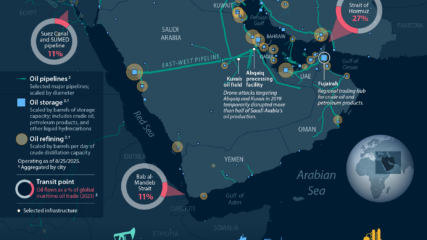
Now let me just say that the strait is not closed because right now Iran is sending its own oil through it and other countries that they cut deals with are sending oil. Our goal is to ensure freedom of navigation for anybody who wants to use the strait. And it looks like that we’re going to try to do that either by military convoy system or kind of clearing the area of all Iranian military capabilities. And also you have to also be able to better protect the onshore production capabilities south in some parts of the Gulf. So it’s a complex task.
And the Israelis have shot down almost every drone shot at them since 2024. Only like two have gotten through to Israel because Israel is a very small country with dense air defenses. Many, many, many drones have gotten through in the Gulf area because it’s a very big area with a lot of targets in a lot of places. So this is part of the problem.
Ken Stein: Should we take Kharg Island?
Michael Eisenstadt: I’m against the idea of taking Kharg Island. Kharg Island is an island in the northern part of the Persian Gulf where Iran exports 90 percent of its oil and gas. I’m not sure about the gas, but certainly oil. It’s really their Achilles’ heal.
So a lot of speculation in the media has been that we’re sending the Marines in order to land on Kharg Island and seize it. I’m not sure that’s the plan. I would advocate simply planting mines off the shore of Kharg Island and saying, “We will not let you sweep the mines. But if you are willing to let traffic go through the strait, we’ll sweep the mines then.” It will basically be an opening for diplomacy over the status of the Gulf and the passage through the Strait of Hormuz in accordance with international law, which is what existed before the war.
I don’t know if it’ll work. But you can always bomb, and it is better to use direct means. By the way, there’s also the Iranian ships that are going through the strait right now. Why not interdict them? We won’t be able to get all of them because our fleet is not as big as it used to be. We have a much smaller navy than we used to have. But a number of countries in the last few days said they’re willing to help us: the U.K., France, Japan and a few others. Maybe they can help interdict Iranian tankers and reduce Iran’s oil income that way.
And this is nondestructive because it’s reversible. We’re not bombing things on land, which could take years to repair. I prefer a more reversible, less destructive way of escalating that gets us to perhaps de-escalation. But I don’t know if it’s going to work, and it might in the end require a major military operation.
My main concern, and this is the last point, is a lot of Iran’s drones have over a thousand-mile range. So it doesn’t matter if you clear the coastal areas. They could launch drones from the middle of the country and hit tankers in the Gulf. That’s a lot of territory you have to clear in order to ensure freedom of navigation in the Gulf. That may not be doable.
But do you know what? During the Iran-Iraq War in 1980 through ’88, there were about 400, 450 tankers that were hit in the course of the war. About 50 of them were damaged or sunk, and traffic still continued. So there is a certain pain level at which, if you get the damage below certain level, traffic will continue, which is necessary for the world economy. Maybe that’s where we hope to get.
Audience question: One of the original goals was regime change. Do you see any political group that’s ready to step in and replace the ayatollahs and the mullahs?
Michael Eisenstadt: There’s no alternative organization in Iran, unless you see regime change as approved by the IRGC, like kind of a Venezuela, which is not regime change. That was simply managed transition.
I’m not saying it’s not possible for a mass uprising to occur and then effect regime collapse, but then what happens after? I think it’s unlikely, but never rule these things out. We have lived through things that we never thought we would see in our lifetime.
Audience question: What do you see as the long-term probability of Iran and their strategy long term as it relates to whatever support they get from China and Russia?
Michael Eisenstadt: You know, Iran has a long history with Russia, and it is one of distrust. Parts of Iran today in the Caucasus and Central Asia were bitten off by czarist Russia in the 19th century. And they felt that the Russians kind of dealt with them duplicitously in the run-up to the negotiations of the nuclear deal. So there’s a great deal of distrust, but they work on a transactional basis. Russians are providing intelligence. They’re also providing drones, according to President Zelenskyy of Ukraine. So if it’s in Russia’s interest to keep us pinned down in the Gulf and bleeding, there’s grounds for cooperation.
The Chinese are very careful. Look, China gets a lot of this oil from the Arab Gulf states, so they always play both sides. Ninety percent of Iran’s oil goes to China now. But that’s still not the majority of the oil it gets from the region. It comes from Saudi, comes from other Arab Gulf states. So they don’t want to alienate these countries either because they do a lot of business with them.
I’m sure the Chinese will help militarily in some areas quietly, but on the other hand, it’s not in their interest to alienate the Arabs that they do a lot of business with or to give Iran the ability to do something that could cut off — right now they get oil at a discount from Iran. It’s a great deal for them, so don’t screw it up. So I think they’re probably trying to thread the needle there in terms of help out Iran to some extent, but on a very limited basis.
Audience question: Right now the Houthis don’t seem to be doing anything, but there seems to be a lot of concern about that. So can you give us an analysis of, one, why they’re not involved in it yet? Do you anticipate they will be? And what the impact will be if they impede passage to the Red Sea.
Michael Eisenstadt: The Houthis until recently were seen as kind of these wild mountain men who were undeterrable because war is their national pastime, and they’re high on khat and therefore either their judgment is impaired or they’re kind of high on both their successes and their commitment to jihadism.
But the United States hit them pretty hard during Operation Rough Rider in March to May of 2025, and then the Israelis hit them hard. And the Houthis, when the Israelis concluded the ceasefire in Gaza, President Trump’s 20-point peace plan, they said, “We will cease fire as long as there’s a ceasefire in Gaza.” There is no ceasefire in Gaza, but the Houthis have not resumed fire.
So they have a pretext if they want either to open fire against Israel or in support of Iran. So I think even these wild mountain men, I think there comes a time when it’s like enough. We need to lick our wounds and recover, and enough of a good thing.
Audience question: Can you elaborate on scenarios from an Israeli perspective and from an American perspective? It might be different. What would be the worst-case scenario, the best-case scenario and the most probable scenario?
Michael Eisenstadt: I don’t have a fully developed set of scenarios, but I’ll give you just a few thoughts. If the efforts to enforce freedom of navigation in the Gulf don’t succeed or succeed at great cost to oil infrastructure, this has tremendous potential implications for the global economy in terms of food security because of the fertilizer and transportation costs, recession.
Now in terms of the U.S.-Israel relationship and the Jewish community here, my one concern is if it goes badly, Israel will have been implicated in another Iraq. You already hear voices saying the Israelis dragged the U.S. in. Already there is growing questioning of the U.S.-Israel relationship. I think this will further catalyze this debate about the U.S.-Israel relationship.
But if it ends well, I think it’ll in many ways vindicate those who say that Israel and the U.S. together took care of a common enemy that has killed hundreds of Americans over the decades and has been a constant thorn in the side of the United States.
Ken Stein: How about congressional elections in the fall and people running for Congress and taking a point of view A, B or C on is this a quagmire? Did we get in and out? Is this long-lasting? And probably we won’t have clear answers.
Apropos to your question, I spent the last five days trying to figure out what’s most achievable and what’s least achievable. I have nothing to base this on other than the books that sit next to me in my study.
Most achievable: degrading military capacity of Iran, limiting oil revenue effectiveness, delaying nuclear progress. Conditionally achievable: weakening the IRGC. I don’t know what weakening means. So we’re going to have to figure that out. Capturing some of the uranium, a partial ideological rollback, meaning Iran is less toxic but not completely tox-less if there’s such a word.
Least achievable: regime change on a fixed timetable, permanent nuclear prevention, eliminating ideology of hatred and creating stable citizen rule quickly.
Now those I think are realistic. I don’t think they come with politics or polemics on either side. This is a far more complicated war than June 2025 when you did something for 24, 48 hours and the ramifications, as Michael has already said, could be long-lasting. But we don’t know how long and how it will last. Do I sound like an academic?
Michael Eisenstadt: Ken, just one thing about the nuclear, because I did mention that. This is really critical. There’s been a lot of speculation in the media about the status of Iran’s nuclear program. Basically, as far as we know, Iran has 11 bombs’ worth of high-enriched and 20 bombs’ worth of low-enriched uranium. Most of it is probably underground in Isfahan, being in safekeeping, but some of it was under the rubble at Fordow and Natanz, the two enrichment facilities. We don’t really know, at least in the open sources, whether they recovered it or not or whether they’re leaving it under the rubble or whether they moved some to tunnels for safekeeping.
Do they also have centrifuges that can enrich to weapons level, weapons grade, and then can they turn it into a weapon? Now we do know that the Israelis and Americans have done their best to destroy the infrastructure that would be needed for weaponization. So they might be able to create weapons, maybe, down the road. But this is one of the unknowns of this work, and maybe this will be addressed in the final phase of the war. We don’t know.
Ken Stein: Iran’s necessity for a nuclear weapon is not so much to use it as it is a means to negotiate so that the regime can live tomorrow. And it has to be seen in that light as well as “Well, maybe they’ll use it anyway.” Negotiations are big, and the Iranians have negotiated this nuclear weapon acquisition for well over 35 years, on and off, back and forth, regardless of who’s president, regardless who’s in charge of the International Atomic Energy Commission. It’s been part of Iran’s foreign policy, and one can consider it to be part of Iran’s foreign policy tomorrow as well.
Audience question: Two things. First of all, so far I haven’t heard any real rationale for why the United States entered this war, other than when you mentioned earlier that you felt like Netanyahu whispered in Trump’s ear that now is a good time. That’s No. 1. But No. 2, in the Israeli press, which has only just gotten slight attention in the American press, there’s a lot of talk about how Israel’s on the regional stage, the United States is on an international stage, and China is playing a bigger role in all of this than anybody’s willing to acknowledge. The question is, what do you really see the role of China is vis-a-vis the United States, their intelligence capabilities that they’ve provided to Iran, their ability to inflict pain on the United States through Iran as a proxy of China.
Michael Eisenstadt: On this, I will tell you, first of all, I don’t follow the China angle very closely, but my understanding is that it is mainly the Russians who have been more, I think, forthcoming with regard to Iran in terms of providing assistance. I’m sure the Chinese are learning things by watching us, but we’re also learning things by doing.
And let me just say, getting back to the question about a justification for the war, it is probably a function of temperament. I’m a kind of kick your enemy while they’re down kind of guy. Not in every case, but in the case of Iran, it may turn out to be just the opposite of what I may say right now, if you could somehow pare down Iran’s military capabilities so that we can disengage from the region, and it may turn out to be the opposite, then we can really focus exclusively on China.
It may not turn out to be that way, but you can make an argument that at the beginning of the war, I could see that in President Trump’s mind that we’ll deal with this problem, plus it will demonstrate to our enemies you don’t mess with the United States. It’ll strengthen American deterrence. And that will be useful perhaps to prevent a war in the Strait of Taiwan.
But, on the other hand, we brought down our stockpiles of munitions and come out of this war with an even more deeply divided electorate, more averse to foreign entanglements, you might create opportunities for China. So wars always involve a crapshoot and risk in this regard.
Audience question: We’ve got two members of two think tanks looking at the big picture of the United States, an environment where there’s antisemitism, especially on college campuses; embedded U.S. sleeper cells from Iran; shocks to gasoline, diesel fuel and aviation fuel. War in Iran is not widely understood or supported by the general population. We have MAGA isolationism. Do you see a likelihood for anti-war protests similar to the 1960s?
Michael Eisenstadt: I think it happened in the ’60s because we had a draft, and I think a lot of young people didn’t want to be drafted. That was part of it. I think you already are seeing kind of a revolt to some extent within MAGA wing of the Republican Party today.
But the polling data shows there’s still solid support. As long as President Trump is committed to the war, it seems a lot of people, a lot of supporters, are willing to still support him. And the more extreme critics are still, it seems, marginal thus far. That could change. That could change.
So I don’t know. I don’t see right mass protests right now. I do see in Washington, though, a debate about war powers, about the president reneging on what some people who voted for him thought for the promise that he made, so that could be a problem for him in the midterms.
Ken Stein: When I organized the Vietnam Moratorium in 1969 at the University of Michigan, you got 58,000 people on a Thursday night into the stadium. That was ’69. The war began to percolate in American society in ’62 and ’63, and the anger against the war built, so much so that Johnson didn’t run again. This is something that has happened in 21 days. I don’t think it’s yet percolated into American society. And it certainly hasn’t, as Michael said, it didn’t have an impact upon people like me who were afraid to go to Fort Wayne in Detroit and get our physical ’because we didn’t want to become 1-A.
That’s very different than the campus today. I mean, it is hugely different. It doesn’t mean it can’t turn, but you don’t have a bubbling of six, seven or eight years like you had back then. That’s the distinction.
Michael Eisenstadt: Especially if there’s any casualties, though, that could change.
Audience question: Israel’s in two hot wars. They just bombed Syria in the last week to protect the Druze. They’re still in 53 percent of Gaza, and they’ve got to have some plans to be ready for the Houthis if that happens. How long can they keep this up?
Michael Eisenstadt: Look, Gaza is a low-level kind of operation at this point. Lebanon has the potential to be something bigger that entails major mobilization and a major presence on the ground, and that has the potential to expand much further, depending on how far Israel eventually goes into Lebanon.
But it’s been remarkable watching the degree to which Israelis are resilient and the way that the problem of October 7th kind of led to a change in mindset in terms of willingness to do this and to show up. These waxed and waned, the support, especially Gaza was starting to kind of lose popularity. There was a question about the endgame and what’s the point of continuing fighting there. And especially since after 2½ years of fighting, 53 percent of Gaza is controlled by Hamas. They’ve taken heavy losses, and they have very inexperienced people under arms now. But they’re still able to have parades.
So I don’t know what the answer is, but partly it’s a function of leadership. And also there’s an ethos of kinds of collective pulling together to deal with the threat.
Iran, I think, there’s universal support for it. I think Hezbollah, universal support for it. Gaza, I think, is a divisive issue. And, of course, it is also tied to the Palestinians, what’s going on in the West Bank now, which is causing a lot of division within the Israeli body politic.
So it depends on which wars you’re talking about really. But people are still showing up for the two wars that are supported by most of the population.
Ken Stein: October 2023, to give you an idea again of the 30-month difference, there was a sense that the U.S. was withdrawing from the Middle East. We were pivoting to Asia. There was a sense that American Jews were definitely distancing from Israel, and perhaps it was irreversible. I’m quoting from national Jewish publications. I think antisemitism, like anti-Zionism and anti-Israelism, has thrown American Jews back to one another, even if they don’t particularly like each other’s respective political parties, good, bad, indifferent.
I think there was great hope before October 2023 that there would be a two-state solution, that the Palestinians and the Israelis would find a way, and the only person that was lying in the way of this was Bibi Netanyahu and his right-wing government. Well, we learned on October 8th it’s a lot more than just the Israelis.
So what’s the lesson for us? The lesson for us is if we have accepted norms of behavior, we have to be flexible enough to adjust them according to the realities of the moment and not get hidden in ideologies and philosophies. We have to be flexible ’cause we’re not sure what tomorrow’s going to bring.
And I’m talking about American Jewry. I’m not necessarily talking about American society. And if we stay hidebound and fossilized in yesterday’s belief, then what we’ve done is we disadvantage ourselves for having an open mind about what tomorrow will bring.
I think Michael has demonstrated a breadth of knowledge and a depth and an incisiveness that has been particularly unique. I cannot thank him enough.