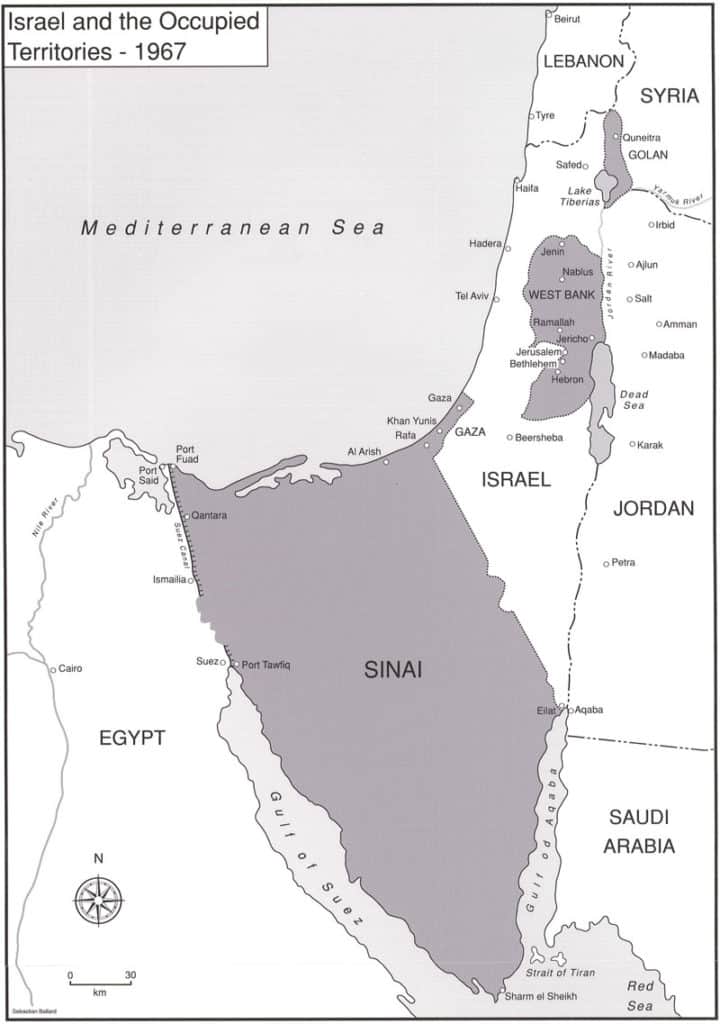
Resolution 242 calls for Israeli withdrawal from unspecified captured territories in return for the right of all states to live in peace. It does not call for a full withdrawal. It is the basis for treaties with Egypt (1979) and Jordan (1994) and for PLO recognition of Israel (1993).
[1] Its mention and terminology are found as the basis for convening the December 1973 Geneva Middle East Peace Conference, the aborted October 1977 U.S.-Soviet Declaration, and the September 1978 Camp David Accords. The resolution is the central concept of the March 1979 Egyptian-Israeli and the October 1994 Jordanian-Israeli Treaties. Acceptance of the resolution’s content was a pre-requisite for the opening of the U.S.-PLO dialogue in December 1988 and the convocation of the Madrid Middle East Peace Conference in October 1991. Reference to 242 is centrally placed in several U.S.-Israeli memoranda of understanding about the conduct of future negotiations, the 1980 Venice Declaration of nine European countries for Middle East peace, the September 1993 Israel-PLO Oslo Accords, the October 1998 Wye Accords, the March 2003 Road Map for Peace, and the exchange of letters between President George W. Bush and Israeli Prime Minister Ariel Sharon in April 2004. The March 2002, Beirut Arab summit Declaration, also known as the Arab Peace Initiative does not include mention of 242, nor for any apparent reason was it mentioned as a term of reference in the convocation of the November 2007 PLO-Israeli Annapolis summit.
[2] Memorandum of Conversation between Muhammad Hafiz Ismail and Henry Kissinger, 25 February 1973, Armonk, New York, Nixon Presidential Materials Project, NSC Files, Henry Kissinger Files, Middle East, Box 25.
[3] For example see an excellent summary by The Washington Institute for Near East Policy, UN Security Council Resolution 242 Building Block of Peacemaking, Washington, D.C., 1993; David Korn, The Making of United Nations Security Council Resolution 242, Pew Case Studies in International Affairs, Case 450, Washington, D.C, The Pew Charitable Trusts, 1992; and The Journal of Palestine Studies, Autumn 2007, Vol. XXXVII, Number 1.
[4] Remarks by Joseph Sisco, Minutes of a Private Meeting, United States Institute for Peace, Washington, DC, April 3, 1991.
[5] Address by President Lyndon Johnson, National Foreign Policy Conference of Educators, Washington, D.C., Public Papers of the Presidents of the United States: Lyndon B. Johnson, Office of the Federal Residence, Washington, D.C., June 1967.
[6] Gideon Rafael (Israel’s Ambassador to the UN in 1967), Destination Peace/ Three Decades of Israeli Foreign Policy/ A Personal Memoir, New York: Stein and Day, 1981, pp. 189-190.
[7] Eugene Rostow (Undersecretary of State for Political Affairs, 1966-1969), “The Intent of UNSC Resolution 242—The View of Regional Actors,” in The Washington Institute for Near East Policy, UN Security Council Resolution 242/ The Building Block of Peacemaking, Washington, D.C. 1993, p. 17. Examples of the detailed discussion leading up to the resolutions passage see U.S. Department of State, Foreign Relations 1964-1968, XIX, Arab-Israeli Crisis and War, 1967. Documents 481-504.
[8] Remarks by Alfred L. Atherton, Jr. Assistant Secretary of State of Near East and South Asian Affairs), AA Status Report on the Peace Process, address to the Atlanta Foreign Policy Conference on U.S. Interests in the Middle East, April 5, 1978.
[9] Meir Rosenne, “Understanding UN Security Council Resolution 242 of November 22, 1967, on the Middle East,” in Jerusalem Center for Public Affairs, Defensible Borders for a Lasting Peace, Jerusalem, 2005.
[10] Remarks by Nabil Araby, “The Intent of UNSC Resolution 242—The View of Regional Actors, “ in UN Security Council Resolution 242 The Building Block of Peacemaking, Washington Institute for Near East Policy, 1993, pp. 35-44.
[11] Kenneth W. Stein, interview with Yahiel Kadishai, Tel Aviv, Israel, July 5, 1993.
[12] Remarks by Yossi Ahime’ir, Yedi’ot Aharonot Shiv’a Yamim supplement, August 23, 1991.
[13] Remarks by Joseph Sisco, NBC’s “Meet the Press,” 12 July 1970.
[14] Text from Manama News service, Bahrain, January 5, 1989, Foreign Broadcast Information Service-Near East and South Asia, U.S. Department of Commerce, Washington, D.C.
[15]Henry Kissinger, Crisis: The Anatomy of Two Major Foreign policy Crises, New York: Simon and Schuster, 2003, p.140.
[16] Remarks by Jimmy Carter, as quoted in Presidential News Conference, March 9, 1977, The American Presidency Project, www.presidency.ucsb.edu/ws/print.php?pid=7139.
[17] See remarks by Jimmy Carter, Palestine: Peace Not Apartheid, Simon and Schuster, November 2006, pp. 38-39, 207, 208, and 215. See also Carter’s acceptance speech for the Nobel Peace Prize, December 10, 2002; presentation before the Council on Foreign Relations, March 2, 2006; and the opinion piece that appeared in 70 newspapers (so claimed by the Carter Center). These remarks can all be found either on the Carter Center website (under news/documents), www.cartercenter.org, or on National Public Radio’s “Fresh Air” site, www.npr.org/templates/story/story.php?storyId=6543594.