March 12, 1947
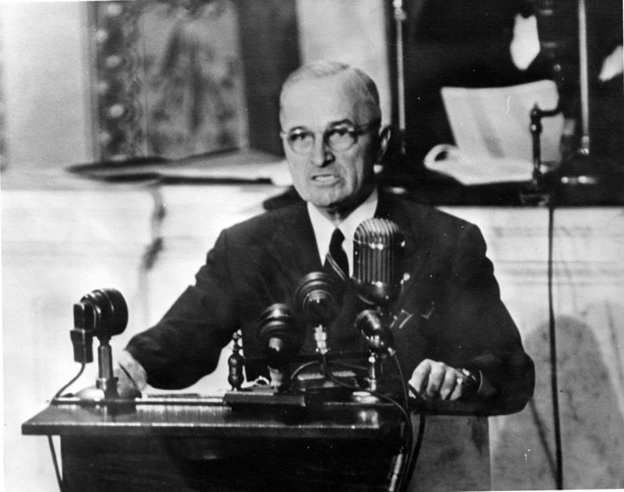
In a speech to a joint session of Congress, President Harry Truman outlines a new direction for American foreign policy. In what became known as the Truman Doctrine, the president establishes that the United States will assist all democratic nations under threat from totalitarian forces. The Truman Doctrine is aimed at thwarting the Communist expansion in Eastern Europe and other regions of the world since the end of World War II.
The president says: “One of the primary objectives of the foreign policy of the United States is the creation of conditions in which we and other nations will be able to work out a way of life free from coercion. … We shall not realize our objectives, however, unless we are willing to help free peoples to maintain their free institutions and their national integrity against aggressive movements that seek to impose upon them totalitarian regimes.”
The focus of Truman’s address to Congress is an appeal to provide $400 million in aid to the Greek and Turkish governments. Congress approves the aid request and helps stem the spread of communism into the eastern Mediterranean.
The policy of supporting democracies and preventing the spread of communism provides part of the rationale for Truman’s recognition of the State of Israel in May 1948.
The Truman Doctrine eventually is extended to other regions after the Berlin blockade in 1948, the fall of China to Communists in 1949 and the invasion of South Korea in 1950. In the Middle East, the Truman Doctrine is applied to support the U.S. interest in protecting access to oil.