Explainer: Eurovision Contest (6:12)
…event and Israel’s participation competing and hosting; examines why Tel-Aviv was chosen over Jerusalem to host the festival; and covers attempts by the BDS movement to generate controversy and protests….
The discovery of rich fields of natural gas beneath the eastern Mediterranean Sea has given traditionally resource-poor Israel the chance to supply its own energy needs, help wean the European Union off its dependence on Russian energy, and build closer economic and diplomatic ties with Egypt, Jordan, Cyprus, Greece and even the Palestinian Authority. But Israel only has a quarter-century or so to make the most of its newfound energy wealth.
The Israeli election on April 9 is just the first part of the process to decide who will lead the country. Our newest Israel on Board video explains what happens next and how the country’s government is formed.
CIE Vice President Rich Walter speaks with Eli Sperling, Academic Research Coordinator of the Emory Institute for the Study of Modern Israel and a Visiting Professor for the Tam Institute of Jewish Studies at Emory University about the influence of politics in Israeli culture.
In this four part video series, CIE Vice President Rich Walter speaks with Emory University Professor Rabbi Michael Berger about the influence of religion in Israel’s politics.
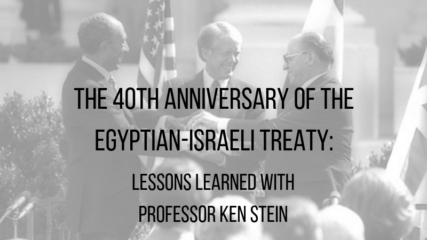
In this two-part Whiteboard video series, we explore the transition from the 1978 Camp David Accords to the Egyptian-Israeli Peace Treaty signed at the White House on March 26, 1979.
March 26, 2019 From 1967 forward, Arab-Israeli negotiations began in earnest. First under the Nixon and Ford administrations, then under the Carter administration, Egyptian President Anwar Sadat and Israeli prime ministers implemented the political trade-offs…
Our latest Israel on Board video explains how the electoral system in Israel works. The video highlights the voting process, explains proportional representation and the electoral threshold, and describes why there are so many different parties.
Professor Doron Shultziner explains the origins of Israel’s democratic norms and how the country has used Basic Laws to uphold the rule of law in the absence of a formal constitution.
An overview of the important role that Hebrew played in the Zionist movement and how the movement itself helped spur the revival of the language.
Scholars and policy experts Jonathan Schanzer, Todd Stein, Alan Makovsky and Professor Ken Stein discuss the evolution, successes, and challenges of the US-Israel relationship.
Our latest Whiteboard video explores the history and context of ultra-Orthodox deferments from the Israel Defense Forces. Beginning with the 1947 status-quo agreement between David Ben-Gurion and Agudat Israel, we explain the origins of the policy and why it has become so divisive in contemporary Israeli society.
A look into Israel’s growth and success as a technological titan and its evolution into the Start Up Nation.
Scholars and policy experts Yitzhak Reiter, Joel Singer, Jonathan Schanzer and Rachel Fish discuss potential resolutions to the Israeli Palestinian Conflict.
The second video in our new Israel on Board series focuses on a brief overview of Israel’s economy. The video emphasizes how Israel turned challenges in the country’s early years into opportunities for economic growth and investment. Additionally, we look at Shimon Peres’ role in helping Israel transition from an agricultural based economy to become the start-up nation.
In recognition of the anniversary of the United Nations’ passage of Resolution 181 on November 29, 1947, we present our newest three-part whiteboard videos providing context to this historical moment in Jewish history.
Scholars Asher Susser, Yitzhak Reiter, Yaron Ayalon and Rachel Fish discuss Zionism’s emergence, evolution, and its impact on Jewish and Israeli identity.
Professor Asher Susser describes the neighborhood of the Middle East, Arab nationalism, and the changing relationships of the region’s states with Israel.
ISMI’s Eli Sperling presented this discussion on Religious Pluralism in Israel for the Anti-Defamation League on October 25, 2018.
This presentation addresses the changing practices within shared holy places in Jerusalem between conflict and contestation with special focus on the Temple Mount compound and the Western Wall. It discusses strategies of stakeholders and conflict management methods that have been used in order to mitigate disputes as well as the incentives for tolerance and coexistence. Presenter Yitzhak Reiter, ISMI visiting scholar, is a Professor of Islam, Middle East and Israel Studies. He chairs the Department of Israel Studies and is the head of the Research Authority at Ashkelon Academic College.
Emory Professor of Contemporary and Middle Eastern History, Political Science, and Israeli Studies and Center for Israel Education President Kenneth W. Stein applies decades of document-based research, interviews and scholarship, including new insights gleaned from the study of detailed minutes in the Israel State Archives, to examine the Camp David Accords 40 years after Egypt’s Anwar Sadat and Israel’s Menachem Begin signed the agreement Sept. 17, 1978, that concluded 13 days of negotiations led by President Jimmy Carter.
Our second animated white board video covers in detail what took place during the thirteen days of negotiations at Camp David in September 2018. The video begins with Egyptian President Anwar Sadat’s priority on getting back the Sinai Peninsula which Egypt lost to Israel in the June 1967 War and the origins of direct negotiations between Israel and Egypt following Sadat’s visit to Jerusalem in November 1977.
In this animated white board video, we explore Jimmy Carter’s efforts at achieving peace in the Middle East.
Emory Professor of Contemporary and Middle Eastern History, Political Science, and Israeli Studies and Center for Israel Education President Ken Stein discusses the teaching and status of Israel on college campuses at the CIE 2018 Educator Enrichment Workshop.