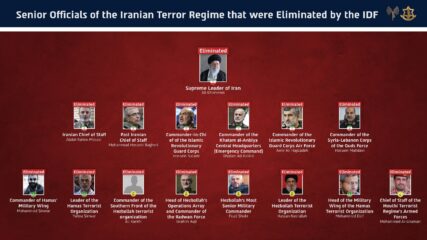
Evaluating the 2023-2025 Hamas-Israel War and Its Consequences (video, 44:06)
CIE President Ken Stein briefly reviews the 2023-2025 Hamas-Israel war and examines the short- and long-term consequences.
Compiled by Aidan New Iran, a Shia- and Persian-majority theocracy, frequently clashes with its Sunni Arab neighbors, including Bahrain, Egypt, Saudi Arabia, and the United Arab Emirates. These tensions are rooted in religious and ethnic…
Hezbollah emerged in Lebanon in the 1980s, rooted in the historical marginalization of the country’s Shiite community. Today, Hezbollah is a major player in Lebanese social and political life, wielding significant influence over both the government and the military situation.
Since Hamas and allies invaded Israel, killed 1,200 Israelis and others, and seized more than 240 hostages Oct. 7, Israel has conducted a methodical military campaign in Gaza that has uncovered hundreds of miles of…
Five months since Hamas brutally murdered 1,200 Israelis and others on Oct. 7 and kidnapped more than 240, Israel still seeks to balance freedom for all hostages with Hamas’ military and political destruction. Until the…
The 11th webinar in the Center for Israel Education’s weekly series on the Israel-Hamas war is a special one-on-one conversation between CIE President Ken Stein and David Harris, the former longtime CEO of the American…
With more than 1,200 murdered and 250 kidnapped by Hamas terrorists on October 7, the Middle East and other parts of the world continue to seethe with emotion and limitless uncertainties. Joining us for CIE’s…
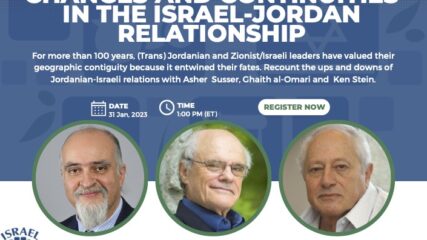
Jan. 31, 2023 In this 48-minute webinar recorded Jan. 31, 2023, two experts on Jordan, the Washington Institute’s Ghaith al-Omari and Tel Aviv University’s Asher Susser, help CIE President Ken Stein explore more than a…
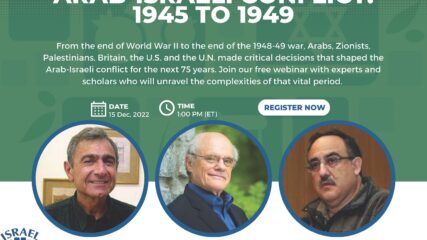
In this 46-minute video recorded Dec. 25, 2022, two emeritus professors from the Hebrew University of Jerusalem joined President Ken Stein to discuss the key period when the Zionists succeeded in creating and securing a…
Recorded March 20, 2022, this 33-minute presentation by Center for Israel Education President Ken Stein addresses how teachers’ decisions on when in history to begin the story of Israel alter what students learn about Zionism, the State of Israel and the Jewish people’s connection to the land.
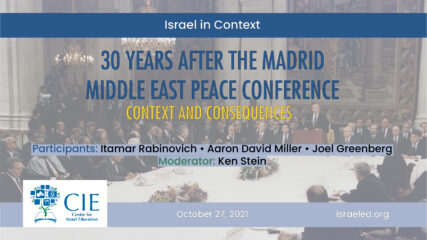
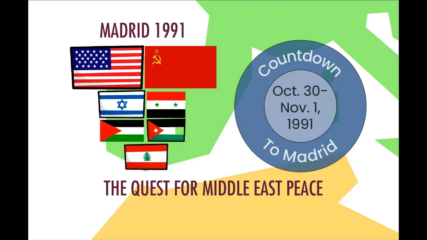
This 54-minute webinar, recorded Oct. 27, 2021, is part of the Center for Israel Education’s “Israel in Context” series and is incorporated into an extensive set of documents, study guides, videos and other resources CIE has compiled at https://israeled.org/madrid-conference/ to mark the 30th anniversary of the Madrid Middle East Peace Conference, when Israel first sat at the same table with all of its immediate Arab neighbors to talk peace.
October 18, 2021 Examine the events that led the United States and the Soviet Union to convene high-level delegations from Israel and all of its immediate Arab neighbors, as well as other regional parties, in…
CIE asked friends and experts in the field of Israel Studies to discuss the challenges and successes of the State of Israel in this past year, and to reflect on the coming year. Below, we…
CIE board members Nachman Shai, a former Knesset member and a Labor candidate in the March 2021 election, and Yaron Ayalon, the director of the Jewish studies program at the College of Charleston, discuss the decline and possibilities for revival of the once-dominant political left in Israel in a series of three online conversations held in the first three months of 2021.
Former Knesset member Nachman Shai, who reported on and worked for the Israeli prime minister, reflects on what Israel and the world lost when he was assassinated.
CIE Founding President, Professor Ken Stein and Visiting Israeli Scholar, Dr. Nachman Shai, who served in the Israeli Parliament for 10 years, explain the context and implications of the Abraham Accords for Israel and the Middle East.
Using archival and published sources, including materials from the CIE website, CIE President Ken Stein identifies six factors as reasons for the Zionists’ success: Zionist political action, the impaired socio-economic condition of the Arab population,…
March 3, 2020 Aaron David Miller analyzes the evolving role of the United States in Middle Eastern and Israeli politics and diplomatic processes. Miller currently serves as vice president for new initiatives and a distinguished research…
The analysis summarizes the declaratory or aspirational Trump Plan for a Palestinian-Israeli settlement, outlining proposals on final status issues, and the proposed economic development package, with a hope for a two state-solution. Maps are used to show how Palestine’s and Israel’s borders have changed over the last 150 years. (Video or audio)
CIE President Ken Stein speaks with David Makovsky, the Ziegler distinguished fellow at the Washington Institute for Near East Policy on June 19, 2019. The major focus of the discussion was on the upcoming US led Peace to Prosperity workshop which was held in Bahrain June 25 and 26, 2019 at which Makovsky was an observer. Stein and Makovsky discuss, in-depth, the economic summit, the Trump administration’s Middle East Peace Plan, and the prospects for success.
In this two-part Whiteboard video series, we explore the transition from the 1978 Camp David Accords to the Egyptian-Israeli Peace Treaty signed at the White House on March 26, 1979.
March 26, 2019 From 1967 forward, Arab-Israeli negotiations began in earnest. First under the Nixon and Ford administrations, then under the Carter administration, Egyptian President Anwar Sadat and Israeli prime ministers implemented the political trade-offs…
Scholars and policy experts Yitzhak Reiter, Joel Singer, Jonathan Schanzer and Rachel Fish discuss potential resolutions to the Israeli Palestinian Conflict.
In recognition of the anniversary of the United Nations’ passage of Resolution 181 on November 29, 1947, we present our newest three-part whiteboard videos providing context to this historical moment in Jewish history.