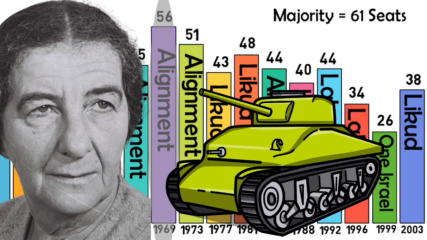
The first video addresses the first waves of Jewish immigration to the Land of Israel under the modern Zionist movement, first under Ottoman rule, then under British control. The video concludes with the first official partition proposal for Palestine, the report of the British Peel Commission in 1937.
The third video in the series examines the partition resolution and map, the reception from Jewish and Arab leaders to the UNSCOP report, and the actual vote Nov. 29, 1947.

Foreign Minister Abba Eban addressed the U.N. Security Council one day after the Six-Day War began and as Israel was moving from fear of destruction to an extraordinary military victory. He framed Israel’s self-defense after weeks of mounting danger and emotional drain.
Moshe Dayan, celebrated fighter for Zionism and the state, provides detailed and gripping glimpses of how he and his cohorts fought for Zionism in Syria in the early 1940s.
President Johnson’s remarks became the philosophical outline for UN Resolution 242 passed in November 1967. Core to his view was that Israel would not need to return to the pre-1967 war borders, and that the territorial integrity and sovereignty of all states in the region should be protected.
Two days after the conclusion of the June 1967 War, Eshkol, recounts the series of events that led to war, the war itself and the immediate aftermath. He reaches out to Arab states for peace seeking a path to peace with her belligerent neighbors. A week later, Israel will quietly messages Cairo and Damascus through the US, hat Israel seeks an end to the conflict. No answers are received.
March 1968 “The Six-Day War,” Israel Government Year Book, 5728 (1967-68), March 1968, Central Office of Information, Prime Minister’s Office The Six-Day War The short, sharp encounter that has come to be known as the…
Egyptian President Gamal Abdel Nasser asserts that the conflict with Israel is not over access to the Gulf of Aqaba but the very existence of Israel; Egypt’s foes are Britain and the United States, which support Israel.
Palestine’s High Commissioner Chancellor seeks to halt the Jewish National Home in favor of the Arabs. He fails to overcome the Zionist drive and Arab unwillingness to cooperate with his intentions.
The CIA report details Iran’s aggressive foreign policy of promoting Islam as a radical platform for governance, noting also the new regime’s vigorous anti-U.S. outlook. Viewing Iran exclusively as an asset in the Cold War and not comprehending the potential power of political Islam developing with Iran proved to be one of the greatest oversights in U.S. Middle East foreign policy in the last 100 years.
We use cookies to understand how visitors use our site and to show relevant
content across the web. You can accept everything, reject non-essential
cookies, or customize your choices.
Privacy policy.
Customize your choices
EssentialRequired for the site to work. Always on.