January 28, 2026

CIE President Ken Stein spoke about the causes and consequences of the 2023-2025 Hamas-Israel war on January 28, 2026, at Hebraica University in Mexico City. The following is a transcript of that presentation. Watch the 44-minute video here.


This presentation or my connection to Mexico City and to Hebraica comes from two mutual friends, Rabbi Analia Bortz and Mario Karpuj. Both of them were students of Danny’s in Argentina. They were rabbis, of course, in Atlanta, and they invited Daniel Feinstein to come and speak at our shul. We had just recently established it. And we got to talking about Israel studies and Israel learning, and we were doing Israel teacher workshops in Atlanta.

We had done ultimately 22 or 23 of them. And before we knew it, we had 15 or 16 Central and South American teachers participating. Half of them were Mexico City teachers. And over the corresponding five or six years, there must have been about 70 or 80 such teachers.

So it was the connection that brought me back here, basically through the unwavering, untiring, and, as I’m fond of saying in a very polite way, the slave-driven manner of my very dear friend Mauricio “Morrie” Friedman. Mauricio himself is an incredibly dedicated educator. And every time he’s asked, I’ve said yes. I believe this is the fifth time that I’ve actually been giving a presentation in this room.

I also would like to thank my staff in Atlanta, Michael, Maya, Ben, Burke, Carmen and Tiffany, for doing so much of the work that has enabled me to be here and use the content and the sources that I am, and we look forward to being joined by Giselle next week.

My topic tonight is not a good one. But let me put it differently. It’s not one that has lots of answers. It has a lot of speculation. We as historians are much better at trying to understand the past because we have a body of information. We tell that story, and then someone comes along and unravels a whole new set of information or sources, diaries, memoirs, private notes that become unfolded.

And then yesterday’s history is then revised. So we’re always going through a process of revising history and having what might be called revisionist history. I can’t imagine that some of the things that I will be saying today will not be proven to be inaccurate in the weeks and months ahead.

My task is to talk about the war, its origins, its consequences.

The war has not ended. There is a ceasefire. It was brokered by U.S. President Donald Trump in September of 2025 and ratified by the U.N. Security Council in November, U.N. Resolution 2803.

Both Trump’s ceasefire and the Security Council resolution may be found on our website. We have 150 posts in Spanish, and those documents are there in Spanish, along with lengthy introductions. The other 3,300 posts are in other languages, mostly in English. I welcome you to join our Israel learning community.

This was the fifth war between Hamas and Israel. It was Israel’s longest war, considered to be the most brutal attack against Jews since the Holocaust.

By the time the war ended, Israel had enhanced its strategic position vis-a-vis all of its neighbors, immediate contiguous neighbors, and Iran. Israel demonstrated its military might at war’s end, showed that it was the regional hegemon, at least as far as military was concerned.

The war pulled Israelis together as a people and as a nation, with Jews and non-Jews around the world supporting the state with their time, their volunteerism and their funds. But the war did not end the deep disagreements on a variety of domestic issues that still eat at and create great controversy within the State of Israel.

Here I speak of just two: one, whether the Haredim, the very Orthodox in Israel, should be conscripted into the army; and the second, whether the prime minister, his government and the Knesset should in fact rest power away from the judiciary. In other words, somehow tilting the power structure in the State of Israel.

The Israeli government, led by Prime Minister Netanyahu, would argue that already the Supreme Court had overreached, had shown too much involvement in making decisions on day-to-day life in Israel, and it was his goal and his desire and that of his coalition to at least equalize the balance, if not tilt it more toward the prime minister himself.

All sorts of interpretations were given to that, including the prime minister’s desire to control the judiciary because of his active engagement in three major judicial proceedings against him. Speculation, true or not — not for me here to make a judgment.

But the war did not end these broad disagreements. It didn’t necessarily heal some of the major cleavages that exist in Israeli society between the religious or those who want a more religious Zionism, a more religious Jewish state, and those who lean very heavily toward the secular.

There is within that statement itself a much broader topic which we could address, but we won’t have time to. It’s the whole question about Israel at 77. Is it finished?

Is it finished as a state? Is it — I don’t mean in terms of its demise — but is it finished in deciding its borders? Which the answer is no.

Is it finished in deciding the role of religion and state? Not really.

Has it finished in determining what role the state should have in worrying about minorities? If it were created for a Jewish state, and though it says in the Declaration of Independence, it makes mention of being democratic and Jewish, can that balance ever be balanced, or can those poles ever be balanced?

A major result of this war, and I think it must be said almost immediately upfront, is at no time in Israel’s history, in its 77 years, has its relationship with its major patron been as close and as deep and as so self-reinforcing. I can say that, with a high degree of certitude, that since Truman, since 1948, Israel has never been as close to the United States in so many ways, even with disagreements that often are seen in the media or heard or listened to. That relationship is deep and undivided.

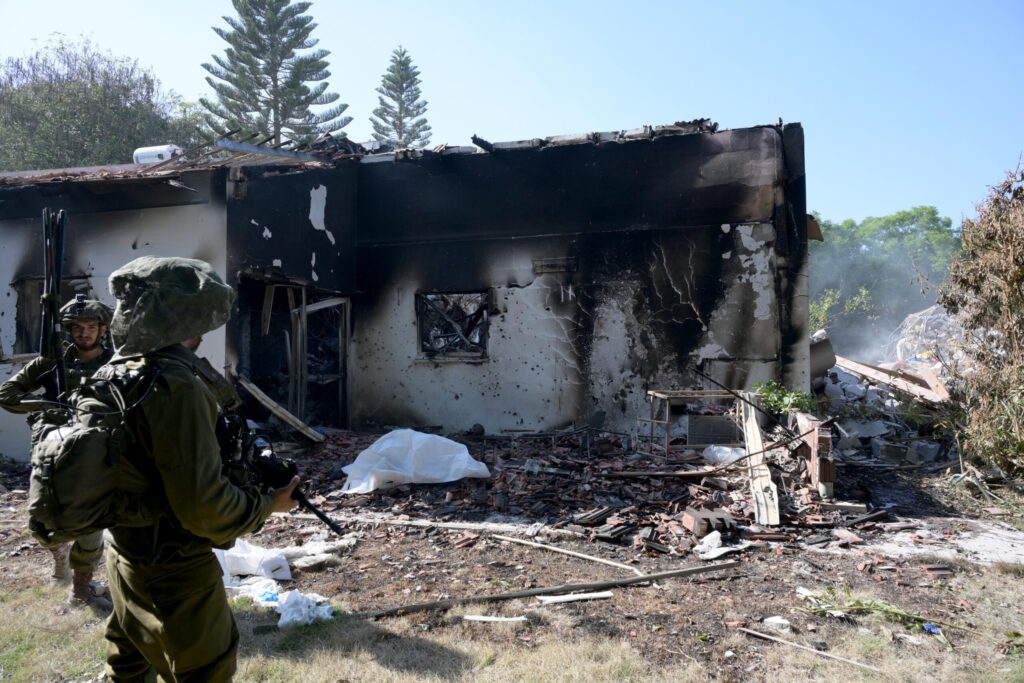
At dawn on Saturday, October 7th, Hamas launched Operation Al-Aqsa Flood, the deadliest attack of Jews, the deadliest terrorist attack in the world since September 11th.

After breaching the Gaza barrier under cover of heavy rocket fire, Hamas fighters, terrorists, crossed the 30-mile swath of land in southern Israel, overrunning at least 20 civilian communities and military bases. The orders were explicit: Kill as many people, kill as many Jews, seize as many hostages as possible.

This was not a hidden agenda. This was an agenda that Hamas had articulated, that Hamas had stated in its ideology, in its written remarks and its foundation charter of 1988, which also may be found on the website, as well as the remarks of Hamas leaders over the last 30 years about what they’ve said about Israel and what they’d like to see — namely, no Jewish state west of the Jordan River.

By nightfall on October 7th, about 1,200 people were dead in Israel, 251 hostages taken: 168 were eventually returned, 83 bodies recovered, with one body recovered this past week, the last. The hostage crisis forged a powerful emotional bond among Israelis, strengthening national resolve throughout the war.

Hamas had embedded its forces in Gaza beneath hospitals, schools, mosques, churches, ensuring that Israeli counterstrikes would generate civilian casualties of enormous proportion. Hamas was using length of tunnels that some estimated to be 500 and 800 miles long under Gaza. For the first two months of the war, The New York Times said these were alleged tunnels. It could not be proven because The New York Times did not have independent evidence.

I’m not singling out The New York Times here. What I am singling out is how the media can cover a war when it doesn’t have actually people on the ground who can report but can have people in Beirut or Jerusalem or Washington, D.C., who can be telling you exactly what they think is going on because someone made a phone call to them. And that’s how the media reported the war for the first six or eight months.

And those of us who followed the war were astonished to learn that many of the claims that were made that the Israelis had at the beginning were actually true. Others of us believed it from the outset because we had read Arabic and Hebrew sources, which had told us about the tunnels long before there was the notion that somehow Israel had invented it.

By the time the ceasefire took place in 2025, more than 60,000 Palestinians were reportedly killed, 2,400 Israelis, foreign nationals, and thousands and thousands of people injured, some tragically never to recover. By the end of January 2026, all hostages and bodies have returned home, as I noted.

Why did Hamas take hostages? To barter for the return of Palestinians held in Israeli jails, to secure agreement on how and where the war was being fought in Gaza, to extract any political or military advantage that would enable it to keep its physical presence in Gaza once the war or the ceasefire ended.

Hamas wants to be in this territory and have some sort of influence over it because, for Hamas, this is considered to be Palestinian land, and they feel by rights they should have control over it, even if it’s contained, even if it’s limited. Don’t ask me if Hamas will or will not be disarmed. People can always find arms.

Is it in Hamas’ interest to disarm? Of course not. It’s Hamas’ interest to continue its battle against the State of Israel, which is part of its charter.

Hostages were used for bartering. It generated crippling emotional pain on Israelis and Jews throughout the world for two full years. It was the focus of attention of world Jewry. How were the hostages being treated? When would more come home? What more could the Netanyahu government do? Why wasn’t it doing more?

And those questions were never answered. But it was a gripping example of what Hamas wanted to do to Israel and to the Jewish community: squeeze it emotionally, remove its resilience and identity to the State of Israel as best it could, and knowing full well that Israel’s military response on mosques and in hospitals and in the public square would in fact kill civilians, and the international media would actually come down hard and repeatedly on the State of Israel. In that sense, Hamas cleverly succeeded.

Hamas’ motivations were threefold. Its mass Jewish casualties aimed to derail Arab normalization with Israel, especially weakening the Palestinian Authority, which it thought was unlawfully in control from Ramallah because the Palestinian Authority had in 1993 signed an agreement with the Israeli government of mutual recognition.

For Hamas, the PLO recognition of Israel was like a rabbi eating pork. It was inexcusable, should not have been done because no Arab state should give the Israelis any sense of sovereignty or notion of peoplehood. Jews are not a people, according to them. They’re not a state, and they certainly don’t deserve sovereign territory west of the Jordan River. This is not information which Ken Stein has invented. This is all information which is heavily documented by Hamas’ own statements and by its own ideology.

Regrettably, too many people in the West and too many Israelis did not read, did not understand, did not comprehend, nor did they digest exactly what Hamas stood for and what it spoke for. And yet this was the fifth time that Hamas had engaged Israel in a war of any duration. The last ones lasted for two weeks, three weeks, four weeks, maybe five weeks. This one was 737 days.

Hamas leader Yahya Sinwar made Hamas’ objective unmistakably clear in May of 2021, reaffirming Hamas’ doctrine of Israel’s eradication through arms he had. He also lavished praise on Iran for its financial and military support. In 2019, the Revolutionary Guard commander Hossein Salami described Israel as a cancerous tumor destined for destruction. Ayatollah Khamenei, himself the head of the Iranian Islamic Republic, reiterated similar statements in 2024, portraying Israel as illegitimate, unstable and temporary.

An Israel airstrike killed Salami in June of 2025.

Within Palestinian politics, Hamas had since its founding been insisting on total control over the Palestinian national movement. All the land west of the Jordan River should belong to the Palestinians. Israel should never have been sanctioned by the United Nations. Israel should never have been recognized by the U.N. or by the United States or by 80, 90, 100 other countries or more, and certainly Hamas was acidly opposed, avidly opposed to Sadat’s peace with Israel in 1979.

Hamas never made that a hidden statement, but people were not listening. And in a moment maybe I’ll give you an explanation as to why. For Hamas, any additional agreement between Israel and Saudi Arabia, whether tacit or quiet or public, could not be tolerated. It couldn’t be tolerated because Saudi Arabia was considered to be the guardian of the Muslim holy sites.

Moreover, it was intolerable for Saudi Arabia to even embrace the possibility of having a quiet agreement with Israel because that was contrary to Iran, Hamas’ patron and historic ideological rival of Saudi Arabia. The Iranian clerical leadership, as the leaders of the Shia Islamic community, have always believed that the Sunni Saudi family lineage were wrongful inheritors of Muslim leadership worldwide, which they find was usurped from the Shia guidance in the seventh century.

October 7th, Hamas leadership believed that the Israeli public was so internally fragmented, weak and incoherent that it would fray. Hamas saw others across the world were witnessing in Israel massive demonstrations against the prime minister and his government policies. Hamas leaders believed that Israeli society and its social fabric was torn apart, that it could not muster a successful or prolonged military reply to the Hamas attack.

Hamas at its foundation in 1988 wrongfully built its organization on the assumption of — I don’t know if it was wrongfully for them, but wrongfully in terms of the outcome — built its organization on the assumption that Israelis were not a people. They therefore lacked the will and the stamina to fight for their land and their country. Israelis were fake. Israelis were an invention. Israel only came about because of what Europeans did to Jews for centuries. Hamas believed, like other Arabs and Palestinians, that Israel was invalid.

Israel’s response to the Hamas attack of refusing not to defend itself or move from its ancestral home showed exactly to Hamas that Israel was not artificial, that Israel was resilient. That as Golda Meir once said, “We have no other place to go.”

Hamas leaders, and this we’re less sure about, believed or were mistakenly assured in conversations that anti-Israeli elements of the axis against Israel, Iran, Hezbollah, Islamic Jihad, the Houthis, they would join in attacking Israeli population centers in what was hoped would be a long war of attrition.

Hezbollah in southern Lebanon did join the struggle against Israel on October 8, but it did not launch a massive barrage using even a third or let alone a quarter or maybe even only 15% of the 150,000 missiles in its arsenal. It didn’t join Hamas in the attack, and that in its major sense gave Israel an opportunity to hold off from worrying about a massive war with Hezbollah in the north and could, as was said by its own leaders, tend to business and tend to Hamas.

Hezbollah refrained from massive engagement. It was concerned that Israel would stave off Hamas’ attacks and turn its highly effective and feared air force against the Hezbollah leadership. Hezbollah actually only bought a year because a year later Israel actually killed their No. 1 and No. 2 persons in leadership, and they actually crippled or decapitated another 2,000 to 4,000 Hezbollah leaders.

It was remarkable, as an American, since I followed U.S. relations with the Middle East for all 50 years of my academic involvement, it was remarkable to me how two presidents of two different political parties responded with immediacy in actions that pushed back against what Biden called the evil of what had been done and what Donald Trump actually did in the use of U.S. forces in bombing the Iranian nuclear facility Fordow in June of 2025.

Biden immediately sent U.S. aircraft carriers to the coast of the Mediterranean to warn Hezbollah. And I remember Biden vividly saying, “Don’t. Don’t.” He essentially meant “Don’t ratchet this up.”

So America’s presence and America’s involvement meant a great deal to the State of Israel, which proved that over the long haul those in the United States and those elsewhere who’ve advocated for a strong U.S.-Israel relationship were, in fact, correct. They were justified. That all these long years of seeking American support for Israel’s ability to defend itself was, in fact, taking very real shape in a war that was attacking Israel, that was inside Israeli borders of 1967.

Each of the short previous wars concluded with an intense, nationally sanctioned, foreign policy ceasefire. Think about the present time as I say this. And each time Hamas survived as a political movement, even when its military capabilities were dramatically reduced. Every time Hamas succeeded in having the international community criticize Israel, or worse, for using overwhelming force and harming civilians in Gaza. It was another act in the same play.

There were variations in the themes. But the hero and the heroine, the villains, the victor and the vanquished, or those who didn’t end up being victor and vanquished, still remain the same. From the 2003-2005 clash, Israel’s prolonged military response unfolded among the international community of nations a persistent and virulent barrage of antagonism and condemnation, virulent antisemitic outbursts — I can’t say the international community was responsible for that; individuals were responsible — and calls for sanction and actually elimination of the Jewish state.

I had taught at Emory University for 45 years. Never once did I ever see a demonstration of people marching across that campus that said, “End the occupation from the river to the sea.”

Now universities acted differently. Some acted with immediate response. Some were more tolerant, some were less so with the demonstrators. A lot of it had to do with the climate of center-left politics that had come to take hold of many American campuses. Center-left politics are not necessarily negative. They’re not necessarily bad. But they tend to align with the underdog. And here the Palestinians were clearly seen as the underdog.

I’d like to, at this juncture, make some comparisons and maybe some lessons learned of this attack in October 2023 and the attack on Israel that took place 50 years earlier on Yom Kippur on October 6, 1973.

After Israel’s decisive victory in ’67 — what do you want from a historian? I’ve got to teach history. After Israel’s decisive victory in the Six-Day War, the June war, there was a strong belief in Israel that its military was invincible. The IDF’s quick and overwhelming victory over Arab forces had only increased the national sense of military superiority, but also established a psychological belief that Israel was untouchable on the battlefield.

The mindset was reinforced by the high-tech military equipment that Israel acquired, used, successfully built and developed, tanks, advanced surveillance technology, which gave Israel a distinct advantage.

In the ’73 war, Israel was militarily ready, but it wasn’t willing to pre-emptively strike. I don’t know if that’s complacency. That was a feeling of “no one can touch us.”

When, in fact, Sadat and the Egyptian army crossed the canal, they destroyed the Bar-Lev Line on the eastern side of the canal. Syria invaded from the north, came all the way down to the B’not Ya’akov Bridge, actually into what was pre-’67 Israeli land, and the Israelis had to regroup, reorganize and respond in a manner that at least the war would restore Israel’s deterrence and maybe even end up with military advantage.

When the war ended in ’73, Israel was 101 kilometers from Cairo, 60 miles, a relatively small amount of distance.

In the 2023 Gaza war, there was a perception of deterrence. Israel’s primary strategic doctrine was based on deterrence. The Iron Dome missile system, advanced intelligence capabilities were seen or believed to be nearly impregnable against threats from Hamas and Hezbollah.

Israeli policymakers and military leaders believed that Hamas, despite launching sporadic attacks, did not possess the capacity, let alone the will, to escalate into a major coordinated assault that might be joined by others in the Axis of Evil. They believed that their technological advantages and military superiority would effectively neutralize a large-scale attack.

Actually, it wasn’t a large-scale attack. It was a pretty small attack but very concentrated and most brutal.

Hamas had gradually built its military capabilities, including larger stockpiles of rockets, drones, tunnel infrastructure. Israeli intelligence apparently, and I say apparently because we haven’t, we don’t yet have a full finding of what Israeli intelligence believed or what they knew or what was actually actionable intelligence, failed to understand the level of preparation that Hamas was making for a war.

There was a false sense of security derived from Israel’s historical military successes. This led, I think, to a degree of complacency of those in leadership positions — political, military, let’s leave that for commissions of inquiry if that’s what they’re going to find. In the ’73 war, it was an underestimation of Arab intentions, signals from Egypt and Syria, if the dots could be connected. Suggested military mobilization and vague diplomatic maneuvers were interpreted as part of routine posturing.

But there were knowledge gaps. Israel’s military intelligence service had information about Egyptian buildup near the canal, but it dismissed it or dismissed a good portion of it, interpreting it as a possible ploy to gain leverage in negotiations rather than a precursor to war. In other words, if you want to believe an outcome, you can channel the information that you have into the conclusions that will ratify or give support to those conclusions.

That’s why you always need people in intelligence who are seeing the information, seeing the conclusions, and then take the conclusions and turn it on its head and say, “Supposing we’re just totally wrong.”

Now, when you’re in a State of Israel that has a very narrow waist, your goal is not to fight a war on your territory but to fight a war on their territory. Your goal is to use your citizen army in a short war so the citizens who are taken into the army as reservists don’t have to take so much time out of their economic engagements. Those have been two parts of Israel’s foreign policy and military doctrine since Israel was created in ’48.

And I can’t speak for the 2023 war because there’s so much that we still don’t know, but there was a failure to predict that Hamas would do, in fact, what it did. Hamas’ attack was not large scale. It was very focused and was very low-tech: bulldozers, Ford F-150s, small Toyota wagons, motorcycles. This was not a missile that was being fired from Tehran or near Tehran 1,200 miles away.

The October 7th attack was a coordinated affront on Israel, combining rocket barrages, ground infiltration, terror attacks on civilian targets. Israel’s intelligence apparatus missed the scope of the assault, missed the timing, and there was an overreliance on technology. Is that complacency? I was 5,000 miles away from Israel. I don’t have the audacity to even say that the Israelis were complacent.

It seems from afar that there were certain conclusions drawn about what Hamas would not do. Most significantly, and here I emphasize most significantly, there was a belief among some in the Israeli political establishment and maybe the military establishment too that if Hamas, if Hamas, who controlled Gaza, could have Palestinians come into Israel on a daily basis and earn a wage and come home with money in their pockets and put that money on the table for their families, that somehow that would assuage their ideological passion to destroy the State of Israel and kill Jews.

The notion that you can economically neutralize, purchase, I don’t know what the right word is, someone’s ideology if they’re terribly committed to it was proven not to be possible.

And I might say as a historian, in the 1930s there were elements within the socialist Labor Party that actually believed if Jewish immigration to Palestine, land purchase and building the economy, reducing infant mortality, increasing the engagement of Arabs in the educational system because of Israel’s contribution to the tax revenue, that somehow the Arabs, their antagonism to the State of Israel with Palestine at the time would be neutralized.

For some it was. But for the elite that were, I would say, rabid in their antagonism for the State of Israel, that’s so not the case.

In 1973, Sadat went to war, at least he claims this, he went to war not to destroy the State of Israel, but only to cross the canal and get America’s attention. There was a communication which Sadat had with the CIA on the second day of the war in which he said to Henry Kissinger, who was then National Security Council adviser and not yet also secretary of state, “Mr. Kissinger, our goal is to get you engaged in a process where we can be more of assistance to you in the Middle East.” He didn’t say anything more than that.

Now Kissinger, the Machiavellian Realpolitik man that he was, looked at this document, according to Kissinger’s own acknowledgment, and said, “This guy’s got balls.” I was going to say chutzpah, but it’s about the same.

Sadat went to war. He almost lost it. He almost lost the 15,000-man Third Army that was surrounded by Israelis.

Kissinger understood that Sadat and Meir could, if they were willing to trust the United States, could inch closer together. No one was talking about peace. No one was talking about treaties. People were just talking about maybe reducing the chances of another war.

And from ’73 until ’79, that’s what happened. Sadat kept his foot on the pedestal. Sadat kept pushing for an accommodation with Israel where he’d get back Sinai and he could turn Egypt away from the Soviet Union.

Hamas did not go to war in order to message the United States that it was interested in a peace with the State of Israel, or it was interested in inching toward no more war. That’s not why Hamas went to war in October of 2023. And that has to be clearly mentioned as a distinguishing element.

What lessons might be learned?

Overconfidence and complacency, if they apply, can be dangerous to a state that’s a minority state in terms of its Jewish presence in the greater Muslim Middle East.

Intelligence needs humility in its analysis always. Underestimating the resolve of the adversary? You can’t ever do that.

Misreading signals and the importance of crisis awareness? Take heed. Understanding the psychological dynamics of your adversaries is terribly important.

Acknowledging that asymmetric warfare is not the same as fighting army to army. Understand that there can be an overreliance on technology, but there can’t be an under-reliance of it either.

And, finally, recognize there are existential threats.

Israel in the Middle East in 2025 is not Israel in the Middle East when Egypt signed its peace treaty with Israel in 1979. Israel in the Middle East in 1979 can best be described as a region that was part of a global balance of deterrence, balance of power. There were patrons. There were clients. You knew who was on one side.

Syria was stable. Lebanon was relatively stable. Jordan was relatively stable. The PLO was relatively weak. Egypt was stable.

Now you’re at the end of this war in early 2026. Lebanon is unstable. Syria is trying to gain its stable legs. Israel is in control of Gaza, 52%, but it means Hamas is in control of the other 48.

So the strategic balance has shifted, but Israel is less likely to reach out for any kind of unilateral or even negotiated withdrawal from any territories. The Israeli government in 2024 passed a couple of Knesset laws or resolutions, said that Israel was totally opposed to a Palestinian state. And yet the international community continues to preach, harp, demand that the two-state solution is the only real endpoint at which these two sides could live together.

But maybe it’s possible that these two sides don’t want to live together. Maybe they don’t want to share the land west of the Jordan River. Maybe they’re totally opposed to the other deep, deep down, and they don’t have any interest in reconciliation. But they’ll use the process of negotiations not to reach a conclusion.

Is that possible? It can’t be discarded from reality.

In whose interest is a two-state solution? You have to ask yourself the question. Will it make the Middle East more stable? Will countries no longer want to usurp the agency of the Palestinians? Will Iran be any less active in trying to shape Islamic Jihad or Hamas or other Arab states who want to continue to use the Palestinians as a pawn in their inter-Arab politics?

Lastly, Israel’s relationship with Iran remains open-ended. There’s no doubt that Iran was set back militarily because of two swarm missile attacks against Israel in April of 2024 and again in October 2024. Israel was able to essentially mow the grass and create air corridors for itself that eventually enabled the Israeli Air Force to have unimpeded access to the skies in June of 2025.

Iran could never have guessed that not only the U.K. and the U.S. and Jordan and other Arab states would lend support to Israel in pushing back these swarms, but they would actually hope for a diminished Iranian presence in the Middle East.

Reality is, Iran has between $33 [billion] and $43 billion in petrodollar assets that come to it annually. China takes between 80% to 90% of its oil. And China’s thirst is unending. Iran will be and continue to be a player in the Middle East because it has oil, because it has petro-wealth, and so will the Saudis. And so will Israel because of its military and its economic strength.

Turkey’s seeking to play a regional role perhaps. And certainly there’s Qatar, which has a definite interest in supporting Hamas and Turkey, even if behind the curtain.

So the region has changed in terms of what’s on Israel’s immediate borders. But is it a long-lasting change?

And I’m not yet convinced that is the case.