United Nations Adopts Resolution 242CIE+
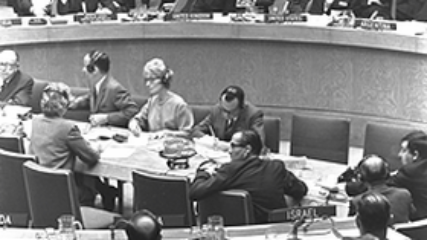
In the wake of the June 1967 Six Day War, the United Nations Security Council adopts Resolution 242, a document which has served as a framework for all major Arab/Israel negotiations since.
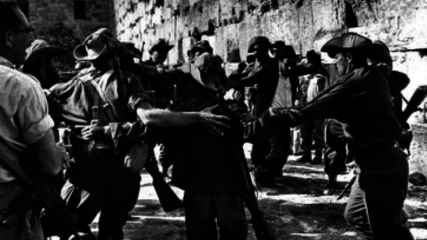
Following Israel’s victory and subsequent acquisition of Jordan’s territory along the West Bank of the Jordan River in the war, the Israeli government annexes roughly 70 square kilometers of land next to West Jerusalem.
February 2, 1965 The Knesset revises the Absentees’ Property Law to allow the Custodian for Absentees’ Property, a state office, to maintain, rent or sell property in Israel held in a waqf, an endowment created…
The Palestine Liberation Organization (PLO) is established during a Palestinian National Council meeting of nearly 400 delegates convened by King Hussein of Jordan.
IDF troops kill 48 Israeli Arabs returning from their fields at dusk.
Killed in an ambush along the Gaza border, Ro’i Rothberg is eulogized by Moshe Dayan. Rothberg becomes a symbol for the inability to achieve peace in Israel’s early years.
Two Israeli paratrooper platoons made up of approximately fifty IDF soldiers storm an Egyptian army camp in Gaza. The raid is a reprisal for continued fedayeen (Palestinian militants) attacks against Israeli civilians.
Created in 1920 to serve as a neutral, independent trade union representing all Jewish workers in Palestine, the Histadrut had grown to 503,000 members by 1953, representing approximately 75% of the country’s workers.
Jordan formally annexes the West Bank and East Jerusalem, allowing the Palestinian inhabitants therein to obtain Jordanian citizenship.
December 11, 1948 The United Nations General Assembly passes Resolution 194, addressing “the situation in Palestine” amid the ongoing Israeli War of Independence, on a vote of 35-15 with eight abstentions. The resolution never references…
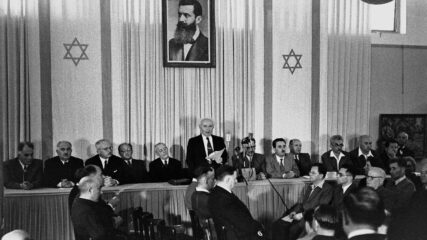
On Friday afternoon in the Tel Aviv Museum, David Ben-Gurion, chairman of the Provisional State Council, declares Israel’s independence. The United States is the first country to recognize the new and already besieged state of Israel.
April 22, 1948 As communal violence increases with the approaching departure of British troops and expected declaration of Israeli independence, the Haganah seizes Haifa, and as many as 25,000 Arabs flee the city, possibly in…
The United States was deeply worried that supporting the establishment of a Jewish state would jeopardize Arab oil supplies and force the US to send troops, risking a confrontation with the USSR.
A two-day debate on the future of Britain’s presence in Palestine begins in the British House of Commons. Eventually it is decided to terminate the 1922 League of Nations Mandate for Palestine.
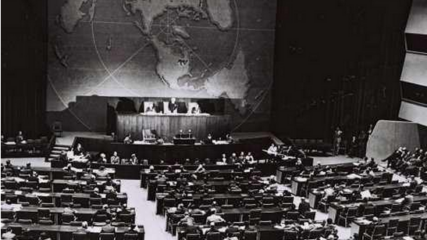
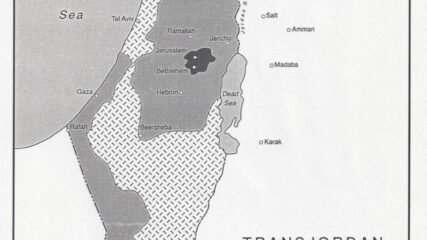
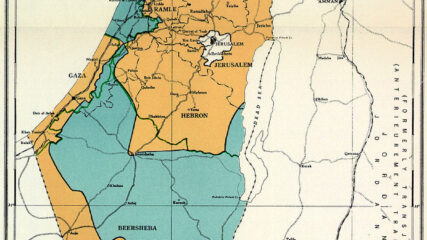
The United Nations General Assembly passes Resolution 181 by a vote of 33-13 with 10 abstentions. The Resolution recommended the creation of separate Arab and Jewish states in Palestine, linked by an economic union.
September 29, 1947 The Arab Higher Committee for Palestine formally rejects the U.N. Special Committee on Palestine’s partition plan, which advocates for the division of the land into a separate Jewish and Arab states and…
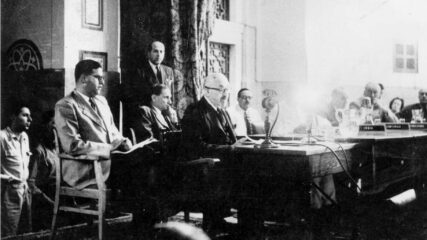
The United Nations had set up UNSCOP in April 1947. Its purpose, like previous commissions that visited Palestine, is to investigate underlying causes for communal unrest and to make political recommendations about curtailing violence.
May 4, 1947 The Irgun sets off explosives at 4:22 p.m. to blast open a hole in the wall of the Acre (Akko) fortress, used as a prison by the British Mandatory authorities, in an…
April 2, 1947 The British government notifies the United Nations of its intent to bring the question of Palestine’s future before the next U.N. General Assembly. The United Kingdom also requests a special General Assembly…
The British respond to rising violence in Mandatory Palestine by asking the United Nations to figure out what to do.
A Land Transfer Committee report reveals that Arabs in Palestine willingly continued to sell land to Zionists in the early 1940s despite the British legal prohibition on doing so.
The Mufti has enormous power in his hands, yet he chooses non-engagement with the British, who controlled Palestine.
A specialist in the field of educational psychology, Gavriel Salomon served as Dean of the Faculty of Education at the University of Haifa from 1993-1998.
At the conclusion of a four-day conference in Cairo, Egypt, Arab leaders adopt the Resolutions of the Inter-Parliamentary Congress. The conference and resolutions are a response to the British Peel Commission Report of 1937.