July 3, 1930
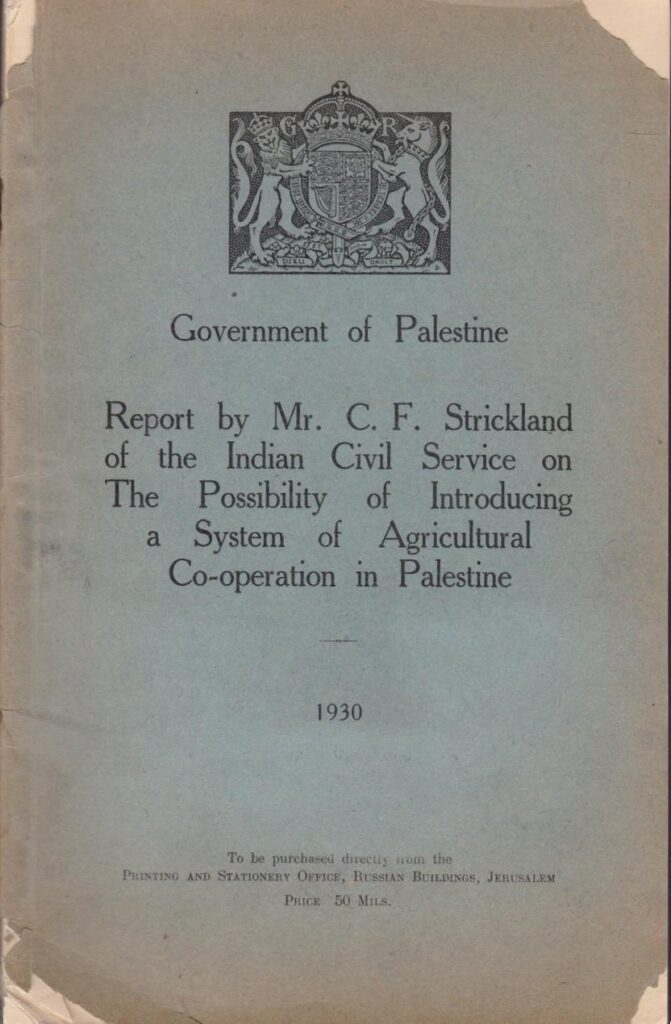
After the 1929 riots in Palestine, the British government launched a series of intense and detailed investigations into the economic and social conditions believed to underlie Arab unrest. Among the most detailed, erudite and influential was this report by C.F. Strickland, formerly of Britain’s civil service in India. Strickland’s observations and findings from the first half of 1930 greatly influenced Sir John Hope Simpson’s July 1930 report, which in turn influenced the Passfield White Paper in October 1930.
Hope Simpson’s negative view toward the Jewish national home was strongly affected by Sir John Chancellor, Britain’s high commissioner in Palestine. Hope Simpson readily agreed with Chancellor’s view that the Jewish national home should be slowed down if not stopped. Personal ambition also appears to have had a role. Hope Simpson wanted to succeed Chancellor as high commissioner and sought Chancellor’s endorsement at the Colonial Office. In the broad context of British reports on the reasons for Arab unrest in 1929, Chancellor influenced the view reported by the Shaw Commission that Jewish immigration was the key cause for Arab anger. Ultimately, Hope Simpson did not receive the appointment.
Strickland did not argue that Jewish land purchase caused Arab peasants’ economic decline. Nor did his report seriously examine the Jewish contribution to Palestine’s wider economy, including the substantial Jewish tax revenues that helped finance British public works. Instead, he focused on the impoverishment, indebtedness and vulnerability of the Arab fellaheen. For 1930, he estimated that roughly 100,000 Arab peasants were heads of households and that four out of five were in some form of debt. The 1931 Census of Palestine confirmed Strickland’s estimate: These heads of households supported more than 500,000 individuals.
His proposed solution was the creation of cooperative credit societies. Ideally, each village would have its own credit cooperative, overseen or assisted by a government representative, to help peasants escape agricultural insolvency. Yet Strickland recognized that village societies were divided by family, clan, status and local rivalries, so cooperation over credit controls could be rancorous. In some places, he suggested two or three cooperatives might be necessary within the same village area. He also argued that Jewish cooperatives could not realistically serve Arab villages because the level of confidence between the two communities was too low. In this respect, his diagnosis was sociologically alert, but his confidence in bureaucratic remedies was naïve. By contrast, Jewish self-created cooperative credit societies were functioning because of the collaboration among participants.
Strickland also wanted a method for collecting outstanding debts before viable credit societies could function. Indebted peasants, however, were hardly eager to enter a scheme that might expose the full weight of their obligations. His enthusiasm for cooperative credit stood at a pronounced distance from the sullen, exhausted and economically battered Arab peasantry he hoped to rescue.
Subsequent British reports, including those by Johnson-Crosbie and Lewis French, adopted a similar view: The Arab peasant needed protection against both natural hardship and man-made economic pressures. Yet the practical results were meager. The British did not provide meaningful agricultural credit services, did not unfold a Palestine-wide development loan and did not significantly reduce peasant indebtedness. In the early 1930s, the British administration did remit rural taxes for five years, but that relief was as limited as it was temporary. The Arab population continued to grow slowly as infant mortality declined and longevity increased because of Jewish funding and British assistance to all populations. Arab peasants in Palestine found no debt relief from money lenders and political leaders. Rural change and peasant destitution contributed to the Arab unrest from 1936 to 1939.
Strickland’s report contained useful recommendations, many of which were not implemented. He favored compulsory collective marketing of oranges; he dismissed the idea of providing Arab peasants with “valuable” cows, arguing that at their “present stage of understanding” they would not feed or maintain them properly. Any progress in dairy production, he believed, would likely occur near Jewish dairy colonies. He also advocated urban credit societies, the introduction of uniform weights and measures to replace local variations, and the installation of a loudspeaker in every village to broadcast important government announcements.
In the end, Strickland’s report mattered less for the reforms it produced than for the assumptions it reinforced. Britain recognized Arab peasants’ poverty and indebtedness but refused to spend the money necessary to transform rural conditions. As a general rule of British expenditures in its colonial administrations, each location was to support local services, which usually meant, first and foremost, allocations for roads, installations for governance, port facilities and communication needs. Instead of financing agricultural reconstruction, reducing debt or creating effective credit mechanisms, British policy increasingly maintained the status quo and moved to contain political unrest. Protecting the Arab peasant became, in practice, less a program of economic uplift than a justification for restricting Jewish land purchase.
That logic culminated in the 1939 land transfer regulations and immigration restrictions that sharply limited the expansion of the Jewish national home. Strickland correctly diagnosed rural distress. The British converted that diagnosis into mechanisms for restraining Zionism and diminishing Jewish growth rather than seeking to fix, even in a limited way, the structural causes for Arab rural impoverishment that stretched back to Ottoman times. Those roots of rural poverty were exacerbated with terrible consequences by drought, locusts, the uprooting of olive trees during British-Ottoman fighting in World War I, and Arab elites who thought nothing about keeping peasants in perpetual debt.
Strickland found the following:
- Annual indebtedness of the Arab peasant was at 30% to 50% or more of assets.
- Burdensome rates of usury amounted to 30% to 200% per annum.
- The late 1920s saw a series of poor yields in crop output.
- The agricultural economy was beset by episodic drought.
- Uneconomic collaborative land use was vastly employed (musha*).
- Economically untenable land parcel sizes were all too frequent.
- The absence of an agricultural bank, agricultural credit or Arab financial credit cooperatives blocked the betterment of the rural population.
- Jewish credit societies were good and demonstrated a healthy, cooperative spirit.
- Factionalism hampered Arab village harmony.
- Fellaheen mistrusted their village leaders, mukhtars and effendis; these notables and local leaders failed to assist them in honest or unbiased ways.
- The annual transfer of a peasant’s entire crop to creditors to satisfy debt was all too frequent, often in advance of the harvest, making the peasant sullen because his output would inevitably go to someone else.
* Musha was a communal system of land tenure and land use practiced in Palestine, Syria and elsewhere in the rural Middle East, whereby parcels of village lands were redistributed every two or five years (or other intervals). Regular reallocation of village lands stifled long-term agricultural investment by a peasant because “his” lands would devolve to another at a subsequent distribution. In 1923, British officials estimated that 70% of rural Arab agricultural lands were used in this manner.
— Ken Stein, June 21, 2026
Government of Palestine
I was directed by the Secretary of State in his letter No. 77288/30, dated 3rd July, 1930, “to proceed to Palestine to study the economic position of the fellahin and to instruct the officers of the District Administration and the fellahin as to the objects and methods of the working of cooperative credit societies.” I interpret this mission as covering all forms of cooperative societies, not merely credit.
1. I arrived in Palestine on July 10th, and have traveled to all parts of the country, visiting Arab villages and Jewish colonies with the assistance of Area and District Officers and of Jewish cooperators. The recommendations contained in this report depend for their fulfillment to a large extent on the measures which may be introduced in accordance with the report of Sir John Hope Simpson and, to the best of my belief, do not conflict at any important point with the recommendations which he is likely to make.
2. The Arab cultivator of Palestine is a man similar in temperament, standard of life and agricultural practices to many of the Muslim cultivators with whose conditions I have been familiar in the north-west of India. He appears, however, to enjoy a slightly higher percentage of literacy and a very acute intelligence. He may be compared favorably in the latter with certain of the peasant classes in Southern Europe. Prima facie there is no reason why he should not attain the same level of prosperity and adopt equally progressive methods of agriculture. His trouble, however, is his debt; so long as a small cultivator sees the burden of his debt to be so great and the rate of accruing interest so high, that not only the present produce of his fields but even the increased amount of produce which he may hope to secure by minor agricultural improvement are insufficient to pay off his creditors, he will make no sincere attempt to alter his plan of cultivation. If his present crops allow him only to pay one-half of the interest upon his debt, there is little inducement to make such improvements as will enable him to pay three-quarters of the amount. The benefit will fall entirely into the hands of his creditors, while he will only labor the harder without hope of reaching freedom. His debt is declared on all sides to have increased seriously in recent years; it is due partly to a succession of bad seasons which have rendered him unable to pay his tithe and other taxes, but more than all to the disastrous fall in agricultural prices which has marked the last two years. I make no comment on the scale of taxation, which does not fall within my terms of reference. To these troubles must be added the natural unpunctuality of an illiterate cultivator, which leads to an accumulation of compound interest; a tendency to extravagance on the occasion of marriages (instances ranging up ₤2000 have been brought before me, though I do not suggest that they are frequent or general), and the lack of control over the credit which he has received at cruel rates of interest from the merchants or professional money-lenders. These rates appear to vary from a nominal 30% to a nominal 200% per annum, the actual rate being on account of deductions and frequent compounding, somewhat higher than the figures shown here. Since the Turkish law prohibits a rate of interest in excess of 9% the pro-note is drawn up in a form concealing the exact nature of the transaction; either it shows that the borrower has received a larger sum than that which was actually paid, e.g. ₤15 instead of ₤10, or a fictitious sale of goods is included in the terms, and if the goods change hands at all they are immediately returned to the lender. The case of a cat, which carried two tablets of soap across a table from the creditor to the debtor, who thereupon agreed to buy for ₤50 “the load of soap borne by this animal,” may be mythical but indicates a common method of evading the law. The total amount of debt has been estimated at ₤2,000,000 and the number of cultivating families to be 80,000 to 100,000. The average per family would thus be ₤20, and a normal cultivator’s holding may be 100 dunums or 23 acres. These figures, however, are uncertain, and it is not always clear when they are quoted whether they include the debts of the Bedouin and of the Jewish colonists, and whether they include recent productive as well as old and unproductive debt. I have made no attempt to arrive at a more accurate figure, but my enquiries in the villages have shown me a number of cultivators whose debt ranges from ₤10 to ₤1000. There are also a few who are entirely free. It appears in any case that the amount of debt is not only burdensome and such as hampering any attempt at progressive agriculture, but that no small percentage of the cultivators are entirely insolvent, and neither cooperative credit nor any form of State loans can place them on a solvent footing, if the whole nominal claim of their creditors is to be repaid.
3. The cultivating methods of the small Arab farmer are as primitive as in the majority of undeveloped countries. In the hills, at least, he uses the nail plough which merely scrapes the surface, and it is not easy, in consequence of the stony soil, to introduce a more powerful implement. The terracing of hillsides, though excellent in some places, is unsatisfactory in others, and a progressive denudation of the slopes is clearly proceeding where the terraces are not well maintained. It is not surprising therefore that his estimated out-turn of wheat is about 60 or 70 kilograms per dunam or between 500 and 600 lbs. per acre, while the milk output of his cows is optimistically guessed at 200 gallons per annum. A casual observer might prefer a much lower figure. His backwardness is due to lack of opportunity as well as lack of security in the past, to instability of character and to the load of debt which hampers all his operations. It is useless to suppose, for the reasons given above, that a serious attempt at agricultural improvement will be made before he has been relieved from this debt or has been led to realize that a sustained effort can in the end relieve him from it. The insistence of his creditors leaves him at present barely enough for his subsistence, and it is only natural that if easy and uncontrolled credit be given to him from any source, he will misuse a bounty the value of which he has had no chance to learn. It may be possible, in addition to affording him a controlled source of credit to proceed direct to the organization of marketing, but here again the difficulty will be the character of the Arab peasant. So long as his outlook on life is hopeless and his attitude towards his fellow villagers is one of suspicion, he will seldom be loyal to a marketing association, and without the intention of loyalty on his part it will be difficult to enforce any marketing contract which he may enter into and break. The problem is very similar to that of Ireland and Germany fifty years ago and of many peasant countries in Eastern Europe and in Asia. Stability of character is a plant of slow growth, but without it there is no hope of freeing the peasant permanently from the debt which he has learned to regard as inevitable; still less is it practicable to undertake those more advanced forms of cooperation or agricultural organization which require a broad view beyond the confines of the village. It may be argued that certain countries have undertaken marketing as their chief from of cooperation, but wherever the peasant was originally indebted, as in Ireland, it must be remembered that the credit societies, though they have now receded into the background, were the first stage in the building, on which the creameries and other bodies have now been superposed.
4. The first essential therefore for the organization of the Arab fellah is to provide him with the current resources through a cooperative credit society (leaving the clearance of his major debt to a later time) to form his character slowly in such a society during a term of years, and to train him to watch his expenditure and submit it to the criticism of his fellow members, to be punctual in payment, and to be loyal to his society rather than to those creditors who are the cause of his afflictions. It must be realized that it will not be possible to achieve this result through an Agricultural Bank. In almost every village when I asked the fellahin to offer their own solution for their difficulties they replied with a demand for an Agricultural Bank. In many cases I am convinced, and a short cross-examination strengthened me in my opinion, that they had no idea what such a bank is. They were merely repeating the catch-word which they had heard from other people. Whatever the merits of an Agricultural Bank for long-term loans, it is much less efficient than cooperative credit for the supply of current needs, and it makes no attempt at the building of character. A cultivator may take his crop loans from an Agricultural Bank for the whole of his life, but unless he is an exceptional man he will be no less under the necessity of continuing the process as an old man than he was in his youth. Through an Agricultural Bank he builds up no owned capital of his own. It is a palliative, not a remedy, so far at least as short term credit is concerned. There are also many inconveniences in combining the issue of short and long term loans in the same institution; and the supervision which a prudent institution must exert over the use of long term money by a simpleminded cultivator renders it impossible for him to learn the value of economic independence and self-government. In an Agricultural Bank he is always a borrower; in a cooperative credit society he rapidly becomes borrower and lender at the same time.
5. There will of course be difficulties in organizing any self-governing group among fellahin who are limited in their views and for the most part illiterate. On the other hand their illiteracy is less than in many parts of India where cooperation has attained a measure of success. The schoolmasters of Palestine are said to be of a type which will readily assist the village movement and in natural intelligence and in readiness to consider and accept the cooperative idea when placed before him, the Arab appears to me to stand above the Indian, and in many cases, also the European peasant. Faction is rife in every village and will no doubt prove a serious obstacle. It may often be necessary to create more than one society in a village, but since the villages are for the most part large, and often contain a population of several thousand persons, it would in any case be dangerous to organize in a single society all the members of a village community who may wish to cooperate. Where, therefore, there is a demand for separate societies in each faction, their creation, though unpleasant, may be less harmful than it would be in small villages. I recommend that a second society already existing is likely to exceed a manageable number of members (e.g. from 50 to 100 persons). This, however, will be a matter for the Registrar to decide on the basis of local experience. The system, therefore, which should be created among the Palestine Arabs, is that known in Germany and Europe as the “Raiffeisen” society, characterized by a small area of operation, modest contributions towards the share capital, equality of voting power among the members, unlimited liability towards the creditors of the society and a close internal control over the borrowings and repayments of every member. This system, which has now won almost universal acceptance in peasant countries, will afford the Arab villager a means of drawing together the threads of his social and economic life in the village. In many Asiatic countries which have been exposed to the impact of European influences, the village community has been violently broken up or gradually dissolved. The experience of Palestine has been the same. In one respect the Arab has been fortunate, in that the plan of joint borrowing under the title of the “kafala mutasalsila” is still generally understood and practiced; there can be no better introduction to the Raiffeisen system and the cooperative idea.[1] But a cooperative society of credit will be based not on the property of the joint borrowers but on their honesty of character and punctuality of dealing. It will therefore readily admit landless men, whether tenants of laborers, if their character is satisfactory, and will exclude persons of the highest status, whether effendis or mukhtars, in whom the members of the society have no confidence. The procedure of forming a society has been explained to the British and Palestinian officers who accompanied me to the villages, and a draft of model rules with a number of standard forms will be supplied for the benefit of the future Registrar. By means of small subscriptions paid by each man according to his capacity over a period of ten years, the society will gradually build up a capital of its own; but in the earlier years will need assistance in the form of a loan either from Government or from the commercial bans. A sum of about ₤22,000 is already in the Treasury on account of the old Ottoman Agricultural Bank, and it is probable that further recoveries will be made from the debtors of that institution. This money, which was derived from the pre-war inhabitants of the country, should be made available for small initial loans to the first cooperative societies, on the basis of unlimited liability, not of a mortgage of their property, and repayable by instalments over a term of years. The rate of interest should not be less than 8% since a lower rate will impede the formation of a Central Cooperative Bank when the time is ripe. Such a bank will not be able to lend at less than 8%. In addition to this sum, or, if any society prefers, as an alternative to it, it will be possible to continue the excellent system of joint loans which are made by Barclay’s Bank in Nazareth, and which that Bank would no doubt be willing to extend to its other branches if societies recommended by the Registrar were to approach it. The present rate of interest is the legal maximum of 9% plus a commission, and if the formation of societies were to relieve the Bank of the necessity for maintaining a field staff for recoveries and enquiries, it would presumably be possible to dispense entirely with the commission.
6. The ultimate solution of the question of cooperative finance will no doubt be, as in other countries, the registration of a Cooperative Central Bank. The object of such a bank is to receive deposits from the public, and loans from Government or from the commercial banks as well as share money from its own shareholders, and to make loans to the primary societies affiliated to it. These shareholders should be (1) leading individuals who are interested in the welfare of the cultivators and who are willing, on this account, to subscribe to one or two share each of ₤10, and (2) the primary societies to which loans are to be made. The directorate is drawn from both these classes of shareholder and, in such a country as Palestine, it is usual to appoint a high officer of Government (not the Registrar) as President of the Bank. Deposits for a cooperative bank will not be forthcoming until the movement itself is fairly well established, and I do not advise that such an institution be formed for several years. When it does come into existence, the commercial banks will no doubt prefer to finance it, whether by advances against Government securities or by cash credit in a simple form rather than to deal directly with the primary societies. The Bank is now however guaranteed by Government.
7. A cooperative society or bank, which lends only to its own members, receives the bulk of its own members, receives the bulk of its deposits (whether from members or non-members) for fixed term and opens current accounts for its members only, is not exposed to the risks of a commercial bank. I recommend therefore that a cooperative institution which does not receive deposits at all or for a short term from non-members and does not open current accounts for non-members be exempted from registration under the Banking Ordinance.
8. Borrowing from an outside institution while its own funds are growing and lending to members at higher rates of interest than that which it borrows, a village society should be able at the end of ten years to exhibit a substantial capital of its own, sufficient for the current agricultural needs of the members. It will not in the earlier years be able to undertake on a large scale the repayment of outside creditors; and I have explained in the villages that so long as interest on that debt is being charged at excessive rates, it is virtually impossible for the debtor to rescue the principal. The right procedure, though I admit that it may be too heroic for some of the villages, is for the society to call upon the creditors of its members to agree to a reasonable settlement, reducing the rate of interest to a moderate figure on condition that the payment of such installments as may be fixed is rendered possible by loans from the society. If, as must be anticipated, many of the merchants and money-lenders refuse to accept these terms, the right remedy — again heroic but in my opinion indispensable — is to discontinue all payments to the creditors, leaving them to seek their remedy through the Civil Court. The Civil Court, in giving a decree, will often consent to fix installments, and in any case bring down the interest to a lower rate. In either of these cases the society, if it does not consider that the judgment debtor is totally insolvent, i.e. if the amount decreed is not more than he can every hope to repay — in which case he should apply for insolvency — will either help him in meeting the instalments, or will apply to its financing institution for a special loan in order to pay the decree money in a lump sum. Such action will only be taken by the society if the member has been constantly loyal to his obligations towards it. The higher judicial authorities should be approached if it is found that installments are not fixed by the Courts in such amounts or at such intervals as it may be possible for a cultivator to pay. I do not for a moment suggest that this long struggle against the weakness of their own characters and against the pressure of angry creditors will be comfortable or easy to the members of the cooperative credit societies; but I have never pretended that the process of cooperative self-education is comfortable and easy. I only claim that for the illiterate cultivator who is indebted it is the only possible way of securing freedom. I, at least, know no other.
9. It will be evident from what has been said above on the subject of the rates of interest charge, that the legal rate of 9% prescribed by the Turkish law is a dead letter. It is evaded by the merchants in the form of fictitious sales and of deductions from the nominal loan, while the commercial banks find it necessary to charge a commission which substantially increases the total debit against the borrower. I have been assured both by the banks and by merchants that loans at 8% or 9% without commission are habitually made to sound men on good security. But it is obvious that 9% is not a possible rate for a merchant to allow to a cultivator in a distant village, whose inclination and intention is frequently to avoid repayment if he can. The bad debts of merchants are no doubt considerable, and since the legal rate of interest is in practice a dead letter, (as a legal rate of interest has always been, to the best of my belief, in every country and in every century in which it has been laid down) it will be better to abolish it entirely. At present it merely serves to mislead the observer, and to force the lender in unsatisfactory methods of evading the law or enhancing by commissioning the actual charge. If for any reason the maximum rate is nominally retained, I recommend that cooperative societies be formally exempted from it. If a society is borrowing from its financing institution at 9% or 10% — and it will seldom be able to obtain money for less — it must itself charge 12%, in order to collect as rapidly as possible a capital of its own. In no village in which I have mentioned this figure has a word of protest been uttered, and it is clear that men who are paying 50% or more will gladly accept a rate of 12%. Any attempt to force the lending rate of societies down to 9% or 10% will result in impeding the creation of their own capital and postponing the day of their financial independence.
10. Though it is desirable that the cooperative societies shall receive the general assistance of the District Officers and their administrative superiors, it will nevertheless be clear that the technical organization and supervision of the Raiffeisen credit societies, such as I have described, will need not only a separate Registrar, but also a man of high and specialized qualifications. He should be entirely free from other duties and should be encouraged to spend the maximum number of days outside his office. In order to retain a trained man on this duty he must be well paid and in the event of an officer junior to him acting in a superior post, he should be seconded and draw also the same acting pay. The remarks of the Royal Commission on Agriculture in India have already been brought to the attention of the Palestine Administration, but I include them again in order that they may be studied in this immediate connection.
Paragraph 376 of the Report of the Royal Commission on Agriculture in India. Cmd 3132.
376. If, as we hold, an efficient department must be retained to perform the essential duties of education, supervision and inspection: if the time has not yet come when the department can be weakened either in numbers or quality, the personality of the Registrar is a matter of the greatest importance. In the circumstances we have described in the opening paragraph of this chapter, it was inevitable that at the outset the Registrar should be the foundation of the movement. It was for him to study the experience of other countries and to bring his knowledge to the examination of the economic problems of the “agriculturists, artisans and persons of limited means” for whose relief legislation was undertaken. It was never intended that he should be merely a registering officer. He was expected to provide supervision, assistance, counsel and control and, though he was warned that he must not allow cooperation to become an official concern managed by State establishments, he was held to be primarily responsible for seeing that societies were formed on a sound basis and was given wide powers to ensure this. The Committee on Cooperation, after a careful enquiry into the movement throughout India, expressed their considered view of the qualifications required and the duties to be performed, in no ambiguous terms. He must be continually studying cooperative literature, which is now most extensive; he must make himself acquainted with economic conditions and practices both throughout India and in his own province; he must know the principles and methods of joint stock banking; and must examine the systems of developing thrift and inculcating cooperation which have been tried in other countries. He is also head of teaching establishment and must devise effective means for impressing a real knowledge of cooperation on the bulk of the population. He has further to control a large staff and to draft model by-laws and rules, to collect statistics and write reports, to advise Government on various subjects, and to keep in close touch with the higher finance of the movement as managed by provincial banks and central banks.
From such a survey as we have been able to make of the movement, we are inclined to doubt whether these words were before some local governments when appointments to the post of Registrar were made. When the Committee on Cooperation toured India in 1944-45, the cooperative movement was still almost entirely confined to credit and development even in that direction was still far from the stage which it has now reached. To the list of qualifications laid down by the Committee we would now add others, for the modern Registrar must be fully abreast of the activities of all departments working for the improvement of rural conditions; he must see that there is a sound foundation of Better Business to support the superstructure of Better Farming and Better Living; the more efficient the movement, the more will other departments make use of it to promote their own special activities. If our view is accepted, that the experts of other departments will find, in a wide-spread and efficient cooperative movement, the one agency enabling them to reach the mass of the rural population, the Registrar of the future will need to be very carefully selected.
We, therefore, recommend that local governments should select the best man available as Registrar; on no account should the post be regarded as a convenient refuge for an official promoted by seniority to Collector’s rank. Administrative experience, knowledge of the people and their economic conditions and ability to enlist the cooperation of honorary workers are essential qualifications. A registrar, once appointed and proved efficient, should not be transferred from the post until the full benefit of continuity of poly has been assured. The minimum period during which he should hold the appointment should not be less than five years, on the assumption that he has already had two years service as Assistant or Joint Registrar, and the maximum not more than ten. Within these limits, it should be possible on the one hand to gain the advantage of long experience and, on the other to avoid committing the movement for longer than would be prudent to the charge of a single individual. If, during his period of office, the time should come when the Registrar would, in the normal course, be promoted to some higher post such as that of Commissioner of a division, we consider that he should retain his appointment with the emoluments and position of the higher rank. The movement is gathering force so rapidly in some provinces that the post of Registrar is becoming one of the most important under the local government and should be recognized as such.
In order to ensure that future Registrars possess the technical qualifications we have enumerated above, we recommend that there should be an officer under training in all provinces. He could fill a leave vacancy, act for the Registrar, if he went on deputation to study conditions in Europe, or himself be placed on deputation for such study. Evidence of the value of deputation for this purpose was given by several officers who appeared before us and we consider it desirable that it should be encouraged. We think that it should usually be preceded by considerable study and experience of the movement in India, in order to ensure a full acquaintance with the nature of the problems on which further light is to be sought. Full advantage should, we think, be taken by officers on deputation of the opportunities of obtaining a special training in technique and field work which are provided by the Horace Plunkett Foundation in London and the Irish Agricultural Organization in Dublin respectively. Both these institutions have very generously offered to train a limited number of honorary workers free of charge. If honorary workers willing to take advantage of this offer are forthcoming, we consider that they should be encouraged to do so by a grant from Government towards the expenses involved in a visit to Great Britain and Ireland.
In this connection, we would suggest that the Government of the Central Provinces should consider the desirability of appointing a whole time Registrar in that province. The number of societies in the Central Provinces falls little short of the number in Bombay, whilst the population of the province is greater than that of Burma. We are aware that the total membership of societies is much smaller than it is in either of the two provinces mentioned, but we cannot regard as satisfactory the present arrangement under which the registrar of Cooperative Societies in the Central Provinces is also Director of Industries and Registrar of Joint Stock Companies. We consider that the appointment of a whole-time incumbent would assist in removing the defects which we have had occasion to comment on in the earlier paragraphs of this chapter.
11. The Palestine Government should therefore select the most competent man available from its existing officers who are familiar with village work, offering him the pay of Grade I together with a Settlement Officer’s allowance, requiring him to remain on cooperative duty for at least five years (subject to ordinary periods of leave) and seconding him for acting appointment. In order that he may speak with authority on the technical subjects with which he is dealing, he should be sent for a period of six month’s deputation to examine rural conditions in general and the cooperative movement in particular in several selected countries. His tour might include a visit to the Punjab in India, where he should become thoroughly acquainted with the management of the rural societies and the training of the cooperative staff. Certain special types of societies deserve his notice in Bengal, Bombay and Madras, and a fortnight spent in Ceylon will show him the defects which may appear in the cooperative movement under an imperfect plan of supervision and the manner in which a fully trained officer proceeds to correct them. His movements in Europe will to a large extent be influenced by the European languages which he knows. The cooperative organization in France is so dependent on State finance that it is not suitable for imitation, but if he knows French he can make a useful tour in Italy, Belgium and South Holland: while German would take him the advantage through Germany and Czechoslovakia. He should in either case visit the Jewish societies in Poland since his understanding of the Jewish movement in Palestine will be helped by an observation of Jewish methods in the earlier homes of the members. If he has time, it will also be profitable to visit the International Institute of Agriculture in Rome, the Cooperative Section of the international Labor office in Geneva, the Horace Plunkett Foundation in London and the Cooperative Union in Manchester. Time will scarcely permit him to study the Irish Movement, though there is much to be learned of value from its recent developments.
12. On his return he should select two Arab officers to work under him as Inspectors of Cooperation, but the appointment of a Jewish assistant or inspector might be discussed with the Cooperative Council when formed. Such an officer would in my opinion be able to render valuable service, but the right man may be expensive and only the right man will be worth appointing. It is improbable that the right man will be found in the legal profession since the principal requirement is not legal knowledge but a cooperative spirit and a capacity to win the confidence of cooperators. I attach great importance to his learning Hebrew, whereby he can establish direct relations with the Jewish societies, and care must be taken that the premature appointment of a Jewish assistant does not cut off the Registrar from the Jewish community.
The training of inspectors in the Punjab extends over a period of 18 months, the candidates being for the most part graduates of an Indian University, and being required to pass, towards the end of their training, an examination in economics of a post-graduate standard. So high a standard may not be attained by the Palestinian staff in the beginning, but the Registrar should devote himself largely to their training, insisting upon a full course of reading as well as practical work with their own hands in the village societies. If it should be desired to send them also overseas, they would find in the Punjab a certain number of persons who know Arabic, and would also be able to work in English with the Indian staff of the Punjab Register. The intensive course of study for cooperative inspectors in the Punjab is held in the winter during four months, from November to February, and their admission to this class, which is held in English could, perhaps, be obtained.
13. The Registrar will proceed with caution. There can be no greater mistake than the hasty registration of half-baked societies. It is better to disappoint an eager group of fifty persons, teaching them and wearying them until fifteen remain, than to extend credit to a number of indebted cultivators whose sole idea with regard to the proposed society is that it will give them money at 12%. Government should not be disappointed if the first society is only registered when the Registrar himself has been six months at work in Palestine.
14. The present position of the Registrar of Cooperative societies under the Attorney General is not appropriate to the duties now proposed for him. His primary function is not legal, as is that of the Registrar of Companies. If the cooperative movement among the Arabs is successful, an increase of his subordinate staff, both in the field and in the office, will be unavoidable, and will justify the creation of an independent Cooperative Department. In addition to Arab Inspectors and to a Jewish Inspector, possibly also a marketing organizer, he will require such an office staff, familiar with Arabic and Hebrew, as to obviate the necessity for frequent translation into English, a process which results in delay and inconvenience. The language difficulty will, however, be minimized if all model rules and forms, whether in Arabic or Hebrew, are printed or lithographed, in order that a divergence from the normal may be easily perceptible. Contract and mortgage forms also should be standardized and printed. The Registrar will prepare the Arabic forms and rules, and will invite Cooperative Council to collaborate with him in respect of Hebrew documents. If manuscript or non-standard forms are used, a measure of delay in examination cannot be avoided.
In the event — which I should regret — of additional duties being given to the Registrar, they should be of a nature to take him into the villages and bring him into touch with the land administration and the social and economic life of the people.
15. The utilization of Jewish societies to extend knowledge of cooperation to the Arabs does not seem to me practicable in the case of cooperative credit. I visited a Jewish society to which Arabs from several surrounding villages have been admitted, and found the Arab members unwilling to consider the idea of separate societies. But I did not feel that whatever the goodwill of the Jewish organizers, the Arab members were regarded as being on a level with the other members of the society, nor was there own society the large number of Arabs who separate societies in each village could embrace. The reluctance of the Jews on this point is very natural; a society including numerous persons from several villages would be cumbrous and uncooperative. It will be better in every case to organize separate rural societies of credit for the Arabs. The question of marketing is discussed later.
16. If the Trans-Jordan Government should desire to send a candidate for cooperative training under the Registrar, the training given to him should be similar to that of the Registrar’s inspectors. A note on the Trans-Jordan Agricultural Bank has been given to the High Commissioner and the British Resident.
17. A touring officer will be in a better position to exercise the duties of registration, inspection, audit and dissolution of societies than a Registrar who is confined, as has hitherto been the case, to his office chair. He should exercise the fullest powers of control, and a revised Ordinance and revised regulations under the Ordinance have been laid before the Palestine Government for consideration.
18. The manner of exercising his powers will be different in the case of the Jewish and Arab communities: the Jews are familiar with cooperation, the community is closely knit and the societies are, on the whole, well organized. What is required in the case of this community is a more efficient audit and a stricter regulation of those societies, which are not truly cooperative. I find it, for instance, impossible to believe that the cooperative system can cover the principle of lottery, or that a group of persons residing principally in Rumania is entitled to operate in land transactions in Palestine under the shelter of the cooperative law. There is no reasonable doubt that the better Jewish cooperatives will welcome action by the Registrar, in consultation with them, to restrain the eccentricities of the more erratic societies. The bulk of the Jewish societies are good, and there is a healthy cooperative spirit among them. I therefore support the proposal which is already under discussion for the formation of audit unions, which will be recognized by the Registrar as competent to appoint an auditor to carry out the audit of the societies affiliated to them. The Registrar will retain his full power of inspecting the audit unions under the Ordinance, and if he is a genuine cooperator and trained man, I have no doubt that cordial relations can be established.
19. As regards the treatment of unsatisfactory societies, whether Jewish or Arab, the Registrar will take action not only to cancel registration but also to liquidate the funds of the societies. It is not sufficient to strike a society off the register, leaving the funds in possession of any person who may be fortunate enough to hold them. If a society is shown by its audit — a copy of which should in every case be sent to the Registrar — to be persistently uncooperative or unbusinesslike, it should be liquidated after due warning. There are at present a number of societies which have never submitted an audit report or a balance sheet; and though I recognize that the other duties of the Registrar have rendered it impossible to insist on a full compliance with the law, there should be no laxity on this point when the Registrar is in a position to deal with it.
20. The existing system of audit is definitely unsatisfactory. Each society is free to select an auditor at its own discretion from a large number of competitors, whose procedure is in no way checked and upon whom therefore an undesirable pressure may be exerted to be lax in their examination if a renewal of the engagement is to be secured. Moreover, laxity is not the only defect. A cooperative audit differs in kind and intention from a mere business audit, and a cooperative auditor should deal with a number of questions, with which a commercial auditor does not usually concern himself. These relate to the cooperative quality of the society and its proceedings, and should always be discussed in a special report to the members, which should without fail be mentioned in the auditor’s certificate. (Provision for this report has been made in the draft of regulations). A cooperative audit of this type will, it is hoped, be provided by the organization of audit unions, and all societies which do not join a union should be audited by a person appointed by the Registrar (as empowered in my draft of an Ordinance). The Registrar should prescribe the fee to be paid by each such society, and since in these cases a charge for supervision of audit may reasonably be made, the fee need not be limited to the amount paid to the auditor, and the balance may be credited to the audit fund.
The Arab village societies can be adequately audited by the registrar and his inspectors. Their accounts will be very simple, and I am taking steps to obtain model account books for the use of such societies, which the Registrar can adopt in Arabic to the purposes of this country. Though audited by the official staff, the Arab societies should from the first pay an audit fee into a non-official fund, temporarily controlled by the Registrar but intended to form the nucleus of a future Arab audit union. Whether a number of such unions hereafter spring up cannot be foreseen, but it appears preferable that all rural societies should directly join a single union as the center of their movement. Certain of the Arab marketing societies may find it convenient to join a Jewish audit union, but in view of the difference of language and script their admission should be subject to the approval of the Registrar, and provision should be made accordingly in the rules of the Jewish unions, if the possibility of admitting Arab societies is contemplated by them at all.
An Arab union cannot be organized in the near future, but must await the growth of a sufficient number of societies.
21. For dealing with the Jewish societies and as a means of ascertaining their views, a Cooperative Council will be of assistance both to the Registrar and to the movement. This body, whether registered as a cooperative society or not, might consist of eight or nine persons, five being representative of Jewish audit unions (no union having more than one representative), and three being non-officials appointed by the High Commissioner from other individuals interested in cooperation but not on the committee of an audit union. The Registrar should be entitled to attend all meetings and to bring with him any other servant of Government who can contribute usefully to the discussion of a specific subject, but there is probably no advantage in allowing the Registrar a vote. The functions of the Council should be advisory, and the Registrar should bring before it all questions of importance, while retaining unimpaired his official powers. So long as the Arab societies are few and immature, I do not recommend the appointment of an Arab to the Council. Their representatives will hereafter be found among the Presidents of flourishing societies, and it cannot at this stage be foreseen whether they will join the Cooperative Council now proposed, or will create a similar body of their own, which will unite with Jewish representatives for the discussion with the Registrar of matters of common interest.
22. It is a recognized principle that cooperative societies shall receive privileges and shall be exempted from the formalities of the law so far as may be practicable. It is for this reason that a special cooperative law is required. Those who enter a cooperative society agree thereby to submit themselves to the control of Registrar, subject always to an appeal from the society to the Registrar and from the orders of the Registrar to the executive authority which placed him in his post. I regard it therefore as highly undesirable that there should lie an appeal from a trained Registrar to a Court of law where this can be avoided. An appeal against an order refusing to register a society should lie to the executive superior and not to a judicial Court. An order of cancellation of registration, when financial interests have already been built up, stands on a different footing and an appeal to a Court must naturally be allowed. In general, however, the fewer the formalities and the fewer the appeals, the better. No man need enter a society unless he wishes, and if he desires to maintain a right to a technical and exactly prescribed procedure, he and his friends should register under the Companies Ordinance. The liquidation of societies should therefore be conducted by the Registrar through a liquidator appointed by him on principles of general equity and on lines laid down in the Ordinance and regulations. I recommend that the recent amendment of the Cooperative Societies Ordinance whereby Part 6 of the Companies Ordinance was made applicable to the winding up of societies be cancelled and that cooperative societies by similarly released from section 117 of the Companies Ordinance.
23. A summary procedure is also needed for recovery of debts from stubborn defaulters. There are two alternative courses: a society may be permitted, as in many European countries to protest a bill which has not been paid, and in the event of no objection being raised by the defaulter within a few days, to take out execution against him through the Execution Office. This plan seems suitable to the Jewish societies which are relatively skilled in methods of business. For the Arab rural societies I prefer the other course whereby every dispute between the society and any member, including the failure to pay a debt which is due, shall be compulsorily referred to the Registrar, or to an arbitrator appointed by him, for decision by an award in arbitration. The jurisdiction of the Courts is in such cases totally excluded. The award of the arbitrator is presented to the Civil Court which, without hearing objections or summoning the other party, proceeds to execute it. The Execution Office is not entitled to interfere with the award in any way, such as the granting of instalments not contemplated by the arbitrator. All appeals ad misericordiam have been heard in advance by the arbitrator, and there is no occasion for the Execution Office to entertain them. Moreover, if a defaulter against whom execution has been taken out repents and asks the society to treat him with lenience, my experience is that the societies are only too inclined to be mild and to grant unjustified extensions. If the societies are involved in the complexities of execution procedure and objections in Court, it will be difficult to find villagers who will accept office in them and will sacrifice the necessary time for prosecuting the claims of the society. Service as an office holder in a rural credit society is honorary, and entry into the society is, as stated above, entirely voluntary.
24. Various complaints have been brought before me with regard to the cost of execution and the delays therein involved. I am not able to make many useful suggestions in this point. Cooperative societies should be exempted from as many stamps and fees as possible; and award should be reduced to 1 per cent, levied in execution under the Arbitration Ordinance. It is likely that the execution of cooperative warrants would be more efficient and more prompt if carried out by bailiffs than by policemen.
25. A further reasonable privilege for rural societies in outlying areas will be the transmission of funds by Government order from the nearest sub-Treasury to a bank or a Government Treasury elsewhere. Villagers cannot be expected to understand in full the methods of commercial payment, and it is not safe for them to retain large sums in their possession or to carry them by hand throughout the country. There may also be cases in which a society will desire for the sake of security to keep its surplus cash in the safe of the District Officer. This privilege would also be helpful, though the surplus cash ought to be reduced at all times to the minimum possible. Those funds which for the time being are not required should be repaid to the financing institution.
26. A Registrar who is to receive special training and to be entrusted with great responsibilities must be prepared to take a wide view of his function. He is not merely relieving the peasants from debt but is undertaking a reconstruction of their lives and of the future of the country. He must aim at adult education and at the teaching of citizenship in a community in which these ideas are at present almost unknown. He cannot succeed in isolation but will need the help of every Department, and in his turn will make himself and his societies a means for carrying out the objects at which the other departments aim. A cooperator has first to relieve the rural population from debt, but having done so, he proceeds to his real task, which is to serve the purposes of other people. The Cooperative society is the most valuable agency which can be found in a village for the promotion of agriculture, education and public health; and though it is difficult for the officers of those Departments to grasp the fact at first, while the Registrar is fighting the evil of debt and is therefore postponing his approach to his ultimate duty, they will realize the real object of the society when the members, having learnt by cooperation in credit the value of cooperation in the abstract, will go on at the instigation of the Registrar and his staff to demand new schools, to adopt measures of health and to accept the improvements offered to them by the agricultural and veterinary officers. One of the first allies of the Registrar is the schoolmaster, and the special class for schoolmasters now projected at the Tulkarem Agricultural School should provide him with men qualified and ready to work with him for the general welfare of the village.
27. In order to understand the scope of his duties the Registrar must be a continual reader. It is not enough to fight the evils of the countryside with empirical weapons. He must always strengthen himself by the study of what has been done elsewhere and must soak his mind in rural economics and in cooperation. He must live his work as well as perform it. For this purpose he will need a large and growing library of economic books. I have drawn up a small preliminary list, but Government will be well advised to give him a special grant from which he may add to his official library year by year. He should similarly insist on his subordinate staff maintaining their studies, and if books suitable to the purposes of Palestine do not exist, it will be the pleasant duty of the Registrar to write them.
28. I have referred above to the need for collaboration with the District Officers. It will be impossible for a District Officer to acquaint himself with all the technicalities and conventions of cooperation, nor is it convenient that he should attempt to do so. The District Officer, when visiting a village should not fail to enquire as to the progress of the society, to see the cash in the hands of the treasurer in order to avoid embezzlement, and to admonish any leading member who may be causing trouble whether by taking an undue amount of the funds as a loan to himself or by other means. The Registrar will find that he cannot dispense with the help of the District Officer and the latter will soon discover that the activity of the Registrar, at all events, after the first year or two, means much for the progress and the peace of the village.
29. The society is the natural channel by which agricultural improvements will be brought to the knowledge of the small cultivators. It is comparatively simple for an agricultural officer to discuss an improvement with a large landowner or a man of education, and there is a hydra headed theory that agricultural knowledge filters down. I believe this theory to be totally mistaken, and the enquiries which I have made in Palestine tend to show that those improvements which have been adopted by well-to-do men have not been imitated by their simpler brethren. The poor man believes that the rich landowner either enjoys facilities which he himself does not possess, or that he is willing to submit to an economic loss in order to gratify an officer of Government. If the Agricultural Department wishes to establish satisfactory relations with the small cultivators, especially in the hills and the backward areas, they should approach the credit societies, in which they will find a group of men accustomed to work together and trust one another. A village demonstration plot, on which a cultivator selected by the society agrees to try the seed or the implement recommended by an agricultural expert, side by side with the seed and the implement which he ordinarily uses, will, properly conducted, carry conviction to fifty persons, each of them cultivating a small holding, whom it would have been impossible for the agricultural expert to convince individually. The societies when convinced will be able to take over in bulk selected see, stock and implements, swarms of bees and the lighter cross-bred poultry. The Registrar’s staff and the agricultural officers will be able through joint meetings to reinforce the lessons of such demonstrations, and within a few years the supply of selected animals and seed and implements to the societies should exceed anything which the Agricultural Department is at present able to supply.
30. I am anxious in passing to deprecate the use of the name “cooperative” by any Department except with reference to registered cooperative societies. A village demonstration plot is not a cooperative plot, unless it is actually in the hands of a registered society, and a scheme for joint purchases or manufacture of milk or other products at an Agricultural School is not cooperation unless the capital is supplied by the producing fellahin, and unless the management is solely and entirely in their hands. All such schemes are to be welcomed on the ground of the valuable instruction which they give, but it is advisable to avoid a lax use of the cooperative term which can only cause misunderstanding in the minds of the people.
31. Such minor operations of agricultural purchase as appropriate to the need of the majority of Arab villages can be carried out through credit societies. Marketing, however, is a more difficult matter, and one which can only be successfully conducted if the final contact with the market is made through an organization commanding skilled employees and a large bulk of produce. There is therefore little hope that Arab societies will be able to set up their own marketing organization in the near future; nor will it often be necessary for them to do so, since in this sphere the efforts of the Jews and Arabs can be combined with advantage to all parties. Separate marketing societies should be formed in each Arab village where there is a prospect of commanding a sufficient quantity of produce, e.g. oranges, to deserve the attention of a large marketing organization. The association of the two communities in the same society will not ordinarily be convenient, but the affiliation of local Jewish and Arab societies to a single federation where a small committee of educated and broadminded men can be brought together, does not suffer from the same social disadvantages and will prevent needless competition in the market. A meeting of orange growers which I attended at Jaffa put forward a strong demand for the creation of marketing societies, but few concrete suggestions with regard to the manner of forming them. The first step is to be taken by the growers themselves, who should approach Government asking for the imposition of a fee, e.g. 10 mils on every case of oranges exported. On the export of three million cases would yield a sum of ₤P.30,000. The policy question has been adopted with regard to oranges in South Africa and tea, cotton and jute in India. There are similar instances in other countries. The proceeds of the fee would be devoted to technical research and to advertising in the foreign market. A part could also be employed to pay a special organizer familiar with the conditions of the orange industry in Palestine, who should, with the assistance of Jewish cooperators and the Registrar, encourage the Arab orange growers to form marketing societies and to bind themselves by a contract of sale. The fee could be managed by a semi-official committee of growers and Government nominees, and would be in a position to voice the demands of the producers for reduced railway freights, abolition of import duties on box-wood and the establishment of a Government mark to be applied only to oranges of approved grade and packing (as in Denmark, Ireland and England). The committee would also plan out a scheme of packing-house areas throughout the whole orange country in order to avoid overlapping. Similar measures can subsequently be taken with regard to tobacco almonds and other crops. The Orange Growers’ Federation or Exchange, which will be formed by the Jewish and Arab societies, should insist on the use of a standard contract approved by the legal experts of Government, and any defect which may subsequently be found in the contract in consequence of judicial decisions should be promptly remedied by legislation with retrospective effect.
32. I am myself a convinced believer in the compulsion of minorities in the field of agricultural marketing. Such countries as South Africa, Queensland, and Jamaica have taken powers, when 75 or 90 per cent of the growers are combined in a single selling organization, to compel the remainder to use the same channel in order that the process of placing the crop on the market may be orderly and controlled. It is instructive to note that the Agricultural Marketing Bill recently outlined by the British Minister for Agriculture, appears to contemplate similar action in England. The failure of Hop Growers Limited, which handled 90% of the British output of hops, but was unable to bring the owners of the remaining 10%, is a well known instance of the trouble which a negligible minority may cause to the agriculture of any country. When the large majority of orange growers or other farmers in Palestine are united in a single organization, compulsion of a recalcitrant minority will be entirely justified.
33. A demand for assistance in respect of barley was strongly expressed by the settled and the nomadic Bedouin in the Beersheba and Gaza districts, but the problem in their case is rather to produce and sell at a remunerative rate a crop of which the value has fallen throughout the world, than to obviate internal competition. Palestinian barley has apparently been displaced in the British market by Californian barley, and the only visible remedies are: (1) greater production per acre, and (2) better grading and cleaning. For the former I suggest that an agricultural station or a series of demonstration plots be created at Beersheba, and selected Bedouin be persuaded to grow the improved barleys of the Agricultural Department side by side with their own varieties. If the leaders of the tribes can be convinced that the selected barleys are better than their own, it may then be possible to collect a large stock of the better types and exchange it in the sowing season, weight for weight, with that which the Bedouin would otherwise sow. Thereafter arrangements should be made for the maintenance of a small stock in Beersheba district replacement of grain which has become mixed in the hands of the growers. The Agricultural Department has already applied for a special grading and cleaning plant at Haifa, and if funds permit, I recommend that in the interests of the growers this plant be set up. There is no immediate prospect of the Bedouin or other barley growers keeping their grain clean on the threshing floors.
34. The cooperative sale of milk under hygienic conditions would confer great benefit on Palestine, the present supply of this quality being unequal to the demand. It is useless to provide Arab peasants with valuable cows which at their present stage of understanding they will not feed or maintain in the proper way. If any progress on these lines be made it will be in the neighborhood of the Jewish dairying colonies; but no Jewish dairy can be expected to accept a dirty or an excessively fluctuating supply of milk. On the other hand the Arab clients of such a society may be assured that their milk will be accepted, during periods of surplus, on an equal footing with that of the original members. The proposed milk installation at Tulkarem school will do doubt also teach Arab cattle owners the advantages of milk manufacture, and the Registrar may be able to form milk supply societies in the surrounding villages. These should at first bind themselves only to supply their milk to the school, but may at some future date become competent to take over the plant and contribute to the capital.
35. The need for Arab cooperation is not confined to the villages. No less than the Jews, Arabs in the towns require money for the opening of small businesses, the purchase of their raw materials and the meeting of unforeseen domestic needs. The first principle of urban credit is thrift. The ultimate ideal of an urban credit society should be to lend to each member only what he himself has saved. From the beginning therefore urban credit societies should require every member (1) gradually to subscribe a share of considerable size and (2) to open a regular savings deposit account, against which he would be entitled to borrow when necessary at a reduced rate of interest, paying a higher rate on any sum which he borrows in excess of such savings. I am here speaking of the individual urban member. A producers’ society on the other hand cannot be expected to supply a large part of its initial capital, though its rules should prevent the hasty distribution of profits before an adequate reserve fund has been built up. Where real security in the form of a mortgage on property or a lien on materials can be offered by a producers’ society, the financing institution should accept this in addition to the usual personal guarantees. The financing of urban producers’ societies involves some risk, and the Jewish societies appear to incur occasional bad debts as do similar bodies in other countries. It is therefore prudent to build up a reserve fund or a bad debt fund in the financing body, to meet this possibility. It is however conceivable that in the interests of communal harmony and of the unity of labor, some of the Jewish urban societies will be willing to finance Arab societies of producers. There is no cooperative objection to such a policy.
36. Attention should also be paid by the Registrar to the small handicrafts, which are in danger of disappearance under the pressure of factory competition. Such crafts are particularly deserving of assistance from Government in the form of loans, of technical instruction and of guidance in marketing. I have had no time to examine the mother-of-pearl industry at Bethlehem, the weavers of Meidel and Ramallah or the soap-makers of Nablus. These and such other industries as exist in Palestine should not only be conserved, if it is possible to find a market for their produce, but also taught to produce goods of a respectable quality and to avoid Europeanized and uniform designs. It is, however, much easier to provide societies of handicraftsmen with their raw material than to market their output.
37. In consequence of the indebtedness of the rural population and of the slow rate at which healthy cooperative societies of credit will be organized, it is advisable to continue the issue of short term loans from Government on occasions of local or general scarcity. In a year of average crops the peasant should be able to finance himself until the following harvest from the sale of his produce, if only he will have the strength of mind to refuse to deliver it over to his creditors. So long as he surrenders everything to them, I see no hope for his ultimate redemption: and the plan for clearance of heavy debts (apart from the credit societies) which I outline in a later part of this report, will render it possible for a man, who wishes to free himself from the yoke, to face his creditors with a certain amount of courage. But it is not the business of any Government to finance a cultivator who is not willing to make an effort to save himself when an opportunity is offered to him. Crop loans issued by Government should therefore be issued not as a normal annual event, but in times when the harvest is insufficient to carry the cultivator on until the next harvest I recommend that crop loans be issued to individuals through the District Officer under the general supervision of the Area Officer, so far as concerns non-members of credit societies, and that a sum proportionate to its membership to be similarly lent through the District Officer to any credit society of which the members are in difficulties. It would not be fair to deny special assistance to the members of a society on the ground that they possess funds sufficient for their needs in an ordinary year. Crop loans, if limited as I suggest, will be issued in extraordinary years, and the societies will be as well entitled to them as are non-members. The rate of interest charged by Government might be 9% to individuals and 8% to societies, but in any case the rate at which the society re-issues the loan should not be restricted by Government. A member will often prefer to pay 12% in order to strengthen his society, rather than 9% to a body in which he feels no personal stake. When at some future time a central bank is created, the crop loans in special years which are needed by members of the society will naturally be advanced by Government in a lump sum to the central bank, leaving that body to distribute to the societies at its discretion.
Jewish credit or agricultural societies can also be used as a channel for the issue of crop loans to their members, provided the societies are not engaged also in long-term business. A combination of short and long term credits make it difficult to ascertain the correct position of a society.
38. I now turn to the question of long term credit. I propose to deal only with the rural question. Short term credit, the usual requirement of the towns, is not seriously deficient: the Anglo-Palestine Company and the General Mortgage Bank advance also long-term loans for urban building. Rural long term credit on the other hand is available only to a limited degree from the Palestine Corporation, which has sanctioned about ₤P.50,000 for the development of orange groves for a maximum period of 12 years; from the Palestine Mortgage and Credit Bank for the housing and equipment of workers’ settlements, the sum advanced being between ₤P.15,000 and ₤P.20,000 for a maximum period of 15 years; and the Central Bank of Cooperative Institutions in Palestine, which has sent ₤P.20,000 for orange groves for periods up to 10 years.
39. Cooperative credit societies are not suitable agencies for the distribution of long-term loans. The bases of short and long term lending are different, and confusion will arise in the minds of the managing committee if both functions are undertaken by a single body. A cooperator borrows from his society on the basis of his character and his capacity to use the money wisely, while a person demanding a long term loan offers his property as security in the first place, though character is not ignored. It is important to prevent the intrusion of this idea of property as the basis of credit into the transactions of a cooperative society. As the owned funds of a society increase, it will be able to make loans of moderate amounts, repayable over periods of four or five years, without taking mortgage security at all; and if loans of an excessive amount are issued through the society from a mortgage institution to an individual member, an undue burden is thrown on the unlimited liability of the other members. While therefore a mortgage institution will do well in the interests of all parties to refer to a credit society before making an advance to one of its members, an advance should not be made to or through a credit society of the ordinary type.
40. So far as I can judge from a short stay in the country and from enquiries in the district, long term credit is seldom justified in the hilly areas. If there is much terracing to be done, it can be carried out piece-meal by the family labor of a small cultivator and by the private resources of a larger landowner. If the landowner is so heavily indebted that he cannot undertake any gradual terracing of the land, it is doubtful whether the return from such an undertaking will be sufficient in the hills to repay the cost of the work. Where irrigation is not concerned, the planting of fruit trees is not extremely expensive, and I have little faith in a landowner, whether indebted or not, who will not agree to a scheme of piecemeal development when no reduction of costs is secured by operating on a larger scale. The only exception to the general rule would appear to be the formation of a dairy herd; and if good security can be offered by a landowner whose requirements exceed the means of a credit society, this would be a legitimate object for a mortgage loan.
41. Long term credits are then justified if required for (1) development of irrigated land in the plains; (2) repayment of old debt. Preference should undoubtedly be given to development. It is possible to combine the clearance of debt with the development of land where the security is sufficiently good, but normally the indebted man has contributed in a greater or less degree to his own troubles. Whatever weakness there may be in his character could be corrected if here were dealing in short term credit in a cooperative society under the supervision of his fellows, but long term loans from a mortgage institution bring him under no such supervision, and it is likely that he will be an unsatisfactory client. If part of his land or lease the whole of it for a term of years. I realize that this suggestion will be intensely unpopular, but I will be no party to involving Government or a mortgage institution in a series of embarrassing disputes with prominent persons throughout the country, which may end in the unpopular process of foreclosure and sale. Long term credits for the repayment of debt should therefore be given, if at all, with great caution and against security which is not only theoretically sound but can be realized in case of need without difficulty and without communal protest. There remains the principal object of long term credits in Palestine, the development of irrigated lands in the plains.
42. Reference has been made to the need for caution. Intensive agriculture is expanding at a rapid rate and there have been instances in the past of a fall in values in consequence of over-rapid growth. It will therefore be dangerous for Government or any body financed or guaranteed by Government to become the creditor of a large percentage of the rural population. The debtors have in such a case everything to gain by a change of Government, and the gratitude which they might at first feel for the financial assistance is apt to be short-lived. It is also difficult, if not impossible, for Government or any institution in which Government is involved, to recover its debts from a large majority of the population in any area in which the debtors declare themselves (for good or bad reasons) unable to repay. An Agricultural Bank guaranteed by Government stands in this respect on the same footing as Government itself, and I consider it therefore unwise for a general campaign of debt redemption or mortgage loans for development to be undertaken throughout the country. Whatever is done should be done by measured stages, while the future of the agricultural market in Palestine and aboard is closely watched. I do not wish to assume a pessimistic attitude with regard to the orange or any other market, but there can be no question that the issue of loans for orange groves amounting perhaps to several millions of pounds in a short period would be a rash venture.
(1) A consortium of commercial banks might be formed on the analogy of the Agricultural Mortgage Banks of Great Britain and the Irish Free State, the capital being provided or guaranteed partly by Government and partly by the banks in the consortium. Any odium which might result from foreclosures and other strenuous action would to some extent be reduced, since the debtor and his sympathizers could not deny that private money was at stake. On the other hand there is no likelihood of commercial banks entering at present into a consortium of this type, which should undertake to guarantee long term loans to Arab borrowers on more than a negligible scale. The distrust of the agricultural classes as independent borrowers is deeply rooted, and in my opinion, so long as the borrowers remain independent and imperfectly controlled is well grounded. Such a mortgage bank therefore would be compelled to pay a high rate of interest on any debentures which it might issue, and it is notable that the Agricultural Mortgage Bank in England was not able to place the whole of its issue in debentures at 5%. A mortgage bank lending to Jewish cultivators would have more chance of success, and I will return to this question below.
44. (2) The second agency for long term credits is nominally independent Agricultural Bank as commonly demanded by the articulate Arabs of this country. It will, however, have no hope of raising funds or making progress without a Government guarantee, and will then be exposed to all odium of a frankly official body in case of taking stringent measures. If, as may be assumed, it has a non-official or largely non-official Board of Directors and a separate office, it will need to operate on a comparatively large scale in order to meet its expenses. Both for this reason and on account of the natural inclination of businessmen to expand any institution which they are directing and to show a large and progressive balance sheet, there will be a strong temptation to issue a large number of loans on security which may be excellent, but to individuals who may fail to meet their obligations for lack of close supervision and control. It seems to me impossible that a Board of commercial men should exercise that continuous supervision or possess that detailed knowledge, which the temperament of the Arab borrower renders desirable. The experience of many countries also shows that an Agricultural Bank lending individual borrowers on a mortgage of land or other immovable property is entirely unsuited to the temperament and the methods of small cultivators. The Agricultural Bank of Kenya, recently created, will deal with estate-holders and is in no way comparable with an agricultural bank in Palestine. The small Agricultural Bank in Trans-Jordan, inherited from the Turkish Government, is also compelled to foreclose on and sell the property of about 4% of its borrowers in each year, and defaults are far more frequent among the individuals who borrow on a single mortgage than among the groups of joint borrowers who offer as primary security their collective personal guarantee.[2] The sale of 4% per annum of the properties mortgaged to an agricultural bank in Palestine would provoke political and possibly racial feeling of the most dangerous kind. The classical instance however, which shows the unsuitability of such a bank to the purposes of the small cultivator, is the Agricultural Bank of Egypt. I have described in some detail on a previous occasion the experience of this Bank, and the reasons which have caused it almost entirely to discontinue dealings with the Egyptian fellahin. It would be invidious at the present time to say more than that a simple and often cultivator does not recognize the obligation of prompt repayment to an imposing institution in a distant town which he regards as either an oppressive or an enormously wealthy creditor who need only be paid if it is able to enforce payment. I am in any case deeply and immovably convinced that an agricultural bank in Palestine dealing on a commercial basis with small farmers would be as great an evil as any Government could introduce: supervision would be impossible, repayments would be reluctant and sales of land would be unpleasantly frequent.
The agricultural Bank of Cyprus works in a different manner. It is financed by means of fifty-year bonds issued by the Ottoman Bank, the interest being guaranteed at 4% by the Cyprus Government. It has advanced ₤250,000 at 8% to cooperative societies throughout the island. The societies lend to their members for periods extending up to 20 years, and the mortgages taken from the members are passed on by the societies to the Bank, which now holds a considerable percentage of the rural mortgages in Cyprus. It should be noted that, (1) the Ottoman Bank is not increasing its bond issues, in spite of keen demand, beyond the limit of ₤250,000, and (2) that advances to small cultivators on mortgage security for a long term through rural credit societies are by no means the soundest form of cooperation, and I should be very sorry to see them imitated in Palestine. Since I have not visited Cyprus, I do not think it appropriate to comment more frankly, but the brevity of my remarks on agricultural banks in general as a means of financing small cultivators should not be taken as weakening in any way the vigor with which I reject this entirely unsatisfactory solution of the problem so far as the Arabs are concerned.
45. (3) There remains the only possible method of finance (in the absence of cooperative mortgage institutions, which cannot be created until the cooperative system has been working for at least ten or fifteen years) namely, a Government Loan Fund from which advances should be made with the full knowledge and supervision which the circumstances require. A Government fund administered by a small committee consisting, for instance, of the Treasurer, the Commissioner of Lands, the Director of Agriculture and, if necessary, one commercial banker, will involve less expense, and will be less liable to expand its lending operations in order to show an imposing balance sheet. The staff of the District Administration and of the Agricultural Department will be at its disposal, and since there is no prospect of a separate agricultural bank or a consortium being set up without a large contribution of State capital or a State guarantee, nothing is lost by placing the administration directly in the hands of the State. I realize that official procedure will be slow and is always considered a fair subject of attack, but in the peculiar circumstances of this country, it is preferable to any other arrangement which will not secure both caution in lending and control over the use of the money by the borrowers.
46. I now have to consider the methods by which such a fund can be administered and the purposes to which it can be applied. It is in the first place unnecessary to subject Jewish borrowers who offer sufficient security to the same close control as Arabs, who as a community tend to be less prudent. I would therefore offer to the Jewish community that if they will arrange for the issue of long-term debentures, either through a mortgage bank specially created by them, or through a consortium of those Jewish institutions (the Central Bank of Cooperative Institutions, the Palestine Corporation, and the Palestine Mortgage and Credit Bank, possibly also the Anglo-Palestine Company) which are already engaged in long-term rural business, the Government will take up an amount of the debentures equal to those which they sell to other persons or bodies, subject to a maximum limit which might be, at all events in the first place, ₤P.250,000. The term of the debentures might be 25 years, and there should be no implied promise that Government will take up new debentures on their expiry. The bank ought by that time to be well established. Government could claim a seat on the Board of Directors, a right to approve the auditors and in the last resort, if the operations of the Bank are held by Government to involve undue financial risks, Government should be entitled to recall its capital in five annual instalments of ₤P.50,000. It could be provided that this power should not be exercised during the first five years of the bank’s life, and that notice of two years should be given before the first instalments become payable. An arrangement of this kind would leave the Jewish community, which is familiar with mortgage credit and has carried out with success a number of similar transactions in the Jewish settlements, free to develop on its own lines and to attract additional capital as required from its sympathizers throughout the world. If on consideration the community does not welcome this proposal, it may be necessary to deal with the Jewish applicants also directly from the Government loan fund, but the loanable capital available for the Jewish community would then be smaller, since there would be no private subscriptions, and the procedure of Government Departments would lead to friction from time to time.
47. The remainder of the fund, whether intended for Arabs alone or also for Jews (in case of the failure to create a Jewish Mortgage Bank), should be devoted to the development of irrigated or irrigable land in the plains. It would be possible, if on general grounds it were made advisable, to develop a village or group of villages as a whole. It has been suggested that in about 200 villages, owning about three and half million dunams in the maritime plain, a total of perhaps 300,000 dunams is both capable of irrigation and also suitable for plantation with orange groves. The figures are not exact, since in the absence of an exact land record and detailed water survey it is not certain how much land is really suitable for oranges, how much for other fruits and how much is irrigable. The cost of developing a dunam of orange grove for a Jewish settler is put at about ₤P.100, while for an Arab who uses more labor of his own, requires no new house, and has ordinarily other land to live on while the grove is being developed, it is in the neighborhood of ₤P.40 or ₤P.50. I do not propose to enter into the details of such a scheme which would involve major questions of policy. Legislation would clearly be required. There is in general much to be said for encouraging the fellah to sell a part of his irrigable land through the agency of the Loan Fund Committee, and to repay the reasonable claims of his creditors from the sale proceeds and develop the remainder of his irrigable land with any surplus remaining and with such additional money as the Fund will advance. If such a general scheme is not approved, loans to single applicants for development can be advanced in the usual way, but (1) an arrangement for irrigation cannot often be made for single individuals, (2) a redistribution of holdings will be necessary if water is not to be wasted, and (3) the amount of debt required to clear the old creditors and also pay for development, will be such as to overburden some of the borrowers. The total interest on this larger amount, at the lower rate charged by the Fund, may not exceed that which a fellah formerly owed to his creditors on a smaller amount, but he will now be made to pay it punctually and in full, whereas formerly he did not do so. He may in consequence be sold up or compelled to see before the land yields him its enhanced return, and thus will be worse off than before. If he is a member of a cooperative society, the latter will also suffer in case of such a forced sale. Or the fellah, seeing prosperity before him, may begin to spend money more freely and be less interested in the society on which he has hitherto depended. He will be a less satisfactory member, and if foolish enough to become unduly embarrassed, may sell the whole of his property and disappear, leaving the society unable to recover its dues. From every point of view therefore it is essential that, whether borrowing singly or as a sharer in a wide project of development, his use of the money be watched by the Agricultural Department, and it seems preferable that he should first clear his debts, if considerable, by surrendering part of his land.
48. The old Ottoman Agricultural Bank charged 6% interest plus 1% commission and also placed ½% on the tithe. The result was probably a net income equivalent to about 9%. The funds, which, in accordance with my proposal, will be administered by the Government can, I assume, be raised in the open market at a rate not exceeding 6%, and if they are lent out at 9% to individuals and 8% to groups or to cooperative societies, the surplus thus accruing will not only ensure the fund against possible losses but will also cover that portion of it which from time to time will lie unused. Even if not more than half of the money is actually in use at the rate of 8% and the balance is earning 4% on short term deposit, the cost of the loan at 6% will be met. It is obviously reasonable to reduce the rate of interest when a group or persons or a society such as a society of cooperative irrigation offers collective security.
49. The banks at present engaged in long term credit are issuing their loans for periods up to 15 years; it may be wise for the rules of the Loan Fund to prescribe a maximum of 20 years, but it will not often be necessary to exceed ten or twelve years.
50. No loan should be made to a member of a cooperative society without informing the committee of the society and listening to any objections which they may have to offer.
51. Loans should ordinarily be given only against a first mortgage and to not more than 66% of the value. The valuation will be carried out by persons appointed by Government, though the absence of a crop record in Palestine, to which reference is made below, will render the process of valuation more difficult. In order to avoid overlapping with credit societies, a minimum of ₤P.50 should be fixed for every loan, and a sum of less than ₤P.100 should not be advanced to a member of a credit society unless the Government is assured that the society is unable to finance the borrower. It will not be prudent of Government to lend any member of a society whom the committee, though having funds at their disposal, consider to be untrustworthy and refuse to finance.
52. The terms on which land is at present held by settlers under the Jewish National Fund preclude the possibility of an absolute mortgage. If a separate Jewish Mortgage Bank is founded, the position can be discussed by this body with the National Fund, which will possibly be prepared to guarantee such loans or to modify the terms of land tenure. If the mortgage is laid only upon the lease of the settler, i.e. upon his right to hold the land for the balance of 49 years, the amount advanced by a mortgage institution will clearly be less than if a full mortgage were available.
53. To meet this case, and also for the convenience of those Jewish societies which are taking chattel mortgages, it will be convenient if an entry of such chattel mortgages is made in the Land Register and if a “caution” is also there entered whenever future crops have been mortgaged without the land. It should be the duty of the Land Registry to draw attention of all persons, who may examine the entry concerning such a plot of land, to the existence of the “caution.”
54. In order to finance the Loan Fund, the share of Government in a Jewish Mortgage Bank it created, and the short term advance to cooperative societies and to individual non-members, it will be necessary for the Palestine Government to raise a loan. The amount of such a loan will depend upon the decision of Government with regard to the development of the orange-growing areas, whether by accepting individual applications or by taking up a group of villages as a whole, and on the rate at which such development is to be carried out. I recommend that in the first place the loan be of ₤1,000,000, and that an offer to invest ₤250,000 in a Jewish Mortgage Bank (or in a consortium of existing banks which do long-term rural business) be made to the Jewish community. The balance will be at the disposal of Government for development and for long and short term loans; but it does not appear prudent to embark on a larger loan than this in the first stage of the undertaking. If a development policy is approved and if any part of the orange lands is offered to Jewish purchasers in order to clear the debt of the Arab owners, I have no doubt that the debentures issued by the Jewish Mortgage Bank will be rapidly taken up. There will then remain from ₤500,000 to ₤750,000 in the hands of Government for the use of both communities, but needed primarily for the Arabs who are not in a position to raise a large sum.
55. Having dealt with the questions of Cooperation and of long term credits, I now have to consider other matters which concern “the economic condition of the fellahin.” I recommend in the first place that the use of metrical weights and measures be made compulsory throughout the entire country at the earliest possible date. The coexistence of a different rotl and oka etc., etc., in a number of districts exposes the country man to the risk of unfair treatment when he is dealing with the merchant. I have raised this question in many villages, asking the fellahin in particular whether the change would involve any inconvenience to their women-folk; They have, in all villages except one, approved of my proposal and have added that their women would soon adapt themselves to the new measures. A curious clause in the Weights and Measures Ordinance lays down that the metrical system may only be made compulsory within five years from the issue of the Ordinance. This period is rapidly passing and I recommend that no further time be lost. Government should arrange for the manufacture and distribution at cost price of metrical weights and measures bearing an official stamp. The possession, apart from the use, of the older weights and measures should be prohibited and the shops should be inspected from time to time in order to ensure compliance. Article 262 of the Turkish Penal Code prohibits the use of other weights and measures than those prescribed, but apparently does not forbid their possession. The Weights and Measures Ordinance penalizes the use or the possession of false weights and measures, but not of others than those prescribed. A legislative amendment will apparently be needed.
I have reason to believe that the Trans-Jordan Government will be prepared to follow the policy of the Palestine Government if the metrical system is compulsorily introduced.
56. The holdings of the cultivators consist at present, in the Majority cases, of a number of scattered strips and patches of land in all directions around a village. The system of inheritance also tends to a progressive subdivision of each holding. It is clear that this fragmentation and sub-division materially reduces the value of the fellah’s holding as a working farm and in almost every village in which I have discussed the matter, the fellahin have agreed that if two or three classes of land were established and each man were given in one place the amount of land which he formerly held in each class, or if compensation in the form of a larger area were given when land of a lower quality is taken in exchange for land of a better quality, they would all gain considerably from the transaction. They admit that they would grumble at first, but add that if the re-allotment were honestly carried out under the orders of Government they would soon be thoroughly content. It is evidently impossible for the fellahin to carry out such re-allotment by consent. The schemes of partition which they themselves will propose are for the most part conservative, and such as perpetuating, if they do not aggravate, the sub-division of holdings and the fragmentation of plots. The allotment of strips at Samakh is a striking instance of the evil which results from following the wishes of the people. The partitioning officer, being associated with a committee with which he had to reach agreement, was unable to carry out a radical plan of re-allotment, and though he reduced the number to four strips for each person, the strips are of enormous length, and I found one measuring 2,150 meters from end to end and 4.5 meters in width. The lie of the land does not appear to necessitate this curious elongation; it is merely the result of old habit and prejudice. The Land Settlement Ordinance gives the Settlement Officer considerable powers to reject a scheme put forward by the people, if unsatisfactory, and to insist on a better scheme of his own. Where the land is undivided in practice as well as in theory, few obstacles arise, and he can assign to each sharer a single block, or a block in each class of land which can be economically farmed. If a partition has been privately made but not registered he can achieve the same result with a little more argument and difficulty, taking account, in his assignment of blocks of the improvements actually made in any parcel by one of the co-sharers. I propose therefore that the undivided villages be settled before those which have been legally divided, because a consolidation of holdings can easily be secured by partition in the former. The desire for an acceleration of settlement should not compel or induce a Settlement Officer to accept any method of partition preferred by the people, which is less sound from the economic and agricultural standpoint. Every partition of undivided land should be in the form of block holdings. I recommend that orders of Government be issued to this effect. If the present opportunity is missed, it will never recur.
The need for block assignments is most pressing in the orange-growing belt of the maritime plain, where effective irrigation is dependent on it. The settlement of such villages should on no account be so hurried as to lead to imperfect partition, whether the land be really undivided or privately partitioned.
The case of the fully partitioned villages in the orange belt is somewhat different. A complete re-allotment of parcels without the consent of the people can only be carried out here with the aid of legislation. Since the treatment of the undivided villages will occupy the Settlement officers and the Survey Department for some time, I suggest that all fees be remitted when any legally divided land is, during and after the settlement, the subject of sale or exchange with a view to consolidation of any holding, and that the Land Registrar be authorized to decide whether a doubtful transfer falls within this description or not. Some transfers for the purpose of consolidation have already been made, and a remission of fees will increase their number. Eventually, when the settlement of undivided villages has been finished, legislation will be needed. Compulsory repartition is familiar to every European country and I have seen it proceeding without difficulty in Scandinavia and Switzerland and have conducted it by cooperative consent in India.[3] The law which I suggest for imitation is that of Holland, but all the laws on the subject can be obtained from the International Institute of Agriculture in Rome. No appeal from a proceeding in consolidation should be allowed to a judicial Court, except on a strict question of law. In Norway, the only country which I know where appeals to the Courts are allowed on other points, the result is frequently to delay the completion of repartition for a number of years.[4]
57. While the advantages of a clear record of rights in land will be secured on the completion of the Land Settlement now proceeding, there is no provision for the future record of corps and cultivators. Under the Indian Revenue System there is in each village a Village Accountant on a pay of about ₤2 a month (plus certain fees), who maintains, in addition to the village field map and a copy of the record of land right, a register showing the name of the cultivator of each field in each harvest, the kind of crop sown, the area of the crop and the area matured and failed. This record is of great utility both to Government in the Statistical Department, to the officers of the District Administration, to the Agricultural Department and to the cooperative societies. He also surveys and demarcates the parcels or holdings assigned to each co-sharer in a partition of joint land, thus relieving the Survey Department. If the extra expense of such a staff can be afforded, it will be of value in Palestine; and it will be difficult in its absence for the District Officer or other person to estimate the annual income of an individual who applies on the plan which I shall describe below, for a settlement of his debts. The Indian Headman of the village is rewarded for his services by a payment of 5% of the land revenue which he collects. The Mukhtar in this country receives only 2%, and many enquiries show that the sum thus paid to him is in many cases very small. If his remuneration were raised to 5%, he might well be able to carry out a collection of all village taxes, thus dispensing with the need for a rural tax-collector, and also to maintain a crop record either personally or, if he is illiterate, through the help of the clerk whom he at present employs.
58. Several cases have been brought to my notice in which a Civil Court executing a decree against a judgement debtor has attached and sold the whole land of the debtor or the whole of his crop. The Turkish law appears to exempt from sale such amount of land, etc. as is needed for the support of the debtor and his family. It may be argued that the judgement debtor should be familiar with this law and should raise an objection before the executing officer, but it is not reasonable to expect a fellah to raise a legal objection of this kind. A Civil Court, before selling any agricultural land, should be required to call for a report from the District Officer, showing how much land the debtor possesses, and how much can be sold without reducing his holding below the minimum necessary for his subsistence. In the course of this enquiry, the District Officer might with advantage refer to the Land Register to discover whether there are any charges on the land. The assertion of such a charge is at present, at all events in some cases, left to the charge-holder, who may happen to be unaware of the proceedings.
59. Certain villages have put forward a request for the total prohibition of the sale of agricultural land, whether voluntary or by order of the Court. I do not wish to enter upon this question, with which Sir John Hope Simpson is primarily concerned.
60. It is admitted that the number of warrants of imprisonment issued against judgment debtors is deplorably large, and that the prisons contain an excessive proportion of persons thus arrested. The draft Imprisonment for Debt Ordinance reduces from 91 to 21 days the period of imprisonment, and lays upon the creditor the burden of payment for his debtor while in jail. It also requires a Court to be satisfied that the judgment debtor is in a position to pay and is willfully withholding payment before a warrant is issued against him. If the Ordinance is passed in this form, the debtor, whether honest or dishonest, will be in a stronger position than hitherto, and it may be well for Government to consider whether they will not make a more marked distinction between the two cases. An honest debtor who is unable to pay is sufficiently protected by the requirement that his ability to pay be proved — the burden of proof being presumably on the creditor — and there is no need to reduce the period of imprisonment in his case, since he will not be imprisoned at all. A stubborn debtor, on the other hand, who is able to pay and refuses to do so, is not a deserving object for leniency, and the reduction of the maximum period of imprisonment in his case is not easily justified. A cooperative society for instance, which has lent to an apparently respectable and loyal member, but finds that on account of some internal quarrel within the village he is unwilling to meet his obligations, should be entitled, after obtaining an award against him in compulsory arbitration — in the course of which the arbitrator hears everything that the defaulter has to say — to commit him to prison at the society’s own expense for a sufficient period to deter other members from likewise breaking their promises. In the case of a stubborn debtor the maximum period of imprisonment should be not 21 or 91 days but six months or a year. There will be no fear of the prisons being crowded with debtors since no creditor will put a debtor in jail at his own expense merely for the pleasure of doing so. Reference is sometimes made to the fact that the debtors who are now committed to prison seldom complete the entire sentence of 21 days. This only means that the creditor has bullied them into signing some still more unreasonable pro-note or bond than before. He will have opportunity of doing this, if he has to prove to Court or Executing Officer that his debtor is in a position to pay. He will also bear in mind the procedure, which I have now to recommend for settlement of debts in the case of an honest debtor who is completely or partially insolvent. I recommend therefore that the maximum period of imprisonment be not reduced, but that, as provided in the draft Ordinance, the Executing Officer be satisfied that the debtor is able to pay, and the creditor be charged with his maintenance while under confinement.
61. Not only will the growth of the cooperative societies be slow but there will always be a number of persons who, on account of unstable character or of heavy indebtedness, or of faction in the villages, will not be admitted to the societies by the other members. The economic problem of the rural Arabs is not solved unless those persons are also offered a way of escape from their difficulties. The most obvious remedy is to extend to the cultivator the law of bankruptcy, which under the Turkish Code is applicable only to merchants. It is, however, demoralizing to a peasant to pass through a formal Insolvency Court, which lends him an opportunity by means of fictitious debts and concealment of assets — neither of which can always be detected by a stationary Court — to avoid the payment of a fair dividend to his creditors. Bankruptcy is an infectious disease among farmers, since it does not often carry in an agricultural community the stigma which is attached to it by the commercial classes. Bankruptcy is not therefore a sufficient answer to the question of rural debt.
62. Various proposals have been made to me for penal action against the usurer. It is demanded that he be imprisoned for charging more than 9%, that his property be confiscated, or that the whole of his claim be cancelled. Stringent action of this kind is not likely to bring about the desired result. The lender will either cease to lend entirely, in which case the fellahin will be distressed, or will find new ways of evading the new law as they evade the present existing law. It is quite certain that a lender cannot be compelled by legislation to make advances at a rate which he does not consider high enough to cover his risks in view of the class of person to whom he is lending. Another suggestion is that all debts be registered in a Court or before an officer of Government or in an agricultural bank, and that no debt which is not so registered be recoverable at law. Such a procedure, which may be practicable in a very simple community, seems to me unduly restrictive in a country where commercial life is active. Commercial debts cannot be subjected to such a rule without serious derangement of trade, and it will be impossible so to define the kind of debt between a merchant and fellah which it is desired to register, as to avoid encroaching on the commercial field. It will be inconvenient, too, to differentiate between the various communities in Palestine, some of which would be unwilling to limit in this way their agricultural credit. Moreover, the fellahin also have their commercial dealings and it would be comparatively easy to evade the suggested rule by making advances not only nominally but actually in the form of goods. A case came before me in Beersheba where one of the Bedouin who required a loan in cash was given 20 kantars of barley in kind at ₤P.2 per kantar and was obliged to sell the whole amount forthwith to the son of the lender at the prevailing market price of ₤P.1,100 mils per kantar.
The only remedies for usury, which I believe to have effect; are (1) the provision of alternative credit to honest men on reasonable terms, i.e., Cooperation: (2) publicity of the terms of the loan. The fellahin whom I have questioned have nearly always known exactly what they owed, and at what rate of interest. This is ensured by the annual renewal of bonds. (3) The imposition of a duty on the Courts, instead of allowing a discretion, to enquire into the terms of a transaction between a non-cultivator (merchant, moneylender or landlord) and a cultivator (small landowner or tenant), when it comes before them. This result can best be attained by prescribing compulsory issues, on which a definite finding must be reached, such as (a) Is the transaction one involving the relation of creditor and debtor, in form or in reality between a non-cultivator and a cultivator? (b) Were the terms of the transaction reasonable and fair, and without undue influence? (c) What equitable relief should be granted to the debtor? The present Ordinance admitting oral evidence with regard of the pro-note to a third party whose rights are reserved by the Ordinance, and I recommend that when the debtor is cultivator, the reservation of third party’ s rights on transfer of the pro-note be cancelled.
63. The demoralizing effect of bankruptcy cannot entirely be escaped. It may nevertheless be reduced by employing a special procedure which the fellahin will regard as exceptional and which need not be permanent. I have pointed out on a previous page that no Government can allow itself to become the creditor of a very large percentage of the population. If this is correct, the idea of assessing each debtor’s capacity to pay and giving him a loan from an Agricultural Bank or from Government to pay off all his creditors is ruled out of consideration. Any procedure in fact which leaves the initiative directly in the hands of debtors, will lead to a swamping of the Courts, or other officers concerned, with a deluge of eager applicants. If the District Officer were authorized to make a summary settlement of the debts of the fellahin, at least 50% of the population would be at the door of his office within a week. If on the other hand, a judgment debtor (if honest) is protected from imprisonment by the new Imprisonment Ordinance, and if, as required by the Turkish Law, the Courts exempt from sale that amount of land and agricultural necessaries which is sufficient for the support of the fellah and his family, the initiative towards the settlement of debt can safely be left with the creditor. I recommend that legislation be passed providing that any owner or tenant of agricultural land against whom a warrant of arrest or attachment of land is issued by a Civil Court in execution of a decree obtained against him by his creditors, be entitled to apply to the District Officer — or, if hereafter the increase of such cases justifies the establishment of a Special Court or Officer then to that Court or Officer — for a settlement of his debts and an assessment of his capacity to pay. The existing Courts have not time to undertake this new work, now would they be well adapted to a special and summary procedure. A strict judicial treatment will not touch the evil, and the ordinary rules of judicial evidence should be set aside. The District Officer, acting under the general guidance of the Area Officer, will notify the case in the Gazette or otherwise as Government may think fit, and will invite all persons having a claim against the debtor to put forward such claim, together with the documents in support of it, or a brief written statement of evidence, within a limited period of time. On the receipt of the application the District Officer will inform the Civil Court or Execution Officer who will stay the proceedings in execution. Other suits pending, or thereafter instituted, against a person thus notified, should be stayed or refused, and the claimant referred to the District Officer or special Court. The debtor, when filing his petition before the District Officer, will add a statement of his land and other assets together with an estimate, countersigned by the Mukhtar or such other authority as the District Commissioner may direct, of the annual produce of his land and his other earnings. (It is obvious that a system of crop records would be invaluable for such a purpose). The District Officer, after hearing the creditors and the debtor in a summary manner, and after a visit to the village and an examination of the debtor’s lands, will assess the maximum sum which the debtor, while maintaining himself and his family, is able to repay in an average year, and will consult the creditors as to the method of payment. Under the Alienation of Land Act in several provinces in Northern India, the land of an agriculturist may be leased to a creditor or to another person for 20 years, at the end of which time the debt is totally extinguished. It would be possible in Palestine to follow the same course or, if the creditors prefer, to leave the debtor in possession and to fix the instalments which he should pay into the District Officer’s Court on each harvest. The lease or the instalments will not necessarily extend over twenty years, but should in no case be longer. It may be possible to pay off all reasonable debts in a shorter period. The District Officer will investigate so far as possible — and, I quite realize the difficulties of doing so — the origin of such debt, the real rate of interest had been calculated from the first at a moderate rate, say 12%. If the transactions of a creditor and debtor extend over a period of years, the limit might be set at the date of the British occupation of the country. The claims of Government should be separately calculated, and should not be scaled down, though it will be for Government to consider whether in case of such a special settlement, which will set a broken man on his feet again, some concession with regard to the older official claims might not be made. Loans advanced to the debtor at a reasonable rate of interest and for useful purposes on honest terms, such as those of Barclay’s Bank at Nazareth and similar institutions, should be included in the total without reduction. The process of scaling down is intended only for those who have gambled in loans to a semi-insolvent fellah at an exorbitant rate. The District Officer, after estimating the annual surplus of the debtor and hearing the proposals of the creditors will decide whether the land shall be leased for a term of years, leaving the fellah to earn his living by cultivation as a tenant or by a labor, or whether the debtor shall be left in possession subject to the obligation of punctually paying his instalments. In the event of unjustified default in any instalment, the District Officer will of his own motion either proceed to execute his original order by distraint as though the overdue instalment were a sum due to Government, or will, if he thinks fit, revise his order and give the land on lease. The share of each creditor in the annual instalments should be fixed by the District Officer’s original order, and all payments by the debtor should be made into the District Officer’s Court and not direct to any creditor. Care must be taken that a debtor does not by collusion with a friend set up against himself an imaginary debt, which he will proceed to admit in order to reduce the balance available for his genuine creditors. I do not expect that the number of cases with which a District Officer will have to deal at any given moment will be such as to make a full enquiry impossible. If, however, the number becomes large, the appointment of a special officer or Court will be inevitable, and in the interests of the country, the outlay will be justified. The Officer or Court must be itinerant, and visit the village of the debtor wherever possible.
An appeal against the order of a District Officer should be sent to the District Commissioner, whose decision should be final. The order of a Special Court should be final.
64. The proposal for settlement of debts which I have here outlined is open to attack from several directions. It is an attempt to exclude the jurisdiction of the Courts. This cannot be denied and the justification lies in the need for a special and summary course of action. It may be criticized as unjust to the creditors, but since the debtor in question is ex hypothesis insolvent, the creditors are not entitled to hope for a full payment. The procedure will differ from that of an Insolvency Court in discriminating between debts at a reasonable rate and debts at an exorbitant rate of interest. From the point of view of the fellahin it may be objected that no general shaking off of burdens is contemplated. This is true. A general shaking off could only be carried out with funds of Government, and I do not consider that Government can safely finance it. In reality it is open to any fellah who really wishes to free himself, to discontinue all payments towards his creditors. It is not necessary or advisable for Government to declare moratorium, as has often been suggested to me. Each debtor will declare it for himself and put in practice. The creditors will then be forced into the Court if they wish to recover anything at all, and this will, whether they like it or not, enable their debtor to claim the benefit of the special law. They will no doubt cease to lend to any debtor who ceases to repay, but the only reason where a cultivator of reasonably thrifty habits is at present obliged to seek credit from a money-lender is that he has delivered the whole of his produce to his creditor at the last harvest, and has nothing to live on and no seed to sow. This will no longer be the case, if he abstains from delivering his produce to his creditors, and the loss of new credits will therefore not hurt him in any way. In case of a failure of the harvest, Government will advance crop loans, either directly to him, of if he is a member of a cooperative society, then to his society. There will be no fear of his starvation, his creditor will be forced to take the initiative if he himself has the courage to stand firm and the essential point which I wish to make is this: that a man who has not the courage to stand firm against his creditors, when a road of escape is open to him if he does so, is a man whom no procedure and bounty can finally release from debt. He lacks the necessary character, and if he is cleared once, he will in a short time be indebted again to the maximum limit of his credit.
65. There may be special cases in which for sufficient reason a cooperative society or Government itself may be willing to advance to a cultivator the full sum assessed against him by the District Officer and to recover from him by instalments. The action of a cooperative society in this respect will depend upon the past behavior of the debtor as a member of the society. I do not recommend that Government should often take such a step on its own account.
66. My final recommendation is that if possible a public utility company be formed under the partial control of Government, and if necessary with a subsidy from Government for the broadcasting of news in Arabic throughout the villages in Palestine. The Arab is an intelligent man but frequently illiterate. His ideas are subject to perversion by biased or inflammatory news. I should like to see a receiving set and loudspeaker owned or leased by the village as a whole, installed in the village meeting house and kept in order by the touring staff of the broadcasting company. I find it incredible, though I have been frequently assured, that an Arab village will not subscribe for the maintenance of such an installation at a moderate figure. The news supplied should of course not merely be Government statements or instructive material. General news, which at present reaches the village in a distorted from could thus be supplied in a true form; there should also be amusing matter, music and other entertainment. The idea may be novel, but I am convinced that the great lack of rural life throughout the world is the lack of novelty and variety in interests. The effect would not be immediate, but I do not doubt that in the end Government would be well repaid both financially and from many more important points of view.
[1] In one hill village my explanation of a society’s working was greeted by a peasant, an old soldier, with the remark, “That is like societies I have seen in Romania. They are very good”.
[2] There have in the past been defaults in payment, and a sum of ₤45,000 is still outstanding. Much of this is said to date from the years immediately after the war, when animals in poor condition were bought from the Army and failed to survive. Later defaults have been less frequent, and there is no reason to anticipate serious trouble in future.
[3] Studies in European Cooperation, Volume II: Government Press, Lahore.
[4] See the section on Consolidation of Holdings in my Studies in European Cooperation, Volume II.