Nasser Calls for Israel’s Destruction in Speech to Trade Unionists, May 1967CIE+
Ten days before the start of the Six-Day War, Egyptian President Gamal Abdel Nasser declares that Egypt, Syria and other Arab states intend to destroy Israel.
With tensions on its borders, Eshkol tries to reassure Israeli public. Instead he gives a “painfully faltering” speech. Popular and party disgruntlement follow, opening the way for Eshkol to turn over the Defense Ministry two days later to General Moshe Dayan.
Egyptian President Gamal Abdel Nasser asserts that the conflict with Israel is not over access to the Gulf of Aqaba but the very existence of Israel; Egypt’s foes are Britain and the United States, which support Israel.
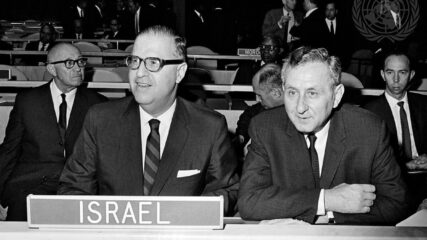
The Israeli ambassador to the United Nations delivers a detailed outline of events that will lead to war two days later.
Two days after the conclusion of the June 1967 War, Eshkol, recounts the series of events that led to war, the war itself and the immediate aftermath. He reaches out to Arab states for peace seeking a path to peace with her belligerent neighbors. A week later, Israel will quietly messages Cairo and Damascus through the US, hat Israel seeks an end to the conflict. No answers are received.
Ambassador Abba Eban tells the U.N. why Israel had to fight the war earlier in June 1967 and calls for new efforts for regional peace.
After the June 1967 war, the Israeli government sent word through the United States to Egypt and Syria seeking to jump-start a peace process. Apparently no response was received.
President Johnson’s remarks became the philosophical outline for UN Resolution 242 passed in November 1967. Core to his view was that Israel would not need to return to the pre-1967 war borders, and that the territorial integrity and sovereignty of all states in the region should be protected.
Arab states declare “no peace, no negotiation, no recognition” with Israel after their collective defeat in the June 1967 War.
Resolution 242 calls for Israeli withdrawal from unspecified captured territories in return for the right of all states to live in peace. It does not call for a full withdrawal. It is the basis for treaties with Egypt (1979) and Jordan (1994) and for PLO recognition of Israel (1993).
Coming up, fifty years after the June 1967 War. How many times have I taught the causes and effects, or written about the War? Hundreds of times in forty years.
September 25, 2019 Former IDF spokesman and Knesset member Nachman Shai speaks of elections, Israel in public opinion, Donald Trump, a two-state solution and his plans as an Emory visiting scholar. Nachman Shai gained international…
While too much is unknown after a week of fighting to make definitive statements about the war, certain possible outcomes can be explored.
Washington Institute Senior Fellow Michael Eisenstadt speaks about the regional effects of the 2023-2025 Hamas-Israel war and the ongoing U.S.-Israel-Iran war in March 2026.
Iran’s move to assert sovereignty over the Strait of Hormuz has short- and long-term implications for the Islamic regime and the world economy.