A Panacea in the Pandemic: Distance LearningCIE+
June 10, 2020 By Dr. Ken Stein, Founding CIE President The pandemic has had a blistering impact on our lives. When and where will it end? Unexpected and unnecessary deaths. We have learned that some…
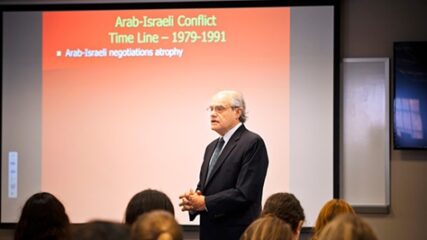
Ken Stein, Emory University, Center for Israel Education, spring 2020 What are turning points or legacy moments in history? That was the focus of my Zoom class at Emory for 80 students in late March…
Given the turmoil in Syria, sectarian violence in Iraq, Lebanon’s economic woes, Turkish military adventurism, and Iran’s regional mischief-making, the October 2019, US bipartisan congressional delegation visit to Amman made great sense. It emphasized that for Washington, Jordan is a critical geographic and political asset for America and, for anyone else interested in preserving some measure of regional stability in at least part of the tumultuous Middle East.
March 25, 2019 Kenneth Stein, the founding president of the Center for Israel Education, has taught Middle Eastern history and politics at Emory for 43 years. He spent more than half that time serving as…
Forty years ago this month, President Jimmy Carter convened the Camp David summit between Israeli and Egyptian leaders to push Arab-Israeli negotiations forward in an unprecedented and intensive manner.
In January this year, the veteran Arab journalist Rami Khouri made this assessment of the Middle East as a region, “Never before has the Arab region been so fractured, violent, volatile and vulnerable to the…
The notion of a two-state solution remains front and center as the most often discussed and endorsed solution to the Palestinian-Israeli dimension of the conflict in the Middle East. So why has it not happened?
Four out of every five Jews in the world live in the United States and Israel; 6.3 million in Israel, 6.7 million in the US. According to Pew Research Center Studies, 7 in 10 American Jews feel attached or very attached to Israel.
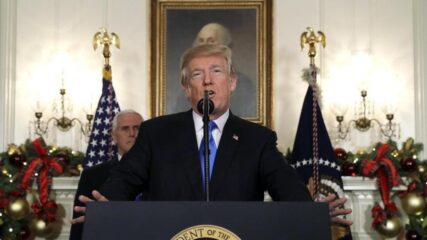
Whether you hate or love President Trump, don’t let it blind you from the meaning of the words he utters, or the tweets he sends. Regardless of your emotions or strong political leanings, his words are decisively important; he is President of the United States.
In two books written sixty years apart, When Prophecy Fails, 1957 (Festinger, Riecken and Schachter) and The Influential Mind, 2017 (Sharot, an Israeli neuroscientist), the conclusions were the same.
Rabbis who attended the AIPAC-sponsored National Rabbinic Symposium Association meeting in Washington at the end of August sat in my sessions on Zionism with common interests.
Scrutiny and planning prove essential when selecting college courses.
In teaching history, the most difficult task remains creating context:catapulting students back into a different time frame and having them disregard their contemporary historical perspective. The goal is to witness history as it unfolded, not as it concluded.
For the last several years, I have heard and witnessed personal stories about Israel (dis)engagement. Everyone asks how to stem distancing from Israel.
Placing Jewish destiny into Jewish hands was why Zionism emerged at the end of the 19th century. Acquiring political power to promote Jewish security is how a Jewish state was created.
Published by JESNA, Jewish Education Service of North America ISSUE #18 WINTER 2004 Israel Education and the College Campus, “Awake ye from ye slumber, the call that is heard, oh my people.” Agenda: Jewish Education,…
Coming up, fifty years after the June 1967 War. How many times have I taught the causes and effects, or written about the War? Hundreds of times in forty years.
In the aftermath of UNSC Resolution 2334 condemning Israeli settlement construction, Secretary of State John Kerry publicly blamed Israeli settlement construction in the West Bank for being the major barrier to a two-state solution to resolution of the Israeli-Palestinian conflict.
For almost 100 years, the Declaration has represented, for the Palestinians, the political beginning of Palestine falling out of their influence and into the control of the budding Zionist movement.
The report, clearly a snap shot, conveys a picture of anti-Semitic activities on US campuses. A strong correlation is found between the occurrence of BDS activity and the occurrence of anti-Semitic expression where incidents were reported.
In 2008 and again in 2012, President Barack Obama made lofty promises and gallant assessments about Iran and the Middle East respectively. His remarks to the annual AIPAC conference four years ago about Israel and Iran have proved to be out and out fictions. Who will hold the 45th President accountable for promises made but not kept?
Candidates that speak forcefully about a strong US-Israeli relationship and a need to provide Israel with a qualitative military advantage over any array of adversaries, secure the attention of American Jewish voters who put Israel at the top of their list in determining who should receive their vote in congressional and presidential election contests.
In the interest of securing any deal rather than the right deal – politics over principle – the president and the diplomats he sent to negotiate seem to have forgotten or perhaps never learned why Iran must not get a nuclear weapon.
At Seattle’s Temple de Hirsch Congregation a week ago, the audience audibly gasped when I told them that the next day I would be giving a noon talk at Evergreen State College.