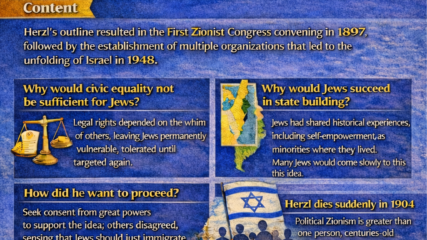
9 Key Questions About Theodor Herzl’s “The Jewish State,” February 14, 1896CIE+
Nine questions guide key understandings about Theodor Herzl’s “The Jewish State.”
August 10, 2025 Updated August 11, 2025, with follow-up resources. CIE and partners including including Hillels of Georgia, American Jewish Committee, the Jewish Federation of Greater Atlanta’s JTeen initiative, the Anti-Defamation League, the Jewish Community…
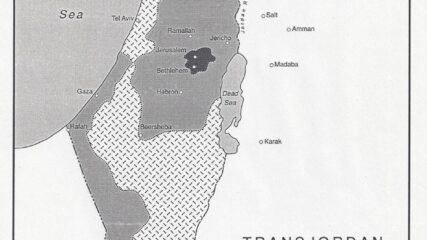
Ken Stein, President, Center for Israel Education, May 19, 2025 Introduction Since 1937, the idea of geopolitically separating Jewish and Arab populations west of the Jordan River has been a recommended solution to mitigate violence between…
Stein, Kenneth, “Legal Protection and Circumvention of Rights for Cultivators in Mandatory Palestine,” in Joel S. Migdal, (Ed.) Palestinian Society and Politics, Princeton, (1980): 233-260. In the immediate wake of communal violence that plagued Palestine…
March 12, 2025 By Ken Stein The Jewish growth in Mandatory Palestine in the period of the New Yishuv to establish a Jewish territory for a state had significantly developed by 1939. Arab leadership in…
March 5, 2025 The Center for Israel Education is unique because its work is based on Jewish context and otherwise mostly unavailable content. Providing excellence in Israel education through perspective and via multiple platforms separates…
Kenneth Stein, “Palestine’s Rural Economy, 1917-1939,” Studies in Zionism, Vol. 8, No. 1 (1987), pp. 25-49. During the early decades of the 20th century in Palestine, the majority Arab population sustained itself primarily through agricultural and pastoral…
Where you choose to begin or tell or remember it shapes the history and politics you do or do not want to convey. What you include and what you leave out reveals your knowledge,
biases, and political intentions.
Sung or recited on Passover, the original Dayenu is reflective appreciation of 14 significant events specifically wrapped around the exodus from Egypt. The Dayenu presented here chronicles Jewish history from Exodus to the present day. This history can be read individually or responsively. Different moments and personalities in Jewish history could have been included. Hebrew and Spanish versions of Dayenu are available.
The writing of any history is an art and not a science. History is not stagnant because there are always new materials discovered and new means used to analyze data. There is the bias and…
Neither Israel’s political culture nor Israel’s democracy based on Jewish self determination simply materialized on May 15, 1948. A connection exists from Jewish self-rule in the Diaspora to Zionist political autonomy during the Yishuv and to contemporary Israeli political culture. Likewise, the origins of Israeli democracy are found in the hundreds of years of Jewish Diasporas transitioning into the Zionist movement to the state; from aliyot before the Palestine Mandate to 1948 and since. Components of Israeli political culture…
להיות עם חופשי בארצנו Zionism’s two part history, Early History to 1897 and Zionism 1898 to 1948 Where has Zionism succeeded? What remains incomplete or unfinished? Finished or well-shaped results of Zionism Unfinished results…
Explore the foundational text of the State of Israel.
On January 1, 2022, I completed 43 years of teaching at Emory University. It was a great run and great fun. Along the way, I accumulated more pieces of paper than was necessary, among them…
Using original sources and employing perspective are keys to substantive Israel education. Failure to use either, handicaps and prejudices learning about Israel. When documents and texts or a broad overview of the literature in a field are not employed, there is a strong possibility that the educator either has a personal political agenda or, is covering up for their own lack of knowledge of what they are teaching. This premise is true for teaching any country’s history and through the lens of any discipline. I reside in the discipline of history.
Ken Stein, Emory University, Center for Israel Education, spring 2020 What are turning points or legacy moments in history? That was the focus of my Zoom class at Emory for 80 students in late March…
Context and perspective are key elements in understanding history. Zionism emerged in the 19th century because there was a unique Jewish identity built around belief, Torah, ritual, and community concern for one another. And second, the presence of wretched anti-Semitism. Nordau gave an impassioned speech about the Jewish condition at the First Zionist Congress in 1897 in the late 19th century making the case for a Jewish national home. Nordau energized the audience and the Zionist movement.
In January this year, the veteran Arab journalist Rami Khouri made this assessment of the Middle East as a region, “Never before has the Arab region been so fractured, violent, volatile and vulnerable to the…
Four out of every five Jews in the world live in the United States and Israel; 6.3 million in Israel, 6.7 million in the US. According to Pew Research Center Studies, 7 in 10 American Jews feel attached or very attached to Israel.
In two books written sixty years apart, When Prophecy Fails, 1957 (Festinger, Riecken and Schachter) and The Influential Mind, 2017 (Sharot, an Israeli neuroscientist), the conclusions were the same.
Rabbis who attended the AIPAC-sponsored National Rabbinic Symposium Association meeting in Washington at the end of August sat in my sessions on Zionism with common interests.
In teaching history, the most difficult task remains creating context:catapulting students back into a different time frame and having them disregard their contemporary historical perspective. The goal is to witness history as it unfolded, not as it concluded.
At Seattle’s Temple de Hirsch Congregation a week ago, the audience audibly gasped when I told them that the next day I would be giving a noon talk at Evergreen State College.