9 Key Questions About Theodor Herzl’s “The Jewish State,” February 14, 1896
Nine questions guide key understandings about Theodor Herzl’s “The Jewish State.”

From biblical times to the present, Jews and Judaism have had an unbroken connection to Zion, a reference to Eretz Yisrael, the Land of Israel, derived from the hill at the heart of Jerusalem. Zionism was and remains the Jewish quest to have and sustain a Jewish state in Jews’ ancient land. Zionism is Jewish nationalism.
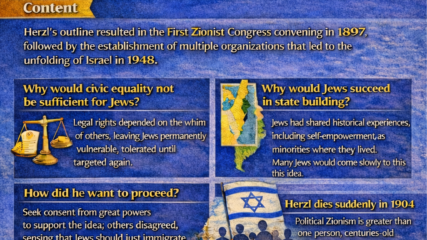
Nine questions guide key understandings about Theodor Herzl’s “The Jewish State.”
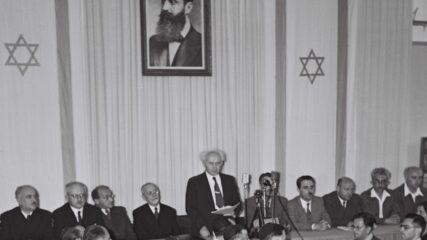
The Declaration recounts the Jewish connection to the Land of Israel, the birth of Zionism and U.N. recognition of a Jewish state’s legitimacy. It also promises that the state will be a democracy for all its citizens.

From biblical times to the present, Jews and Judaism have had an unbroken connection to Zion, a reference to Eretz Yisrael, the Land of Israel, derived from the hill at the heart of Jerusalem. Zionism…

April 14, 2025 The period of the New Yishuv lasted from the last 40 years of Ottoman rule in Palestine through the British Mandate until the establishment of Israel in 1948. It saw the growth…
להיות עם חופשי בארצנו Zionism’s two part history, Early History to 1897 and Zionism 1898 to 1948 Where has Zionism succeeded? What remains incomplete or unfinished? Finished or well-shaped results of Zionism Unfinished results…

By Scott Abramson, May 2024 Introduction — A Unique Hatred If the Bible nearly 3,000 years ago described the Jews as “a people who shall dwell alone,” Jewish history has since validated this as prophecy….
Delve into the roots of Jewish peoplehood and the pivotal moments in Jewish history that led to the rebirth of Israel in 1948. Explore how precarious Diaspora life and outbursts of violent antisemitism catalyzed Jewish self-determination. Examine how Jewish leaders employed compromise, perseverance and adaptation in interactions with the Ottomans, British, and Arabs to overcome challenges, and so much more.

In a 40-minute video recorded June 14, 2021, Dr. Yaron Ayalon of the College of Charleston and Rich Walter of the Jewish Federation of Greater Atlanta delve into the history and the political and cultural…
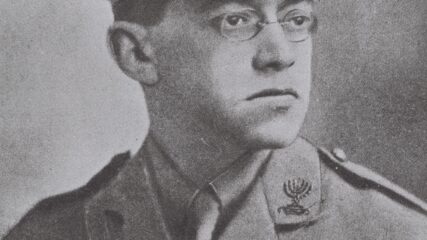
Ze’ev Jabotinsky argues that peaceful coexistence between Arabs and Jews in Palestine is impossible until Zionists demonstrate through strength that they are an irreversible presence in the Land of Israel.
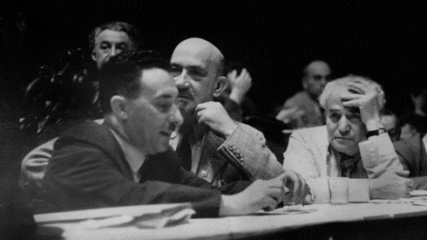
Jewish Agency head David Ben-Gurion emphasizes that a Jewish state will be a place for all, including Arabs, and calls for Jews to be better educated about the elements of a state.

Celebrating the creation and survival of the State of Israel, the yearbook provides a thorough history of the Zionist movement from the First Zionist Congress in 1897 to independence in 1948.

The text of the 1906 Jewish Encyclopedia entry on Zionism from its biblical origins to the death of Theodor Herzl in 1904.

Glossaries This section offers easy access to names, events, and terms associated with modern Israeli history. Terms listed were used successfully by students for understanding context in learning about modern Israel and the Middle East….
Zionism and Israel: From the Tanakh to 1948 explores the foundations of the centrality of the Land of Israel to the Jewish people and how the relationship between the people and the land evolved over time. Activities and background information are provided to help learners explore the growth of the Jewish Diaspora, the evolving relationship between the people and the Land and the origins of the Zionist movement. Following the First Zionist Congress in 1897, Zionism and Israel: From the Tanakh to 1948 shifts to explore how the Basle Declaration and subsequent documents guided the movement’s actions towards its vision for a Jewish State. The material concludes with an exercise on Israel’s Declaration of Independence.
Rabbi Michael Berger, a professor in Emory University’s religion department, and CIE President Ken Stein, an Emory emeritus professor, trace 3,000 years of Jewish connection to the Land of Israel and the strategies that prepared…

From the biblical covenants, Jews bound themselves to the belief in one G-d, an unbreakable tie to the Land of Israel. From its inception, Jewish identity was wrapped around the mutual commitments between G-d and the people. Judaism became the foundation for Christianity and Islam.

From 1898 to 1948, Zionism evolved from an idea to a concrete reality: the actual establishment of the Jewish state, Israel. Slowly, a few immigrating Jews created facts by linking people to the land. For half a century, fortuity and fortitude made the Zionist undertaking a reality. They exhibited pragmatism and gradually constructed a nucleus for a state. Through perseverance Zionists empowered themselves.
If one wants to start from scratch or build on an already sophisticated knowledge base about Zionism, modern Israel and the Arab-Israeli conflict, we believe that the books in English here have significant value. While…

May 7, 2023 In a 32-minute presentation recorded during the second hour of our special two-hour Israel@75 webinar and Teen Israel Leadership Institute session May 7, 2023, Adina Karpuj, a podcast producer for Israel Story who lives in Jerusalem, talks…
Explore the foundational text of the State of Israel.
Winter 1979 By Shlomo Avineri “Zionism as a National Liberation Movement,” Jerusalem Quarterly 10 (Winter 1979): pp. 133-144. At the root of Zionism lies a paradox. On the one hand, there is no doubt about…
Recorded March 20, 2022, this 33-minute presentation by Center for Israel Education President Ken Stein addresses how teachers’ decisions on when in history to begin the story of Israel alter what students learn about Zionism, the State of Israel and the Jewish people’s connection to the land.

Ben-Gurion elegantly connects modern Israel from messianic redemption to Zionism, building the country through labor and immigration, with dual needs to remain actively linked to the Jewish diaspora and Jewish values through education.

Prime Minister-elect Begin rebukes President Carter’s assertion that Israel will need to withdraw from almost all the lands Israel secured in the June 1967 war, especially Jerusalem and the West Bank. Begin is adamant opposed to dealing with the PLO. Begin refuses to relinquish Israeli decision-making to US preferences or dictates. These fundamental policy disagreements will remain unresolved between Begin and Carter for the duration of Carter’s presidency, and years after.

Novelist Amos Oz’s final speech provides a summation of a lifetime of insights into Israeli society and a vision for what Zionism has yet to accomplish.

Whether you are Jewish or non-Jewish, knowing and familiarizing yourself with the history and future of Israel is about knowing your unique origins.

This report submitted to the United Nations at the end of 1951 notes that “some one million Jews have become the victims of accelerated antiSemitism” since 1948 in the Muslim countries of the Arab League and North Africa, “communities which have existed for thousands of years.” The report analyzes the situation for Jews overall and explains restrictions and oppressive measures country by country.
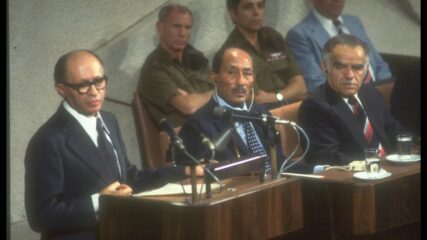
Begin welcomes Sadat’s bold initiative, seeking an end to the conflict with other Arab states through negotiated treaties. Begin invites other Arab leaders to negotiate as Sadat was doing.
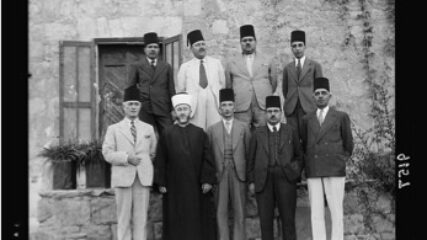
Mufti opposes Arab majority state in ten years contrary to wishes of a dozen key other Palestinian leaders. Mufti wants no Jewish political presence in Palestine whatsoever.

In September 2023, thirty years after the historic signing of the Oslo Accords, there is occasion to review Prime Minister Rabin’s understanding of them. I assembled this collection years ago from Daily Reports- Near East and South Asia, 1993-1995. Two short items about Rabin’s views are also found or linked here. Rabin provided a summary of his views of the Accords in a Knesset speech in October 5, 1995. Some of Rabin’s reasons for signing the Accords are also provided in Yehuda Avner’s The Prime Ministers.
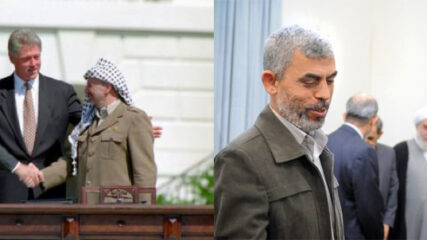
For more than a century, Arab and Muslim leaders have expressed hatred for Jews, Zionism and Israel, although some have pointed internally for the failures of the Palestinian Arab national movement.

Kenneth W. Stein, “One Hundred Years of Social Change: The Creation of the Palestinian Refugee Problem,” in Laurence Silberstein (ed.), New Perspectives on Israeli History: The Early Years of the State, New York University Press,…

Three European journalists provide firsthand accounts of the First Zionist Congress and its delegates.

Eventual founding leader of the World Zionist Organization Theodor Herzl says a Jewish state is need in response to antisemitism.
