

The 39th president of the United States, Jimmy Carter had an outsized influence on the Middle East during his one term in office, from the high of the Camp David Accords and peace treaty between Israel and Egypt to the low of Iran’s takeover by expansionist Islamicists and the Iranian hostage crisis. A proponent of a regional peace approach while in office, Carter has increasingly advocated Palestinian interests and criticized Israel and the Israeli government during his longest-ever post-presidency.
The Key Curated Essentials for Jimmy Carter


Before Camp David
Brookings Institution Report: “Toward Peace in the Middle East,” 1975 CIE+ members only
December 1975
Outlining an Arab-Israeli settlement, the Brookings report calls for Israel to withdraw to “almost the pre-June War borders” and for “extensive Palestinian autonomy.” The Carter administration embraces the report for its foreign policy.
Memorandum of Conversation: U.S. Secretary of State Vance in Israel With Israeli Foreign Minister Yigal Allon, 1977 CIE+ members only
February 16, 1977
With candor, Israeli Foreign Minister Allon tells Secretary of State Vance that the Israeli Labor government would under no circumstances negotiate with the PLO until it gave up terrorism, recognized UNSC 242, and unequivocally accepted Israel’s right to exist. Only in 1993, did the PLO accept these premises, Sixteen years had then passed while Israel built settlements virtually without restraint in the territories.
Memorandum of Conversation Between President Carter and Prime Minister Rabin, March 1977 CIE+ members only
March 8, 1977
This first Carter-Rabin meeting was unpleasant at best. Rabin would not turn over Israel's negotiating prerogatives to the US; Carter publicly told Israel that it might have to return to the June 1967 borders. Carter said Rabin was like a "dead fish." and Rabin said that he felt 'cornered by Carter." His administration was interested in carving out the West Bank for Palestinian political expression even before the PLO was prepared to accept Israeli legitimacy. And Israel was not prepared to withdraw from the West Bank, a position also held by Menachem Begin.
Jimmy Carter Remarks on Palestinian Homeland and Q&A Session in Clinton, Massachusetts, 1977 CIE+ members only
March 16, 1977
Carefully stated, Carter says that there should be a homeland for the Palestinian refugees. He is the first US president to assert the need for a place for the Palestinians and for Israel’s right to exist in peace.
Minutes of a Policy Review Committee Meeting About the Middle East, 1977 CIE+ members only
April 19, 1977
When the Carter Administration entered office in 1977, an early foreign policy priority was to kick-start Middle East negotiations. In this Policy Review Committee Meeting, Carter’s staff proposed a negotiating outcome that would pass through a conference, including the withdrawal of Israel’s forces to almost the 1967 borders, bringing the PLO into talks as Palestinian representatives, all the while seeking to uphold Israel's security requirements.
Memorandum of Conversation Between President Carter and President Sadat, April 1977 CIE+ members only
April 5, 1977
In their first meeting, Anwar Sadat and Jimmy Carter have a vividly detailed exchange about negotiations between Israel and Arab parties, particularly Egypt.
Memorandum of Conversation Between President Carter and President Assad, 1977 CIE+ members only
May 9, 1977
This meeting was the only one between U.S. President Carter and Syrian President Assad during the Carter administration. Carter wanted to learn Assad’s requirements for an agreement with Israel. Assad doubted that the Saudis would join this process. In the end, Assad made it clear that he was not rushing into an agreement with Israel, even if asked by the United States. Carter acknowledged knowing little about the Palestinian refugee issue and said the U.S. was committed to the security of Israel.
Israeli Prime Minister-Elect Menachem Begin on ABC News’ “Issues and Answers,” May 1977: Rebukes Carter, Insists Israel Will Not Withdraw From West Bank CIE+ members only
May 22, 1977
Prime Minister-elect Begin rebukes President Carter’s assertion that Israel will need to withdraw from almost all the lands Israel secured in the June 1967 war, especially Jerusalem and the West Bank. Begin is adamant opposed to dealing with the PLO. Begin refuses to relinquish Israeli decision-making to US preferences or dictates. These fundamental policy disagreements will remain unresolved between Begin and Carter for the duration of Carter’s presidency, and years after.
Memorandum of First Meeting Between Prime Minister Begin and President Carter, 1977 CIE+ members only
July 19, 1977
After his surprise electoral victory in May, Prime Minister Menachem Begin traveled to Washington to establish a rapport with President Carter. While this initial meeting was cordial, each met the other’s stubbornness, a characteristic that would keep their relationship respectful but acrid for years to come.
Israel’s Framework for the Peace-Making Process With Its Neighbors, July 1977 CIE+ members only
July 19, 1977
Begin tells Carter that Judea, Samaria (the West Bank) and the Gaza Strip will not be placed under foreign sovereignty; likewise, these areas will not be annexed, leaving them open for possible negotiations.
President Carter’s Meeting With Israeli Foreign Minister Dayan, September 1977 CIE+ members only
September 19, 1977
The vast gulf in US and Israeli positions about Palestinian self-determination, the degree of withdrawal from the West Bank, and future borders is precisely stated. A year later at the end of the Camp David negotiations, Israeli and US views had not changed at all.
Joint U.S.-Soviet Statement on the Middle East, 1977 CIE+ members only
October 1, 1977
Naively, the Carter Administration believes that a conference with the USSR would start comprehensive negotiations; instead, the fear of Moscow’s engagement helps drive direct Egyptian-Israeli talks.
Memorandum of Conversation Between U.S. President Carter and Israeli Foreign Minister Dayan, October 1977 CIE+ members only
October 4, 1977
Common to both the Labor Party and to Begin’s government was a fear that the US would pressure Israel into unwanted concessions and deny Israel its right to sovereign decision-making. It was a concern that Dayan expressed in this October 1977 meeting, and one that he would articulate on several occasions during the Camp David negotiations.
U.S.-Israeli Working Paper on Conference Procedures, 1977 CIE+ members only
October 4, 1977
After brutally frank and caustic meetings between Israeli Foreign Minister Dayan and President Carter, the US relents to Israeli demands that a peace conference be only an opening for direct talks.
Israeli Prime Minister Menachem Begin’s Palestinian Autonomy Plan, 1977 CIE+ members only
December 28, 1977
Five weeks after Egyptian President Anwar Sadat flew to Jerusalem in November 1977, to accelerate Egyptian – Israeli negotiations, Begin brought to President Jimmy Carter, Israel’s response to Sadat’s peace initiative: political autonomy for the Palestinians in the West Bank and Gaza Strip. No Palestinian state was considered.
Jimmy Carter’s Unbridled Praise for the Shah of Iran at a State Dinner in Tehran, 1977 CIE+ members only
December 31, 1977
Having made human rights a central pillar of his foreign policy, Carter nonetheless seemingly ignored the abuses the Shah of Iran imposed upon his own people. Carter's unctuous praise for the Shah at this state dinner angered Iranians in general, the clerical regime that replaced the Shah in 1979, resulting in negative consequences for Carter as he went into the 1980 presidential election.
Explainer: Carter’s Search for Middle East Peace (4:15)
September 5, 2018
In this animated white board video, we explore Jimmy Carter’s efforts at achieving peace in the Middle East.
Statements by Presidents Sadat and Carter in Aswan, Egypt, 1978 CIE+ members only
January 1, 1978
As part of a joint statement, President Carter makes promises regarding US’ role in coming Political-Military Committee Talks in Cairo and Jerusalem. Likewise presenting a four-point formula for resolving the conflict, these statements contribute to US-Israeli tensions.
Mark Siegel Resignation Letter and Conversation With President Carter, 1978 CIE+ members only
March 8 and 9, 1978
Siegel resigned over two matters: the administration’s policy of selling advanced fighter aircraft to Saudi Arabia and Egypt, which he believed a threat to Israel’s national security, and his sharp disagreement with the Carter White House for not allowing alternative views on policy matters to find their way to the President’s desk. Siegel’s detailed interview about the administration’s anti-Israeli viewpoints are explained here.
Memorandum of Conversation Between U.S. President Carter and Israeli Prime Minister Begin and Their Delegations, March 1978 CIE+ members only
March 21, 1978
After a year in office, the Carter administration’s initiative to achieve a comprehensive Middle East peace between Israel and her Arab neighbors had stalled. At this White House meeting, Dayan reviewed Israel’s concerns about the West Bank and Brzezinski criticized Begin’s autonomy plan for the Palestinians. Begin and Carter’s mutual dislike over policy decisions continued to rise.
Six July 1978 U.S. Documents on Egyptian-Israeli Narrowing of Differences CIE+ members only
July 1978
These six documents reveal the advanced state of Washington's success in finding compromise language and principles for achieving Egyptian and Israeli agreement on bilateral matters and about Palestinian West Bank self-rule (Begin's ideas), though significant gaps remain before the Camp David Summit.
Camp David Through the Egypt-Israel Treaty
The Winding Road to the (Camp David) Peace Summit CIE+ members only
September 2018
Forty years ago this month, President Jimmy Carter convened the Camp David summit between Israeli and Egyptian leaders to push Arab-Israeli negotiations forward in an unprecedented and intensive manner.
Memorandum of Conversation Among President Carter, Secretary of State Vance, Prime Minister Begin and Foreign Minister Dayan at Camp David, September 16, 1978 CIE+ members only
September 16, 1978
In this meeting, the contents of which have not been released by the Foreign Relations of the United States (FRUS) but are available from the Israel State Archives (ISA), Begin clearly committed that “perhaps one military settlement” in the Jordan Valley would be established during the three months of the treaty negotiations. The extraordinarily contentious public dispute on the settlements would mar the diplomatic success of the Camp David Accords and add tension to the already fraught Carter-Begin relationship.
Camp David Conversation Between President Carter and Foreign Minister Dayan on Jerusalem, September 17, 1978 CIE+ members only
September 17, 1978
On the last day of negotiations at Camp David, President Carter asked Israel to accept the US position that Jerusalem was occupied territory; Dayan shot back in vigorous opposition, "if we had known that you would declare your position on Jerusalem, we would not have come here. This is the first time that we are confronted with an American position and specifically on the most sensitive issue. All your positions with regards to settlements are insignificant compared to our confrontation on the issue of Jerusalem."
Minutes of Departure Conversation Between Carter and Begin, September 1978 CIE+ members only
September 20, 1978
Begin agrees to halt settlements construction only for the duration of the peace treaty negotiations, not until Palestinian autonomy is applied. Carter erroneously believes that Begin made a promise to halt settlements.
Camp David Accords, 1978
September 17, 1978
With President Carter mediating, Sadat and Begin agree to two outlines: a framework for a treaty between them and to define Palestinian “autonomy,” not self-determination or a state for them.
Elyakim Rubinstein, “The Players of Camp David — An Insider Israeli View on the Personalities and Ideas That Drove the History-Making Camp David Accords,” Cairo Review, Winter 2019 CIE+ members only
March 2, 2023
Introduction With an extraordinary legaI mind and life of civil service to the state of Israel, Elyakim Rubinstein served as an estimable Supreme Court Judge, as legal adviser during the Egyptian-Israeli negotiations, worked closely with...
Woodrow Wilson Center: Camp David 25th Anniversary Forum, Washington, 2003 CIE+ members only
September 17, 2003
Recounting events at the Egyptian-Israeli-American negotiations, a dozen American, Israeli and Egyptian participants discuss those 13 days of negotiations. Negotiators agreed that they pursued success through “constructive ambiguity,” some at high levels, so the respective sides could agree, for example, on using the term “modalities” to describe a future element that could not be defined in a more tangible way. President Carter and Israel's attorney general at the time of Camp David disagreed at the conference about what Prime Minister Begin promised on the duration of a settlement moratorium. William Quandt, an NSC official, acknowledged that there was no written record of a Begin promise for three months. Carter claimed the promise was in his diary notes, but others who saw Carter's diary said no such promise was made or was in Carter's notes.
Menachem Begin’s Statement to the Knesset on the 1978 Camp David Accords CIE+ members only
September 25, 1978
Begin summarizes in great detail the contents and the political implications of the recently signed Camp David Accords. He reiterated Israel's continued presence in Jerusalem, per its June 1967 Law, and clarified the terms used in the agreements.
Moshe Dayan’s Remarks to the Knesset About the 1978 Camp David Accords CIE+ members only
September 29, 1978
Dayan made the case to the knesset that it should vote in favor of the Camp David Accords stipulating why doing so would be in Israel's long term interest. He stated specifically that there was no promise for a Palestinian state, IDF forces would remain in the West Bank, negotiations for a peace treaty would continue, and these agreements were signed by the President of Egypt and the President of the US.
November 1993: Discussion on Camp David Negotiations With Hermann Eilts, Samuel Lewis, William Quandt, Hal Saunders, Dan Kurtzer and Ken Stein, Hempstead, N.Y. CIE+ members only
November 1, 1993
U.S. diplomats Hermann F. Eilts, Samuel W. Lewis, William B. Quandt, Harold H. Saunders and Daniel C. Kurtzer discuss President Carter and the 1978 Camp David negotiations with Ken Stein at a conference at Hofstra University.
Explainers: Egypt-Israel Peace (2 videos, 7:03 and 7:56)
March 26, 2019
In this two-part Whiteboard video series, we explore the transition from the 1978 Camp David Accords to the Egyptian-Israeli Peace Treaty signed at the White House on March 26, 1979.
Ziv Rubinovitz and Gerald Steinberg, “Not So Reluctant: Menachem Begin and the Israel-Egypt Peace Negotiations,” Fathom Journal CIE+ members only
June 1, 2019
Ziv Rubinovitz and Gerald Steinberg provide an incisive summary of their larger work on Menachem Begin for Fathom in June 2019. Reprinted with permission of the authors.
Memorandum of Conversation Between U.S. President Carter and Israeli Prime Minister Begin, March 1979 CIE+ members only
March 2, 1979
Embedded in the September 17, 1978 Camp David Accords were broad outlines for an Egyptian-Israeli Peace Treaty and a Framework for Palestinian autonomy. The details of both remained to be negotiated. Yet, obstacles to implementation of the Accords appeared almost immediately.
Conversation Between U.S. National Security Adviser Zbigniew Brzezinski and Saudi Prince Fahd on Camp David Accords and Other Regional Issues, March 1979 CIE+ members only
March 17, 1979
Nine days before the signing of the Egyptian-Israeli treaty, U.S. National Security Adviser Zbigniew Brzezinski and Saudi Foreign Minister Prince Saud carry out an extraordinarily frank conversation. It includes bilateral relations, common fears of regional turbulence and Anwar Sadat’s estrangement from other Arab leaders.
U.N. Security Council Resolution 446: Territories Occupied by Israel, 1979 CIE+ members only
March 22, 1979
Carefully sandwiched between Jimmy Carter’s high-risk visit to Egypt and Israel and the signing of those countries' peace treaty, the Carter administration allows the U.N. Security Council to deplore Israeli settlement building and demographic changes in Jerusalem.
Memorandum of Agreement Between U.S. and Israel, 1979 CIE+ members only
March 26, 1979
If Egypt breaches the Egyptian-Israeli Treaty, the US will enhance its presence in the area, provide military and economic supplies to Israel, and vote against any UN resolution contrary to the treaty.
Israel-Egypt Peace Treaty, 1979
March 26, 1979
Signed sixteen months after Sadat’s visit to Jerusalem, it calls for establishment of diplomatic relations, staged Israeli withdrawal from Sinai, and American security arrangements to support the bilateral treaty.
Map of Egyptian-Israeli Peace Treaty, March 1979 CIE+ members only
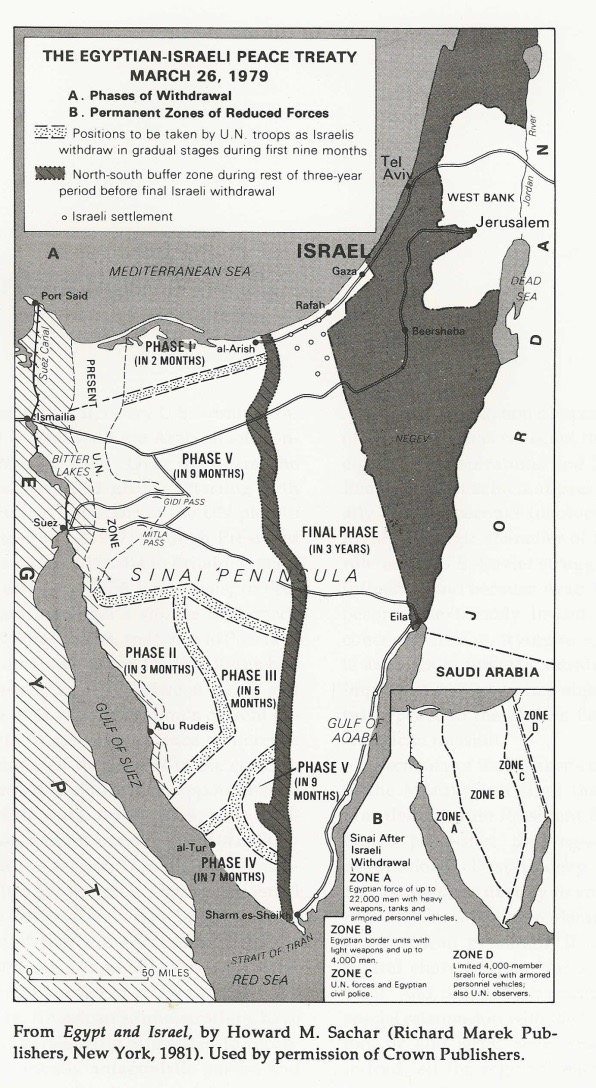
March 26, 1979
To test Egypt’s intentions, Israel took eight years, from January 1974 to April 1982, to withdraw from virtually all of Sinai.
Egyptian-Israeli Peace Treaty — Context and Implications CIE+ members only
December 27, 2021
March 26, 2025 By Ken Stein The ripe conditions that prefaced the 1979 Egyptian-Israeli treaty and might presage additional Arab-Israeli agreements are almost totally absent in 2025. Why? Today, there is an absence of political...
The Peace Treaty With Egypt: Achievements and Setbacks, Conference, Tel Aviv University CIE+ members only
March 17, 1981
The Shiloah Center for Middle Eastern and African Studies, Tel Aviv University, March-17-18, 1981, Reprinted with permission. Participants included researchers, academics, politicians, and business people.
40th Anniversary of the Egyptian-Israeli Treaty, Ken Stein and Michael Jacobs (44:57) CIE+ members only
March 26, 2019
March 26, 2019 From 1967 forward, Arab-Israeli negotiations began in earnest. First under the Nixon and Ford administrations, then under the Carter administration, Egyptian President Anwar Sadat and Israeli prime ministers implemented the political trade-offs...
Former Carter Adviser Kenneth Stein Reflects on Israel-Egypt Treaty for AJC Global Voice CIE+ members only
March 25, 2019
March 25, 2019 Kenneth Stein, the founding president of the Center for Israel Education, has taught Middle Eastern history and politics at Emory for 43 years. He spent more than half that time serving as...
Reassessing Sadat, Begin and Carter CIE+ members only
May 24, 2024
It is now apparent that distances between the Carter administration and Israel did not begin in earnest after Begin’s May 1977 election or over the settlements. Newly available materials show that from its outset, the Carter administration prioritized curbing Israeli influence in Washington.
Ken Stein to Scott Slade: Carter Had a Loaded Deck at Camp David CIE+ members only
January 9, 2025
January 9, 2025 WSB radio veteran Scott Slade interviewed CIE President Ken Stein about President Jimmy Carter and the Camp David peace process for a “Scott Slade’s Georgia” piece that aired just hours before Carter’s...
After the Egypt-Israel Treaty
Map of Regional Boundaries After the Israel-Egypt Peace Treaty, 1979 CIE+ members only
March 26, 1979
Under the 1979 peace treaty, Israel withdrew completely from the Sinai, abandoning settlements and oil fields, by 1982. But Egypt did not reclaim the Gaza Strip, which it had controlled from 1948 to 1967.
U.N. Security Council Resolution 452, 1979 CIE+ members only
July 20, 1979
This was the second UNSC Resolution within four months supported by the Carter administration condemning Israel's settlement building in the territories. It too greatly angered the Israeli government and American supporters of Israel.
U.N. Security Council Resolution 465 on Jerusalem, Settlements and Territories, 1980 CIE+ members only
March 1, 1980
Showing its public opposition to Israeli actions in the lands taken in the June 1967 war, an area that the Carter Administration
wanted reserved for Palestinian self-rule, it 'strongly deplores' Israel's settlement policies. Passage of the resolution three weeks
prior to the New York and Connecticut presidential primaries, cause many Jewish voters to vote in favor of Ted Kennedy
and not for Carter, helping to splinter the Democratic Party.
Venice Declaration on the Middle East Concerning Inclusion of PLO in Negotiations, 1980 CIE+ members only
June 13 and 15, 1980
It calls for “recognition of the legitimate rights of the Palestinian people, a just solution to the
Palestinian problem, the right to self-determination, [and] for PLO association to the negotiations.”
Summary of President Jimmy Carter’s Meetings With King Hussein, 1980 CIE+ members only
June 16 and 17, 1980
After the September 1978 Camp David Accords ended, the Carter administration diligently tried but failed to persuade Jordan's King Hussein to be part of the follow-on negotiations over Palestinian autonomy. Carter felt Hussein was obstructionist; Hussein did not believe in 1978 that the US could halt Israeli settlement building as promised then. Hussein was correct. He also believed that Palestinian Autonomy might have a negative impact on many Palestinians living in his kingdom. Hussein was skeptical of the US capacity to negotiate for his national interests. At the same time, privately, Egypt's Sadat was not displeased that the Jordanians remained out of favor with the US, and away from any negotiations that would detract from implementation of Israel's promised full withdrawal from Sinai, per their 1979 Treaty. In 1988, Hussein stepped away from the West Bank’s future; in 1994, Jordan signed a peace treaty with Israel.
U.N. Security Council Resolution 478, 1980: Criticizing Israel Over Territories Taken in June 1967 CIE+ members only
August 20, 1980
The United States abstains on a Security Council resolution declaring Israel's Basic Law on Jerusalem to be in violation of international law.
Post-Presidency
Ken Stein Addresses Jimmy Carter’s Legacies, Views Toward Jews CIE+ members only
January 6, 2025
January 6, 2025 CIE President Ken Stein addressed “Jimmy Carter’s Middle East Legacies” during a webinar hosted by Scholars for Peace in the Middle East in cooperation with the Association for the Study of the...
Jimmy Carter, 1924-2024 CIE+ members only
October 17, 2022
The 39th U.S. president, Carter mediated the 1978 Camp David Accords and 1979 peace treaty between Israeli Prime Minister Menachem Begin and Egyptian President Anwar Sadat. The treaty was the first between Israel and an...
Camp David and the Pursuit of Peace: Comparing the 1978 and 2000 Summits CIE+ members only
1978-2000
Perspective provides valuable insights in evaluating contemporary diplomacy. Though neither the Palestinian-Israeli-U.S. summit of July 2000 nor the Egyptian-Israeli-U.S. summit of September 1978 ended discussions between Israel and its Arab adversaries, there were more differences than similarities between the two intense and highly charged meetings.
Asaf Romirowsky: Jimmy Carter’s House of Mirrors CIE+ members only
December 6, 2016
Lewis Carroll's Through the Looking-Glass and What Alice Found are a great way to understand the Palestinian narrative and in particular, advocates of the Palestinian cause like former President Jimmy Carter.
Ken Stein to Dan Senor: “Carter Didn’t Understand” National Interests in Middle East CIE+ members only
January 9, 2025
January 9, 2025 Dan Senor, co-author of The Genius of Israel and Start-Up Nation, brought Center for Israel Education President Ken Stein on his Call Me Back podcast on Jan. 9 just hours after the...
Daniel Brumberg, “The Carter Administration and the Logic of Comprehensive Peace – A Study of How Middle East Policy Became a Presidential Concern and the Limits of a Globalist Foreign Policy.” (With permission of the author, September 2022) CIE+ members only
Spring 1982
As an MA student, Brumberg's thesis cogently lays out how and why President Jimmy Carter, a candidate without any significant foreign policy experience chose to embrace the unexpected objective of seeking a comprehensive Middle East peace. Prompting Carter’s imperative was the drive provided by Zbigniew Brzezinski, Carter’s National Security Adviser. Brzezinski’s motivation emerged from wanting to satisfy a Saudi imperative to find a resolution to the Palestinian-Israeli conflict and thereby reduce the chances of another oil price spike or oil price embargo. Brzezinski believed that a stable oil order would benefit Carter’s re-election chances. Brzezinski also wanted to severely reduce the influence of the American Jewish community’s influence on the making of Middle East foreign policy. He wanted to demonstrate to the Saudis that he could accomplish that objective. In the end oil prices were higher in November 1980.
Ken Stein: “Carter Was Willing to Change History to Fit His Own Needs” CIE+ members only
January 6, 2025
January 6, 2025 CIE President Ken Stein is interviewed about Jimmy Carter by Foundation for Defense of Democracies Executive Director Jonathan Schanzer on the “FDD Morning Brief” on January 6, 2025. Jonathan Schanzer: It’s now...
Interviews With Key Figures From the Carter Era
Atherton: Ken Stein Interview With Ambassador Roy Atherton, Washington, D.C. CIE+ members only
July 16, 1992
July 16, 1992 Ken Stein Interview with Ambassador Roy Atherton, Washington, D.C., July 16, 1992 Alfred Roy Atherton Jr. participated in U.S-Soviet Middle East negotiations and formulation of the Rogers Plan, 1969; Kissinger-Ismail secret meeting...
Avineri: Ken Stein Interview with Professor Shlomo Avineri, Hebrew University Campus, Givat Ram, Jerusalem, Israel CIE+ members only
July 6, 1993
Serving as director general of the Israeli Ministry of Foreign Affairs in 1976-1977, Avineri recounts Romanian overtures to Rabin for a visit to gauge interest in another agreement with Egypt. He estimates that Rabin and Begin both took strategic considerations in hand in negotiating; he is highly critical of Carter's political naivete.
Bar-On: Ken Stein Interviews With Hanan Bar-On, Jerusalem, Israel CIE+ members only
November 12, 1992, and July 9, 1993
In the 1975-1979 period, Hanan Bar-On served in the Israeli Embassy in Washington and then for seven years as director general of the Foreign Ministry. His insights highlight the building strain that evolved between Jimmy Carter and Menachem Begin. From an Israeli viewpoint, he recalls how unpredictable Zbigniew Brzezinski behaved toward the Israelis, how flexible Moshe Dayan was in seeking compromises, and how the Leeds Castle foreign minister talks in England in July 1978 established the contours for the successful Camp David negotiations two months later. He sheds important light on the context of the four Egyptian-Israeli agreements: Sinai I (1974), Sinai II (1975), the Camp David Accords (1978) and the Egyptian-Israeli Peace Treaty (1979).
Ben-Elissar: Ken Stein Interview With Dr. Eliyahu Ben-Elissar, Jerusalem, Israel CIE+ members only
November 13, 1992
As a longtime confidant of Menachem Begin involved in the Herut party, Eliyahu Ben-Elissar was Israel’s first ambassador to Egypt. He was a staunch supporter of keeping the area of the West Bank — Judea and Samaria — under Israeli control. Later he became Israel’s ambassador to France and then the United States.
Eilts: Ken Stein Interview With Ambassador Hermann Frederick Eilts, Boston, 1991 CIE+ members only
April 11, 1991
Hermann Eilts played a pivotal role in representing the U.S. to Egypt and vice versa in the vital 1973-1980 period when Egypt embraced Washington and turned away from Moscow, and made peace with Israel. Eilts knew Egyptian President Sadat as well as any American official in the period. He provides rich detail and vivid insights into Sadat's often mercurial decision-making.
Evron: Ken Stein Interviews With Ambassador Ephraim Evron, Ramat Aviv, Israel CIE+ members only
March 24, 1992 and November 15, 1992
A life-long Israeli civil servant, Epi Evron was deeply engaged with Kissinger, Sadat, Meir, Rabin, Carter, Begin and others, as Egyptian-Israeli negotiations unfolded in the 1970s. One will find crisp in his interview insightful assessments of personalities, decision-making processes, and colorful vignettes.
Ghorbal: Ken Stein Interview With Ashraf Ghorbal, Cairo, Egypt CIE+ members only
November 9, 1992
Ashraf Ghorbal represented Egypt to the US for four years from 1968 to 1972 until Egypt restored diplomatic relations with the US in the wake of the October War. Ghorbal was Sadat's Ambassador in Washington for 11 years until 1984. He credits Sadat with foresight in setting out and fulfilling his diplomatic objectives; breaking from the USSR, aligning Cairo with the US, harnessing US diplomacy under Kissinger and Carter to secure Sinai's return to Egyptian sovereignty, and even if that meant signing agreements and recognizing Israel.
Khaddam: Ken Stein Interview With Syrian Vice President Abdel Halim Khaddam CIE+ members only
July 18, 1993
From 1970 to 1984, Khaddam served as Syria’s foreign minister, and later he was Syria’s decision-maker for actions in Lebanon. He recounts Syrian anger toward Egyptian President Sadat’s slow but continual bilateral engagement and recognition of Israel. He recalls how Syrian President Assad, after a four-hour meeting, refused Henry Kissinger’s invitation to attend the 1973 Geneva peace conference, not wanting to sanction the closeness Sadat was establishing with Israel and with Washington. These were the same reasons why Syria refused President Carter’s invitation to attend a similar Middle East peace conference in 1977. Khaddam says, “We were shocked by Sadat’s actions."
Khalil: Ken Stein Interview With Former Egyptian Prime Minister Mustafa Khalil, Cairo, Egypt CIE+ members only
July 14, 1993
Mustafa Khalil served as the primary Egyptian negotiator in tying up the Egyptian-Israeli treaty with Israeli Foreign Minister Moshe Dayan between September 1978 and March 1979. Though most of the talks took place in Washington, the final excruciating details were negotiated in difficult exchanges in Jerusalem between Jimmy Carter and Menachem Begin in the week before the March 26, 1979, treaty signing.
Korn: Ken Stein Interview With David Korn, Washington, D.C. CIE+ members only
October 29, 1992
October 29, 1992 After learning Hebrew, David Korn rose to become chief of the political section while at the U.S. Embassy in Tel Aviv (1968 to mid-1971). Later, he was office director for northern Arab...
Lau-Lavie: Ken Stein Interview With Naftali Lau-Lavie, Jerusalem, Israel CIE+ members only
July 8, 1993
For years, Naftali Lau-Lavie worked closely with Moshe Dayan. His remarks here focus on Dayan as Menachem Begin's foreign minister (1977-1979). He provides sumptuous detail on Dayan's thinking and interactions with the Carter administration as it tried to force a Palestinian/PLO state on Israel in seeking a comprehensive Middle East peace.
Lewis: Ken Stein Interview with U.S. Ambassador Sam W. Lewis, Washington, D.C. CIE+ members only
February 28, 1992
Sam Lewis was the U.S. ambassador in Israel when Menachem Begin was prime minister; his influence was most significant in keeping a taut and fraught Israeli-U.S. relationship from unravelling in the Camp David era. Lewis' recollections and conclusions are enormously incisive.
Pattir: Interviews with Dan Pattir, Media Adviser to Prime Ministers Rabin and Begin, Jerusalem and Tel Aviv, Israel CIE+ members only
August 1992
From 1974 – 1981, Dan Pattir served as advisor on media and public affairs for Prime Ministers Yitzhak Rabin and Menachem Begin. Prior to working for two Prime Ministers, he Pattir worked in the Israeli media, and here he recalls in detail how Kissinger maneuvered the Geneva 1973 conference to keep the Soviets out of decision-making. Likewise he was intimate with the negotiating details and personal relationships that unfolded between Egypt and Israel in that period, especially 1977-1979 including his rendition of the September 1978 Camp David negotiations. Pattir concluded that the Carter administration, no matter how long it earnestly tried, it failed to grasp that neither Egypt nor Israel, were going to allow other Arab states or the Palestinian issue to interfere with their eagerly sought mutually beneficial bilateral agreement, before, during or after Camp David.
Sasson: Ken Stein Interview With Ambassador Moshe Sasson, Jerusalem, Israel CIE+ members only
August 6, 1992
Moshe Sasson spanned four decades in his service to Israel, from the Haganah's Arab Department of Intelligence in the 1940s to being Israel's Ambassador to Egypt in the 1980s. He recollects analytically and in detail his conversations with Arab leaders at Lausanne as well as personal impressions of Moshe Dayan and Anwar Sadat. A tour de force.
Saunders: Ken Stein Interview With Dr. Harold Saunders, Washington, D.C. CIE+ members only
May 12, 1992
From 1961 until the early 1980s, Harold Saunders was a key US State Department bureaucrat, an enormously capable word-smith. He had his hand in drafting the 1974-1975 ARab-Israeli Disengagement Agreements, Camp David Accords and E-I Treaty. His memory for detail enabled consequential decision-makers to understand the historical context of events and ideas such as 'land for peace,' 'territorial integrity,' 'legitimate rights,' and a myriad of diplomatic promises made spanning multiple presidencies.
Siegel: Ken Stein Interview With Carter Jewish Liaison Mark Siegel, Washington, D.C. CIE+ members only
July 21, 2010
As a Democratic Party operative, Mark Siegel astutely helped Jimmy Carter win the 1976 election. He assisted in delegate selection and on the platform committee and kept Eugene MaCarthy’s name off the New York ballot. In the White House, as the administration’s liaison to the Jewish community, he abruptly resigned for being lied to by the administration. He explains Brzezinski/Carter disappointment with Sadat’s historic 1977 trip to Jerusalem because it channeled Arab-Israeli negotiations into a bilateral pathway. With that, the Brzezinski/Carter fear was realized. Any hope of Palestinian self-determination and Israeli withdrawal from the West Bank/Gaza Strip would be endlessly postponed in favor of Egyptian-Israeli national interests. He is frank in his descriptions of the ineptitude of those who worked in the Carter White House.
Sirry: Ken Stein Interview With Omar Sirry, Cairo, Egypt CIE+ members only
January 5, 1993
Omar Sirry provides intimate details of the diplomatic aftermath of the October 1973 War, the Kilometer 101 talks, Kissinger’s choreography of the December 1973 Middle East peace conference, and admiration for Sadat as the “modern Egyptian Pharaoh” who was not ever politically passive but took repeated initiatives for Egypt’s benefit.
Sterner: Ken Stein Interviews with Ambassador Michael Sterner, Washington, D.C. CIE+ members only
May 13, 1992 and June 17, 1993
In the 1970s, US State Department Ambassador Michael Sterner was privy to Sadat's preference for step-by-step diplomacy PRIOR to the 1973 October War. He is critical of the Carter administration for being too satisfied with only a bilateral Egyptian-Israeli Agreement.
Tamir: Ken Stein Interview With General Abrasha Tamir, Tel Aviv, Israel CIE+ members only
November 14, 1992
Tamir was a 35-year veteran of the Israeli army, attending all Egyptian-Israeli negotiations as a strategic planner. He stated that he thought the 1973 war could have been averted if Golda Meir had responded to Sadat's pre-war overtures. He credits Henry Kissinger's negotiating successes of the post-1973-war period as laying the basis for the successful 1978 and 1979 Egyptian-Israeli agreements.
Theros: Ken Stein Interview With Patrick Theros, Atlanta, Georgia CIE+ members only
March 31, 1993
From the vantage points of Amman and Damascus in the 1970s and 1980s, Patrick Theros heard the sharp political opinions deeply felt about the United States and the profound anger voiced by Arafat, Jordan's King Hussein and Syria's President Assad for each other.
Veliotes: Ken Stein Interview With Nicholas A. Veliotes, Washington, D.C. CIE+ members only
September 7, 1995
With a keen memory to detail, Nicholas Veliotes engaged an array of American and Middle Eastern political leaders. This interview is laced with charming and enthusiastic candor as he served in American diplomatic positions from 1973 to 1986 in Tel Aviv, Washington, Amman and Cairo. He was present when sensitive U.S. policies were debated and operationalized. His assessments of Kissinger, Sadat, Meir, Nixon, King Hussein, Brzezinski, Carter, Vance and a whole panoply of Israeli officials bubble with content; the vignettes he shares about Nixon and Brzezinski are priceless. In the late 1970s and early 1980s, Veliotes, along with Morris Draper, Hermann Eilts, American consuls general in Jerusalem and other U.S. officials failed in repeated attempts to secure PLO leader Yasser Arafat’s participation in the diplomatic process.
Weiss: Ken Stein Interview With Rabbi Avi Weiss, Riverdale, New York CIE+ members only
September 17, 2008
As a political activist, Rabbi Avi Weiss recollects with keen candor the incidents from 1978 to 1980 in which he personally confronted President Jimmy Carter for what he viewed as his definitive anti-Israeli comments and actions.
