Explainer: Turkey-Israel RelationsCIE+
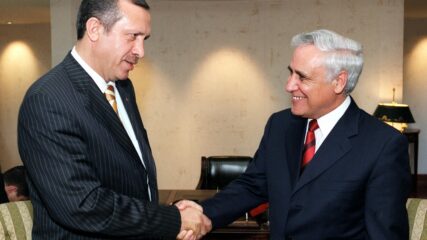
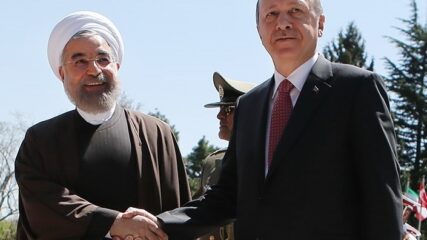
Turkish-Israeli relations have swung between friendship and hostility since Turkey became the first Muslim-majority country to recognize Israel in 1949.
A collection of books and articles providing insights into the history and current situation of Turkey and its relations with Israel.
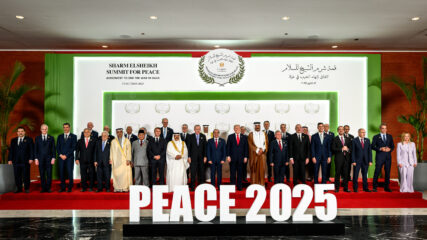
The U.S., Turkey, Qatar and Egypt commit to trying to implement President Trump’s vision for enduring peace in Gaza and the entire Middle East without offering details or obtaining the sign-on of Israeli or Palestinian officials.
May 2025 CIE has compiled the following list of books and articles to guide understanding of the modern Middle East. For a supplement to this bibliography, click on CIE’s Annotated Bibliography of Basic Books on…
CIE has compiled the following list of books, articles and videos, including some available on our website, to guide understanding of the great world powers and their involvement in the Middle East. Books Alterman, Eric,…
Scholarly articles published from the 1880s through 1991.
From the biblical covenants, Jews bound themselves to the belief in one G-d, an unbreakable tie to the Land of Israel. From its inception, Jewish identity was wrapped around the mutual commitments between G-d and the people. Judaism became the foundation for Christianity and Islam.
From 1898 to 1948, Zionism evolved from an idea to a concrete reality: the actual establishment of the Jewish state, Israel. Slowly, a few immigrating Jews created facts by linking people to the land. For half a century, fortuity and fortitude made the Zionist undertaking a reality. They exhibited pragmatism and gradually constructed a nucleus for a state. Through perseverance Zionists empowered themselves.
The clash of great powers to control the Middle East, particularly between the U.S. and the U.S.S.R., neither began after World War II nor ended with the demise of the Soviet Union in 1991. Today, China, the U.S., Russia and Middle Eastern regional powers vie to influence everyday politics and resources.
The aftermath of the “Arab Spring” and waning of great power influence has seen Turkey and Iran, both with imperials pasts to assert themselves regionally. Another Shia-Sunni rivalry unfolds. Look for local proxies to join sides.
The post-WWI San Remo Conference allocates former Ottoman territories to Britain and France and recognizes Jewish self-determination in Palestine by adopting the language of the Balfour Declaration, decisions the League of Nations confirms two years later.
The British Foreign Ministry promises to work toward a Jewish national home in Palestine with no harm to non-Jewish populations or to Jews living elsewhere who might want to support a Jewish home.
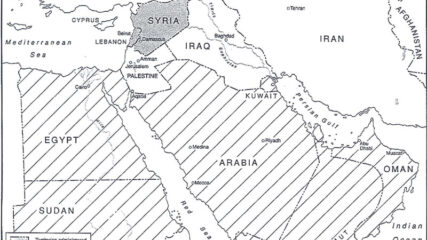
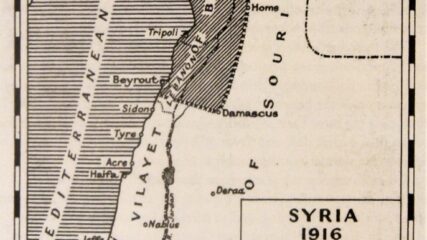
Britain and France secretly divide the Arab provinces of the reeling Ottoman Empire to meet their own geopolitical interests. They offer no concern for the political aspirations of indigenous populations.
The Sharif of Mecca and Sir Henry McMahon, a British official in Cairo speaking for the Foreign Office, exchange letters about the current war effort against the Turks and the future political status of specific Arab lands in the Ottoman Empire. McMahon says, as he repeats in 1937, that the area of Palestine is excluded from any area to be provided to an Arab leader after World War I. The British instead allow the area of Palestine to develop as a “national home for the Jewish people.”
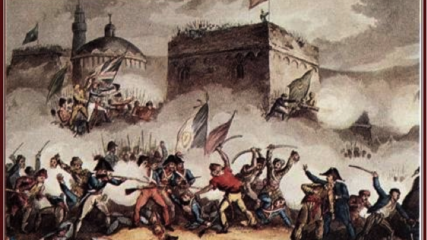
After a successful campaign in Egypt, Napoleon issued a proclamation which declared Jews the rightful heirs of Palestine.