9 Key Questions About Theodor Herzl’s “The Jewish State,” February 14, 1896CIE+
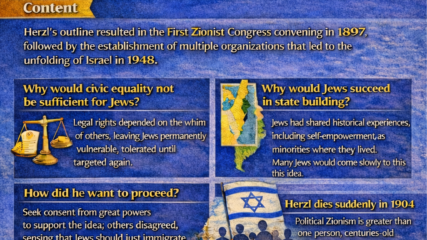
Nine questions guide key understandings about Theodor Herzl’s “The Jewish State.”
Stein, Kenneth, “Legal Protection and Circumvention of Rights for Cultivators in Mandatory Palestine,” in Joel S. Migdal, (Ed.) Palestinian Society and Politics, Princeton, (1980): 233-260. In the immediate wake of communal violence that plagued Palestine…
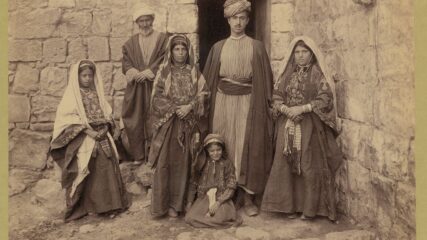
Kenneth Stein, “Palestine’s Rural Economy, 1917-1939,” Studies in Zionism, Vol. 8, No. 1 (1987), pp. 25-49. During the early decades of the 20th century in Palestine, the majority Arab population sustained itself primarily through agricultural and pastoral…
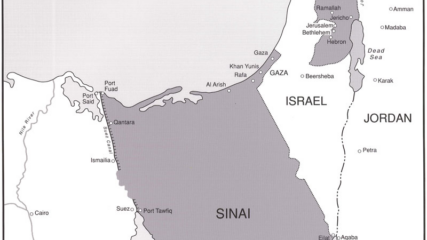
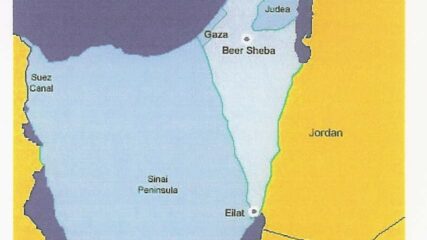
Enormous tension and risks taken by Egyptian and Israeli leaderships are recounted in a brief chronology of events that led to the June 1967 war, a benchmark turning point in Middle Eastern, Israeli, and Jewish history.
Placing Jewish destiny into Jewish hands was why Zionism emerged at the end of the 19th century. Acquiring political power to promote Jewish security is how a Jewish state was created.
“The Quest for Arab-Israeli Peace: Israel’s Disengagement from the Gaza Strip: Precedents, Motivations and Outcomes” Zionism Fulfilled.- Israel’s preemptive physical disengagement from the Gaza Strip in August 2005 was the result of a national consensus;…
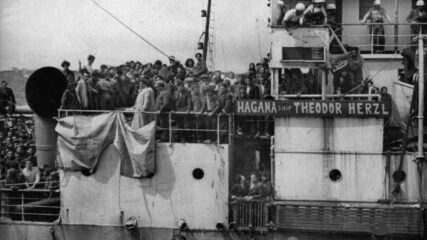
“A Zionist State in 1939,” Dr. Kenneth W. Stein, CHAI (Atlanta), Winter 2002 “Had not the Nazi crimes been committed against Jews during World War II, the Jewish State would have never come true.” So…
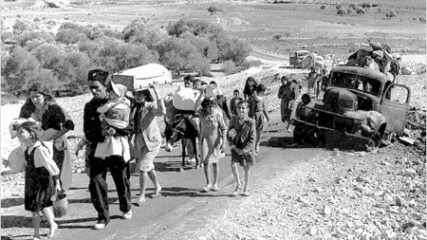
Kenneth W. Stein, “One Hundred Years of Social Change: The Creation of the Palestinian Refugee Problem,” in Laurence Silberstein (ed.), New Perspectives on Israeli History: The Early Years of the State, New York University Press,…
Kenneth Stein, “Rural Change and Peasant Destitution: Contributing Causes to the Arab Revolt in Palestine, 1936-1939,” John Waterbury and Farhad Kazemi (eds.), Peasants and Politics in the Modern Middle East, Florida International University Press (1989), pp. 143-170….
The 1937 plan to partition Palestine was never implemented. It did, however, remain a workable political option for resolving the conflict between Arabs and Zionists. Britain needed to placate Arab state opposition to Zionism, so it refrained from actively revisiting the partition plan.