Bar-On: Ken Stein Interviews With Hanan Bar-On, Jerusalem, Israel

Bar-On: Ken Stein Interviews With Hanan Bar-On, Jerusalem, Israel

In the 1975-1979 period, Hanan Bar-On served in the Israeli Embassy in Washington and then for seven years as director general of the Foreign Ministry. His insights highlight the building strain that evolved between Jimmy Carter and Menachem Begin. From an Israeli viewpoint, he recalls how unpredictable Zbigniew Brzezinski behaved toward the Israelis, how flexible Moshe Dayan was in seeking compromises, and how the Leeds Castle foreign minister talks in England in July 1978 established the contours for the successful Camp David negotiations two months later. He sheds important light on the context of the four Egyptian-Israeli agreements: Sinai I (1974), Sinai II (1975), the Camp David Accords (1978) and the Egyptian-Israeli Peace Treaty (1979).

Interviews|November 12, 1992, and July 9, 1993
El-Gamasy: Ken Stein Interview with General Mohamed Abdel Ghani el-Gamasy, Cairo, Egypt

El-Gamasy: Ken Stein Interview with General Mohamed Abdel Ghani el-Gamasy, Cairo, Egypt

General Ghani el-Gamasy served as Egypt’s chief of staff during the October 1973 war, executed Egypt’s limited success across the Suez Canal, and negotiated with an Israeli counterpart, General Aharon Yariv, the details of the Kissinger-choreographed Kilometer 101 talks, which led to the January 1974 Egyptian-Israeli Disengagement Agreement. Gamasy was surprised when Sadat told him at Aswan then, “Egypt was making peace with the United States and not with Israel.” Gamasy to Yariv, “We (the Egyptians) are finished with the Palestinians.”

Interviews|November 10, 1992
Sasson: Ken Stein Interview With Ambassador Moshe Sasson, Jerusalem, Israel

Sasson: Ken Stein Interview With Ambassador Moshe Sasson, Jerusalem, Israel

Moshe Sasson spanned four decades in his service to Israel, from the Haganah’s Arab Department of Intelligence in the 1940s to being Israel’s Ambassador to Egypt in the 1980s. He recollects analytically and in detail his conversations with Arab leaders at Lausanne as well as personal impressions of Moshe Dayan and Anwar Sadat. A tour de force.

Interviews|August 6, 1992
Pattir: Interviews with Dan Pattir, Media Adviser to Prime Ministers Rabin and Begin, Jerusalem and Tel Aviv, Israel

Pattir: Interviews with Dan Pattir, Media Adviser to Prime Ministers Rabin and Begin, Jerusalem and Tel Aviv, Israel

From 1974 – 1981, Dan Pattir served as advisor on media and public affairs for Prime Ministers Yitzhak Rabin and Menachem Begin. Prior to working for two Prime Ministers, he Pattir worked in the Israeli media, and here he recalls in detail how Kissinger maneuvered the Geneva 1973 conference to keep the Soviets out of decision-making. Likewise he was intimate with the negotiating details and personal relationships that unfolded between Egypt and Israel in that period, especially 1977-1979 including his rendition of the September 1978 Camp David negotiations. Pattir concluded that the Carter administration, no matter how long it earnestly tried, it failed to grasp that neither Egypt nor Israel, were going to allow other Arab states or the Palestinian issue to interfere with their eagerly sought mutually beneficial bilateral agreement, before, during or after Camp David.

Interviews|August 1992
Saunders: Ken Stein Interview With Dr. Harold Saunders, Washington, D.C.

Saunders: Ken Stein Interview With Dr. Harold Saunders, Washington, D.C.

From 1961 until the early 1980s, Harold Saunders was a key US State Department bureaucrat, an enormously capable word-smith. He had his hand in drafting the 1974-1975 ARab-Israeli Disengagement Agreements, Camp David Accords and E-I Treaty. His memory for detail enabled consequential decision-makers to understand the historical context of events and ideas such as ‘land for peace,’ ‘territorial integrity,’ ‘legitimate rights,’ and a myriad of diplomatic promises made spanning multiple presidencies.

Interviews|May 12, 1992
Peter Evan Bass, “The Anti-Politics of Presidential Leadership: Jimmy Carter and American Jews”

Peter Evan Bass, “The Anti-Politics of Presidential Leadership: Jimmy Carter and American Jews”

Peter Bass’s Princeton University Senior thesis is the most comprehensive work on a critical topic that befuddled and dominated Carter’s entire presidency.
Historical context evolves from tepid Jewish support for Carter in the 1976 campaign through ever widening gaps between his administration, Israel and the Jewish community. Carter wanted Middle East policy his way as shaped by Brzezinski. All Israeli leaders chafed at being told what to do, and frequently in public about territorial compromises “they had to make.” American Jews who voted reluctantly for him in 1976, did not do so in the 1980. Carter carried that sting with him for the rest of his life. Bass’s work is superb; thanks are given to him for giving us permission to provide his thesis here.

Issues and Analyses|April 12, 1985
The Problem of Rafah: Prime Minister Menachem Begin’s Letter to Shlomo Goren, 1981

The Problem of Rafah: Prime Minister Menachem Begin’s Letter to Shlomo Goren, 1981

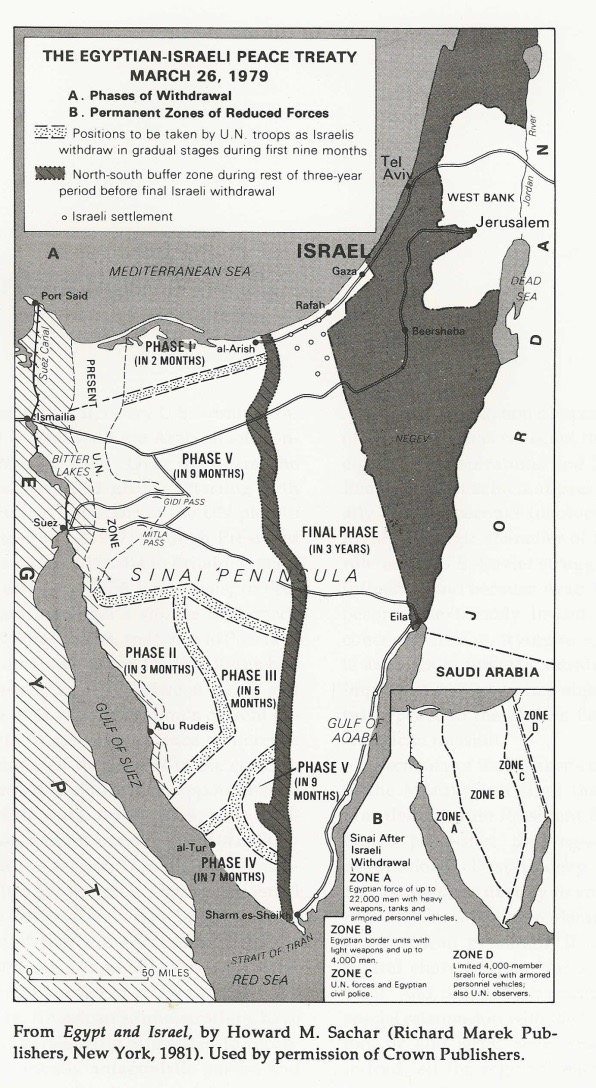
Prime Minister Menachem Begin argues for the return of Rafah to Egypt; the greater purpose is implementation of the Egyptian-Israeli Treaty, which also meant Israel”s withdrawal from settlements in Sinai near Rafah. Egypt in treaty negotiations with Israel, did not want to have the Gaza Strip again under their administration as they had between 1949 until after the June 1967 War

Documents and Sources|August 17, 1981
Summary of President Jimmy Carter’s Meetings With King Hussein, 1980

Summary of President Jimmy Carter’s Meetings With King Hussein, 1980

After the September 1978 Camp David Accords ended, the Carter administration diligently tried but failed to persuade Jordan’s King Hussein to be part of the follow-on negotiations over Palestinian autonomy. Carter felt Hussein was obstructionist; Hussein did not believe in 1978 that the US could halt Israeli settlement building as promised then. Hussein was correct. He also believed that Palestinian Autonomy might have a negative impact on many Palestinians living in his kingdom. Hussein was skeptical of the US capacity to negotiate for his national interests. At the same time, privately, Egypt’s Sadat was not displeased that the Jordanians remained out of favor with the US, and away from any negotiations that would detract from implementation of Israel’s promised full withdrawal from Sinai, per their 1979 Treaty. In 1988, Hussein stepped away from the West Bank’s future; in 1994, Jordan signed a peace treaty with Israel.

Documents and Sources|June 16 and 17, 1980
U.N. Security Council Resolution 465 on Jerusalem, Settlements and Territories, 1980

U.N. Security Council Resolution 465 on Jerusalem, Settlements and Territories, 1980

Showing its public opposition to Israeli actions in the lands taken in the June 1967 war, an area that the Carter Administration
wanted reserved for Palestinian self-rule, it ‘strongly deplores’ Israel’s settlement policies. Passage of the resolution three weeks
prior to the New York and Connecticut presidential primaries, cause many Jewish voters to vote in favor of Ted Kennedy
and not for Carter, helping to splinter the Democratic Party.

Documents and Sources|March 1, 1980
U.N. Security Council Resolution 446: Territories Occupied by Israel, 1979

U.N. Security Council Resolution 446: Territories Occupied by Israel, 1979

Carefully sandwiched between Carter’s high-risk presidential visit to Egypt and Israel on March 10, 1979—to solve contentious disagreements between Sadat and Begin—and the Peace Treaty signing on March 26, 1979, his administration gladly votes at the UN to deplore Israeli settlement building; including demographic changes in Jerusalem. After the Peace Treaty signing, until it leaves office in 1981, the Carter administration will continue to barrage Israel with condemnation for settlement building.

Documents and Sources|March 22, 1979