Cards List
FILTERED BY:
<span class="cie-plus-title">Annapolis: Precedents and Transactions but Not Transformations</span><span class="cie-plus-badge">CIE+</span>

Annapolis: Precedents and Transactions but Not TransformationsCIE+

Since the June 1967 war, more than two dozen mediators have engaged in Arab‐ Israeli diplomacy seeking to clarify one underlying question: under what conditions and over what period of time would Israel relinquish land attained in the June 1967 War, and what kind of understanding or agreement from an Arab partner would Israel receive in return? The Annapolis Conference in 2007, was again a Transaction but not a Transformation of Outcomes.

<span class="cie-plus-title">The Quest for Arab-Israeli Peace</span><span class="cie-plus-badge">CIE+</span>

The Quest for Arab-Israeli PeaceCIE+

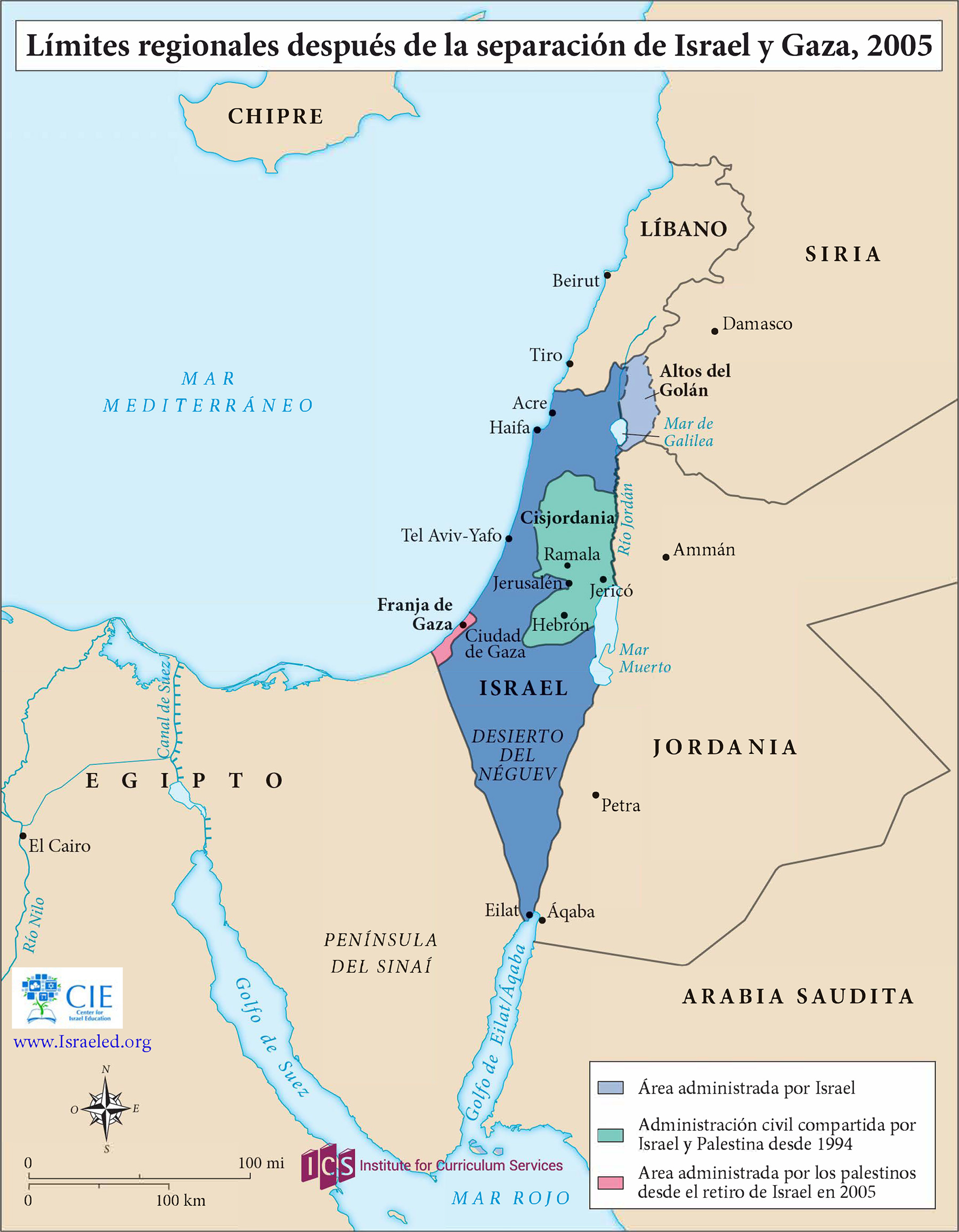
“The Quest for Arab-Israeli Peace: Israel’s Disengagement from the Gaza Strip: Precedents, Motivations and Outcomes” Zionism Fulfilled.- Israel’s preemptive physical disengagement from the Gaza Strip in August 2005 was the result of a national consensus;…

Issues and Analyses, Ken's Blog|February 19, 2005
<span class="cie-plus-title">Prime Minister Sharon’s Address on Gaza Withdrawal at Herzliya Conference, 2004</span><span class="cie-plus-badge">CIE+</span>

Prime Minister Sharon’s Address on Gaza Withdrawal at Herzliya Conference, 2004CIE+

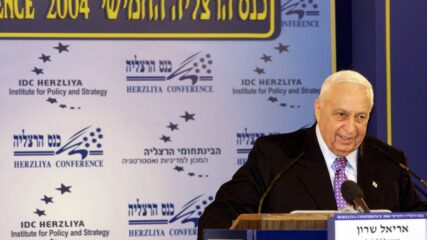
Prime Minister Sharon unilaterally withdrew Israeli military and civilian forces from the Gaza Strip in August 2005. Sharon sought to ensure Israel’s Jewish and democratic essence by getting out of the lives of the Palestinians. Instead Hamas used the territory to kill Jews and degrade Israel morally. Two decades later what would Sharon have said about trusting your neighbor unilaterally?

Documents and Sources|December 16, 2004
<span class="cie-plus-title">Prime Minister Ariel Sharon’s Address at the Fourth Herzliya Conference, 2003</span><span class="cie-plus-badge">CIE+</span>

Prime Minister Ariel Sharon’s Address at the Fourth Herzliya Conference, 2003CIE+

In his speech at the annual Herziliya Conference, PM Sharon articulates his view that the Quartet’s 2003 Road Map for Peace “is the only political plan accepted by Israel, the Palestinians, the Americans and a majority of the international community. We are willing to proceed toward its implementation: two states Israel and a Palestinian State living side by side in tranquility, security and peace.”

Documents and Sources|December 18, 2003
<span class="cie-plus-title">Kenneth Stein, “Separate Palestinians, Israelis Through a Trusteeship,” Orlando Sentinel, 2002</span><span class="cie-plus-badge">CIE+</span>

Kenneth Stein, “Separate Palestinians, Israelis Through a Trusteeship,” Orlando Sentinel, 2002CIE+

Note by the author: As a faculty member at Emory University, I wrote several articles per month for national and local newspapers. This article appeared in October 2002 in the Orlando Sentinel. The idea for a trusteeship to be possibly be considered to manage the Israeli-Palestinian relationship emerged from my decades of study of the Palestine Mandate, understanding the concept of separation of the two communities that was offered by the British on more than one occasion during the 1930s and 1940s, and the American suggestion in early 1948 to create a trusteeship for Palestine’s future. Martin Indyk, a US diplomat published an article about considering a trusteeship as a future political option in a Foreign Policy magazine article in July 2003.

<span class="cie-plus-title">Mitchell Report, 2001</span><span class="cie-plus-badge">CIE+</span>

Mitchell Report, 2001CIE+

In the midst of severe Palestinian-Israeli clashes, a committee led by former U.S. Sen. George Mitchell concludes, as had many previous investigations, that the two communities fear and want to live separately from each other. From the report flows the EU-U.N.-U.S. commitment to a two-state solution suggested in the 2003 Roadmap for Peace.