FILTERED BY:

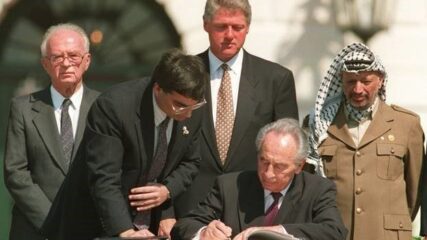
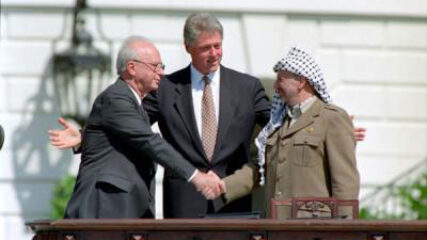
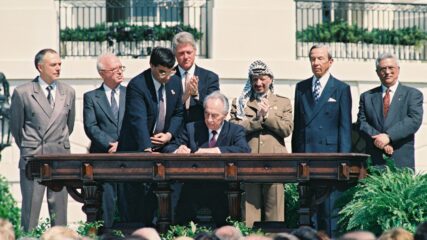
The Oslo Accords, the first direct agreement between Israel and the Palestine Liberation Organization, emerged from secret negotiations after the 1991 Madrid Middle East Peace Conference; established the self-governing Palestinian Authority for parts of the West Bank and Gaza Strip; staggered after the assassination of Israeli Prime Minister Yitzhak Rabin in 1995; and collapsed as a pathway to peace when the Second Intifada broke out in 2000.

The Key Curated Essentials for Arab-Israeli Negotiations, 1992-1999

<span class="cie-plus-title">Israel-PLO Mutual Recognition Agreement (MRA), September 9, 1993</span><span class="cie-plus-badge">CIE+</span>

Israel-PLO Mutual Recognition Agreement (MRA), September 9, 1993CIE+

On September 9, 1993, four days before Yasser Arafat and Yitzhak Rabin signed the Oslo Accords on the White House Lawn, Israel and the PLO signed mutual recognition Letters. Joel Singer, who significantly assisted the negotiation of both the MRA and the Oslo Accords, as well as earlier agreements with Egypt, recalled that the MRA was “a massive leap forward in Israeli-Palestinian relations.”

Issues and Analyses|September 9, 1993
<span class="cie-plus-title">Israeli-Jordanian Treaty Excerpts, 1994</span><span class="cie-plus-badge">CIE+</span>

Israeli-Jordanian Treaty Excerpts, 1994CIE+

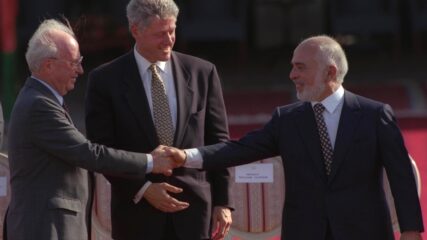
Jordan becomes the second Arab country after Egypt (1979) to sign a peace treaty ending the state of war with Israel. The Treaty addresses boundary demarcations, water sharing, police and security cooperation, environmental issues, border crossings, administration of Muslim holy sites and other issues.

Documents and Sources|October 26, 1994
<span class="cie-plus-title">How Prime Minister Yitzhak Rabin Viewed the 1993 Oslo Accords — A Collection in His Own Words</span><span class="cie-plus-badge">CIE+</span>

How Prime Minister Yitzhak Rabin Viewed the 1993 Oslo Accords — A Collection in His Own WordsCIE+

In September 2023, thirty years after the historic signing of the Oslo Accords, there is occasion to review Prime Minister Rabin’s understanding of them. I assembled this collection years ago from Daily Reports- Near East and South Asia, 1993-1995. Two short items about Rabin’s views are also found or linked here. Rabin provided a summary of his views of the Accords in a Knesset speech in October 5, 1995. Some of Rabin’s reasons for signing the Accords are also provided in Yehuda Avner’s The Prime Ministers.

Documents and Sources, Ken's Blog|September 1993-November 1995

More Curated Essentials for Arab-Israeli Negotiations, 1992-1999

London Document: Jordan-Israel Agreement on International Peace Conference, 1987CIE+

April 7, 1987
The Jordanian king and Israeli Labor Party leaders secretly outline a plan to convene an international conference to move Israeli-Palestinian talks forward through a conference format, but Likud opposition leaders squash the idea.

King Hussein on Jordan’s Separation From West Bank, 1988CIE+

July 28, 1988
Jordan's King Hussein made a strategic decision to disassociate administratively from the West Bank, leaving it to focus Jordanian national identity on only the east bank of the Jordan River. The PLO subsequently negotiated with Israel to rule over some of these lands, as codified in the 1993 Oslo Accords, but no Palestinian state was promised.

Yitzhak Rabin’s Reasons for Signing the 1993 Oslo Accords, Explained in 1995CIE+

November 1, 1995
Days before his assassination, Yitzhak Rabin explains that he accepted the Oslo Accords and shook Yasser Arafat's hand because the PLO represented the last hope for a secular Palestinian nationalism amid the rise of Hamas.

Shimon Peres Defends Oslo Accords, Opposes Palestinian State, Rejects IDF Role in Gaza, September 1993CIE+

September 23, 1993
Foreign Minister Shimon Peres supports the Oslo Accords, opposes a Palestinian state and rejects Israel's role in the Gaza Strip as the enforcer of security — all views that have continuing relevance for Gaza.

Rabin: TV Interview 3 Days Before AssassinationCIE+

November 1, 1995
(November 1, 1995) Interview with Prime Minister Yitzhak Rabin by anchorman Ehud Yaari, Kol Yisra’el party affairs correspondent Yaron Dekel, and YEDI’OT AHARONOT political correspondent Shimon Schiffer

25 Years Since Oslo: An Insider’s AccountCIE+

September 2018
When a leader of one country considers whether the time is ripe to commence peace negotiations with the leader of an enemy, there are two important questions that the leader must consider: Is the other leader willing to make the sacrifices necessary to attain peace? Is that leader strong enough to make those sacrifices and enforce the deal internally, that is, is he capable? The answer to both of these questions must be ‘yes.’ A willing but incapable leader is as bad for reaching a peace treaty as a capable but unwilling leader.

30 Years Since Oslo: Curated Readings, September 2023CIE+

September 18, 2023
This initial Oslo reading compilation was collected in 2018, to recall Oslo 25 years later; it was updated in September 2023. The compilation is of course not inclusive. An effort was made to include items that...

Wye River Memorandum on Unilateral Actions, Security and Other Matters Between Israel and PA, 1998CIE+

October 23, 1998
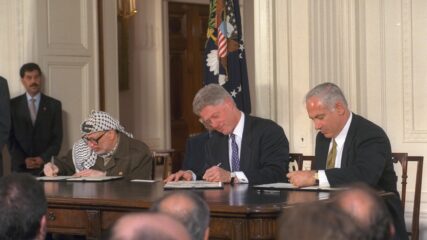
With Israeli-Palestinian talks in a hapless state, President Clinton rejuvenates them. In the Arafat-Netanyahu agreement Israel shares Hebron, with the CIA playing a role in West Bank security.