


Objectives and Conclusions: U.S.-Israel-Iran WarCIE+
While too much is unknown after a week of fighting to make definitive statements about the war, certain possible outcomes can be explored.
Know your past, own your present, assure your future.
While too much is unknown after a week of fighting to make definitive statements about the war, certain possible outcomes can be explored.
Turkish-Israeli relations have swung between friendship and hostility since Turkey became the first Muslim-majority country to recognize Israel in 1949.
A collection of books and articles providing insights into the history and current situation of Turkey and its relations with Israel.
Maya Rezak and Ken Stein, February 27, 2026 Hussain Abdul-Hussain, “Why Saudi Arabia is Turning Back to Islamism – and Against Israel,” Foundation for the Defense of Democracies, February 6, 2026. Al-Arabiya, (editorial) “The Crisis…
Using published archives, press conferences, speeches and numerous interviews, this compilation of quotations traces how official American views on Zionism and Israel have evolved over a century.
No document better reveals the hostility which most Arab leaders and Arab states had in 1947 for Zionism and for a possible Jewish state. The Saudi King notes “that US support for Zionists in Palestine is an unfriendly act directed against the Arabs.” The King’s views were totally supported by US State Department officials including Loy Henderson and George Kennan who advocated strongly against Truman’s support of a Jewish state.
Loy Henderson, Director of the Office of Near Eastern and African Affairs, U.S. State Department, to U.S. Secretary of State George Marshall
Writing two months before the U.S. voted at the United Nations in favor of Palestine’s partition into Arab and Jewish states, Henderson voices profound dislike for Zionism and a Jewish state. He advocates for cultivating positive relations with Muslim and Arab states. He is one of many at the State Department at the time who saw Zionism as contrary to American national interests.
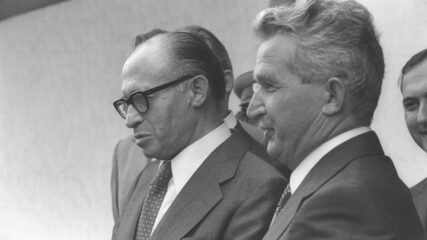
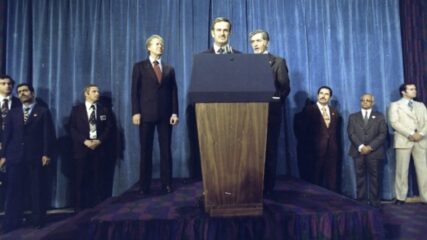
Prime Minister-elect Begin rebukes President Carter’s assertion that Israel will need to withdraw from almost all the lands Israel secured in the June 1967 war, especially Jerusalem and the West Bank. Begin is adamant opposed to dealing with the PLO. Begin refuses to relinquish Israeli decision-making to US preferences or dictates. These fundamental policy disagreements will remain unresolved between Begin and Carter for the duration of Carter’s presidency, and years after.
The plan builds on previous proposals for a two-state solution to the Arab-Israeli conflict and contains a US-Israeli agreement that sets forth final borders for two states. The plan contains multiple prerequisites for Palestinian behavior before either the US or Israel might agree to Palestinian statehood as well as a proposed $50 economic development package to be allotted over a decade.
President Donald Trump announces Operation Epic Fury, the second U.S. attack on Iran’s nuclear and ballistic missile programs in eight months, and urges the Iranian people to overthrow their Islamic regime.
In the waning days of the Reagan administration, Secretary of State George Shultz pushes for U.S.-mediated peace negotiations, including Palestinians, and offers the outlines for a resolution to the conflict.
By Ken Stein, October 28, 2024 When Georgia Governor Jimmy Carter became the 39th President of the United States in 1977, he had little foreign policy experience, particularly regarding the Arab-Israeli conflict. Despite this, he…
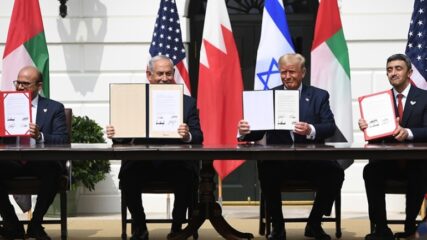
Quietly pursued in the past, long-standing strategic ties between Israel and Gulf states have become public. Building on the historic Joint Agreement signed between Israel and the UAE in August 2020, the Abraham Accords serve as a framework for normalizing diplomatic relations between Israel, the UAE and Bahrain.
After the horrific Hamas attack on Israel, President Joe Biden unequivocally categorizes Hamas’ brutality as “pure, unadulterated evil” and reiterates that the U.S. will “stand with Israel.”
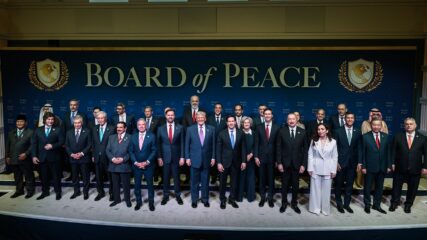
The first meeting of the Board of Peace convened under the Trump ceasefire for Gaza offers grand plans for reconstruction and a vibrant, peaceful future for Palestinians but depends on the disarmament of Hamas.
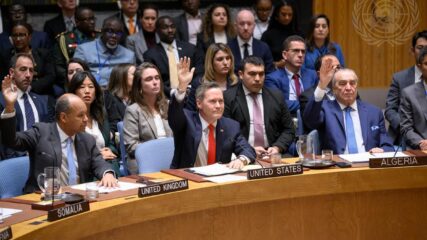
The U.N. Security Council voted 13-0 on November 17, 2025, to adopt Resolution 2803, endorsing the 20-point Trump peace plan to end the Hamas-Israel war. The precedent-setting resolution provides a pathway to stability in the Gaza Strip and offers a chance for less violence in the Palestinian-Israeli relationship.
Updated January 5, 2026; originally posted October 2023. By Ken Stein CIE+ Reliable resources for deeper Israel understanding Embrace informed content on Israel, the Middle East and the Diaspora. Begin with 7 days free to…
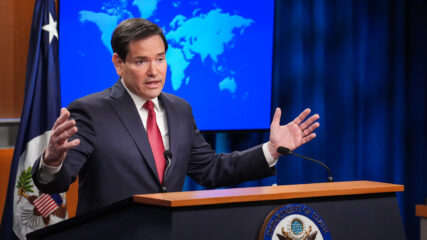
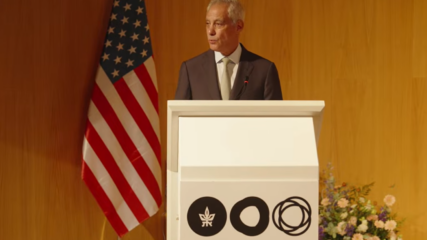
Secretary of State Marco Rubio explains the urgent need to establish the Board of Peace and the International Stabilization Force for Gaza to move from Phase 1 to Phase 2 in the ceasefire, but he also warns that the work likely will last longer than the Trump administration.
Former US President Jimmy Carter embraced Hamas as a legitimate voice of the Palestinian people. His motivations possibly stretched from intentional to misguided to malevolent. Hamas leaders who were engaged in inter-Palestinian struggles remained pleased with the recognition he gave them. American officials and Israelis were keenly perturbed by the courtship he gave them.
In multiple worldwide realms, the magnitude of hate for Israel and Jews soared after October 7, 2023.
Watch our collection of weekly Wednesday webinars with expert analysis and insights into the war and related topics, and register for the next webinar.
Since its inception in 1988, Hamas has been crystal clear about its total opposition to Zionism and Israel. It opposes any kind of negotiations or agreements that recognize Israel as a reality, and its more extreme spokesmen regularly incite or celebrate the killing of Jews.
As a militant Islamic Palestinian national organization, Hamas believes that Israel is illegitimate and should be destroyed through Jihad. Hamas opposes all recognition and negotiation with Israel and opposes PLO/PA leaders who have negotiated and collaborated with Israel from time to time. The Hamas-PA competition severely fragments the Palestinian political community.
The U.S., Turkey, Qatar and Egypt commit to trying to implement President Trump’s vision for enduring peace in Gaza and the entire Middle East without offering details or obtaining the sign-on of Israeli or Palestinian officials.
Speaking in English, Prime Minister Benjamin Netanyahu announces Israel’s airstrikes on Iran, targeting nuclear enrichment, nuclear weaponization, nuclear scientists, the Natanz nuclear facility and ballistic missile infrastructure. Netanyahu says the attack is for the world, not just for Israel.
Prime Minister Benjamin Netanyahu announces Operation Roaring Lion and briefly explains why Israel, with U.S. help, has attacked the nuclear and ballistic missile capabilities of Iran. He also encourages the Iranian people to topple their regime.
May 18, 2025 Contradiction has been a theme in Iran’s relationship with the Jewish people, for nowhere else in the Muslim world have Jews both suffered so grievously and flourished so thoroughly. Nor is the…
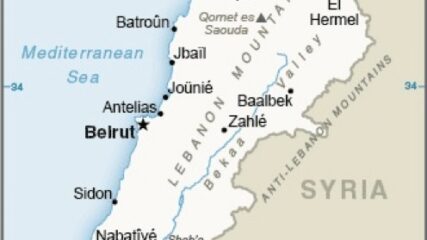
Israel’s opposition to Iranian entrenchment in Syria and Lebanon is twofold: To prevent Iran from building a beachhead against Israel through its proxies on Israel’s borders, and to impede development of Iran’s nuclear and long-range missile capabilities. Israel is absolutely determined and prepared to act forcefully against Iran, which could lead to a full-scale war. Israel must win this struggle against Iran, one way or another.
Hamas’ terrorist assault Oct. 7, killing 1,200 and kidnapping more than 240, was the worst slaughter of Jews since the Holocaust, but the night of April 13-14 could have been worse when Iran attacked Israel…
Netanyahu praises the Obama administration for its support of Israel’s security, then roundly criticizes it for negotiating a deal with Iran that will not roll back its nuclear breakout time and for not demanding that before sanctions are lifted that Iran stop its support of terrorism and threats to wipe Israel off the map.
Hamas’ genocide against Israelis unleashed the long-blistering hatred that Hamas possesses for Israel and Jews. Entries include severe Arab criticism of Hamas, its detriment to Palestinian nationalism, statements by its leaders, and the war’s unfolding.
Vigorously promoting this Iran Deal as a viable way to block and limit Iran pathways to a bomb. While recognizing Israel’s intense trepidation to the deal, he forcefully claims that war remains the only alternative to accepting this agreement, or to any changes to the agreement.
Biden’s is seized by Iran’s nuclear weapons program, and its continued support of terrorist organizations, like Hezbollah and Hamas; they endanger Israel and the world. Golda Meir told him. “Israel’s secret weapon; it has no place to go.”
Having made human rights a central pillar of his foreign policy, Carter nonetheless seemingly ignored the abuses the Shah of Iran imposed upon his own people. Carter’s unctuous praise for the Shah at this state dinner angered Iranians in general, the clerical regime that replaced the Shah in 1979, resulting in negative consequences for Carter as he went into the 1980 presidential election.
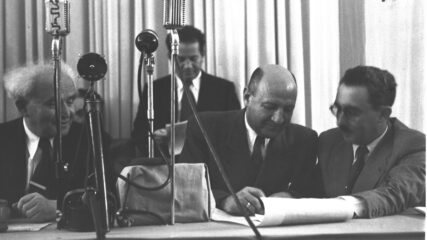
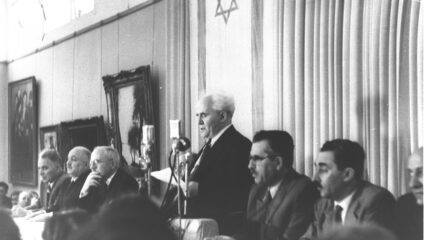
The Declaration recounts the Jewish connection to the Land of Israel, the birth of Zionism and U.N. recognition of a Jewish state’s legitimacy. It also promises that the state will be a democracy for all its citizens.
From biblical times to the present, Jews and Judaism have had an unbroken connection to Zion, a reference to Eretz Yisrael, the Land of Israel, derived from the hill at the heart of Jerusalem. Zionism…
If one wants to start from scratch or build on an already sophisticated knowledge base about Zionism, modern Israel and the Arab-Israeli conflict, we believe that the books in English here have significant value. While…
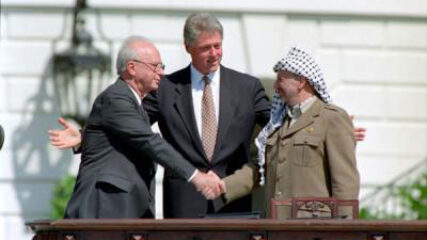
In September 2023, thirty years after the historic signing of the Oslo Accords, there is occasion to review Prime Minister Rabin’s understanding of them. I assembled this collection years ago from Daily Reports- Near East and South Asia, 1993-1995. Two short items about Rabin’s views are also found or linked here. Rabin provided a summary of his views of the Accords in a Knesset speech in October 5, 1995. Some of Rabin’s reasons for signing the Accords are also provided in Yehuda Avner’s The Prime Ministers.
Eventual founding leader of the World Zionist Organization Theodor Herzl says a Jewish state is need in response to antisemitism.
Steady disintegration of Palestinian Arab society from 1945-1949 is detailed by five Arab and non-Arab historians citing local social cleavages, economic impoverishment, fear, indebtedness, and political dysfunction.
By Shlomo Avineri “Zionism as a National Liberation Movement,” Jerusalem Quarterly 10 (Winter 1979): pp. 133-144. CIE+ Reliable resources for deeper Israel understanding Embrace informed content on Israel, the Middle East and the Diaspora. Begin…
Novelist Amos Oz’s final speech provides a summation of a lifetime of insights into Israeli society and a vision for what Zionism has yet to accomplish.
From 1898 to 1948, Zionism evolved from an idea to a concrete reality: the actual establishment of the Jewish state, Israel. Slowly, a few immigrating Jews created facts by linking people to the land. For half a century, fortuity and fortitude made the Zionist undertaking a reality. They exhibited pragmatism and gradually constructed a nucleus for a state. Through perseverance Zionists empowered themselves.
Rabbi Michael Berger, a professor in Emory University’s religion department, and CIE President Ken Stein, an Emory emeritus professor, trace 3,000 years of Jewish connection to the Land of Israel and the strategies that prepared…
March 9, 1932 Pinhas Rutenberg and the Palestine Electric Co. open a hydroelectric power plant at Naharayim. It supplies much of the electricity in Palestine until its destruction by Iraqi troops during the 1948 War…
After signing the Declaration of Principles (DOP) on Interim Self-Government Arrangements, commonly known as the Oslo Accords, on September 13, 1993, Israel and the PLO reached three additional interim agreements before Oslo II: On September…
The Balfour Declaration was the Jewish charter that Herzl failed to obtain from the Ottoman sultan 20 years earlier. The terms were included in the preamble of the Palestine Mandate’s Articles in 1922 after being…
Official Records of the General Assembly, Second Session Supplement No. 11,Volumes l-lV. The British intention (Peel Report in 1937) to partition Palestine into Arab and Jewish states was never implemented. It did, however, remain…
April 15, 2025 Dr. Eli Sperling © Center for Israel Education, 2025 Israeli music offers a powerful lens through which we can understand the country’s cultural and political evolution, serving as both a unifying force…
The First Commonwealth: Kingdom of Israel/the United Monarchy (circa 1030-930 B.C.E.) under Kings Saul, David and Solomon. The monarchy split into two kingdoms in 930 B.C.E. The northern Kingdom of Israel endured until 722 B.C.E., when…
Diversity is one of Israel’s most distinctive features. Finding common ground on sacred ground, Israeli Jews have returned to their homeland from more than 100 countries, forming a population of diverse culture, religious observance and…
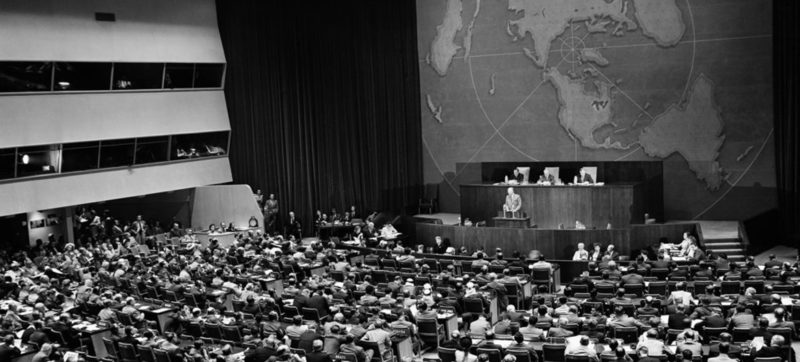
The U.N. partition resolution in 1947 cleared the way for Israel to declare independence six months later, but since then the United Nations has largely been antagonistic and condemnatory toward Israel and a tool for the Palestinians and Israel’s enemies.
Updated January 5, 2026; originally posted October 2023. By Ken Stein CIE+ Reliable resources for deeper Israel understanding Embrace informed content on Israel, the Middle East and the Diaspora. Begin with 7 days free to…
The period of the New Yishuv lasted from the last 40 years of Ottoman rule in Palestine through the British Mandate until the establishment of Israel in 1948. It saw the growth of the Jewish…
Scott Abramson, November 2023 Throughout the history of their diaspora, the Jewish people had represented the definitive nation-in-exile and the quintessential minority, “the minority par excellence,” as philosopher Hannah Arendt described them. Jews had even…
By Ken Stein The Jewish growth in Mandatory Palestine in the period of the New Yishuv to establish a Jewish territory for a state had significantly developed by 1939. Arab leadership in 1938 acknowledged privately…
Two major discordant issues that vexed Israel before October 7, 2023, continue to cleave Israeli society: a possible exemption from mandatory military service for the Haredim and the Netanyahu government’s persistent effort to wrench from…
By Ken Stein, October 28, 2024 When Georgia Governor Jimmy Carter became the 39th President of the United States in 1977, he had little foreign policy experience, particularly regarding the Arab-Israeli conflict. Despite this, he…
Where you choose to begin or tell or remember it shapes the history and politics you do or do not want to convey. What you include and what you leave out reveals your knowledge,
biases, and political intentions.
Since the June 1967 war, Anti-Israeli sentiment on US campuses has grown to extraordinary proportions merging with previously evolved anti-Zionism into sporadic mention to regular embrace.
The writing of any history is an art and not a science. History is not stagnant because there are always new materials discovered and new means used to analyze data. There is the bias and…
Neither Israel’s political culture nor Israel’s democracy based on Jewish self determination simply materialized on May 15, 1948. A connection exists from Jewish self-rule in the Diaspora to Zionist political autonomy during the Yishuv and to contemporary Israeli political culture. Likewise, the origins of Israeli democracy are found in the hundreds of years of Jewish Diasporas transitioning into the Zionist movement to the state; from aliyot before the Palestine Mandate to 1948 and since. Components of Israeli political culture…
Published by JESNA, Jewish Education Service of North America ISSUE #18 WINTER 2004 Israel Education and the College Campus, “Awake ye from ye slumber, the call that is heard, oh my people.” Agenda: Jewish Education,…
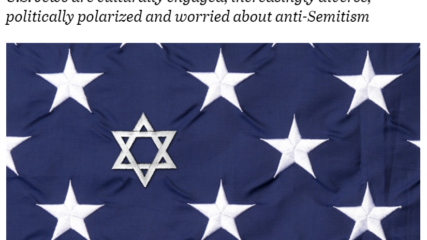
Four out of every five Jews in the world live in the United States and Israel; 6.3 million in Israel, 6.7 million in the US. According to Pew Research Center Studies, 7 in 10 American Jews feel attached or very attached to Israel.
The notion of a two-state solution remains front and center as the most often discussed and endorsed solution to the Palestinian-Israeli dimension of the conflict in the Middle East. So why has it not happened?
The Trump administration’s proposed charter for the Board of Peace, the body the United Nations has charged with overseeing the Gaza ceasefire, does not mention Gaza or any other specific location of operation but does grant its chairman, Donald Trump, extensive control over its mission and operations.
Since its inception in 1988, Hamas has been crystal clear about its total opposition to Zionism and Israel. It opposes any kind of negotiations or agreements that recognize Israel as a reality, and its more extreme spokesmen regularly incite or celebrate the killing of Jews.
In September 2023, thirty years after the historic signing of the Oslo Accords, there is occasion to review Prime Minister Rabin’s understanding of them. I assembled this collection years ago from Daily Reports- Near East and South Asia, 1993-1995. Two short items about Rabin’s views are also found or linked here. Rabin provided a summary of his views of the Accords in a Knesset speech in October 5, 1995. Some of Rabin’s reasons for signing the Accords are also provided in Yehuda Avner’s The Prime Ministers.
Ze’ev Jabotinsky argues that peaceful coexistence between Arabs and Jews in Palestine is impossible until Zionists demonstrate through strength that they are an irreversible presence in the Land of Israel.
Areas of bilateral political and military cooperation are noted to fend off Soviet involvement in the Middle East, to assist Israel in building the Lavi aircraft, to support an independent Lebanon and to promote Arab-Israeli negotiations.
Jordan’s King Hussein made a strategic decision to disassociate administratively from the West Bank, leaving it to focus Jordanian national identity on only the east bank of the Jordan River. The PLO subsequently negotiated with Israel to rule over some of these lands, as codified in the 1993 Oslo Accords, but no Palestinian state was promised.
After failing to have PLO leader Yasser Arafat and Israeli Prime Minister Ehud Barak reach an understanding at Camp David in mid-2000, President Bill Clinton offers a U.S. view of a final-status agreement near the end of his term.
Netanyahu reproaches the international community for supporting the Iran deal, the UN for its deafening silence against threats to Israel, and, against Palestinian leader Mahmoud Abbas for promising to cancel all agreements with Israel.
Secretary of State Marco Rubio explains the urgent need to establish the Board of Peace and the International Stabilization Force for Gaza to move from Phase 1 to Phase 2 in the ceasefire, but he also warns that the work likely will last longer than the Trump administration.
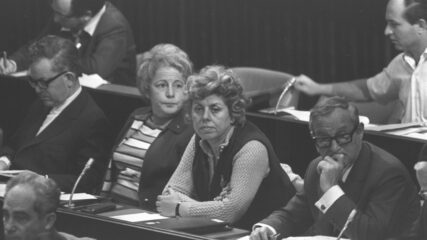
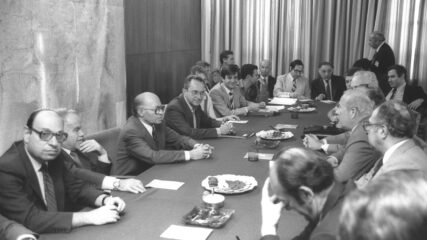
An Israeli commission of inquiry assigns responsibility to military leaders for failures before and during the Yom Kippur War. Prime Minister Meir and Defense Minister Dayan avoid direct blame but soon resign.