Gush Emunim Established
February 7, 1974 Gush Emunim (Bloc of the Faithful), a settler movement closely tied to the National Religious Party, is founded by followers of Rabbi Tzvi Yehuda Kook, including Hanan Porat, Haim Drukman and Rabbi…
Israel is competing in bobsled, alpine and cross-country skiing, skeleton, and figure skating at the 2026 Winter Olympics in Milan and Cortina, Italy.
Durante más de un siglo, los líderes árabes y musulmanes han expresado odio hacia los judíos, el sionismo e Israel, aunque algunos también han señalado internamente los fracasos del movimiento nacional árabe palestino.
While the Palestinian official leading the technocratic Gaza administration promises to open the Rafah Crossing and the Bulgarian high commissioner for Gaza urges the world to focus on the big picture, U.S. envoy Jared Kushner lays out a vision for Gaza as a rapid, phased real estate redevelopment.
Chancellor Merz’s visit coincides with Germany signing the largest Israeli military arms export agreement, covering the Arrow 3, and his support of a two-state solution to the Palestinian-Israeli conflict. Netanyahu recalls centuries of efforts to annihilate Jews, including those in Germany and by Hamas, and says Israel will not give up military control of West Bank land.
The U.N. Security Council voted 13-0 on November 17, 2025, to adopt Resolution 2803, endorsing the 20-point Trump peace plan to end the Hamas-Israel war. The precedent-setting resolution provides a pathway to stability in the Gaza Strip and offers a chance for less violence in the Palestinian-Israeli relationship.
Donald Trump takes a victory lap and lays out short- and long-term visions for Gaza, Israel and the Middle East while becoming the fourth U.S. president to address the Knesset.
Seized by the severity of the Gaza war and nonmovement on a Palestinian-Israeli negotiating process, the U.N. offers a diplomatic road map to end the war and start negotiations. Led by France and Saudi Arabia, it asserts PA primacy as the legitimate Palestinian political representative, addresses possible Palestinian governance reform, seeks to empower a sovereign and economically viable state of Palestine living side by side in security with Israel, and contains other vague PA promises. Israel and the U.S. reject the Declaration. The Israeli government refuses to have outside parties determine the outlines or pace of negotiations with any country because negotiations impact Israeli security today and tomorrow.
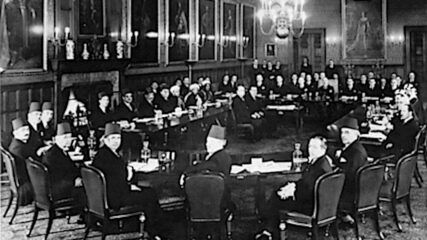
A Zionist delegation to the Paris Peace Conference makes an effective, largely successful case for the League of Nations to incorporate a future Jewish national home into the British Mandate for Palestine.
The Trump administration’s proposed charter for the Board of Peace, the body the United Nations has charged with overseeing the Gaza ceasefire, does not mention Gaza or any other specific location of operation but does grant its chairman, Donald Trump, extensive control over its mission and operations.
Three years after the Israeli government began the process to overhaul the judiciary, and after two years of war delayed efforts, the drive to rein in judicial independence continues.
Former Supreme Court President Aharon Barak makes the case against the Netanyahu government’s efforts to overhaul the judiciary, arguing that Israeli democracy requires judicial independence and protection for minority rights.
Supreme Court President Yitzhak Amit warns about the danger to the Israeli public and democracy of sustained political attacks on the judiciary and individual judges.
Updated January 5, 2026; originally posted October 2023. By Ken Stein Hamas’ Origins The 1988 Hamas Charter and remarks by its leaders and other publications express hatred of Zionism, Israel and Jews. It is thus unmistakable that Hamas…
January 2, 2026 A week of unrest in Iran does not guarantee a revolution even if 85-plus million Iranians are angry at the country’s autocratic, theological rulers. Iran is a security-clerical oligarchy where kleptocracy, cronyism…
Maya Rezak and Ken Stein, December 31, 2025 Yousef Algoos, “MBS in Washington: A new era of strategic tech-alliance,” Al-Arabiya, December 14, 2025. Thomas Albery, “A Crisis of crises: What is going on in Iran?”…
In their fifth U.S. meeting of 2025, President Trump and Prime Minister Netanyahu show unity on Gaza, Hamas, Iran and their mutual appreciation for each other but offer glimpses of differences on Turkey, Syria and the West Bank.
Secretary of State James A. Baker III brings a realistic and prescient vision of Arab-Israeli peace negotiations and U.S. mediation to AIPAC early in the George H.W. Bush presidency.
The fiscal 2026 National Defense Authorization Act shifts U.S. military cooperation with Israel to a postwar focus, including support for neighbors facing Iranian proxies and a response to military embargoes of Israel.
Cinco historiadores árabes y no árabes detallan la constante desintegración de la sociedad árabe palestina entre 1945 y 1949, citando divisiones sociales internas, empobrecimiento económico, miedo, endeudamiento y disfunción política.
Secretary of State Marco Rubio explains the urgent need to establish the Board of Peace and the International Stabilization Force for Gaza to move from Phase 1 to Phase 2 in the ceasefire, but he also warns that the work likely will last longer than the Trump administration.
Failing to account for the effects on his re-election hopes, President Jimmy Carter for the second of three times in 1980 lets the U.N. Security Council enact a resolution criticizing Israeli behavior beyond the Green Line.
PLO Chairman Yasser Arafat issues a declaration with five American Jewish leaders in an effort to meet U.S. conditions for dialogue and thus strengthen his position as the leader of the Palestinian national movement.
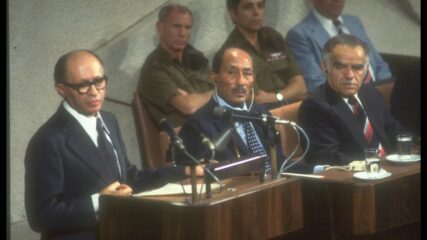
In an unprecedented presidential political gamble, President Carter meets Prime Minister Begin and then President Sadat to tie up loose ends for an Egyptian-Israeli peace treaty, signed two weeks later. During the trip, he delivers the first Knesset address by a U.S. president.