FILTERED BY:

Unlike any other region of the world, Europe has had the most intimate, impactful and longest-lasting relationship with contemporary Israel and its origins. As the birthplace of Judaism and Christianity and with the Holy Land’s valuable strategic location, Europe’s rulers and popes established covetous connections with the land on the shores of the eastern Mediterranean, especially the Galilee, Bethlehem and Jerusalem. Antisemitism, springing episodically from all corners of Europe, catalyzed Jewish migrations. European persecution of Jews marginalized their lives and ironically sustained communal survival. Both realities eventually led to the percolation and development in 19th century Europe of modern political Zionism.

The Key Curated Essentials for Europe and Israel

<span class="cie-plus-title">French President Macron’s U.N. Address on a Two-State Solution, September 2025</span><span class="cie-plus-badge">CIE+</span>

French President Macron’s U.N. Address on a Two-State Solution, September 2025CIE+

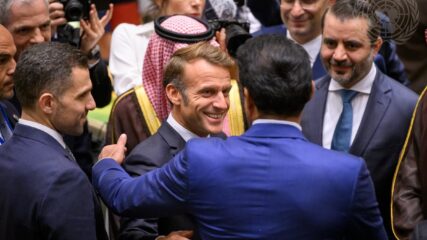
President Macron’s speech links the end of Hamas-Israeli conflict to the evolution of a of two-state solution. He acknowledges that Israel has the power to end the war and evolve a Palestinian state, asserting that if Israel does neither to the satisfaction of France and her European partners, Israel could pay an undisclosed price. He offers no such penalties to be placed on the PA for its failure to meet its commitments. Once again the Palestinian Arab national movement uses the international community to pressure Israel into concessions. On the same day, Israeli
Prime Minister Netanyahu emphatically rejects the establishment of a Palestinian state west of the Jordan River. The Israeli
parliament in June 2004 rejected any unilateral recognition of a Palestinian state by a 68-9 vote.
Documents and Sources|September 22, 2025
<span class="cie-plus-title">Explainer: Europe and Israel</span><span class="cie-plus-badge">CIE+</span>

Explainer: Europe and IsraelCIE+

Historical Background Unlike any other region of the world, Europe has had the most intimate, impactful and longest-lasting relationship with contemporary Israel and its origins. As the birthplace of Judaism and Christianity and with the…

Explainer Articles|January 31, 2025
<span class="cie-plus-title">1914-1915 Hussein-McMahon Correspondence</span><span class="cie-plus-badge">CIE+</span>

1914-1915 Hussein-McMahon CorrespondenceCIE+

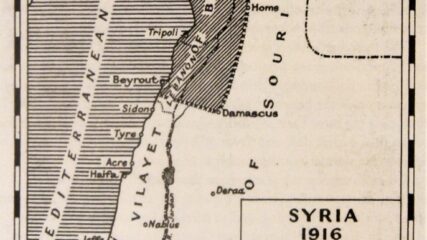
The Sharif of Mecca and Sir Henry McMahon, a British official in Cairo speaking for the Foreign Office, exchange letters about the current war effort against the Turks and the future political status of specific Arab lands in the Ottoman Empire. McMahon says, as he repeats in 1937, that the area of Palestine is excluded from any area to be provided to an Arab leader after World War I. The British instead allow the area of Palestine to develop as a “national home for the Jewish people.”

<span class="cie-plus-title">British Government: Policy Statement/Advice Against Partition, 1938</span><span class="cie-plus-badge">CIE+</span>

British Government: Policy Statement/Advice Against Partition, 1938CIE+

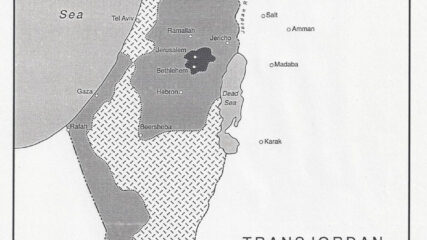
Pressure from Arab leaders in states surrounding Palestine, growing instability in the eastern Mediterranean, and a firm opposition voiced by the British High Commissioner in Egypt, Miles Lampson, caused the British to withdraw the idea of resolving the Arab-Zionist conflict with a two-state solution. Instead, heavy restrictions were imposed in 1939 on the growth of the Jewish National home. Coincidently this policy statement is issued, two days after Nazi Germany attacks Jewish, homes, businesses and synagogues, in what came to be known as Kristallnacht.

Documents and Sources|November 11, 1938
<span class="cie-plus-title">Pro-Zionist Remarks by Winston Churchill, 1939</span><span class="cie-plus-badge">CIE+</span>

Pro-Zionist Remarks by Winston Churchill, 1939CIE+

Over four decades, Winston Churchill’s views on Zionism and Jews varied greatly. Without knowing his long held personal beliefs or the policies he adopted while the Jewish state developed, and only reading this speech, one would not know that he was a political opportunist and certainly not a “Gentile Zionist.”

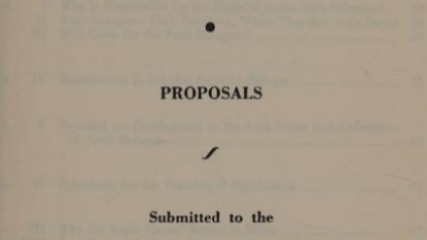
1951 U.N. Report, “The Situation of Jews in Moslem Countries”

1951 U.N. Report, “The Situation of Jews in Moslem Countries”

This report submitted to the United Nations at the end of 1951 notes that “some one million Jews have become the victims of accelerated antiSemitism” since 1948 in the Muslim countries of the Arab League and North Africa, “communities which have existed for thousands of years.” The report analyzes the situation for Jews overall and explains restrictions and oppressive measures country by country.

Documents and Sources|December 1951