October 19, 2023
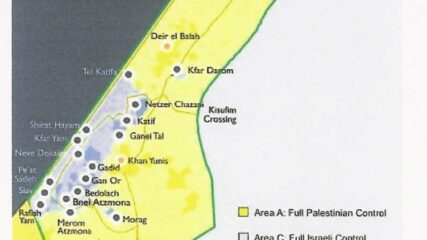
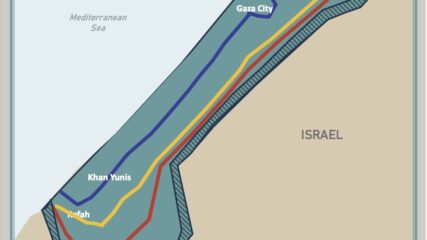
Maps of the Gaza Strip, Israel’s villages and kibbutzim around the Gaza Strip, former Israeli settlements there, and Israel's requested zone of civilian withdrawal 10.14.2023
November 5, 2024
Can a radically hateful ideology ever be neutralized by rationality and logic?
November 5, 2024
Compiled by Aidan New Iran lies behind much of what Israel has battled since Hamas launched its brutal terrorist attack Oct. 7, 2023. By theology and ideology, Iran is committed to Israel’s destruction. By policy...
November 5, 2024
In multiple worldwide realms, the magnitude of hate for Israel and Jews soared after October 7, 2023.
September 2024
Hezbollah has used its stronghold in southern Lebanon to launch continual attacks on northern Israel since October 8, 2023. Hezbollah says it is motivated by its support for Hamas, a fellow member of Iran’s Axis of Resistance surrounding Israel. While Hezbollah is Shia and Hamas is Sunni, both are devoted to Israel’s destruction, and both receive funding from and coordinate with Iran.
May 1, 2024
Hamas’ terrorist assault Oct. 7, killing 1,200 and kidnapping more than 240, was the worst slaughter of Jews since the Holocaust, but the night of April 13-14 could have been worse when Iran attacked Israel...
October 4, 2024
On Oct. 7, 2023, the Palestinian Sunni Islamist group Hamas (a U.S.-designated foreign terrorist organization, or FTO) led surprise attacks against Israel from the Gaza Strip. More than 1,200 Israelis and foreign nationals (including at...
November 14, 2023
These remarks by public figures, writers, scholars, authors and former diplomats are a partial list covering 2003 to 2018. No Arab or Israeli sources are cited.
October 27, 2023
Former US President Jimmy Carter embraced Hamas as a legitimate voice of the Palestinian people. His motivations possibly stretched from intentional to misguided to malevolent. Hamas leaders who were engaged in inter-Palestinian struggles remained pleased with the recognition he gave them. American officials and Israelis were keenly perturbed by the courtship he gave them.
November 1, 2025
Among Palestinians, Hamas popularity soars, two state solution at lowest ebb, Rise in European Anti-semitism, and Michael Mihlstein's insightful analysis an essential read.
February 14, 2024
Scott Abramson and Ken Stein, Center for Israel Education Common political, emotional and strategic threads are present in President Joe Biden’s speeches and comments about the brutal reality of the Hamas attacks on Israel and...
February 13, 2024
February 13, 2024 — Dr. Kenneth Stein and Pastor Dr. Armando Alducin, Israel y el Medio Oriente Entrevista (Israel and the Middle East) with Mauricio Friedman, (75 minutes in English and Spanish) Five points stressed in...
July 12, 2024
The Israel Defense Forces “failed in its mission to protect the residents of Kibbutz Be’eri,” with those failures ranging from planning and communication to command and control, when Hamas overwhelmed the Negev kibbutz on Oct....
April 17, 2024
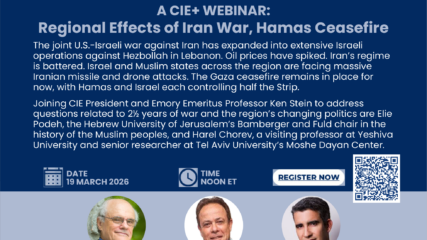
The raw numbers in the wake of Hamas’ Oct. 7 terrorist attack — 1,200 killed and more than 240 abducted — can sanitize the personal trauma and horror of the brutality, including sex-based violence. Women often are stereotyped as victims or peacemakers, but CIE’s 27th weekly webinar on the Israel-Hamas war, set for April 17, examines the reality of women’s responses and roles in Israeli society and the reactions to how they have fought, volunteered, advocated and led for more than six months. Joining moderator Dr. Ken Stein, CIE’s president and an Emory University emeritus professor of Middle East history, political science and Israel studies, are Col. (res.) Pnina Sharvit Baruch of the Institute for National Security Studies and Dr. Julia Elad-Strenger, a political psychologist at Bar-Ilan University.
April 3, 2024
Since Hamas and allies invaded Israel, killed 1,200 Israelis and others, and seized more than 240 hostages Oct. 7, Israel has conducted a methodical military campaign in Gaza that has uncovered hundreds of miles of...
May 22, 2024, 12:00 PM (ET)
More than seven months since Hamas and others killed 1,200 people and seized more than 240 hostages in southern Israel on Oct. 7, the IDF is operating in Rafah but must continue to fight elsewhere...
May 8, 2024
The day after Hamas’ Oct. 7 terrorist assault killed 1,200 and dragged more than 240 kidnapped Israelis and others to Gaza, Hezbollah opened a second front along Israel’s northern border with missile fire from Lebanon....
February 21, 2024
Israel’s diversity is reflected in the range of responses to four months of war since Hamas and others killed 1,200 people and took more than 240 hostages Oct. 7. Amid many examples: Areas in which...
February 14, 2024
The war that began Oct. 7 with Hamas’ killing of 1,200 people and abduction of more than 240 others shook Israel and Israelis to their core. Particularly impacted was Israel’s vibrant economy. With hundreds of...
June 28, 2024
June 28, 2024 The Washington Institute for Near East’s Policy Dana Stroul leads an incisive discussion with four outstanding panelists on “Hezbollah-Israel Escalation” and the high prospects of war on June 28, 2024. The video,...
January 1998
The rise of Hamas marks a shift in the Israeli-Palestinian conflict from a struggle between national movements or states to a battle between religions, making a resolution all the more difficult to achieve.
July 31, 2024
Asher Sussser, “The Rise of Hamas in Palestine and the Crisis of Secularism in the Arab World,” Brandeis, 2006 (79pp). (with permission) Read full article
December 6, 2006
Hamas leader Ismail Haniyeh says in Tehran, "We shall never recognize the usurper Zionism government" and will "continue the jihadist movement until the liberation of Jerusalem."
February 23, 2024
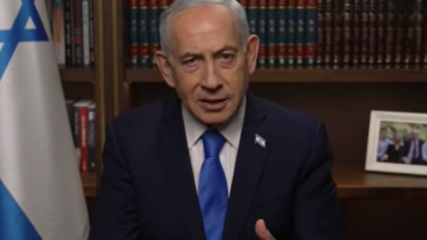
Israeli Prime minister provides minimal detail for the Gaza Strip's post war civilian restructuring, focusing entirely on immediate and long term Israeli security needs with no imposed Palestinian state nor international negotiating intervention acceptable.
July 18, 2024
(with permission) “Don’t repeat our mistakes—we can do it ourselves.” This line occurred to me as I listened to discussions of “the day after” in Gaza. Plans and ideas need to address the detailed problems...
July 24, 2024
In a 52 minute speech, Netanyahu explained Israel’s absolute need for total victory in the Gaza war because Hamas and Iran were both enemies of the United States and Israel. With bi-partisan emphasis, he thanked Presidents Biden and Trump for their unwavering current and past support. Dozens of congressional members did not attend his speech, noting disagreements with the Prime Minister's policies.
September 27, 2024
Netanyahu’s speech reflected on the needed elimination of Hezbollah as an enemy of Israel, a powerful militia fighting in Lebanon against Israel for four decades. On the day of Netanyahu's speech, the Israeli Air Force killed Hassan Nasrallah, the Hezbollah leader in his Beirut offices along with other Hezbollah officials.
October 4, 2024
Iranian Supreme Leader Ayatollah Ali Khamenei delivers a synopsis of Iran’s hatred of Israel and the United States, provides deep insight into his unwavering commitment to destroying Israel, and mourns for slain Hezbollah leader Hassan Nasrallah.
October 2023-July 2024
Watch our collection of weekly Wednesday webinars with expert analysis and insights into the war and related topics, and register for the next webinar.